Google Business Profile leads come from three actions: a call, a direction request, or a message. Each one signals a different level of buying intent. Most guides stop at ranking advice. This one covers what actually turns a profile view into a real enquiry, and how to measure it.
Key Takeaways
- 93% of consumers say ratings and reviews affect their purchase decisions. 82% trust reviews as much as a recommendation from family or friends. Both figures come from PowerReviews’ survey of over 8,000 US consumers.
- 45% of consumers will not buy from a business with no reviews at all, in the same PowerReviews survey.
- Typical Google Business Profiles convert 4% to 7% of views into website clicks. They convert 5% to 8% into phone calls, per WebFX’s compiled benchmarks.
- 88% of consumers would use a business that replies to all of its reviews. Only 47% would use one that never responds, per BrightLocal’s survey of 1,141 US consumers.
- One auto detailing business increased monthly calls from a Google Business Profile from 21 to 120, a 471% rise, over a five-month period. This comes from a published Map Ranking case study.
In this guide
- The Real Gap in Most Google Business Profile Advice
- Why Google Business Profile Actions Signal Different Intent
- How Two Profile Levels Differ
- Fix the Weak Spot In Each Profile Level
- Measure What Google Business Profile Leads Are Actually Doing
- The One Decision Rule For Google Business Profile Leads
- A Real Case: CDC Detailing LLC
- Frequently Asked Questions About Google Business Profile Leads
- Build the Skills Behind Every Local Profile
The Real Gap in Most Google Business Profile Advice
Most advice on Google Business Profile leads focuses on ranking in the local map pack. Ranking matters, of course. But a profile can rank well and still generate almost no real enquiries. Ranking and conversion are two separate problems, and most guides only solve one of them. A business can spend months climbing the map pack and still see the phone stay quiet. Nobody fixed what happens after a searcher actually clicks through.
This is an informed inference from published benchmark data, not a guaranteed formula. Results vary by industry, location, and existing review volume. So treat every figure here as a reference point, not a universal promise. A plumber and a boutique will see different numbers from the same tactics. Their customers make very different kinds of decisions, at very different speeds.
The practical question is narrower than “how do I rank higher.” It is this: once someone finds the profile, what makes them actually call, message, or ask for directions? What makes them scroll past it instead? Answering that question well is worth more than another few places of movement in the map pack.
Why Google Business Profile Actions Signal Different Intent
A direction request is a low-commitment action. A phone call is a much higher-commitment one. Somewhere in between sits a message, which asks for a reply before the relationship goes anywhere.
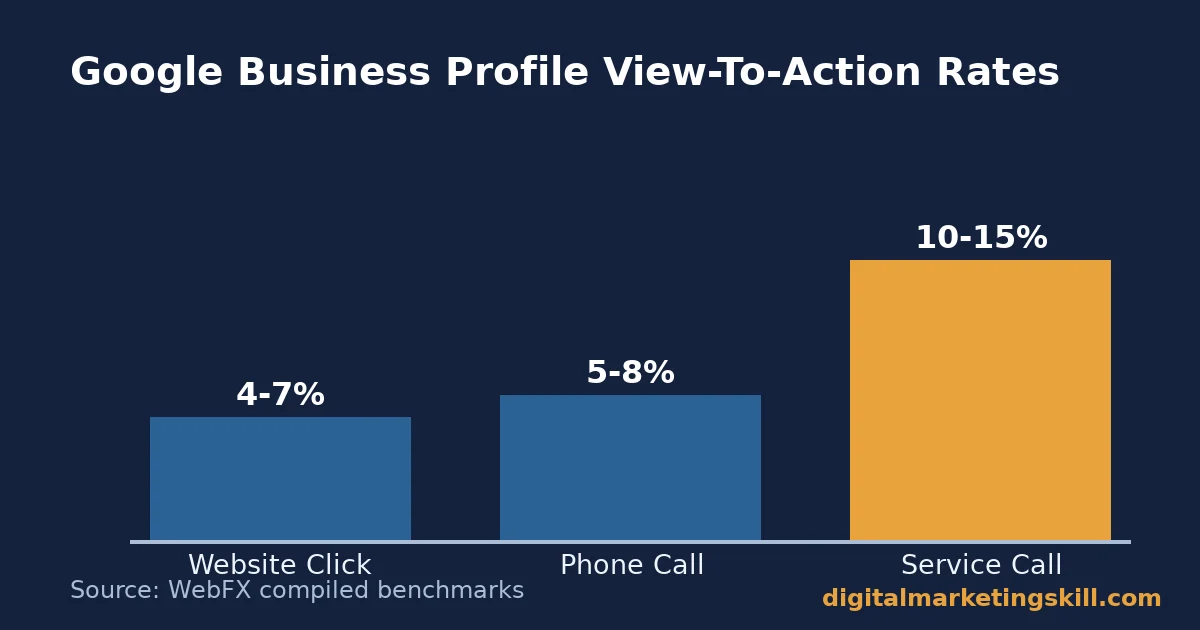
Typical profiles convert 4% to 7% of views into website clicks. They convert 5% to 8% into phone calls, according to WebFX’s compiled benchmarks. Service-based businesses, like plumbers or electricians, often see call rates closer to 10% to 15%. A caller already wants a job done today, not just information. So the higher-commitment action becomes the dominant one, and the profile should be built to support that, not fight against it.
This difference matters for Google Business Profile leads because it changes what “success” looks like by industry. A retail store should expect more direction requests than calls. A home-service business should expect the opposite. Chasing the wrong metric wastes effort optimising for an action your customers were never going to take in the first place. A plumber worrying about a low direction-request count is solving a problem that was never really there.
Google’s own help documentation on Business Profile messaging confirms the point. The feature exists specifically so a business can answer questions in real time. It is not meant to replace a form submission or a slower support channel. That real-time expectation explains why response time matters so much for the message action specifically. It matters far less for a direction request or a passive website click.
How Two Profile Levels Differ
Minimal Profiles: Built For Low Effort, Low Leads
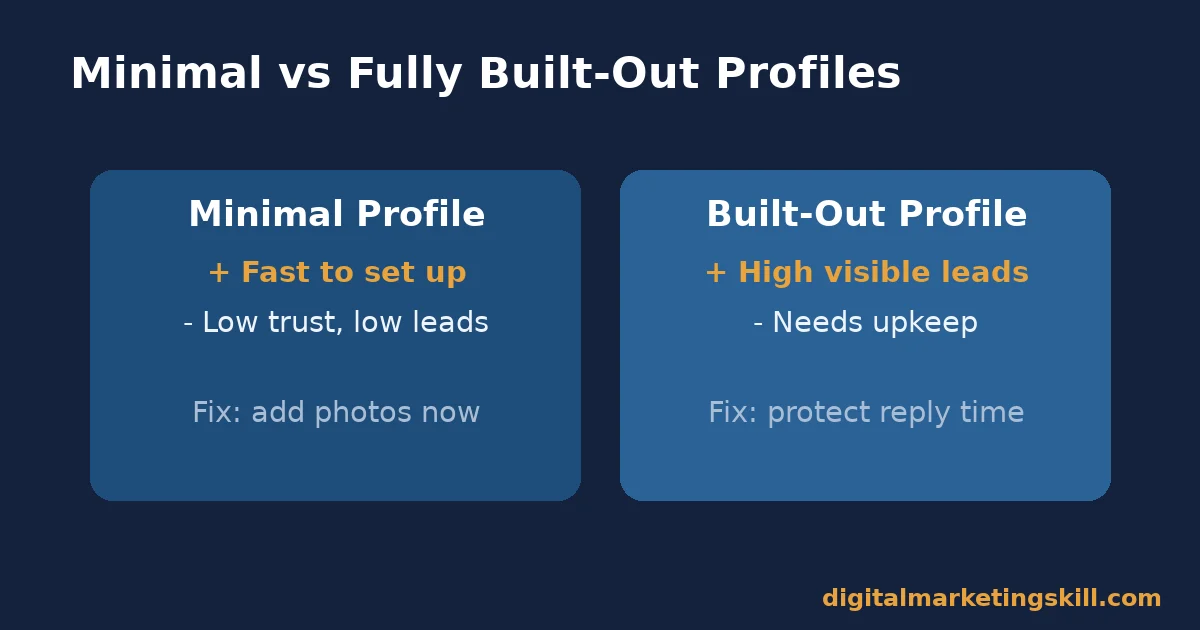
A minimal profile has a name, an address, and a phone number, and little else. It meets the bare requirement to appear in search. It rarely earns much trust from a browsing customer, though. There is nothing to look at, and nothing recent to read. The customer has no real reason to prefer it over any other listing on the page.
The trade-off is obvious. Setup time is almost zero. So is conversion. A customer comparing three similar businesses has no reason to pick the one with an empty profile over one with photos and recent reviews. The empty profile might still rank, but ranking alone rarely closes a sale on its own.
Fully Built-Out Profiles: Built For Maximum Visible Leads
A fully built-out profile has photos, a complete services list, regular posts, and a steady stream of recent reviews with replies. It gives a browsing customer everything they need to decide, without ever leaving the search results page. That matters, because most searchers never bother clicking through to a website if the profile itself already answered the question.
The trade-off here is upkeep. Photos, posts, and review replies all need a standing routine, not a one-time setup. A profile built out once and then abandoned slowly drifts back toward looking minimal, as competitors post more recent content around it. The gap between a fresh profile and a stale one grows wider every month that nobody touches it.
Fix the Weak Spot In Each Profile Level
Minimal Profiles: Lead With Photos and Fast Review Replies
The low-trust problem in a minimal profile has a direct fix. Add photos first. Profiles with photos get 30% to 50% more views than average. Profiles with ten or more photos see roughly double the engagement, per WebFX. Reply to every review within a day or two, even the short ones. A reply shows a real person is behind the listing, not an abandoned page nobody checks.
This single change usually moves the needle faster than anything else. It costs almost nothing, and it takes effect immediately, unlike ranking changes that can take weeks to show up in search results. A business owner with twenty minutes and a phone camera can meaningfully improve a minimal profile in a single afternoon.
Fully Built-Out Profiles: Lead With Message Response Time
The upkeep problem in a fully built-out profile has a matching fix. Protect response time on messages and review replies, even if posting frequency occasionally slips. A beautifully built profile that takes three days to answer a message still loses that lead to a competitor who answered in an hour. All the photos and posts in the world cannot undo a slow reply once a customer has already moved on.
Set a simple internal rule. Check profile messages at the same time every morning and afternoon. A built-out profile then keeps converting the attention it has already earned, instead of losing it to slow replies that a faster competitor would have caught. Assign the task to one specific person if more than one staff member could plausibly check it, so the job never quietly falls to nobody.
Measure What Google Business Profile Leads Are Actually Doing
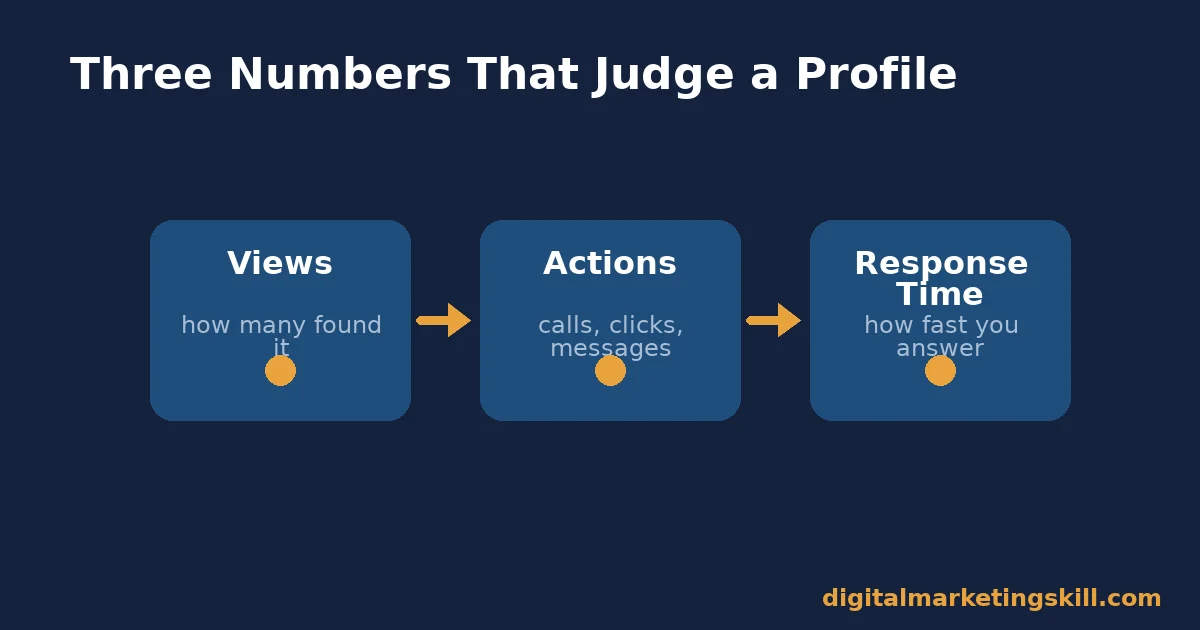
Three numbers show whether Google Business Profile leads are actually flowing. Each one tracks a different part of the journey, so none of them tells the whole story alone.
Views are how many people saw the profile in search or maps. A low view count points to a visibility problem, not a conversion problem. It needs a different fix entirely, usually focused on categories and keywords rather than photos or reviews.
Actions are calls, messages, direction requests, and website clicks combined. This is the headline conversion number, and it is the one most guides focus on almost exclusively. Yet a strong action count still hides a weaker number underneath it, which the next metric catches.
Response time is how long a message or call waits before a reply. It rarely gets tracked. Yet it decides whether an action turns into an actual customer or a missed opportunity that goes to a competitor instead. A profile can post a great action count on paper while quietly losing half of those leads to silence.
Track all three in Google Business Profile’s own performance data, available free inside the profile dashboard. No extra software is required for a small business checking these numbers once a month. Even a simple phone reminder to check the dashboard on the first of each month is enough to catch a slow slide before it becomes a real problem.
The One Decision Rule For Google Business Profile Leads
If the profile already has steady views but weak action numbers, fix photos and review replies first. If actions are healthy but leads still go cold, fix response time instead. The two problems look similar from the outside, but they need different fixes entirely. Applying the wrong one wastes a month of effort on a number that was never the actual bottleneck.
Illustrative, invented numbers: imagine two similar local businesses, each getting 1,000 profile views a month. Business A converts 3% of views into actions. Business B converts 7%. At those rates, business A gets roughly 30 actions, and business B gets about 70, from the same traffic. The gap here is not visibility. It is almost certainly photos, reviews, or response time. Both businesses are being found equally well by the same number of searchers. A third business might convert at 7% too, yet still underperform both, if its response time on messages runs into days instead of hours.
A Real Case: CDC Detailing LLC
CDC Detailing LLC, an auto detailing business in New Jersey, increased monthly calls from its Google Business Profile from 21 to 120, a 471% rise, over a five-month period. This comes from a published Map Ranking case study. The agency’s work included a full photo strategy, a rebuilt services section, a weekly posting routine, and an active review generation and response system. None of these changes involved paid advertising. All of them involved the same free profile tools covered earlier in this guide.
This case study is published by the agency that did the work. It does not state that an independent party verified the before-and-after numbers, so treat the specific multiple as one business’s result rather than a guaranteed outcome. The direction, though, still matches the mechanism described earlier in this guide: more photos and more active review management, leading to more calls.
The same pattern shows up in broader survey data, not just this one case. BrightLocal’s survey of 1,141 US consumers found that most people expect a business to have between 20 and 99 reviews before they trust its star rating at all. A profile with a handful of old reviews is asking a customer to trust a sample size the customer does not actually find convincing.
Frequently Asked Questions About Google Business Profile Leads
What generates the most Google Business Profile leads for a small business?
For most small, local businesses, photos and recent reviews do the heaviest lifting. They give a browsing customer enough confidence to act without leaving the search results page. That page is where most Google Business Profile leads actually begin, long before a customer ever reaches a website or a contact form.
How many reviews does a profile need before it starts converting well?
Credibility usually builds somewhere around 10 to 20 reviews, with a rating of 4.0 stars or higher, per WebFX’s compiled benchmarks. BrightLocal’s survey found many consumers expect even more, closer to 20 to 99, before fully trusting a star rating. A new business should not expect strong Google Business Profile leads from a handful of reviews alone.
Should every Google Business Profile message get an instant reply?
Instant is not required, but fast is important. A same-day reply, ideally within a few hours, keeps most leads warm. A multi-day gap gives a customer enough time to simply call the next business on their list instead.
Do direction requests count as real Google Business Profile leads?
For a retail store or restaurant, yes, since a direction request often means someone is already on their way. For a service business that operates by appointment only, a direction request matters less than a call or a message. Weigh the three actions differently depending on your business type.
Is it worth paying for Google Business Profile management software?
Often not, for a single-location small business. The core free dashboard already shows views, actions, and basic performance data. Paid tools earn their cost mainly for businesses managing many locations at once, where manual tracking becomes genuinely impractical. A single-location business usually gets more value from spending that budget on better photos instead.
Does replying to reviews actually change whether people choose a business?
Yes, according to BrightLocal’s data. 88% of consumers said they would use a business that replies to all of its reviews, compared to just 47% for one that never responds. That is a wide enough gap that review replies deserve a standing routine, not an occasional effort.
Can a new business with no review history still generate Google Business Profile leads?
Yes, though more slowly. A complete profile with strong photos can still earn calls and messages before reviews build up, since some customers act on photos and service descriptions alone. Review volume still helps, so asking early customers directly remains worth doing from day one.
Build the Skills Behind Every Local Profile
Turning Google Business Profile leads into real customers is one piece of a much broader skill set, taught across the Digital Marketing Skill Institute’s Master Diploma in Digital & AI Marketing.
The program is built from four AI-powered tracks: AI-Powered Social Media Management and Advertising, AI-Powered Lead Generation and Email Automation, AI-Powered Google Specialist, and AI-Powered WordPress and SEO Specialist. Together, these total ten courses, with a Full Stack option for students who complete all four.
Every track includes unlimited 1-on-1 coaching and mentoring, a U.S. Project Internship with a verified U.S. Work Reference Letter, and dual US and UK accreditation recognised in more than 100 countries. The program runs 100% online, so you can build these skills from anywhere in your country.
Go deeper on the ranking side with this Google Business Profile optimization guide, or see how it fits a wider plan in this local SEO guide. Compare this with a broader look at lead generation, or sharpen conversions further with these lead generation tactics. Read real outcomes on the reviews page, or go straight to the application page. Learn more about the Institute at digitalmarketingskill.com, wherever you live, or start your own program search from the homepage at any time.
Every figure in this guide was checked against its original source before publication. Figures marked as illustrative are invented examples, not real results.