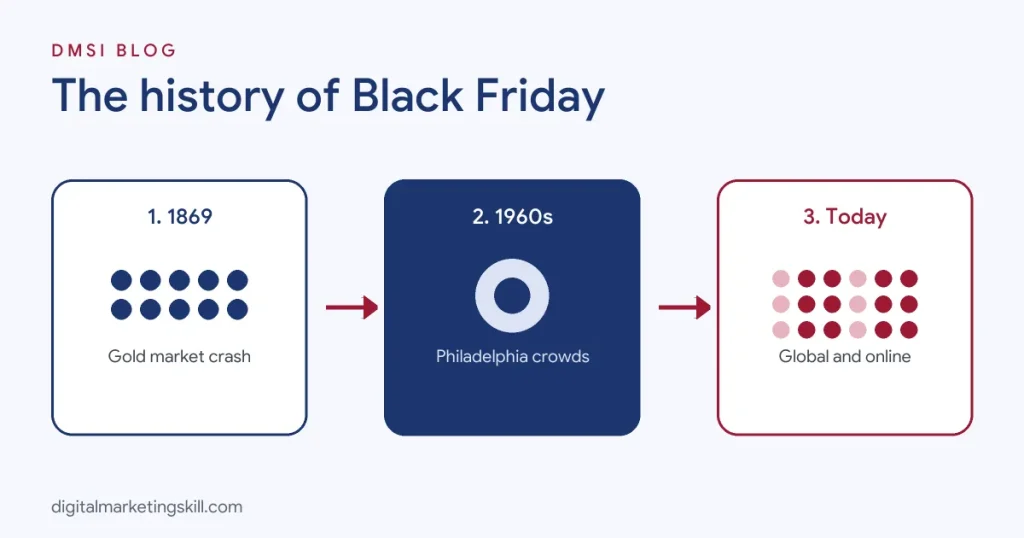
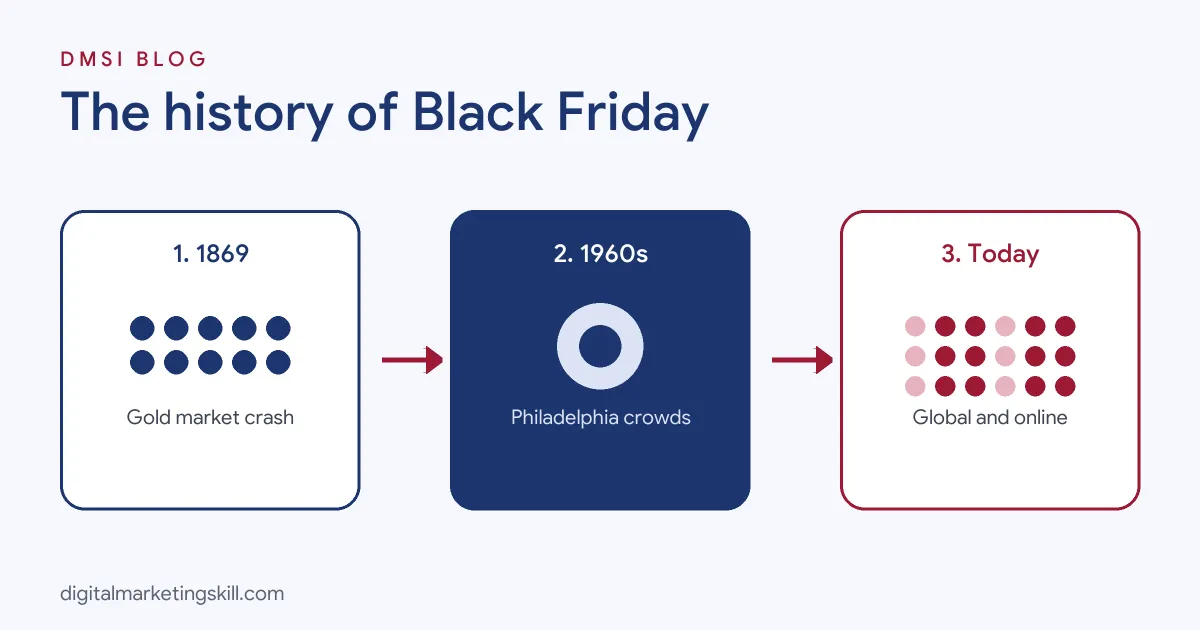
Black Friday began as a name for disaster, not discounts. The phrase was first linked to a financial crash in 1869, then adopted by Philadelphia police in the 1950s and 1960s to describe the chaotic crowds and traffic on the day after Thanksgiving. Retailers disliked the negative label, tried to rename it, failed, and eventually embraced it with a friendlier story about stores moving “into the black”. From there, Black Friday grew into America’s biggest shopping day, spread around the world, moved online and stretched into Cyber Monday and a whole “Cyber Week”. This guide tells the real history of Black Friday, separates fact from myth and explains what its evolution teaches marketers today.
Understanding where Black Friday came from is more than trivia. Every stage of its history, from crowded department stores to one-click mobile checkouts, mirrors a shift in how people shop and how marketers reach them.
Key Takeaways
- The first famous “Black Friday” was 24 September 1869, when an attempt by financiers Jay Gould and James Fisk to corner the gold market triggered a US financial panic.
- Philadelphia police used “Black Friday” in the 1950s and 1960s for the gridlock on the day after Thanksgiving; in 1961 local merchants tried to rebrand it “Big Friday”, without success.
- The popular claim that Black Friday began with retailers moving “into the black” emerged in the 1980s, decades after the name was already in use.
- The term “Cyber Monday” was introduced in 2005 by Shop.org, the online arm of the US National Retail Federation.
- Adobe reported record US online spending of $11.8 billion on Black Friday 2025 and $44.2 billion across the five days from Thanksgiving to Cyber Monday.
In this guide
- What Is Black Friday?
- Black Friday History at a Glance: A Timeline
- 1869: The Original Black Friday
- 1950s and 1960s: Philadelphia Gives the Day Its Name
- The 1980s: “In the Black” and a New Story
- Black Friday Myths That Are Not True
- 1990s to 2010s: Doorbusters, Queues and Thanksgiving Openings
- The Move Online: Cyber Monday and Beyond
- How Black Friday Went Global
- Black Friday Today
- What the Evolution of Black Friday Teaches Marketers
- The Future of Black Friday
- Frequently Asked Questions About the History of Black Friday
- Your Next Step
What Is Black Friday?
Black Friday is the Friday after Thanksgiving in the United States, traditionally treated as the start of the Christmas shopping season. Thanksgiving falls on the fourth Thursday of November, so Black Friday always lands between 23 and 29 November. In 2026, it falls on Friday 27 November.
Retailers mark the day with sales and promotions, and many now run offers for a week or more. Black Friday is followed by Small Business Saturday, Cyber Monday and Giving Tuesday, together forming one of the most important marketing periods of the year.
Black Friday History at a Glance: A Timeline
| Year | Event |
|---|---|
| 1869 | The gold market crash of 24 September becomes known as “Black Friday” |
| 1924 | Macy’s holds its first Thanksgiving Day parade in New York, helping link Thanksgiving with the start of Christmas shopping |
| 1939 | President Franklin D. Roosevelt moves Thanksgiving a week earlier, partly to give retailers a longer shopping season |
| 1941 | Congress fixes Thanksgiving as the fourth Thursday of November |
| 1950s | Philadelphia police start calling the day after Thanksgiving “Black Friday” |
| 1961 | Philadelphia merchants try to rename it “Big Friday”; the effort fails |
| 1980s | The name spreads nationally, along with the “in the black” explanation |
| 2005 | Shop.org introduces the term “Cyber Monday” |
| 2010 | American Express launches Small Business Saturday; Amazon brings Black Friday deals to the UK |
| 2012 | Giving Tuesday launches as a day of charitable giving |
| 2020 | The pandemic accelerates the shift from store queues to online shopping |
| 2025 | US online Black Friday spending hits a record $11.8 billion, according to Adobe |
1869: The Original Black Friday
The first widely recorded “Black Friday” had nothing to do with shopping. On Friday 24 September 1869, two Wall Street financiers, Jay Gould and James Fisk, tried to corner the US gold market by buying up as much gold as they could, hoping to drive the price higher and sell at a huge profit.
Their scheme collapsed when the US Treasury released gold onto the market. The price crashed, the stock market fell sharply, and many investors were ruined in a single day. Newspapers called it “Black Friday”, using “black” in its old sense of a day of calamity, much as people later spoke of Black Monday or Black Tuesday during stock market crashes.
This early use matters because it shows the phrase began with a negative meaning, which shaped how retailers would later react to it.
1950s and 1960s: Philadelphia Gives the Day Its Name
The shopping meaning of Black Friday grew out of a long American tradition of starting Christmas shopping straight after Thanksgiving. By the mid-twentieth century, the Friday after the holiday had become one of the busiest days of the year for downtown stores.
In Philadelphia, the day brought a particular headache. Crowds of suburban shoppers and tourists poured into the city, and many stayed for the Army-Navy American football game, traditionally played in Philadelphia on the Saturday after Thanksgiving. Police officers were required to work long shifts to manage traffic jams, crowded pavements and shoplifting. They began calling the day “Black Friday” because of the chaos.
Local merchants hated the name, which made their busiest day sound like a disaster. In 1961, they tried to rebrand it as “Big Friday”. The new name never caught on. Shoppers, police and the press kept saying Black Friday, and by the mid-1960s the term had begun appearing in print in its shopping sense.
It is an early marketing lesson: a brand cannot simply announce a new name. The words people already use tend to win.
The 1980s: “In the Black” and a New Story
For years, “Black Friday” stayed mostly a Philadelphia expression. During the 1980s, it spread across the United States through newspapers and television coverage of holiday shopping.
As it spread, retailers found a way to turn the negative name into a positive one. In accounting, losses were traditionally recorded in red ink and profits in black. The new story said that many stores operated “in the red” for most of the year and only moved “into the black” on the day after Thanksgiving, when holiday shopping began.
It was a neat explanation and it made the day sound like a celebration of success rather than a traffic nightmare. It also became so widely repeated that many people still believe it is the original meaning. Historians and language researchers, however, have traced the shopping term back to Philadelphia police in the 1950s, decades before the accounting explanation became popular.
In marketing terms, retailers did something clever. They could not change the name, so they changed the story behind it. Brands do the same today when they reframe a criticism or reclaim a nickname their customers already use.
Black Friday Myths That Are Not True
Several popular stories about Black Friday’s origin are inaccurate.
Myth: Black Friday Began With Stores Going “Into the Black”
As explained above, this explanation came later. It is a reinterpretation, not the origin.
Myth: Black Friday Comes From Slave Sales
A claim that circulates on social media says Black Friday originated with the sale of enslaved people at a discount after Thanksgiving. Historians and fact-checkers have found no evidence for this. The documented history of the term points to the 1869 financial crash and to Philadelphia in the 1950s and 1960s. The horrors of slavery are real and well documented, but this particular story about the name is false.
Myth: Black Friday Has Always Been the Biggest Shopping Day
For much of the twentieth century, the Saturday before Christmas often brought higher sales. Black Friday became the biggest shopping day in the US only in the early 2000s, after years of retailers pushing earlier openings and bigger deals. Online, Cyber Monday has since overtaken it as the biggest single day for US e-commerce spending.
1990s to 2010s: Doorbusters, Queues and Thanksgiving Openings
As Black Friday grew, competition between retailers intensified. Stores began opening earlier and earlier, first at 6am, then 5am, then midnight. They advertised “doorbusters”: a small number of products at extremely low prices, designed to bring crowds through the doors.
The strategy worked, sometimes too well. Television news showed people camping outside stores overnight and rushing through doors at opening time. In 2008, a Walmart worker in Valley Stream, New York, died after being trampled by a crowd at opening, a tragedy that led many retailers to rethink crowd control.
In the 2010s, some major chains started opening on Thanksgiving evening itself, a move that drew criticism from employees and shoppers who felt the holiday was being eroded. The phrase “Gray Thursday” briefly entered the vocabulary. Later, many large retailers announced they would stay closed on Thanksgiving Day, partly in response to that backlash and partly because more sales had moved online.
The Rise of Black Friday Week
Retailers also began starting deals earlier in November to spread demand. Black Friday became Black Friday weekend, then Black Friday week, and for some brands a whole “Black November”. This changed the marketing challenge from winning one day to staying visible for weeks without exhausting customers.
The Move Online: Cyber Monday and Beyond
In the early 2000s, online retailers noticed a spike in sales on the Monday after Thanksgiving, as people returned to work and shopped from office computers with faster internet connections than they had at home. In 2005, Shop.org, part of the US National Retail Federation, gave that day a name: Cyber Monday.
The name stuck, and Cyber Monday grew rapidly. Adobe reported that US shoppers spent $14.25 billion online on Cyber Monday 2025, making it the biggest online shopping day in US history at that point. Black Friday itself also moved online, with Adobe recording $11.8 billion in US online spending on Black Friday 2025.
Other days joined the calendar:
- Small Business Saturday, launched by American Express in 2010, encourages people to shop at independent local businesses.
- Giving Tuesday, launched in 2012, promotes charitable giving after the shopping weekend.
- Cyber Week describes the whole stretch from Thanksgiving to Cyber Monday, which Adobe found generated $44.2 billion in US online sales in 2025.
Mobile has become central. Adobe reported that 57.5% of Cyber Monday 2025 online transactions happened on mobile devices. The queues outside stores have largely been replaced by notifications, emails and social media ads. Marketers who once competed for newspaper space now compete for inbox placement and attention in social feeds. Our guide to email marketing explains how brands reach customers directly.
How Black Friday Went Global
Black Friday is tied to an American holiday, yet it has spread to countries that do not celebrate Thanksgiving at all. The internet made this possible. Shoppers around the world saw American deals online, and global retailers and marketplaces brought the event to new markets.
- Canada adopted Black Friday partly to stop shoppers crossing the border to buy in the US.
- The United Kingdom saw Amazon introduce Black Friday deals in 2010. Other retailers followed, and by the mid-2010s it had become one of the UK’s biggest shopping events, with some chaotic scenes in stores in its early years.
- Europe, Latin America, Africa and Asia now run their own Black Friday campaigns. Online marketplaces in countries such as Nigeria, Kenya, Brazil and India promote Black Friday or month-long November sales.
Other shopping events have also grown alongside it. China’s Singles’ Day on 11 November, popularised by Alibaba from 2009, has become one of the largest online shopping events in the world. Salesforce estimated that global online spending on Black Friday 2025 reached $79 billion, showing just how international the event has become.
For marketers, this means Black Friday is now relevant almost everywhere, though local customs, payment methods and delivery expectations differ by country.
Black Friday Today
Modern Black Friday looks very different from its Philadelphia origins:
| Then | Now |
|---|---|
| One day | A week or month of offers |
| Physical stores | Mostly online, mostly on mobile |
| Newspaper ads | Email, social media, search and creator content |
| Doorbusters and queues | Flash sales, countdown timers and early access |
| US only | Global |
| Pay at the till | Cards, digital wallets and buy now, pay later |
Some brands have also pushed back against Black Friday. Outdoor clothing company Patagonia ran its famous “Don’t Buy This Jacket” advertisement in 2011, encouraging people to think before buying. Others close their online stores for the day, donate profits or promote repair and resale. These counter-campaigns show that Black Friday is now a cultural moment brands can respond to in many ways, not just with discounts.
For a look at campaigns that stood out, see our breakdown of Black Friday ads that worked.
What the Evolution of Black Friday Teaches Marketers
The history of Black Friday is full of practical lessons for anyone working in marketing today.
- Customers name things, not brands. Philadelphia merchants could not replace “Black Friday” with “Big Friday”. Listen to the words your customers use and build on them, especially in search and SEO.
- Reframing beats resisting. When retailers could not change the name, they changed the story. Smart brands reframe criticism rather than fight it.
- Follow the customer to new channels. Black Friday moved from city centres to desktop computers to phones. Brands that moved early, such as the online retailers behind Cyber Monday, gained the most.
- Urgency works, but trust matters more. Doorbusters drew crowds, but chaotic scenes and misleading deals damaged reputations. Honest offers and good experiences build long-term loyalty.
- Owning the calendar is powerful. Cyber Monday, Small Business Saturday and Giving Tuesday were all created by organisations that named a moment and promoted it. Brands can create their own moments too, such as anniversary sales or member days.
- Standing out sometimes means doing the opposite. Patagonia’s anti-consumption message stood out precisely because everyone else was shouting about discounts.
If you are planning your own campaign, our Black Friday marketing strategy guide turns these lessons into a step-by-step plan.
The Future of Black Friday
Black Friday will keep evolving. Several trends are already visible:
- Longer seasons: deals spread across November, reducing the dominance of a single day.
- AI-assisted shopping: shoppers increasingly use AI tools and chat assistants to research products and compare deals, which changes how brands need to present product information.
- Social commerce: buying directly inside social apps and live shopping streams is growing.
- Flexible payments: Adobe reported buy now, pay later drove more than $1 billion in US online spending on Cyber Monday 2025 alone.
- Conscious consumption: more shoppers expect brands to show responsibility, from honest pricing to sustainability.
Whatever form it takes, Black Friday will remain a test of how well brands understand their customers, plan ahead and use digital channels effectively.
Frequently Asked Questions About the History of Black Friday
When was it first called Black Friday?
The phrase was used for the gold market crash of 24 September 1869. Its shopping meaning began with Philadelphia police in the 1950s, and it spread nationally in the 1980s.
What does “black” mean in Black Friday?
Originally, “black” meant a day of disaster or chaos. Retailers later reinterpreted it as the day stores moved “into the black”, meaning into profit.
What story about the origin of Black Friday is not true?
The claim that Black Friday began with discounted sales of enslaved people is false; there is no historical evidence for it. The “in the black” story is also a later reinterpretation rather than the true origin.
Why is Black Friday the day after Thanksgiving?
Americans traditionally began Christmas shopping after Thanksgiving, and many people had the Friday off work. Retailers built on that habit with sales and parades.
Who started Black Friday?
No single person started it. The shopping day grew from tradition, and the name came from Philadelphia police. Retailers later turned it into a national marketing event.
Why did Philadelphia call it Black Friday?
Police faced huge crowds, traffic jams and long shifts on the day after Thanksgiving, often made worse by visitors arriving for the Army-Navy football game.
When did Black Friday become the biggest shopping day?
Black Friday became the biggest US shopping day in the early 2000s. Online, Cyber Monday has since become the biggest single day for US e-commerce spending.
When did Black Friday start in the UK?
Amazon introduced Black Friday deals in the UK in 2010, and other retailers soon followed. It grew into one of the UK’s biggest shopping events within a few years.
Who created Cyber Monday?
Shop.org, the digital arm of the US National Retail Federation, introduced the term “Cyber Monday” in 2005 to describe the online sales spike after Thanksgiving weekend.
Is Black Friday still important for marketers?
Yes. Black Friday and Cyber Monday remain among the biggest sales periods of the year, and they test every marketing skill, from email and ads to analytics and customer retention.
Your Next Step
Black Friday shows how marketing changes as customers move to new channels. Keeping up takes skills across email automation, paid social, search and analytics. The Master Diploma in Digital & AI Marketing at Digital Marketing Skill Institute covers AI-powered Social Media Management and Advertising, Lead Generation and Email Automation, Google, and a WordPress and SEO track where you build and rank a real website.
From day one, you work on a real U.S. company’s project through the U.S. Project Internship, so you finish with real results and a verified U.S. work reference letter. You also get unlimited one-on-one coaching. The program carries dual US and UK accreditation, is recognised in more than 100 countries, and runs 100% online over three months.
You can build those skills wherever you live, anywhere in your country. Read student reviews, then apply for the 65% partial scholarship to see if you qualify.
Every claim in this guide was checked against its source before publication: historical accounts of the 1869 gold panic, Philadelphia newspaper and police records as summarised by historians and language researchers, the National Retail Federation on Cyber Monday, Adobe Digital Insights Cyber Week 2025 results, and Salesforce Black Friday 2025 data as reported by Reuters.