Seasonal marketing means planning your promotions, content and offers around the times of year when your customers’ needs and moods change: holidays such as Christmas and Valentine’s Day, shopping events such as Black Friday, and seasonal shifts such as summer, back-to-school and the New Year. Done well, seasonal marketing campaigns reach people when they are already searching, comparing and ready to buy. This guide explains what seasonal marketing is, why it works, the key dates in a marketing calendar, a step-by-step process for planning a seasonal campaign, 20 seasonal marketing ideas, real examples and the trends shaping seasonal campaigns now.
Seasonal marketing is not only for big retailers. A local bakery, a fitness coach, an online course provider and a software company can all use the calendar to make their marketing more timely and relevant.
Key Takeaways
- Adobe expected US online spending across the 2025 holiday season (1 November to 31 December) to reach $253.4 billion, showing how much demand concentrates into a few weeks.
- The five days from Thanksgiving to Cyber Monday 2025 generated $44.2 billion in US online sales, about 17.1% of the whole season, according to Adobe.
- Mobile accounted for 57.5% of US online transactions on Cyber Monday 2025, so seasonal campaigns must work well on phones.
- Google Trends shows the same search terms rising and falling at the same time each year, which lets marketers plan seasonal content months in advance.
- Seasonal moments happen in every quarter, from New Year resolutions in January to back-to-school in August and gifting in December.
In this guide
- What Is Seasonal Marketing?
- Why Seasonal Marketing Works
- What Most Seasonal Marketing Guides Miss
- The Seasonal Marketing Calendar
- How to Plan a Seasonal Marketing Campaign in 8 Steps
- 20 Seasonal Marketing Ideas
- Seasonal Marketing Campaign Examples
- Seasonal SEO: How to Rank Seasonal Content
- Seasonal Marketing Trends
- Seasonal Marketing for Service and B2B Businesses
- Seasonal Marketing Mistakes to Avoid
- How to Measure Seasonal Campaigns
- The One Rule of Seasonal Marketing
- An Illustrative Case
- Frequently Asked Questions About Seasonal Marketing
- Your Next Step
What Is Seasonal Marketing?
Seasonal marketing is the practice of aligning your marketing messages, products and offers with specific seasons, holidays, events or cultural moments to match changes in customer demand. A seasonal marketing campaign is a time-limited campaign built around one of those moments, such as a Black Friday sale, a Mother’s Day gift guide or a January “fresh start” offer.
There are four broad types of seasonal moment:
- Holidays and festivals: Christmas, Eid, Diwali, Lunar New Year, Easter, Valentine’s Day, Mother’s Day and Father’s Day.
- Shopping events: Black Friday, Cyber Monday, Singles’ Day, Prime Day and end-of-season sales.
- Seasons and weather: summer holidays, winter, rainy seasons and spring cleaning.
- Life and business cycles: New Year resolutions, back-to-school, graduation, tax deadlines and the end of the financial year.
Why Seasonal Marketing Works
Seasonal marketing works because it meets customers where their attention already is.
- Demand is already there. People actively search for gifts in December and fitness plans in January. You do not have to create the need, only meet it.
- Urgency is natural. Real deadlines, such as the last order date before Christmas, encourage people to act without artificial pressure.
- Messages feel relevant. Timely content is more likely to be opened, clicked and shared.
- It creates variety. Seasonal themes give you fresh reasons to talk to your audience throughout the year.
- It builds memories. Some brands become part of a season, such as the much-anticipated Christmas adverts of UK retailers.
What Most Seasonal Marketing Guides Miss
Most guides list holidays and suggest themed discounts. That misses three points that separate profitable seasonal campaigns from noise.
- Relevance beats coverage. You do not need to mark every holiday. Choose the moments that genuinely connect to your product and your audience. A tax adviser gains more from the self-assessment deadline than from Halloween.
- Search demand starts earlier than you think. People research gifts, holidays and big purchases weeks before the event. Seasonal content should be published early enough to rank and to catch those early researchers.
- Your audience is local and global. Seasons, holidays and shopping events differ by country and culture. A campaign built around a northern-hemisphere winter will confuse customers in Australia or Nigeria.
The Seasonal Marketing Calendar
This calendar lists common seasonal moments by quarter. Dates for some festivals, such as Eid, Diwali, Easter and Lunar New Year, change each year, so check them annually and add moments specific to your country and industry.
| Quarter | Key moments | Typical themes |
|---|---|---|
| Q1 (Jan to Mar) | New Year, January sales, Lunar New Year, Valentine’s Day, International Women’s Day, Mother’s Day (UK), Ramadan and Eid (dates vary) | Fresh starts, resolutions, love and gifting, celebrating women, reflection and generosity |
| Q2 (Apr to Jun) | Easter, spring cleaning, Mother’s Day (US), graduations, Father’s Day, start of summer | Renewal, family, achievement, travel planning, outdoor living |
| Q3 (Jul to Sep) | Summer holidays, Prime Day, back-to-school, start of autumn | Travel, leisure, preparation, routines, learning new skills |
| Q4 (Oct to Dec) | Halloween, Diwali (dates vary), Singles’ Day, Black Friday, Cyber Monday, Giving Tuesday, Christmas, year-end | Fun, gifting, deals, generosity, reflection, planning for next year |
Keep your calendar in a shared document or content calendar so everyone can see upcoming campaigns, deadlines and owners.
How Far Ahead to Plan
| Moment size | Examples | Start planning | Start promoting |
|---|---|---|---|
| Major | Black Friday, Christmas | 3 to 6 months ahead | 4 to 8 weeks ahead |
| Medium | Valentine’s Day, Mother’s Day, back-to-school | 6 to 8 weeks ahead | 2 to 4 weeks ahead |
| Small | Awareness days, local events | 2 to 4 weeks ahead | A few days ahead |
How to Plan a Seasonal Marketing Campaign in 8 Steps
1. Review Last Year’s Data
Look at last year’s sales, traffic and email results around each seasonal moment. Which products sold best? Which emails performed? When did demand start rising? If you are new, use Google Trends to see when searches for your products peak.
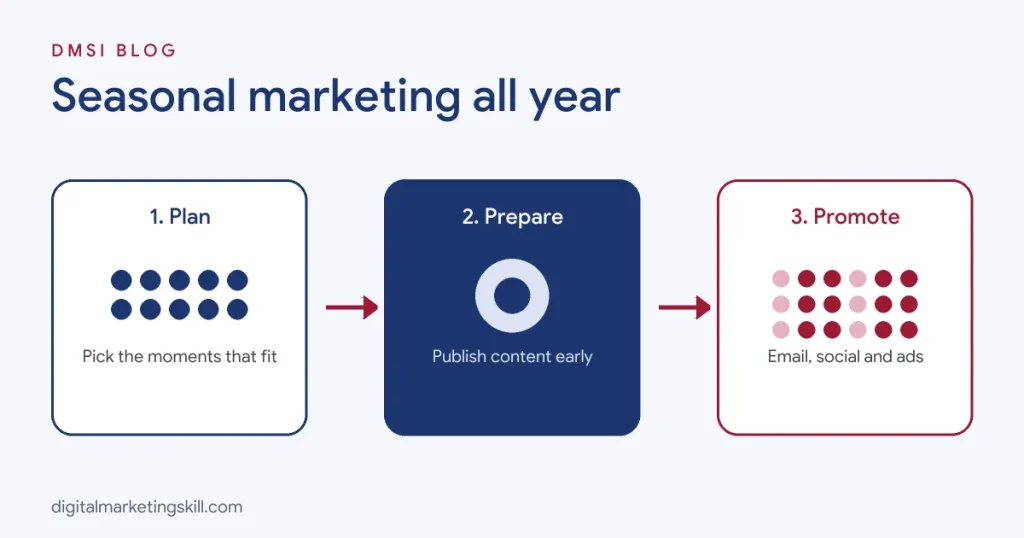
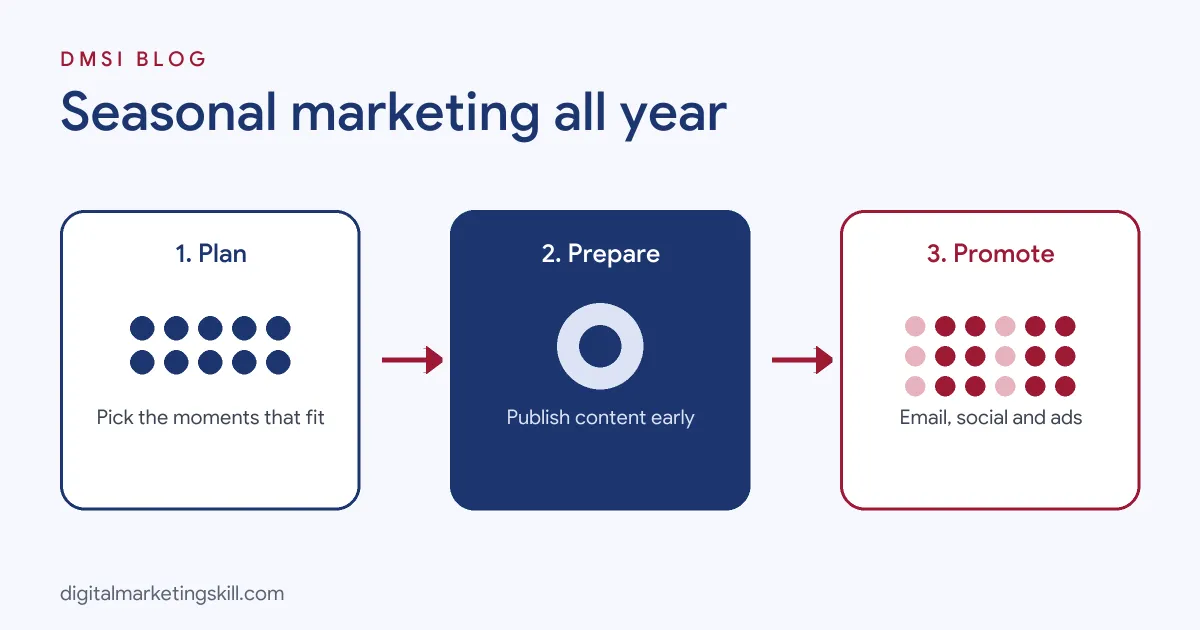
2. Choose the Moments That Fit
Pick a handful of seasonal moments that genuinely connect to your brand and audience. Quality beats quantity.
3. Set a Clear Goal
Decide what each campaign should achieve: sales, new customers, email sign-ups, clearing stock or brand awareness. One main goal keeps the campaign focused.
4. Understand Your Audience’s Seasonal Needs
Ask what your customers need at that time of year. In December, they may need gift ideas and delivery certainty. In January, they may need motivation and value for money.
5. Build the Offer and the Message
Create an offer that suits the moment, such as a gift bundle, a seasonal product or a time-limited bonus, and write a message that ties it naturally to the season. Avoid forcing a link that feels awkward.
6. Prepare Content and Assets Early
Write blog posts, landing pages, emails, social posts and ads in advance. Publish seasonal SEO content weeks before the moment so it has time to rank. For evergreen seasonal pages, such as a Black Friday or Christmas page, reuse the same URL every year so it keeps its search authority.
7. Launch Across Channels
Coordinate email, social media, paid ads, your website and, if relevant, your physical store. Our guide to omnichannel marketing explains how to make channels work together.
8. Measure, Adjust and Record
Track results daily during short campaigns, move budget to what works and write down lessons for next year. Seasonal marketing improves every year you repeat it.
20 Seasonal Marketing Ideas
Offers and Products
- Limited-edition seasonal products or packaging that only exist for a few weeks.
- Gift bundles that solve the “what should I buy?” problem.
- Gift cards for last-minute shoppers, promoted heavily after delivery deadlines pass.
- Tiered or spend-and-save offers that raise average order value.
- End-of-season sales to clear stock and make room for new ranges.
Content
- Gift guides organised by recipient, interest or budget.
- Seasonal how-to content, such as “how to plan a budget Christmas” or “back-to-school checklist”.
- Countdowns and advent calendars with a new tip, deal or story each day.
- Year-in-review content in December, sharing highlights, data or customer stories.
- New Year planning content that helps customers set goals involving your product.
Social and Community
- Seasonal challenges, such as a 30-day January fitness or learning challenge.
- User-generated content campaigns inviting customers to share seasonal photos. See our guide to user-generated content.
- Giveaways and contests tied to a holiday, run within each platform’s rules.
- Behind-the-scenes posts showing how your team prepares for busy seasons.
- Charity partnerships for Giving Tuesday, Ramadan or Christmas.
Email and Ads
- Early-access offers for subscribers before big shopping events.
- Deadline reminders, such as last order dates for Christmas delivery.
- Seasonal retargeting for people who browsed but did not buy. Our glossary explains retargeting.
- Weather-triggered ads that promote umbrellas on rainy days or cold drinks in a heatwave.
- Post-season follow-ups that turn seasonal shoppers into year-round customers.
Seasonal Marketing Campaign Examples
These well-known campaigns show different ways to use the calendar. Focus on the principle behind each one.
Coca-Cola: “Holidays Are Coming”
Coca-Cola’s illuminated Christmas trucks first appeared in its “Holidays Are Coming” advert in 1995 and have returned many times since, including real truck tours in the UK. Principle: repeat a seasonal symbol until customers associate it with the season itself.
Starbucks: Holiday Red Cups
Starbucks has released special holiday cups since 1997, and their annual unveiling has become an event customers look forward to and talk about online. Principle: a small seasonal change to packaging can create anticipation and free publicity.
John Lewis: The Christmas Advert
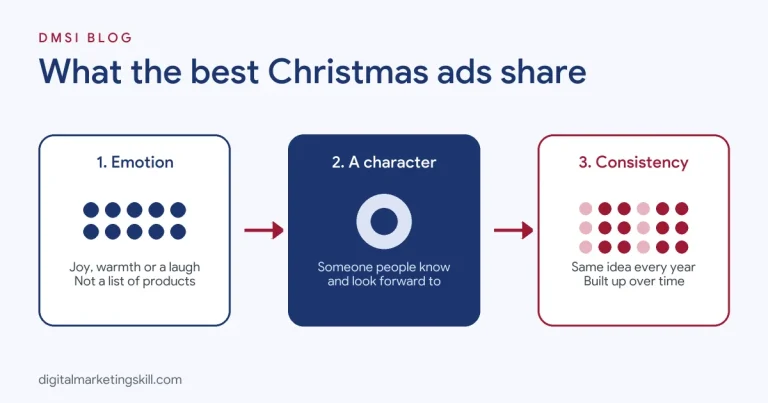
UK retailer John Lewis turned its Christmas advert into an annual cultural moment, with emotional storytelling that people discuss and share every November. Principle: emotional stories can make a brand part of the season. Our guide to Christmas ads looks at what the best ones do.
Spotify Wrapped: Owning the End of the Year
Each December, Spotify gives users a personalised summary of their listening, designed to be shared on social media. Millions of users share it, turning customers into promoters. Principle: personalised year-end content is highly shareable.
Patagonia: “Don’t Buy This Jacket”
On Black Friday 2011, Patagonia ran a newspaper advert telling people not to buy its jacket unless they really needed it, highlighting its environmental values. Principle: going against the seasonal grain can stand out when it reflects genuine brand values. For more, see our breakdown of Black Friday ads and our Black Friday marketing strategy guide.
Seasonal SEO: How to Rank Seasonal Content
Search is one of the most reliable seasonal channels because people search for gifts, deals and ideas before they buy. A few habits make seasonal content far more likely to rank:
- Use permanent URLs. Create pages such as /black-friday/ or /christmas-gift-guide/ without a year in the address, then update the content each season. The page keeps its links and authority year after year.
- Publish early. Search engines need time to discover and rank new pages. Aim to publish or refresh seasonal content six to eight weeks before the peak.
- Match search intent. Search your target phrase and look at the top results. If they are gift guides or lists, a long essay is unlikely to rank. Our glossary explains search intent.
- Refresh the details. Update dates, prices, products and examples each year so the page stays accurate and useful.
- Link from evergreen pages. Add links from your homepage and popular posts to seasonal pages during the season so visitors and search engines find them quickly.
Seasonal SEO rewards brands that plan ahead. The page you refresh this year can bring traffic every year after.
Seasonal Marketing Trends
- Longer seasons: big events now stretch over weeks. Black Friday has become Black Friday week or month, so campaigns need stamina and variety. Our article on the history of Black Friday shows how this happened.
- Mobile-first shopping: most seasonal browsing and a large share of buying happens on phones, so campaigns must load fast and check out easily on mobile.
- Short video and social commerce: seasonal content on TikTok, Instagram Reels and YouTube Shorts drives discovery, and more shoppers buy directly in social apps.
- AI-assisted planning and personalisation: AI tools help marketers forecast demand, write variations of seasonal copy and personalise offers at scale.
- Flexible payments: buy now, pay later has become a major part of peak seasons, with Adobe reporting more than $1 billion in such spending on Cyber Monday 2025.
- Inclusive calendars: brands increasingly recognise a wider range of cultural and religious festivals, as long as they do so respectfully and authentically.
Seasonal Marketing for Service and B2B Businesses
Seasonal marketing is not only for retailers. Service and business-to-business companies have their own seasons:
- Budget cycles: many companies plan budgets in autumn and spend remaining budgets in December, which suits software, training and agency offers.
- Fresh starts: January and September are popular times to change careers, learn new skills or hire new suppliers.
- Industry events: trade shows, conferences and deadlines such as tax returns create predictable peaks.
- Year-end reviews: December content about trends and planning for next year attracts decision makers.
Seasonal Marketing Mistakes to Avoid
- Starting too late and missing early researchers, when ad costs are also lower.
- Forcing a connection to a holiday that has nothing to do with your brand.
- Insensitive campaigns that treat cultural or religious festivals as gimmicks.
- Ignoring local differences in seasons, holidays and payment habits.
- Running out of stock or capacity at the peak.
- Stopping after the season instead of turning new customers into loyal ones.
How to Measure Seasonal Campaigns
Compare results with the same period last year and with a normal week:
- Revenue and profit from the campaign, after discounts and ad spend.
- Traffic and search visibility for seasonal pages and keywords.
- Email open, click and conversion rates for seasonal sends.
- New customers acquired and their lifetime value over the following months.
- Return on ad spend by channel and audience.
The One Rule of Seasonal Marketing
Be useful in the moment. The best seasonal campaigns do not simply decorate an advert with snowflakes or hearts. They solve a real seasonal problem for the customer, whether that is finding the perfect gift, starting the New Year well or getting ready for school.
An Illustrative Case
Imagine an online stationery shop in Nairobi that used to run one big December sale and little else. Sales were flat for most of the year.
The owner reviews two years of data and Google Trends and builds a simple seasonal calendar: a back-to-school campaign in early January, when Kenyan schools start their year; a Valentine’s Day card and gift range in February; a planner campaign in October for the coming year; and a Black Friday and Christmas push in November and December. She publishes a back-to-school checklist and a gift guide on her blog six weeks before each moment, builds her email list with a free printable planner and sends deadline reminders.
Over the year, sales become steadier, the blog starts ranking for seasonal searches and the December campaign performs better because the email list is larger. This example is illustrative, not a real business, but it shows how a seasonal calendar spreads demand across the year.
Frequently Asked Questions About Seasonal Marketing
What is seasonal marketing?
Seasonal marketing aligns promotions, content and products with holidays, seasons and events, so your marketing matches what customers want at that time of year.
What are examples of seasonal marketing?
Examples include Christmas gift guides, Black Friday sales, Valentine’s Day bundles, back-to-school offers, summer travel content and New Year resolution campaigns.
What is the 3-3-3 rule for marketing?
It is an informal rule with several versions. One common version says you have about three seconds to grab attention, three more to hold interest and a few more to make your point, so seasonal ads should make the offer clear immediately.
How do you make a seasonal marketing campaign?
Review past data, choose relevant moments, set a goal, understand seasonal needs, create an offer and message, prepare content early, launch across channels and measure results.
What are the 7 steps of a marketing plan?
A common version is: research the market, define your audience, set goals, choose your strategy, plan tactics and channels, set a budget, and measure and adjust. Our guide to marketing strategy explains the bigger picture.
What are some great Christmas campaigns to inspire marketers?
Coca-Cola’s “Holidays Are Coming”, Starbucks’ holiday cups and John Lewis’s annual Christmas adverts are widely admired for creating anticipation and emotion year after year.
When should I start planning seasonal campaigns?
Start three to six months ahead for major events like Black Friday and Christmas, and six to eight weeks ahead for medium-sized moments such as Valentine’s Day.
Is seasonal marketing good for small businesses?
Yes. Small businesses can use local events, personal service and community to stand out, without needing big budgets.
How do I avoid being insensitive in seasonal marketing?
Research the meaning of each festival, involve people from that community, avoid stereotypes and focus on genuine respect and value rather than sales gimmicks.
How do I keep customers after a seasonal campaign?
Welcome new buyers with a helpful email series, ask for reviews, offer a reason to return and keep in touch with useful content between seasons.
Your Next Step
Seasonal marketing draws on planning, content, email automation, paid social and analytics. The Master Diploma in Digital & AI Marketing at Digital Marketing Skill Institute covers AI-powered Social Media Management and Advertising, Lead Generation and Email Automation, Google, and a WordPress and SEO track where you build and rank a real website.
From day one, you work on a real U.S. company’s project through the U.S. Project Internship, so you finish with real results and a verified U.S. work reference letter. You also get unlimited one-on-one coaching. The program carries dual US and UK accreditation, is recognised in more than 100 countries, and runs 100% online over three months.
You can build those skills wherever you live, anywhere in your country. Read student reviews, then apply for the 65% partial scholarship to see if you qualify.
Every claim in this guide was checked against its source before publication: Adobe Digital Insights 2025 holiday forecast and Cyber Week results, Google Trends, and the brands’ own published campaign histories. The case above is an illustrative example, not a real result.