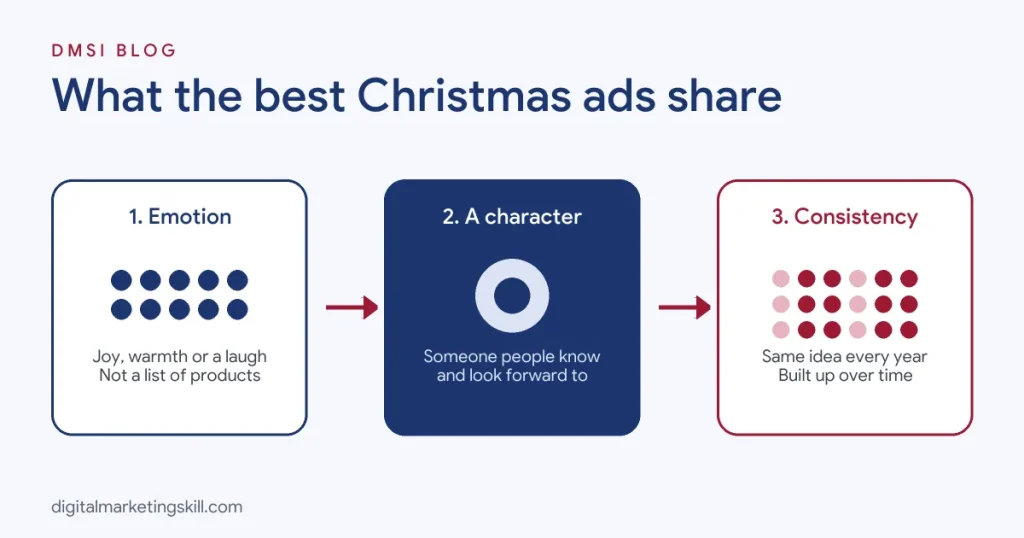
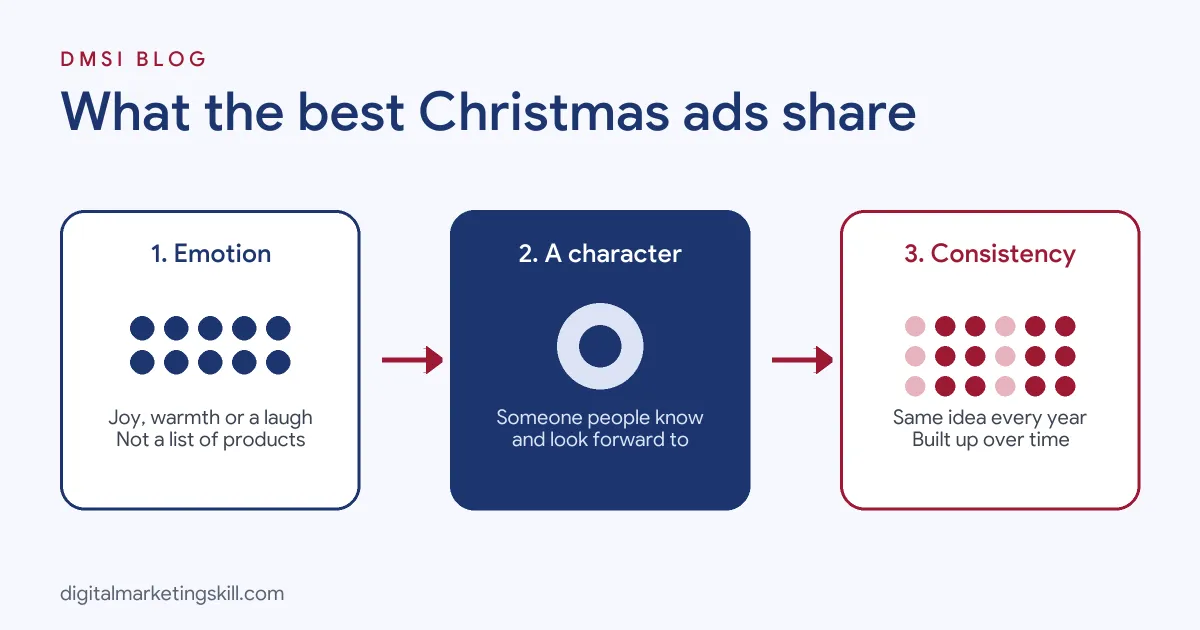
Christmas ads are the festive campaigns brands launch from early November to win attention, and sales, in the busiest shopping season of the year. The best Christmas ads share three things: they make people feel something, usually joy; they use a character or idea people recognise; and they repeat that idea year after year. That is why Aldi’s Kevin the Carrot is back for a tenth Christmas, and why a remake of Coca-Cola’s “Holidays Are Coming” topped System1’s UK rankings last year.
This guide explains what the big festive ads do well, what the data says, and how a small business can make its own Christmas ad with a phone and a modest budget. For the bigger picture, see our guide to brand storytelling.
Key Takeaways
- The Advertising Association and WARC forecast UK ad spend of about £12 billion in the final quarter of 2025, up 7.3% on the year before.
- They expected 83% of that festive spend to go on online formats, with around 40% on search, including retail media.
- System1 reported a record 4.4-Star average for UK Christmas ads in 2025, and said consistency was the clearest lesson.
- In System1’s UK testing, Coca-Cola’s AI remake of its 1995 “Holidays Are Coming” ad came top for both brand building and short-term sales.
- Kantar’s 2025 top ten included five re-used ads, led by Cadbury’s “Secret Santa”, which suggests a familiar idea can work as well as a new one.
In this guide
- What Most Lists of Christmas Ads Miss
- How Christmas Ads Actually Work
- Types of Christmas Ads
- Christmas Ads Worth Studying
- How to Make Your Own Christmas Ad: Seven Steps
- Common Christmas Ad Mistakes
- How to Measure a Christmas Ad
- The One Rule for Christmas Ads
- An Illustrative Case
- Frequently Asked Questions About Christmas Ads
- Your Next Step
What Most Lists of Christmas Ads Miss
Most round-ups rank the year’s ads by how many tears they caused. That is fun, but it hides the real lesson. The ads that pay off are rarely one-off masterpieces. Instead, they are chapters in a story the audience already knows.
System1, which tests ads with real viewers, put it simply in its review of 2025: consistency still wins. Kantar, a rival research firm, reached a similar view, finding that re-used Christmas ads performed as well as new ones.
This matters for small businesses. You cannot match a big retailer’s budget, but you can match its discipline. A simple festive idea you repeat every year, with the same character, colour or song, builds memory over time. That is cheaper than inventing something new every November.
How Christmas Ads Actually Work
A big Christmas ad works on two levels at once. Research firms often call these brand building and short-term sales.
- Brand building. The ad leaves a warm feeling linked to the brand. That feeling makes people more likely to choose the brand later, even if they cannot remember the ad.
- Short-term sales. The ad reminds people what to buy now, such as party food, gifts or a festive product.
The season also follows a clear rhythm. In the UK, the big retailers launch in the first week or two of November. Many tease the ad first with a short clip on social media, then release the full film, then run shorter cut-downs through December.
Most of the money now goes online. The AA and WARC expected 83% of UK festive ad spend in 2025 to go on online formats, and video on demand was one of the fastest-growing channels. So even a “TV ad” today is planned as a set of clips for YouTube, Instagram Reels and TikTok as well. Our guide to online video strategy covers how to plan those formats.
Types of Christmas Ads
Before you script anything, decide which kind of ad suits your brand and budget.
The Emotional Story: Built for Brand Memory
A short film with a beginning, middle and end, often about kindness, family or giving. These are the ads people share and talk about. They need strong storytelling and a clear link back to the brand.
The Returning Character: Built for Recognition
A mascot or character who comes back every year, like Aldi’s Kevin the Carrot. Each new ad builds on the last, so the audience is already invested before it starts.
The Product Feast: Built for Sales
Food, gifts or offers shown in a festive setting. Supermarkets use these to remind shoppers what to buy. They work best when they still have a little story or humour, not just a list of prices.
The Classic Re-Run: Built for Nostalgia
An old favourite, re-aired or remade. Coca-Cola’s trucks and Cadbury’s “Secret Santa” show how a familiar ad can still beat new ones.
The Social-First Clip: Built for Small Budgets
A short vertical video made for Reels or TikTok, often filmed on a phone. It might show your team wrapping orders, a festive product reveal or a customer story. This is where most small businesses should start.
Christmas Ads Worth Studying
| Brand | Ad or campaign | Type | Lesson |
|---|---|---|---|
| Coca-Cola | Holidays Are Coming | Classic re-run | A familiar idea can beat a new one |
| Aldi UK | Kevin the Carrot | Returning character | Build a character people wait for |
| John Lewis | Yearly Christmas film | Emotional story | Make the launch an event |
| Cadbury | Secret Santa | Classic re-run | Tie the story to the product |
| Asda | Grinchmas | New idea, known character | Borrowed fame can help a new idea land |
Coca-Cola: Holidays Are Coming
Coca-Cola’s red trucks first appeared in 1995. In 2025, the brand released a remake made with AI, and System1 found it topped the UK chart for both long-term brand building and short-term sales. The lesson is not about AI. It is that decades of repetition made the trucks a signal for Christmas itself.
Aldi: Kevin the Carrot
Kevin the Carrot first appeared in Aldi’s UK Christmas advertising in 2016. This year he returns for a tenth year in a film called “The Christmas Wish”, made with McCann Manchester. Aldi now teases each new chapter days before the full release, so fans come looking for it. A cheap supermarket has built a character that people discuss like a TV series.
John Lewis: The Christmas Film as an Event
John Lewis launched its first Christmas ad in 2007, and its films such as “The Long Wait” (2011) and “Monty the Penguin” (2014) helped turn the launch of a Christmas ad into a national talking point in the UK. This year’s film, released on 3 November, stars Dame Kristin Scott Thomas as Gloria, with a wooden toy dog called Pickles who nudges her to choose a proper present. The lesson is to treat the launch itself as news, with teasers, a reveal date and a story people can follow.
Cadbury: Secret Santa
Kantar ranked Cadbury’s “Secret Santa” first among UK Christmas ads it tested in 2025, ahead of Coca-Cola. The idea fits Cadbury’s long-running theme of small acts of generosity, and the product sits naturally inside the story as a gift.
Asda: Grinchmas
Kantar noted that Asda’s “Grinchmas” was the only completely new idea to reach its 2025 top ten. It used a famous character to give a new campaign instant recognition. Most small brands cannot license a film character, but the principle still applies: link your ad to something your audience already loves, such as a local tradition or a well-known festive song you have rights to use.
How to Make Your Own Christmas Ad: Seven Steps
- Choose one feeling. Joy, warmth, surprise or a laugh. System1 consistently finds that ads making people feel happy tend to score best.
- Pick a recurring element. A character, a colour, a jingle, a team member or a tradition you can repeat every year.
- Write a 30-second story. A problem, a turning point and a happy ending, with your product or service playing a natural role.
- Show your brand early and often. Viewers forget who made an ad if the logo only appears in the final second.
- Film for vertical first. Shoot in 9:16 for Reels and TikTok, then cut 15-second and 6-second versions.
- Plan the launch. Tease it a few days before, release it in early to mid November and pin it to your profiles.
- Put money behind the best version. Run a small test, then spend most of your budget on the clip with the best watch time and clicks.
If you use music, check you have the rights. Platforms often mute or block videos with unlicensed songs, and that can waste your whole campaign.
Common Christmas Ad Mistakes
Starting From Scratch Every Year
A brand-new idea each November means you rebuild recognition every time. A repeated element saves money and builds memory.
Hiding the Brand
A beautiful film that could be from anyone helps no one. Make sure your brand, product or character is clear throughout.
Launching Too Late
By mid December, feeds are full and many people have finished shopping. Launch in early or mid November.
Only Making a Long Version
Most people will see your ad on a phone, often for a few seconds. Plan short cut-downs from the start.
Being Sad Without a Payoff
Tear-jerkers can work, but only if they end with warmth or hope. An ad that just leaves people feeling low rarely helps the brand.
How to Measure a Christmas Ad
Big brands pay research firms to test ads before launch. Small businesses can use simpler signals:
- Watch time and completion rate: how many people watched to the end on each platform.
- Shares and saves: a strong sign the ad made people feel something.
- Comments that mention the brand or character: proof that people remember who made it.
- Clicks and sales during the campaign: compare with the same weeks last year.
- Search for your brand name: a rise in branded searches often follows a memorable ad.
Our guide to online marketing metrics explains which numbers matter most.
The One Rule for Christmas Ads
Make people feel one good thing, and make sure they know it came from you. Then do it again next year. Every ad in this guide follows that rule. Coca-Cola, Aldi and Cadbury have shown that a familiar festive idea, repeated with care, can beat a brand-new one, and it costs far less to make.
An Illustrative Case
Imagine a small bakery in Manchester with 3,000 Instagram followers. In past years, it posted photos of mince pies with prices. Engagement was low.
This year, the owner creates “The Midnight Elf”, a felt puppet that “helps” the bakers. She films a 30-second vertical video on her phone: the elf sneaks into the kitchen at night, tries to ice a cake, makes a mess, and the team finds him asleep in a box of mince pies in the morning. The bakery’s name and logo appear on the boxes, aprons and door.
She teases the elf for three days, then posts the full video in mid November, with 15-second and 6-second cut-downs. She spends a small budget boosting the version with the best watch time to people within ten miles. Customers start asking about the elf in the shop, and Christmas orders rise compared with last year. Next November, the elf returns. This case is an illustrative example, not a real result.
Frequently Asked Questions About Christmas Ads
When do Christmas ads start in the UK?
Most big UK brands launch in the first two weeks of November. This year, John Lewis released its film on 3 November, and Aldi’s Kevin the Carrot followed days later.
What makes a good Christmas ad?
One clear emotion, a recognisable brand or character, and a simple story. Research from System1 shows that consistency and happiness tend to score highest.
Which Christmas ad scored best last year?
In System1’s UK testing, Coca-Cola’s remake of “Holidays Are Coming” topped both its brand-building and sales measures. Kantar ranked Cadbury’s “Secret Santa” first in its own study.
How much do brands spend on Christmas advertising?
The AA and WARC forecast about £12 billion of UK ad spend in the final quarter of 2025, the festive period. Most of it went on online formats.
Can a small business make a Christmas ad?
Yes. A short vertical video filmed on a phone, with one idea and a recurring character or tradition, can work well on Instagram, TikTok and Facebook.
How long should a Christmas ad be?
For social media, make a 15 to 30-second main version and a six-second cut-down. Big brands also make longer films, but most viewers see the short versions.
Should I re-use last year’s Christmas ad?
It can work. Kantar found five re-used ads in its 2025 top ten. At the very least, keep the same character, music or theme so people recognise you.
Is it OK to use AI to make a Christmas ad?
Many brands now use AI tools for ideas, storyboards or visuals. Coca-Cola’s remake used AI. Be open about it, check the result looks natural and make sure the story still feels human.
Do I need music rights for a Christmas ad?
Yes. Using a popular song without a licence can get your video muted or removed. Use the platform’s licensed music library or royalty-free tracks.
Your Next Step
A good Christmas ad needs content creation, video editing, social media planning and paid ads that reach the right people. The Master Diploma in Digital & AI Marketing at Digital Marketing Skill Institute includes an AI-powered Social Media Management and Advertising track that covers all of these, alongside tracks in Lead Generation and Email Automation, Google, and WordPress and SEO.
From day one, you work on a real U.S. company’s project through the U.S. Project Internship, so you finish with real results and a verified U.S. work reference letter. You also get unlimited one-on-one coaching. The program carries dual US and UK accreditation, is recognised in more than 100 countries, and runs 100% online over three months.
You can build those skills wherever you live, anywhere in your country. Read student reviews, then apply for the 65% partial scholarship to see if you qualify.
Every figure in this guide was checked against its original source before publication: the Advertising Association and WARC Expenditure Report, System1, Kantar (via More About Advertising), Grocery Gazette and Wikipedia’s record of John Lewis Christmas adverts. Details of this year’s ads were checked in November. The case above is an illustrative example, not a real result.