
An import and resell business means buying goods at a low wholesale price, usually from an overseas manufacturer, and reselling them to local buyers at a profit. It is one of the most accessible online business models. But new import rules have made the math harder than most guides admit.
Key Takeaways
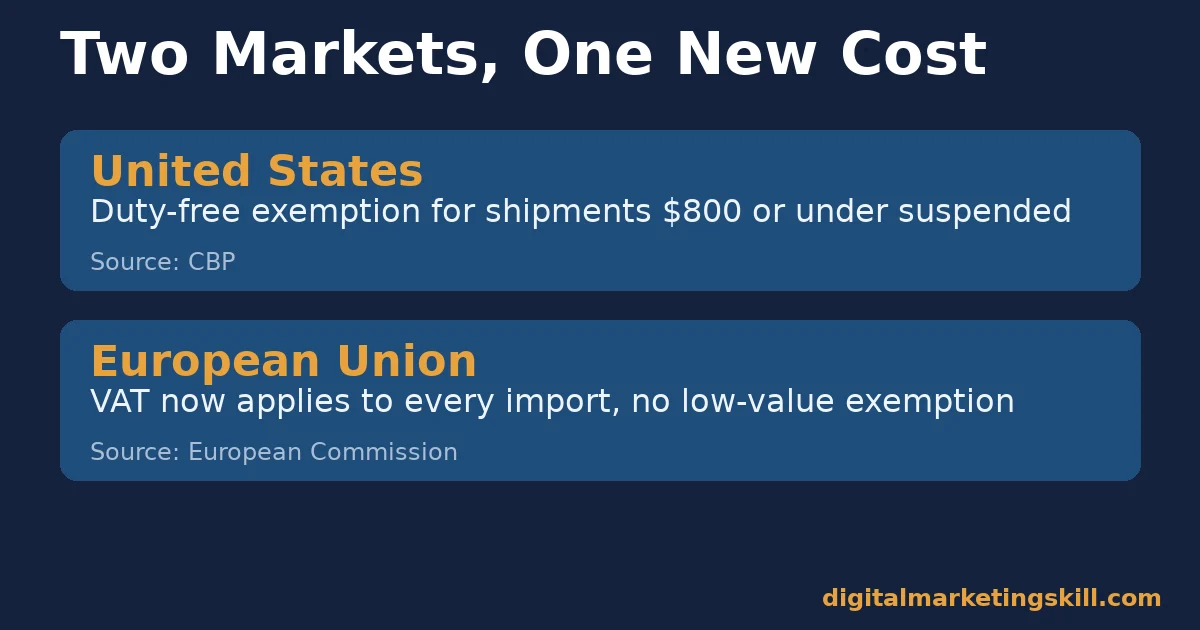
- US customs no longer waives duties on low-value shipments. CBP has suspended the duty-free exemption for shipments valued at $800 or under, so every import now faces applicable duties, according to U.S. Customs and Border Protection.
- The EU made a similar move: VAT now applies to every import regardless of value, after the bloc removed its old exemption for low-value consignments, per official European Commission guidance.
- Alibaba.com’s own figures show the scale of the supply side: over 40 million active B2B buyers sourcing from suppliers across 200+ countries and regions.
- A real, documented case: Wayfair, built on the same buy-low-resell-high model, reports 21 million active customers and roughly 20,000 suppliers in its own SEC filing, proof the model scales. Almost none of that scale happened in its first year.
- Three distinct sourcing models exist: dropship arbitrage, wholesale import, and retail arbitrage. Most new sellers pick one by accident instead of matching it to their capital.
In this guide
- The Gap Most Import Business Guides Miss
- How An Import And Resell Business Actually Works
- Three Models, Three Capital Requirements
- Running Each Model Without The Common Losses
- Measure The Numbers That Actually Predict Profit
- The One Decision Rule That Matters Most
- What A Documented Import-And-Resell Business Looks Like At Scale
- Frequently Asked Questions About Import And Resell Business
- Where To Start, Wherever You Live
The Gap Most Import Business Guides Miss
Most guides to starting an import and resell business describe the happy path. Buy cheap. Sell high. Keep the difference. What they skip is the part that just changed.
Duties and taxes that used to apply only above a threshold now apply to nearly every shipment, in the two largest import markets in the world. That single shift rewrites the margin math for anyone starting today.
A few ground rules. The duty and VAT figures above are current rules, not permanent ones. Trade policy shifts, so check your own country’s threshold before you commit capital. Every number in this guide is traced to the company or agency that published it, with what it does and does not prove stated plainly.
How An Import And Resell Business Actually Works
The model has three steps. Source a product below the price buyers will pay for it locally. Land that product in your country, covering shipping, duties, and any tax. Sell it through a channel where buyers are already looking.
Where The Real Margin Lives
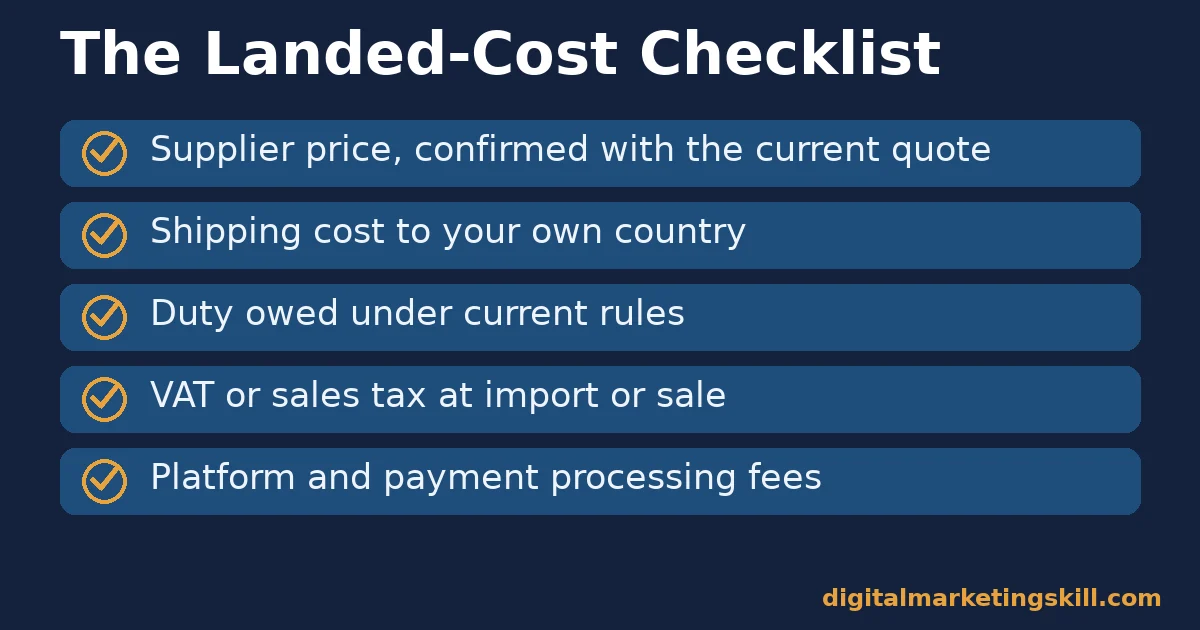
The margin lives in the gap between landed cost and local selling price. Landed cost is not just the supplier’s price. It is supplier price, plus shipping, plus duty, plus tax, plus any platform or payment fee. Sellers who only track the supplier price consistently overestimate their margin, sometimes by half.
This is the single biggest difference between a profitable import and resell business and one that quietly loses money while feeling busy. A seller watching only revenue and supplier cost can look profitable on paper for months before the hidden costs catch up in a tax bill or a customs hold.
Why The Duty Changes Matter Here
For years, small shipments crossed borders duty-free below a set value. That let an import and resell business test new products cheaply, with little capital at risk. Both major rule changes above close that gap.
A shipment that used to land duty-free now carries a duty line. That shrinks the margin on low-ticket items more than on higher-ticket ones, because the flat costs eat a bigger share of a small sale. Pricing a product correctly, not just sourcing it cheaply, has become the harder skill.
A seller importing a $5 accessory feels a flat duty charge far more, as a share of price, than a seller importing a $150 appliance. That is why low-ticket, high-volume import and resell business models have been hit hardest by the rule changes. Higher-ticket, lower-volume sellers have more room to absorb the new cost.
Three Models, Three Capital Requirements
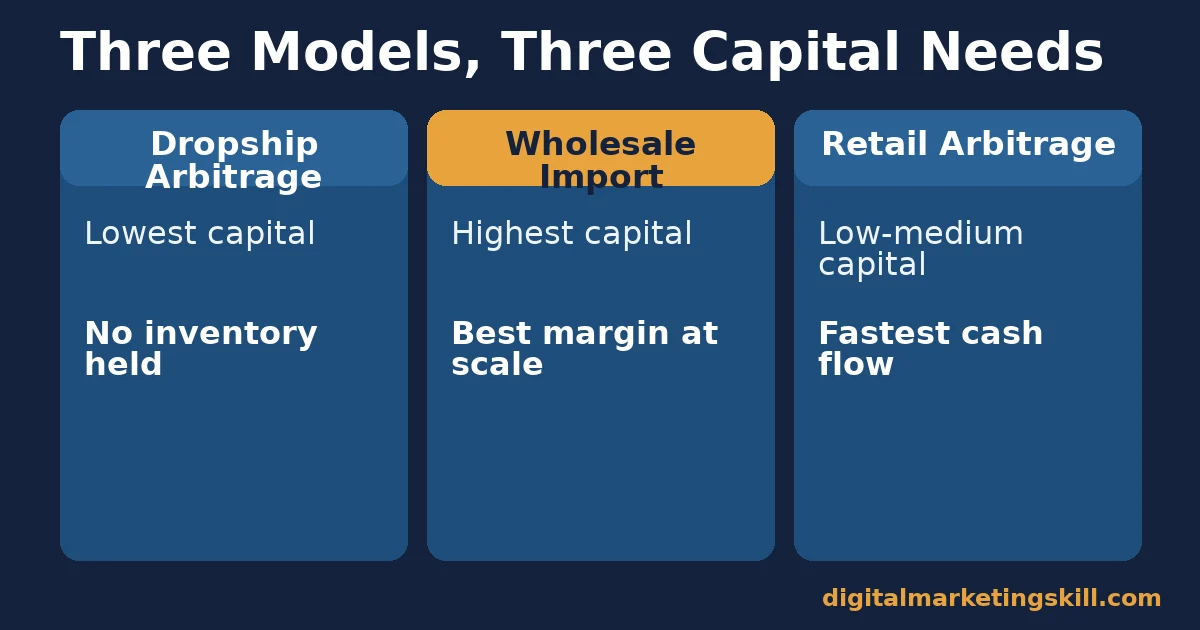
Every import and resell business fits one of three models. Picking the wrong one for your capital is the most common early mistake. It is an easy one to make, because all three models look similar from the outside.
The difference shows up the first time cash flow gets tight. A dropshipper with no inventory can pause spending instantly. A wholesale importer with a warehouse full of stock cannot. Match the model to how much risk you can actually absorb, not how much profit the model promises on a good month.
Dropship Arbitrage: Built For Zero Inventory
You list a product you never touch. When a customer orders, you buy it from the overseas supplier at the lower price and have it shipped straight to the customer. You never hold stock, so your capital risk is close to zero.
The trade-off is speed and control. Shipping direct from a supplier to a customer can take one to two weeks. You also cannot inspect the product before it reaches the buyer. Choose this model when capital is your tightest constraint and you can tolerate slower delivery.
Wholesale Import: Built For Margin At Scale
You buy a bulk quantity upfront, directly from a manufacturer, and import it in one shipment. Per-unit cost drops sharply at bulk volumes, which is where real margin lives.
The trade-off is capital and risk. You pay for inventory before you have a confirmed buyer. You also absorb the duty and shipping cost on the full batch at once. Choose this model once you have tested demand through a smaller model first.
Retail Arbitrage: Built For Fast Cash Flow
You buy discounted stock from existing retailers, online or offline, and resell it at the normal market price elsewhere. This is a distinct model from importing: retail arbitrage sourcing guides describe it as buying from a retailer’s existing discount, not negotiating with a factory.
The trade-off is scale. Discounted retail stock is finite and inconsistent. This model rarely grows into a large business on its own. It works best as a fast way to generate early cash flow while you learn sourcing.
Running Each Model Without The Common Losses
Picking a model is step one. Running it without losing money to preventable mistakes is step two.
Dropship Arbitrage: Lead With Supplier Vetting
Before listing a single product, check the supplier’s completed order count, response time, and review history on the sourcing platform. A supplier who is slow to answer questions before a sale will be slower after one, when a customer is already annoyed.
Wholesale Import: Lead With Landed-Cost Math
Calculate landed cost before you commit to a bulk order, not after. Add supplier price, freight, duty, and any tax. Then compare the total to what buyers actually pay locally, not what you hope they will pay. If the margin is thin before you add marketing cost, the batch is not worth importing.
Retail Arbitrage: Lead With Inventory Turnover
Track how fast each discounted batch sells, not just how cheap it was. Stock that sits unsold for months ties up cash you could have redeployed into the next discount. A fast-turning low-margin item often beats a slow-turning high-margin one.
A Short Duty And Tax Checklist For Every Model
Whatever model you run, check a few things before you commit capital. Confirm your own country’s current duty-free threshold. Check whether VAT or sales tax applies at import or at point of sale. Find out whether your selling platform collects that tax automatically, since several large marketplaces now do this for you.
Getting this wrong does not just cost margin. A shipment held at customs for missing paperwork can cost you the sale entirely, and the customer besides.
Avoid The Products That Draw Customs Attention
Some product categories draw disproportionate customs scrutiny: close imitations of a branded design, counterfeit packaging, and goods that infringe someone else’s trademark. The FTC’s own guidance on misleading claims is a reminder that the legal risk in this business is not only at the border. It also follows you into how you market the product once it lands.
Tools That Fit A First-Time Budget
You do not need expensive software to run a first import and resell business well. A simple spreadsheet tracking supplier price, shipping, duty, tax, and selling price per product does the job a dedicated landed-cost calculator does, just slower.
Most sourcing platforms also publish supplier ratings and completed-order counts for free, which covers the vetting step without a paid tool. Add a paid tool once manual tracking is clearly costing you more time than it saves.
Keep the spreadsheet per product rather than per order. A single row per SKU, updated each time duty rules or supplier pricing shift, shows you at a glance which products still clear your minimum margin and which ones the new rules have quietly pushed into a loss. Review it monthly, not just when a sale feels slow, since margin can erode gradually long before revenue drops.
Measure The Numbers That Actually Predict Profit
Track these four numbers together. Any one alone can mislead you.
- Landed-cost margin: selling price minus the full landed cost (supplier price, shipping, duty, tax, platform fees), shown as a percentage of selling price. This is the real margin, not the supplier-price margin most new sellers calculate.
- Return and dispute rate: the share of orders returned or disputed through your payment processor. A rising rate usually means a supplier or product quality problem, not a marketing problem.
- Repeat purchase rate: the share of customers who buy a second time. Import and resell businesses that only win one-time buyers pay full acquisition cost on every sale, forever.
- Cost per acquisition: total marketing spend divided by new customers gained. Compare this against your landed-cost margin per order. If acquisition cost exceeds margin, every sale loses money.
Our guide to customer relationship management covers the habits that turn a one-time buyer into a repeat one, which is the fastest way to improve the fourth number without spending more on ads.
The One Decision Rule That Matters Most
Never price a product from the supplier cost alone. Price it from the full landed cost, including duty and tax. Then check that figure against what local buyers actually pay for similar items.
Illustrative, invented numbers: a product costs $10 from the supplier. Add $2 shipping, $1.50 duty under the new rules, and a $0.50 platform fee. Landed cost is $14.
If local buyers pay $16 for similar items, the real margin is about 12.5%, not the 60% a seller would calculate from supplier cost alone. That gap is exactly what the new duty rules have widened, and it is the single most common reason a first import and resell business loses money on paper profit.
What A Documented Import-And-Resell Business Looks Like At Scale
Wayfair started as a small online retailer selling home goods sourced from manufacturers and wholesalers, the same buy-low-resell-online model covered in this guide. It grew, over years, into a public company.
Its own SEC filing reports 21 million active customers over the trailing twelve months and a supplier network of roughly 20,000 partners. That is not a dropship side hustle; it is the same mechanism at industrial scale.
The limit on this case: Wayfair is now a billion-dollar public company with warehousing, freight, and software infrastructure no new seller has on day one. Its relevance is not the scale, it is the mechanism. The company grew by consistently matching sourcing to demand and reinvesting margin, the same discipline a one-person import and resell business needs from its first sale.
No small import and resell business will reach Wayfair’s supplier count or customer base quickly, and this guide makes no claim that it will. What transfers from the case is narrower and more useful. Price from landed cost, track supplier reliability, and reinvest margin into the products and channels that already work instead of spreading thin across everything at once.
Frequently Asked Questions About Import And Resell Business
How much money do I need to start an import and resell business?
Dropship arbitrage can start with the cost of setting up a storefront and little else, since you only pay a supplier after a customer pays you. Wholesale import needs enough capital to cover a full bulk order plus duty and shipping upfront, which can run from a few hundred to several thousand dollars depending on the product.
Is an import and resell business still profitable after the duty changes?
Yes, but margins are thinner than when low-value shipments crossed duty-free. Sellers who price from full landed cost, not supplier cost, can still run a profitable import and resell business. Sellers who ignore the new duty lines are the ones who get surprised.
What is the difference between dropshipping and wholesale importing?
Dropshipping means a supplier ships directly to your customer and you never hold stock. Wholesale importing means you buy a bulk quantity upfront and hold the inventory yourself. Dropshipping needs less capital; wholesale importing usually earns a higher margin per unit once you reach meaningful volume.
How do I find a reliable supplier?
Check a supplier’s completed order history, response time to questions, and independent buyer reviews on the sourcing platform before placing any order. A fast, detailed response to a pre-sale question is one of the strongest signals of a supplier who will handle problems well after the sale.
Do I have to pay duty on every import now?
In the United States and the European Union, yes. Both regions have removed the exemptions that used to let small shipments cross duty or VAT-free. Rules vary by country, so confirm the current threshold and rate for your own location before pricing a product.
What products work best for an import and resell business?
Look for real local demand, a landed cost well below the local selling price even after duty and tax, and a history of low returns. Avoid products that are fragile, heavily regulated, or close imitations of a branded design. Those categories draw the most customs scrutiny.
How long does shipping take for an import and resell business?
Dropshipped orders direct from an overseas supplier typically take one to two weeks to reach the customer. A bulk wholesale shipment to your own location can take longer depending on the freight method. Once it arrives, you can fulfil customer orders in days rather than weeks.
Can I run this business part-time alongside a job?
Dropship arbitrage is the easiest model to run part-time, since each order only needs a few minutes of handling once a supplier is set up. Wholesale import needs more upfront time for sourcing and landed-cost math. Once a batch is ordered, though, the ongoing workload is mostly marketing and customer service. Both fit around a full-time schedule.
Do I need a registered business to start?
You can test a product or two without one, but registering early helps in two ways. Many suppliers only offer their best pricing to a registered buyer. A separate business bank account also keeps your bookkeeping clean once duty, tax, and platform fees start adding up.
Can I run an import and resell business from any country?
Yes, the model itself travels. What changes by country is the duty threshold, the tax treatment, and which sourcing platforms ship to you directly. Confirm those three details for your own location before you place a first order, since they decide your landed cost far more than the product you pick.
Where To Start, Wherever You Live
An import and resell business still works, but it now rewards sellers who price from full landed cost and pick a sourcing model that matches their capital. Start with the model that fits your current budget. Calculate landed cost before your first order. Track return rate and repeat purchase rate from day one.
None of this needs a warehouse or a large team to start. It needs one verified supplier, one accurately priced product, and a channel to reach the first hundred buyers. Our small business marketing strategy framework is a useful next step once your first products are selling. Our guide to setting up paid social ads covers how to reach buyers who already show interest in products like yours.
Where Digital Marketing Skill Institute Fits
The marketing side of this business is finding buyers, running ads that convert, and building a list of repeat customers. That is exactly what Digital Marketing Skill Institute’s Master Diploma in Digital & AI Marketing teaches. Its AI-Powered Social Media Management and Advertising track and AI-Powered Google Specialist track both cover how to find buyers for a product like the ones this guide describes, anywhere in your country.
It also includes unlimited 1-on-1 coaching and mentoring, a U.S. Project Internship with a verified U.S. Work Reference Letter, and dual US and UK accreditation recognised in more than 100 countries, delivered 100% online. See the full track breakdown on the Master Diploma program page, read outcomes on the reviews page, and browse more guides on the digital marketing blog.
When you are ready, apply here. Learn more at digitalmarketingskill.com, and start building the marketing skills that make any import and resell business worth running, from digitalmarketingskill.com.
Every figure in this guide was checked against its original source before publication. Figures marked as illustrative are invented examples, not real results.
![9 Amazing Digital Marketing Skills to Make Money Online [With Proof]](https://digitalmarketingskill.com/wp-content/uploads/2019/07/9-Amazing-Digital-Marketing-Skills-to-Make-Money-Online-With-Proof-17.png)






