
A small business marketing strategy is the set of decisions that come before any tactic. It names who you serve. It names why they pick you, which channels you will use, and how you will know it is working. Skip it and every tactic becomes a guess. The CMO Survey found marketing budgets now average 9.4% of US company revenue, so a guess is an expensive one.
Key Takeaways
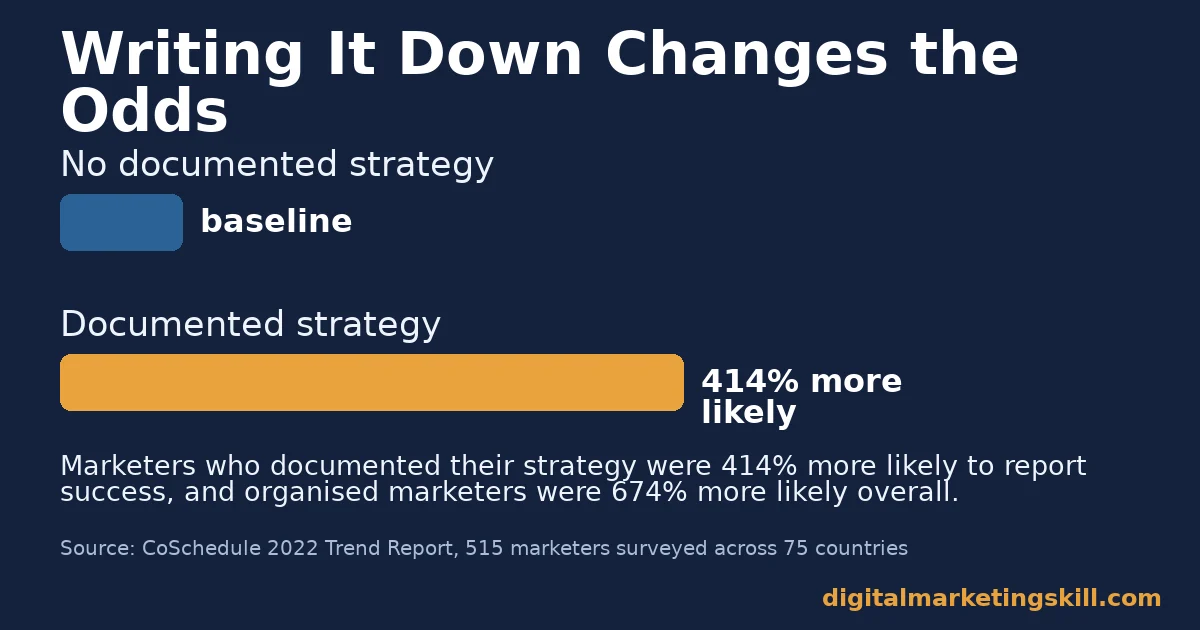
- Organisation beats effort in a small business marketing strategy. CoSchedule’s survey of 515 marketers in 75 countries found organised marketers were 674% more likely to report success than peers. Marketers who documented their strategy were 414% more likely to succeed.
- Mobile is the default screen. StatCounter’s worldwide data puts mobile at 58.99% of web traffic, ahead of desktop’s 39.26%. A strategy built for desktop first is already behind.
- Local search is routine, not rare. BrightLocal’s research found 84% of consumers had searched for a local business in the past three months.
- Some channels earn their keep more than others. HubSpot’s global survey of 3,400+ marketers found three channels that rate highest for ROI: website/blog/SEO, paid social and email.
- Budgets vary by business type. The CMO Survey found B2C product companies allocate about 15.5% of revenue to marketing, against 6.4% for B2B product companies.
In this guide
- Why Most Small Business Marketing Advice Skips the Strategy
- What a Marketing Strategy Actually Does
- The Three Pillars Differ by What They Decide
- How to Build Each Pillar of Your Small Business Marketing Strategy
- Five Mistakes That Undo a Small Business Marketing Strategy
- How to Measure a Small Business Marketing Strategy
- The Most Useful Small Business Marketing Strategy Rule: Write It Down Before You Spend
- A Four-Week Plan to Build Your Strategy
- A Real Case: How One Small Business Rebuilt Itself With a Content Strategy
- Frequently Asked Questions About Small Business Marketing Strategy
- Start With One Pillar, Then Expand
Why Most Small Business Marketing Advice Skips the Strategy
Search for small business marketing advice and you mostly find tactics: post daily, start a newsletter, try short-form video. Each can work. But a list of tactics with no strategy behind it just means doing more. It does not mean doing the right things for your business.
A strategy is the layer above the tactics. It names who you are trying to reach. It names what makes you the obvious choice, and which few channels deserve your limited time. Without it, a small team tries everything a little and nothing well. New to the field? Our beginner’s guide to digital marketing covers the basics this guide builds on.
Here are the ground rules. The budget and channel figures below mostly come from US and global marketer surveys. Treat them as a guide, not a local law, and re-check anything older than a year before you quote it elsewhere. The three-pillar framework in this guide is our own way to organise the decisions. It is an informed inference from the evidence, not a settled fact.
What a Marketing Strategy Actually Does
A marketing strategy answers three questions before you spend a single hour on tactics. Who is this for? Why should they choose you over the alternative they already know? And which channels will you actually show up on, consistently, given the time and money you have?
Tactics answer a different question: what do we do this week? Both layers matter, but the order matters too. A tactic chosen before the strategy is just an activity. The same tactic, chosen after the strategy, is a deliberate step toward a defined customer.
Strategy Decides the Tactics, Not the Other Way Around
Picture two businesses that both decide to “do more social media.” One picked the channel because a competitor uses it. The other picked it because its ideal customers already spend time there. That channel also supports the kind of proof those customers need before buying. Using the exact same tactic, the second business will out-perform the first.
This is why copying a competitor’s tactics rarely works as well as expected. You see the tactic, not the strategy behind it, and the tactic alone was never the reason it worked.
A Strategy Rests on Three Pillars
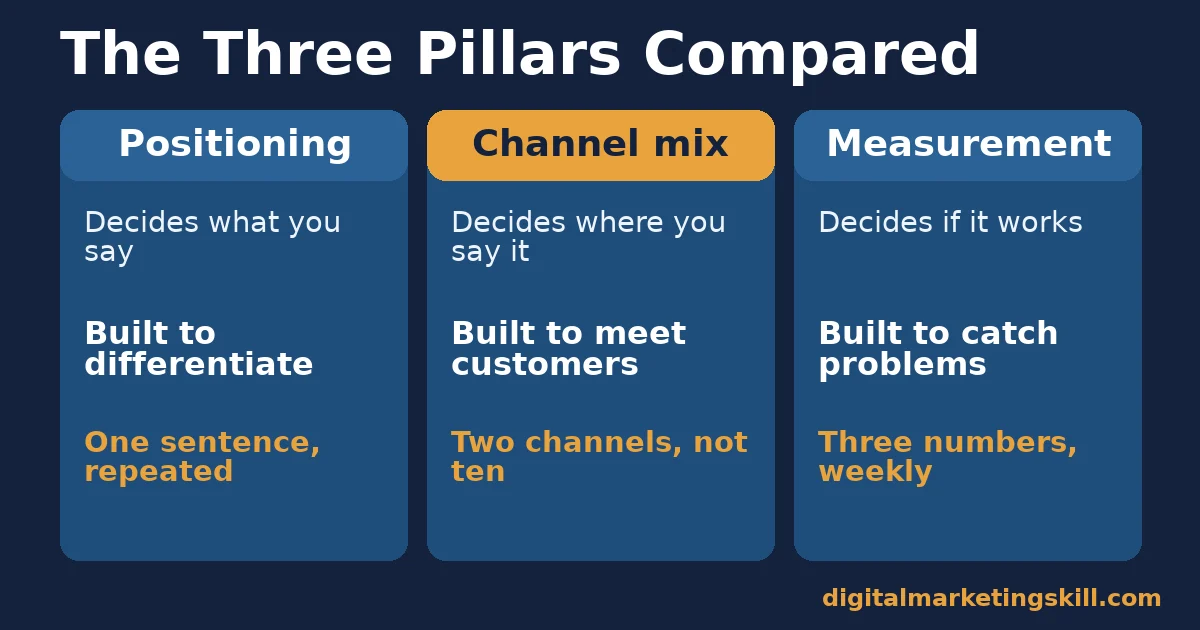
Strip away the jargon and a working small business marketing strategy rests on three decisions: positioning, channel mix and measurement. Positioning decides what you say and to whom. Channel mix decides where you say it. Measurement decides whether it is working. Weakness in any one pillar undermines the other two.
The Three Pillars Differ by What They Decide
Each pillar solves a different problem, so each needs a different kind of attention. Confusing them is one of the most common reasons a small business marketing strategy stalls before it produces results.
Positioning: Built to Make You the Obvious Choice
Positioning is the sentence a customer could repeat to a friend about why you, specifically, are the right choice. It is not a slogan. It names the customer, the problem and the reason you solve it better than the alternative they already know about.
Weak positioning tries to appeal to everyone and ends up persuading no one. A roofing company that says “we do quality work” sounds like every other roofing company. One that says “we’re the roofer who answers every material and warranty question in writing before you sign” gives a nervous buyer a specific reason to pick them.
Channel Mix: Built to Meet Customers Where They Already Search
Channel mix also has to account for the device your customer is holding. StatCounter’s worldwide data puts mobile at 58.99% of web traffic, ahead of desktop’s 39.26%. Any channel you pick should work cleanly on a small screen.
Beyond the device, channel mix is not about being everywhere. It is about showing up, often and clearly, where your specific customer already looks. BrightLocal’s research found that 84% of consumers had searched for a local business in the past three months. That is one reason a well-run Google Business Profile and website still anchor most small business marketing strategies.
HubSpot’s survey of more than 3,400 marketers found three channels marketers most often rate as delivering strong return: website and blog content, paid social, and email. That does not mean every business should use all three. It means these are worth testing first.
Measurement: Built to Catch Problems Early
Measurement is the pillar most small businesses skip, usually because the first two feel more urgent. But without it, you cannot tell a slow-building win from a quiet failure until months of spend are gone.
The fix is not a dashboard with forty numbers. It is three or four numbers, checked on a fixed schedule, so you always know whether the strategy is working before the budget runs out.
How to Build Each Pillar of Your Small Business Marketing Strategy
Knowing the three pillars is not the same as building them. The sections below mirror the three pillars above, with one concrete first move for each. Start with whichever pillar is weakest in your business today.
Positioning: Lead With One Sentence a Customer Could Repeat
Write one sentence: “We help [specific customer] get [specific outcome] by [what makes you different].” Test it on five real customers or prospects and ask if they could repeat the gist back to you. If they cannot, it is still a slogan, not a position.
Put that sentence, or a close version of it, at the top of your website, then repeat it in your Google Business Profile description and on your strongest outbound channel. If your main channel is written content, our content marketing guide shows how to carry that same positioning through every piece you publish. Showing up the same way, every time, is what turns a sentence into a reputation.
Channel Mix: Lead With Two Channels, Not Ten
Pick the two channels most likely to reach your specific customer, based on where they already spend time. Commit to showing up on both for a fixed stretch before you judge results. Spreading thin across many channels usually produces weak presence everywhere, not strength anywhere.
For most local and service businesses, a good starting mix is simple: a complete Google Business Profile, plus one content or social channel where customers already search. That mix matches how often people use local search before a purchase decision. Our guide to local search rankings covers the specific steps for that channel.
Measurement: Lead With Three Numbers Checked Weekly
Choose three numbers. Reach is how many of the right people saw you. Response is how many took a next step. Revenue is how many became paying customers. Check all three on the same day every week, not only at month end.
Write the three numbers somewhere visible, even a sticky note. A number you do not look at regularly might as well not exist.
Five Mistakes That Undo a Small Business Marketing Strategy
Even a well-designed strategy fails when a few habits creep in. Check your current approach against this list, because every mistake here is common and easy to miss from the inside.
- Writing positioning that could describe any competitor. If a rival could put your sentence on their own homepage, it is not positioning yet. Make it specific enough to be wrong for someone else.
- Adding a new channel before measuring the current ones. A new channel without a measurement habit just adds another thing you cannot evaluate. Fix measurement first.
- Copying a competitor’s tactic without their strategy. The tactic you can see is rarely the reason it worked. Ask what customer problem it solves before copying it.
- Treating the strategy as a one-time document. Markets, customers and channels shift. Revisit the three pillars on a fixed schedule, not only when results slip.
- Measuring vanity numbers instead of revenue steps. Followers and impressions feel good but rarely pay the bills on their own. Track at least one number tied to an actual sale.
Fix the mistake affecting your weakest pillar first. One repaired habit usually does more than a new tactic bolted onto a shaky strategy. If more than one mistake applies, resist the urge to fix everything at once. A strategy under repair is easier to judge one change at a time, because you can tell exactly which fix moved the numbers.
How to Measure a Small Business Marketing Strategy
A strategy is only as useful as your ability to tell whether it is working. Each metric below is defined in one sentence, with a note on how to read it. Use them to build a simple weekly check without new software.
Six Metrics Worth Tracking
- Reach. This is how many of your specific target customers were exposed to your positioning in a given period. A low number often means the channel mix needs work before anything else.
- Engagement rate. This is the share of people who took any small action, such as a click or a reply, after being reached. It shows whether your positioning is landing, not just arriving.
- Lead rate. This is the share of engaged people who gave you a way to follow up, such as an email or phone number. A low rate often points back to a weak or unclear offer.
- Close rate. This is the share of leads who became paying customers. It is the number that connects marketing directly to revenue.
- Cost per customer. This is your marketing spend divided by new customers gained in the same period. Compare it with what a customer is worth to you over time, not just their first purchase. Our guide to customer retention covers how to grow that lifetime value once someone has already bought.
- Channel ROI. This is the return generated per unit spent on each channel. HubSpot’s data on website, paid social and email as frequent top performers is a starting benchmark, not a guarantee for your business.
How to Read These Numbers Together
Read the metrics in order, from reach to close, to see where your small business marketing strategy is actually leaking. A low reach number means the channel mix needs attention before anything else. Weak engagement despite good reach points back to positioning. And leads that convert poorly usually trace back to the offer or follow-up process, not to a lack of traffic.
Break the numbers down by channel wherever you can. A blended view can hide one strong channel behind one weak one. Know which is which before you decide where to spend next.
The Most Useful Small Business Marketing Strategy Rule: Write It Down Before You Spend
If you take one decision rule from this guide, make it this one. Before the next marketing dollar goes out, write three things on a single page: your positioning sentence, your two priority channels, and your three weekly numbers. CoSchedule’s research found marketers who documented their strategy were 414% more likely to report success than those who did not.
Here is an illustrative example, with invented numbers. A small bookkeeping firm spends its marketing time trying five channels at once with no written positioning. Leads trickle in but close poorly.
The owner writes one positioning sentence, narrows to two channels, local search and email, and tracks three weekly numbers. Within two months, lead volume drops slightly. But close rate rises enough that paying customers increase overall, simply because the leads arriving now match the sentence the firm actually wrote.
The lesson is about focus, not effort. Rather than working harder, the firm stopped spreading the same effort across too many undefined channels, which is the cheapest fix most small businesses can make.
A Four-Week Plan to Build Your Strategy
Building a small business marketing strategy does not need new software to start. This plan takes about an hour a week using tools most small businesses already have.
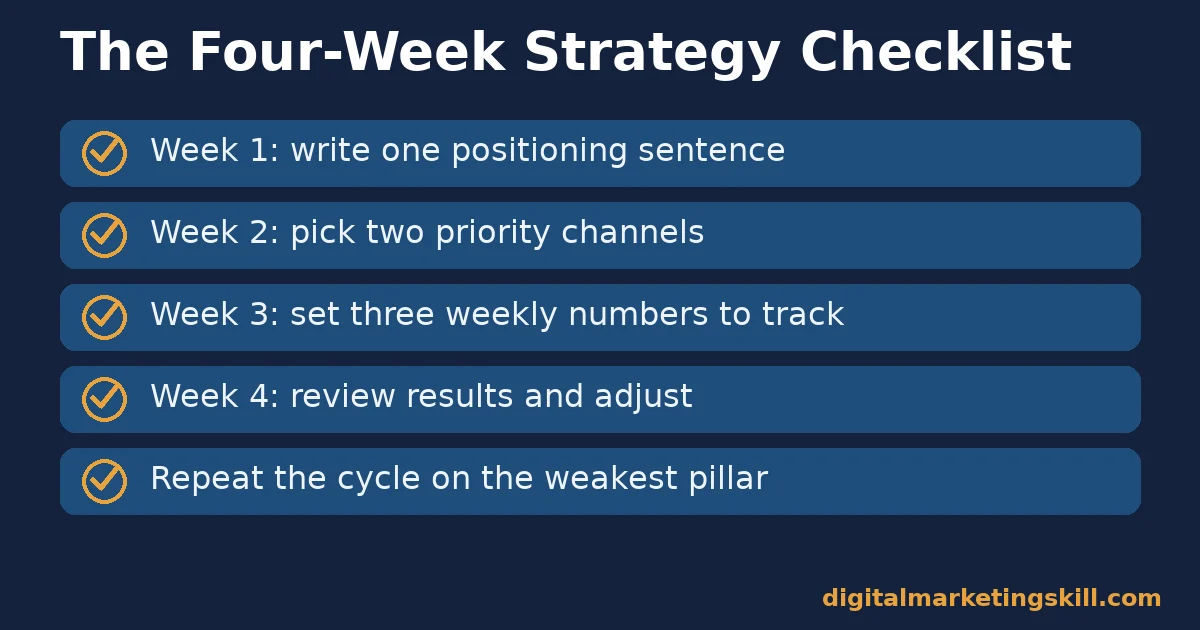
- Week one: write positioning. Draft your one-sentence positioning and test it on five real customers or prospects.
- Week two: pick two channels. Choose the two channels most likely to reach your specific customer and commit to a consistent posting or outreach schedule.
- Week three: set up measurement. Choose your three weekly numbers and set a fixed day and time to check them.
- Week four: review and adjust. Compare your first month of numbers against your starting point and decide what to keep, drop or test next.
At the end of the month, repeat the cycle on whichever pillar is still weakest. A strategy improves through small, regular reviews, not one big rewrite.
A Real Case: How One Small Business Rebuilt Itself With a Content Strategy
Small business marketing strategy sounds abstract until you see it applied under real pressure. River Pools, a US fiberglass pool installation company, lost most of its sales almost overnight during a severe housing-market downturn. By its owner Marcus Sheridan’s own account, the business came close to filing for bankruptcy.
Instead of cutting marketing further, Sheridan rebuilt the company’s strategy around one simple positioning idea. Answer every question a buyer has about fiberglass pools, including the ones competitors avoided, such as price and problems. According to Copyblogger’s case study, the approach made the company’s website one of the most-visited in the pool installation industry.
Keep the limits in mind. The published account does not give audited revenue or traffic figures. Results in one industry during one downturn will not transfer exactly to every business or market. Read it as proof that a clear, honest positioning strategy can outperform bigger ad budgets, not as a guaranteed formula.
Frequently Asked Questions About Small Business Marketing Strategy
What is a small business marketing strategy, in plain terms?
A small business marketing strategy is the set of decisions you make before choosing tactics. Who you serve and why they should pick you come first. Then come the channels you will use, and how you will measure results.
How much should a small business spend on marketing?
It depends heavily on business type. The CMO Survey found B2C product companies allocating around 15.5% of revenue to marketing, against 6.4% for B2B product companies. Use your own industry as the starting benchmark rather than a single average.
How is a marketing strategy different from a marketing plan?
The strategy sets the direction: who, why and where. A plan then turns that direction into a calendar of specific campaigns, content and spend. Without the strategy first, the plan has nothing to organise around.
Which marketing channel should a small business start with?
Start with where your specific customers already search or spend time, rather than the most popular channel generally. For many local and service businesses, that often includes search and a well-maintained Google Business Profile.
How often should a small business review its marketing strategy?
Review positioning, channel mix and measurement on a fixed schedule, such as every quarter. Review sooner if your market, competitors or customers shift noticeably.
Do I need a written strategy if my business is very small?
Yes, even a one-page version helps. CoSchedule’s research found documented strategies linked to a much higher reported success rate than undocumented ones, regardless of company size.
What is the biggest mistake small businesses make with marketing strategy?
Skipping straight to tactics. Picking channels or content formats before you decide who you serve wastes effort. That activity was never aimed at the right customer in the first place.
Can a small business marketing strategy work with a tiny budget?
Yes, because the strategy itself costs nothing to write. A clear positioning sentence and two well-chosen channels, used consistently, usually beat a larger budget spread across many undefined channels. Spend money on execution only after those decisions are made, not before.
Start With One Pillar, Then Expand
A small business marketing strategy works best when positioning, channel mix and measurement reinforce each other. Pick the weakest pillar in your business today, fix it this week, and measure the change before adding anything new.
If you want guided practice building and running a strategy like this, Digital Marketing Skill Institute teaches these skills hands-on.
The Master Diploma in Digital & AI Marketing covers ten courses across four AI-powered tracks, including social media management and advertising, and lead generation and email automation. Every track comes with unlimited 1-on-1 coaching and mentoring and real project-based work experience with a US partner company. The diploma is dual US and UK accredited and recognised in more than 100 countries.
The programme is 100% online, so you can study from anywhere in your country. You can find more guides on the Digital Marketing Skill Institute blog. When you are ready, apply for the Master Diploma or start from the Digital Marketing Skill Institute homepage.
Every figure in this guide was checked against its original source before publication. Figures marked as illustrative are invented examples, not real results.
![9 Amazing Digital Marketing Skills to Make Money Online [With Proof]](https://digitalmarketingskill.com/wp-content/uploads/2019/07/9-Amazing-Digital-Marketing-Skills-to-Make-Money-Online-With-Proof-17.png)