
Most advice to increase business sales focuses on getting more visitors. But Baymard Institute finds that about 70% of online shopping carts get abandoned before checkout. The bigger opportunity is usually the buyers you already have. Fix friction and trust first, then add traffic on top of a funnel that actually converts.
Key Takeaways
- Most carts never convert. Baymard Institute’s aggregate of 50 studies puts the average cart abandonment rate at 70.22%, a figure that has barely moved in a decade.
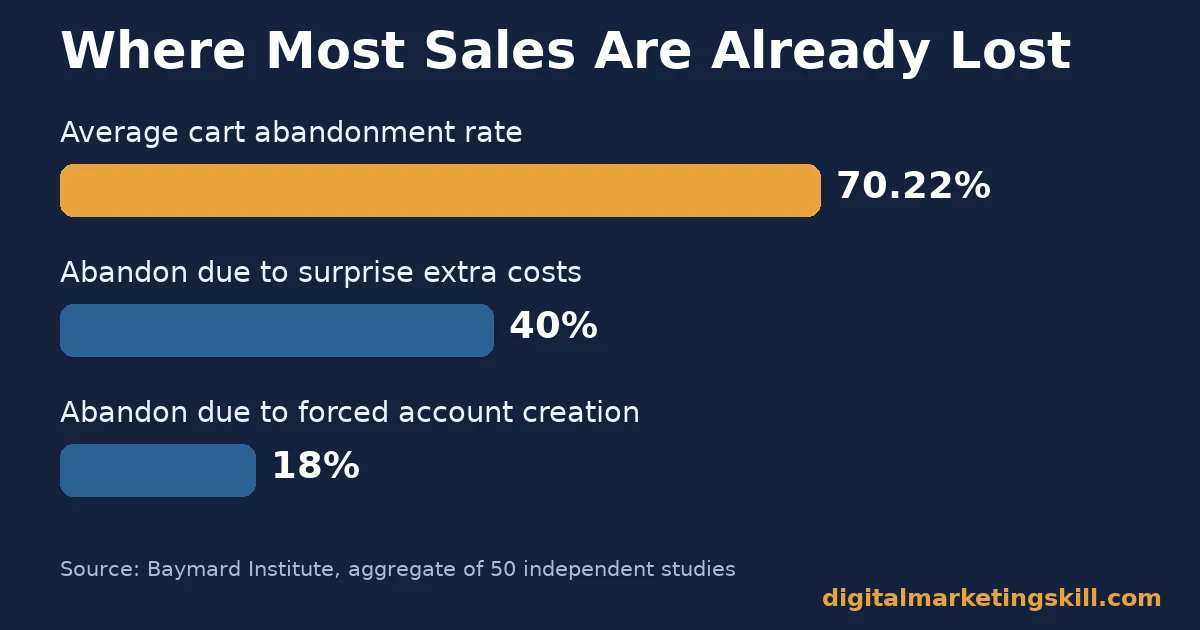
- Cost surprises are the top reason. In Baymard’s research, 40% of shoppers abandoned a cart because extra costs such as shipping, tax or fees felt too high at checkout.
- Forced sign-up still costs real money. One widely documented case saw a retailer lift purchases 45%. The change was simple: replacing forced account creation with a guest-checkout option, worth an estimated $300 million a year.
- Reviews now decide the sale before you do. BrightLocal’s survey of 1,002 US consumers found 97% read reviews before choosing a local business, and 47% will not consider one with fewer than 20 reviews.
- Trust in reviews is real but not blind. The same BrightLocal survey found only 49% of consumers trust reviews as much as a personal recommendation. So reviews support a sale; they do not replace your own case for it.
In this guide
- What Most “Increase Business Sales” Advice Misses
- Where Business Sales Actually Leak Away
- Two Levers Actually Move Business Sales
- How to Fix Each Lever
- Five Reasons a Cart Gets Abandoned, Ranked
- How to Measure Whether Sales Are Actually Improving
- The Most Useful Rule: Fix the Leak Before You Add More Traffic
- A Simple Checklist to Increase Business Sales This Month
- Does This Apply to B2B and Service Businesses Too?
- A Real Case: The $300 Million Button
- Frequently Asked Questions About How to Increase Business Sales
- Start With Your Own Checkout, Then Your Reviews
What Most “Increase Business Sales” Advice Misses
Search for practical ways to increase business sales and you will find long lists of generic tips: post more, email more, discount more. None of that is wrong, but it skips a simpler, more measurable question first. Where, specifically, are buyers leaving before they pay?
This guide names the two leaks that cost most businesses the most money: checkout friction and a missing trust case. It shows how to diagnose each one and fix it, so you can increase business sales before you spend another dollar on bringing in new visitors.
Ground rules first. The abandonment and review figures below come from two named research organisations with disclosed sample sizes. Read them as solid, current benchmarks, not predictions for your own business. The $300 million case is one widely reported, unaudited account of one retailer’s result. Treat it as a strong illustration of the mechanism, not a guaranteed outcome.
Where Business Sales Actually Leak Away
Before you add a new sales channel, look at the one you already have. Most sites lose far more revenue at checkout and in the trust gap than they ever will to weak traffic alone.
The Scale of Checkout Abandonment
Baymard Institute’s aggregate of 50 separate studies puts the average cart abandonment rate at 70.22%. That number has stayed close to 70% for roughly a decade, across a wide range of industries and store sizes.
Device matters too. Mobile abandonment runs notably higher than desktop. A checkout that feels merely inconvenient on a laptop can quietly become a dealbreaker on a phone.
The Trust Gap Before Anyone Reaches Checkout
Many buyers leave even earlier, before they ever load a cart. BrightLocal’s consumer survey found that 97% of people read reviews before choosing a local business, and 31% will only buy from a business rated 4.5 stars or higher.
So a weak or thin review profile can quietly end a sale long before your checkout page gets any chance to help or hurt. This is why efforts to increase business sales that focus only on checkout design, while ignoring the reviews a buyer saw three screens earlier, tend to plateau.
Two Levers Actually Move Business Sales
Everything in this guide sorts into one of two levers. Knowing which one is weaker in your business tells you exactly where to spend the next hour of work. You can increase business sales this way without touching your ad budget at all.
Checkout Friction: Built on What Happens After “Buy”
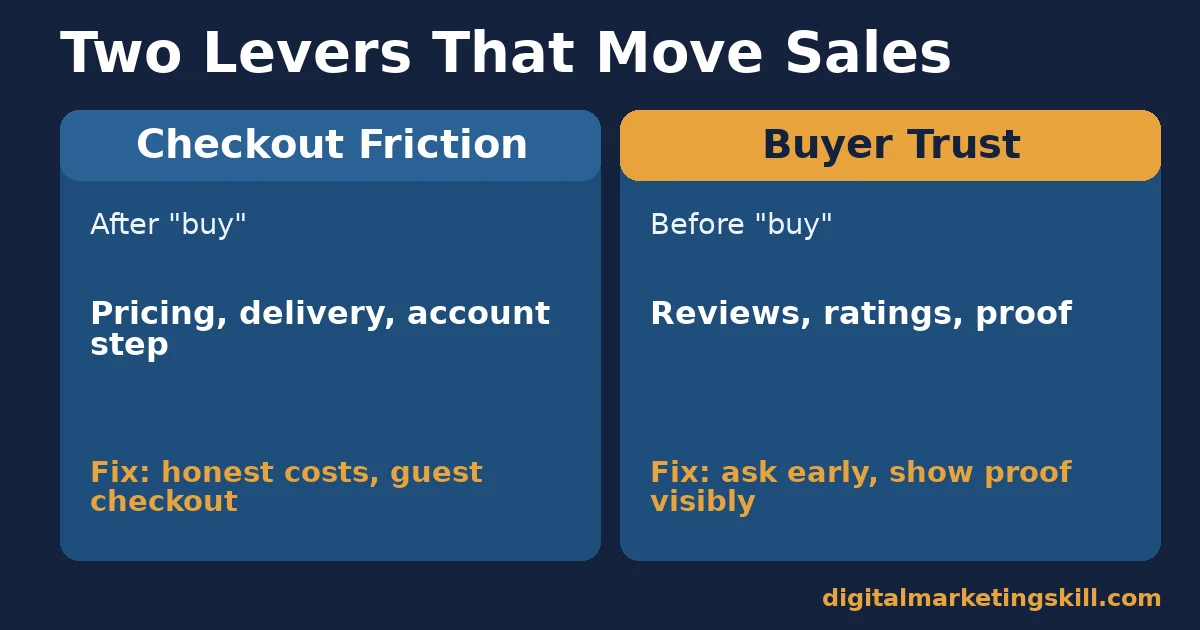
This lever covers every step between a full cart and a confirmed order. Baymard’s research breaks the causes down clearly: 40% blame unexpected extra costs, 20% blame slow delivery, and 18% blame a forced account requirement.
Each of those is fixable without a product change or a bigger budget. They are checkout decisions, not marketing decisions, which is exactly why they get missed by advice focused only on traffic. A business can run flawless ads and still lose most of the resulting buyers right here, at the very last step.
Buyer Trust: Built on What Happens Before “Buy”
This lever covers everything that convinces a stranger you are worth the risk: reviews, star ratings, review count and visible proof. According to BrightLocal’s research, 47% of consumers will not consider a business with fewer than 20 reviews at all.
Trust is earned gradually and lost quickly. A single, highly visible bad review does more damage than most marketing campaigns can undo in the same week. Unlike checkout design, this lever also compounds on its own: more genuine reviews tend to attract more buyers willing to leave their own.
How to Fix Each Lever
Work on whichever lever is weaker in your own numbers first. A sale lost to checkout friction and a sale lost to missing trust need two completely different fixes.
Checkout Friction: Lead With Honest Pricing and a Guest Option
Show shipping, tax and any fees as early as possible, ideally before checkout even starts. Surprise costs are the single most-cited reason for abandonment in Baymard’s research. They are also the easiest one to simply stop causing.
Offer a genuine guest-checkout path. The widely documented “$300 million button” case shows how costly a forced-registration requirement can quietly become, even when nobody on the team intended it as a barrier.
Buyer Trust: Lead With Visible, Specific Proof
Ask every recent customer for a review, immediately after a good experience, rather than hoping reviews accumulate on their own. Volume matters on its own: that 47%-of-20-reviews threshold is a real cliff edge, not a soft preference.
Then make the proof visible exactly where doubt appears, such as beside a price or a shipping estimate. Do not just bury it on a separate reviews page. Our guide to landing page design that converts visitors into leads covers where that proof earns its place.
Five Reasons a Cart Gets Abandoned, Ranked
Baymard’s research ranks the specific reasons buyers give for abandoning a cart. Check your own checkout against each one, in order, since they are listed from most to least common. Fix the top of the list first.
- Extra costs felt too high. Cited by 40% of abandoners. Shipping, tax and fees shown only at the final step feel like a broken promise, even when the total was always accurate.
- Delivery was too slow. Cited by 20%. A vague “5 to 10 business days” reads as a risk when a competitor states an exact date.
- Little trust with card details. A missing padlock icon, an unfamiliar payment processor, or a dated-looking checkout page all raise doubt at the worst possible moment.
- Forced account creation. Cited by 18%. Some buyers will simply leave rather than create one more password, as the case above shows at scale.
- A long or confusing process. Every extra screen, field or click is one more place a buyer can decide the sale is not worth finishing.
Which One to Fix First
Fix in the same order Baymard’s data lists them, since that order reflects how often each reason is actually cited. Start with pricing transparency, then delivery clarity, then the account requirement. Each fix compounds on the one before it, instead of competing for the same attention. That order is the fastest realistic way to increase business sales from a funnel you already have.
How to Measure Whether Sales Are Actually Improving
Track the funnel in stages, not just the final sales number. The list below defines each metric in one sentence and explains how to read it.
Five Numbers Worth Tracking
- Cart abandonment rate. The share of carts started that never reach a completed order. Compare your own rate against the 70.22% benchmark, not as a target, but as context.
- Checkout completion rate by device. The same funnel, split between mobile and desktop. A large gap usually points straight at a mobile-specific friction point.
- Average review count per product or location. How many reviews a typical listing carries. Compare it against the 20-review threshold that changes buyer behaviour.
- Review response time. How long after a purchase a review request goes out. Faster requests, sent while the experience is fresh, collect more and better reviews.
- Revenue per visitor. Total revenue divided by total visitors. This single number rises when either lever improves, which makes it a useful top-line check.
None of these five numbers needs expensive software. A free analytics tool and a simple spreadsheet are enough to track all of them weekly, which matters more than the sophistication of the tool itself.
How to Read Them Together
Read cart abandonment and device completion rate together first. If mobile lags desktop by a wide margin, the friction lever needs work before anything else. If review counts are thin and abandonment looks roughly average, the trust lever is the real bottleneck instead.
Watch the two levers interact over time, too. A business that fixes checkout friction often sees review counts rise on their own soon after, simply because more buyers complete a purchase they can then be asked to review. That compounding effect is a good sign the fixes are working.
Check revenue per visitor monthly, not daily. A single busy or quiet day swings it too much to mean anything on its own, while a month of data shows whether your fixes are actually compounding.
The Most Useful Rule: Fix the Leak Before You Add More Traffic
If you take one decision rule from this guide, make it this one. Do not spend more on ads or outreach until your checkout and trust numbers are at least close to healthy benchmarks.
Here is an illustrative example, with invented numbers. A small online store gets 2,000 visitors a month and converts 1%, for 20 sales. Its cart abandonment sits at 82%, well above the 70.22% benchmark, and most checkouts fail on a hidden shipping fee.
So the owner shows shipping cost on the product page itself, before checkout. By the following month, with the same 2,000 visitors, abandonment falls to roughly 71% and sales rise to 29, without a single extra visitor.
That is the lesson about leverage. Fixing one honest pricing problem moved more sales than a month of extra traffic spend would likely have delivered at the old conversion rate.
A Simple Checklist to Increase Business Sales This Month
You do not need a full redesign to see movement. This checklist fits inside a single working week, and each step targets one of the two levers above, in roughly the order that pays off fastest.
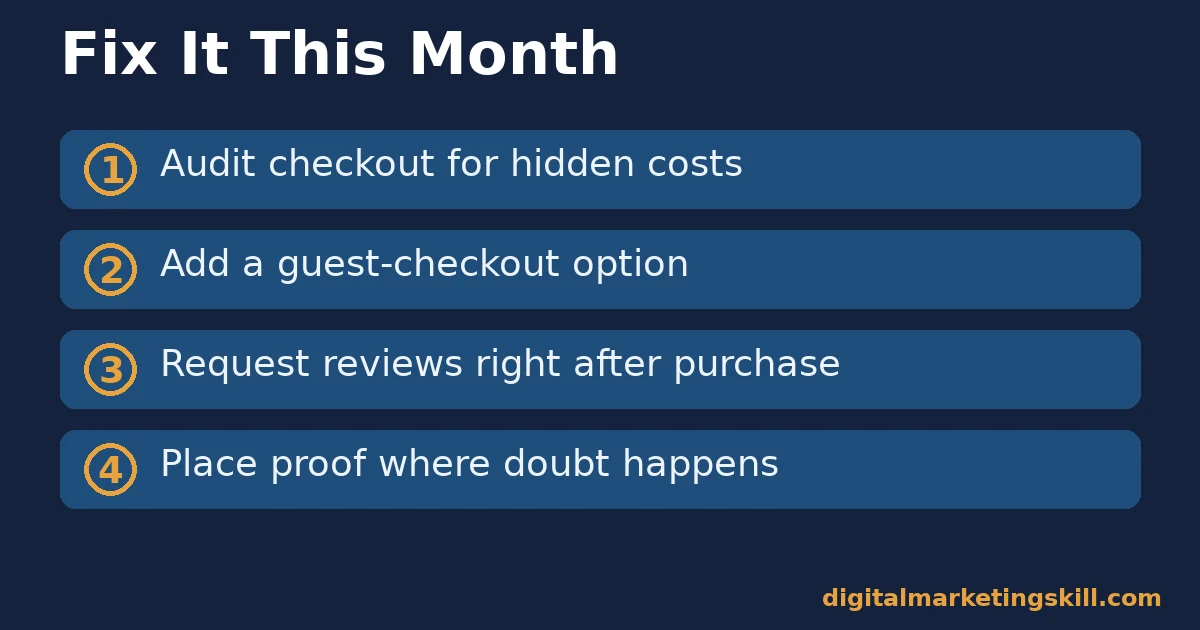
- Audit your checkout for hidden costs. Add shipping, tax and any fees to the product page or cart, well before the final screen, so nothing surprises a buyer at the last step.
- Add or confirm a guest-checkout option. If account creation is required to buy, make it optional. The $300 million case below shows exactly why this single change carries outsized weight.
- Request reviews immediately after purchase. Send the request while the experience is still fresh, rather than weeks later when enthusiasm has faded and response rates drop.
- Place proof where doubt happens. Move a star rating or review count next to the price or the “buy” button itself, not only on a separate reviews page nobody visits.
None of these four steps requires new traffic, a new product or a bigger budget. Together, they target the exact two levers every piece of evidence in this guide points back to, and most teams can work through all four inside a week.
Does This Apply to B2B and Service Businesses Too?
Most of the figures in this guide come from ecommerce research, since that is where checkout behaviour is easiest to measure directly, with clean, comparable data across thousands of stores. The underlying mechanism still applies more broadly, even where the details differ.
A service business does not have a shopping cart, but it has an equivalent moment: a quote request, a booking form or a signed contract. Hidden costs, unclear timelines and a form that demands too much information cause the same hesitation a surprise shipping fee does. A prospect who abandons a half-finished quote request is behaving exactly like a shopper who abandons a cart, for largely the same underlying reasons.
Trust works the same way too. A B2B buyer researching a vendor behaves much like BrightLocal’s surveyed consumers, checking reviews, case studies and references before they ever request a call. The specific proof changes by industry: a software buyer wants case studies, a local tradesperson’s customer wants star ratings, and a consultant’s prospect wants named references. The underlying need for proof does not change at all.
If your business sells a service rather than a product, adapt the checklist rather than discard it outright. Replace “checkout” with your own point of commitment, whatever form that moment takes in your sales process. The goal to increase business sales stays the same either way: remove friction, then supply proof.
A Real Case: The $300 Million Button
A major online retailer required every first-time buyer to register an account before completing a purchase. Usability research later uncovered that many shoppers deeply resented the step, with one famously telling researchers, “I’m not here to be in a relationship. I just want to buy something.”
According to accounts of the widely reported case, the team replaced the forced “Register” button with a “Continue as Guest” option. Purchases rose by 45%, with an estimated annual revenue impact of roughly $300 million.
Treat this as one well-documented, widely cited account from one retailer, not an independently audited study. But the mechanism it illustrates, a single unnecessary step quietly taxing every sale, shows up in some form on most checkout pages that have never been tested against a simpler alternative.
Frequently Asked Questions About How to Increase Business Sales
What is the fastest way to increase business sales?
Fix checkout friction first, since it affects every visitor who already intended to buy. Showing full pricing early and offering guest checkout are usually the two highest-leverage, lowest-cost changes available.
Do online reviews really affect sales that much?
Yes. BrightLocal’s survey found 97% of consumers read reviews before choosing a business, and 47% will not consider one with fewer than 20 reviews. A thin review profile can end a sale before your checkout page gets a chance to help.
Why do shoppers abandon a cart right before paying?
Baymard Institute’s research names unexpected extra costs as the top reason, cited by 40% of abandoners. Slow delivery, forced account creation and a confusing process follow close behind.
Should I offer discounts to increase business sales?
Only after you have fixed friction and trust. A discount on a checkout that still hides shipping costs or forces account creation mostly masks the real problem instead of solving it, and you give up margin you did not need to.
How many reviews does a business actually need?
BrightLocal’s research found 47% of consumers will not consider a business with fewer than 20 reviews. Treat 20 as a practical floor, not a finish line, since review count keeps mattering well beyond it, and more recent reviews count for more than old ones.
Is cart abandonment always a bad sign?
Not entirely. Baymard’s own data attributes a notable share of abandonment to shoppers who were only browsing, comparing prices or saving items for later. Focus your effort on the share you can actually influence: pricing, delivery clarity and checkout steps.
Does mobile checkout need different fixes to increase business sales?
Often, yes. Test your own checkout on an actual phone, not just a resized browser window. Mobile abandonment tends to run notably higher than desktop, so a checkout that feels mildly annoying on a laptop can become a genuine dealbreaker on a small screen with a slower connection.
How quickly can a small business increase business sales with these fixes?
Often within a single sales cycle, since both levers act on buyers who are already close to paying. Pricing transparency and a guest-checkout option can usually be live within days, not months. Reviews take a little longer to build, but even a handful of fresh ones shift buyer behaviour.
Start With Your Own Checkout, Then Your Reviews
You can increase business sales fastest by fixing what already-interested buyers hit on the way to paying you. Pull your own cart abandonment rate this week, compare it with the 70.22% benchmark, and fix pricing transparency first if costs appear late.
For the page where trust and pricing both have to work together, our guide to landing page conversion: fixing friction, then testing goes deeper on the testing side. And for the step before checkout, see our guide to lead conversion strategies that turn more leads into customers. Together, these three guides cover the full path from first visit to repeat buyer.
If you want to build these skills properly, Digital Marketing Skill Institute teaches them hands-on. The Master Diploma in Digital & AI Marketing offers four AI-powered tracks, including AI-Powered Lead Generation and Email Automation and AI-Powered Google Specialist. Together they total ten courses, with a Full Stack option for all four.
It comes with unlimited 1-on-1 mentoring and a U.S. Project Internship with a verified U.S. Work Reference Letter, and is dual US and UK accredited in more than 100 countries.
Study from anywhere in your country. Find more guides on the Digital Marketing Skill Institute blog, and see real outcomes on the reviews page. When ready, apply for the Master Diploma or start from the Digital Marketing Skill Institute homepage.
Every figure in this guide was checked against its original source before publication. Figures marked as illustrative are invented examples, not real results.
![9 Amazing Digital Marketing Skills to Make Money Online [With Proof]](https://digitalmarketingskill.com/wp-content/uploads/2019/07/9-Amazing-Digital-Marketing-Skills-to-Make-Money-Online-With-Proof-17.png)






