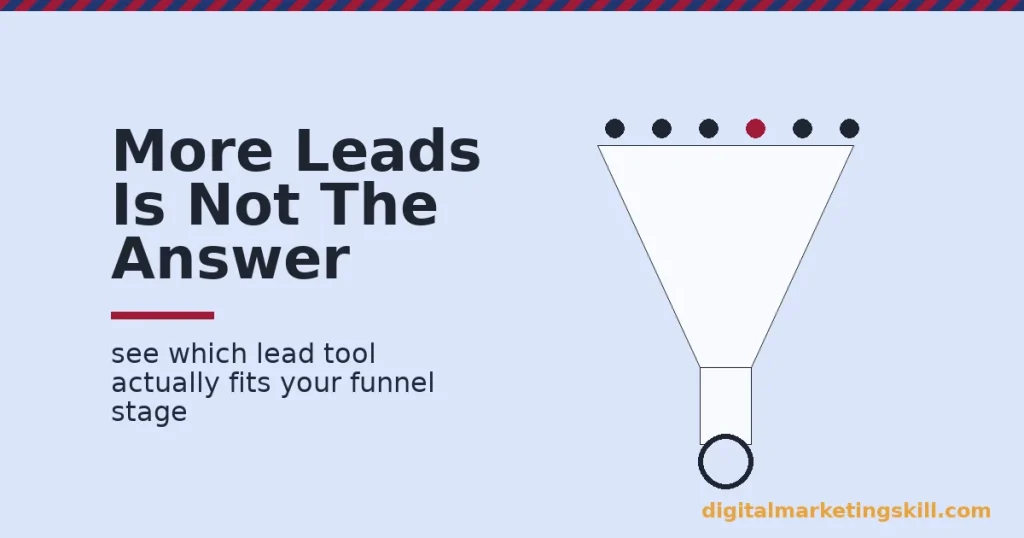
Lead generation tools promise more leads, but more is not the goal. The real test is whether a tool brings in people likely to buy. This guide groups lead generation tools by how they actually work. It shows where each one breaks down, and gives you one rule for matching a tool to the funnel stage it is meant to serve.
Key Takeaways
- 30% of marketers still name lead generation one of their top challenges, according to HubSpot’s survey of more than 1,500 marketers. Yet 56% say it is easier to generate leads now than it was a decade ago.
- The median landing page converts at 6.6%, based on Unbounce’s Conversion Benchmark Report, built from more than 41,000 landing pages and 464 million visitors. Treat anything near or above that as a working page, not a broken one.
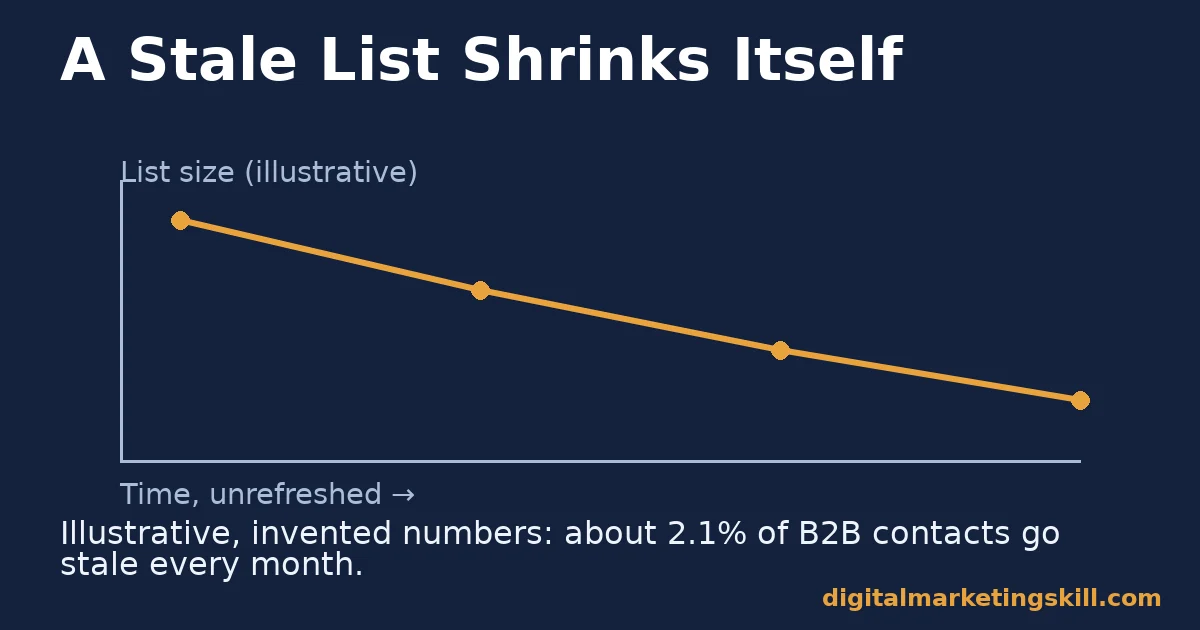
- B2B contact data decays at roughly 2.1% a month, or about 22.5% a year. That is according to MarketingSherpa research cited on HubSpot’s own database decay page. A list you do not refresh quietly shrinks itself out of usefulness.
- An analysis of 1.8 million sales opportunities by Gong found single-threaded deals, with one buyer contact, close at about 5%. Deals with five or more stakeholders engaged close at about 30%.
- A single exit-intent popup, offering a loyalty discount, recovered 53% of visitors who had started, then abandoned, a hotel booking. That is according to a published OptinMonster case study on the travel site Fastrack.
In this guide
- Most Lead Generation Tools Lists Compare The Wrong Thing
- How Lead Generation Tools Actually Work
- Lead Generation Tools Differ By Mechanism
- Fix The Blind Spot In Each Tool Category
- How To Measure Whether Your Lead Generation Tools Are Working
- The One Decision Rule: Match The Tool To The Funnel Stage It Serves
- Frequently Asked Questions About Lead Generation Tools
- Build A Lead Generation System, Not Just A Toolkit
Most Lead Generation Tools Lists Compare The Wrong Thing
Search for the best lead generation tools, and you get a list sorted by popularity or price. That list hides the only question that matters: what job is this tool actually doing? A form builder, an intent-data platform and a live chat widget solve three different problems. Ranking them against each other, as if they compete for the same job, leads you to pick the wrong tool for your stage of the funnel. Worse, the comparison usually ignores who has to act on what the tool produces. A form that generates hundreds of unqualified leads a month looks impressive in a dashboard. But it quietly becomes someone else’s problem the moment a salesperson has to work through the list by hand. That person, not the dashboard, decides whether the tool was worth the cost.
What This Guide Covers
This guide groups lead generation tools by mechanism, not by brand. The mechanism decides whether a tool fits your funnel. Brand is mostly a matter of budget and preference. The specific products named here are examples of each mechanism. They are not a ranked “best of” list. New tools launch constantly, so this is a snapshot of current categories, not a permanent ranking. Every statistic below was opened at its original source. Each one carries the limits the source itself states, such as sample size or whether the result is self-reported.
How Lead Generation Tools Actually Work
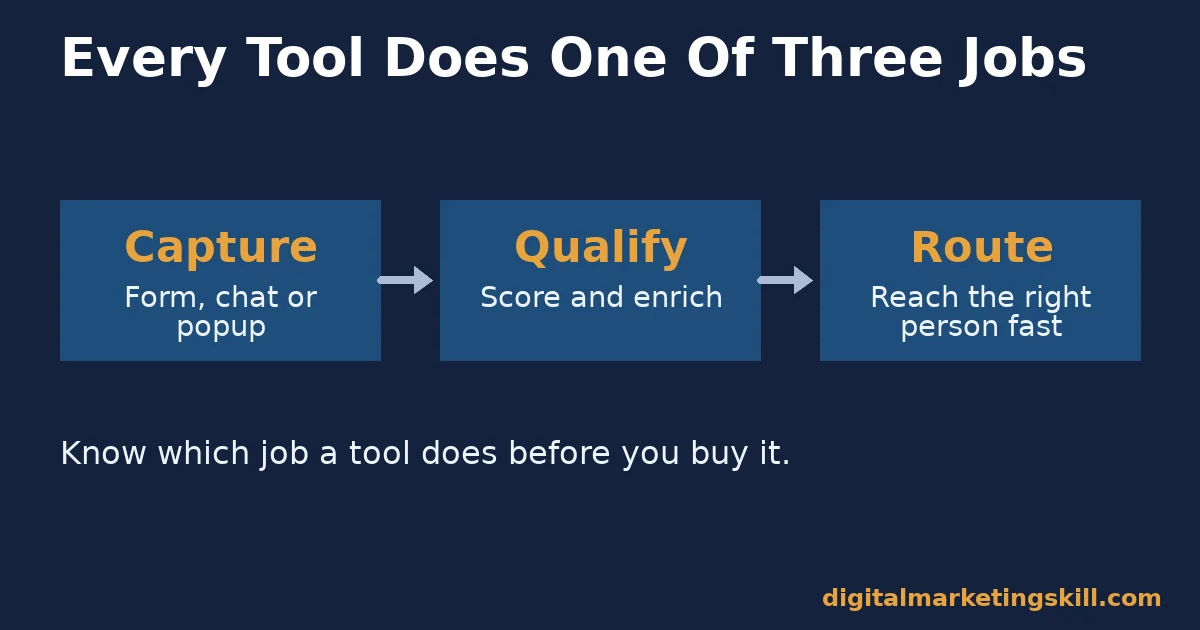
Every lead generation tool on the market does one of three jobs: capture, qualify or route. Understanding which job a tool does, before you buy it, saves a lot of wasted budget. Capture tools turn an anonymous visitor into a named contact. They usually do this through a form, a chat prompt or a popup. Qualify tools score or enrich that contact. That way you know whether they fit your buyer profile before a salesperson calls. Route tools get the lead to the right person fast. Speed decides whether a qualified lead becomes a conversation or goes cold. Research from Gartner, reported by attainmentlabs.com, found the average B2B buying group has grown over the past decade. It now runs roughly five to eight or more stakeholders, depending on company size and deal complexity. Routing a lead correctly is not just about speed anymore. It is about reaching several people inside one account, not just the one who filled out the form.
Why Chasing Lead Quantity Backfires
Most lead generation tools are built to maximize the capture step. That step is the easiest to measure and the easiest to demo. This is where quantity quietly replaces quality. A form that captures 500 leads a month sounds better than one that captures 50. But if only 2 of the 500 ever reply to a follow-up, you have built an expensive list, not a pipeline. The quality question has to sit upstream of the tool choice. It cannot be an afterthought once the leads start arriving.
Lead Generation Tools Differ By Mechanism
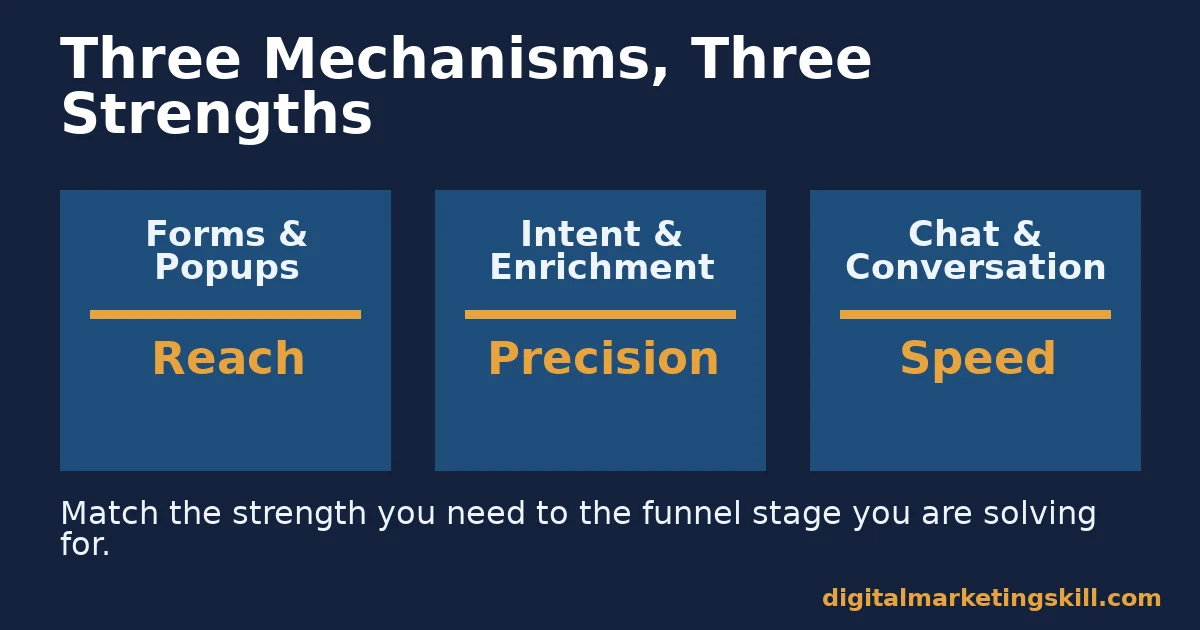
Three mechanisms cover most of the lead generation tools on the market. Each one earns leads in a different way, and each has a different failure mode.
Forms And Popups: Built For Volume At Scale
Form and popup tools, including exit-intent popups and embedded sign-up forms, capture the widest pool of visitors. They work because they interrupt or invite at a moment of attention, usually in exchange for a discount, a guide or early access. Their strength is reach, and the copy on the form itself matters more than most teams assume; see persuasive email marketing for how wording changes response. Their weakness is that a form says nothing about fit. It captures anyone willing to type an email address, qualified buyer or not. That is not a reason to avoid forms. It is a reason to pair them with a qualification step right afterward. Do not send every new contact straight to a salesperson’s queue.
Intent And Enrichment Tools: Built For Targeted Precision
Intent and enrichment platforms work from company and contact data: firmographics, technology stack, hiring signals or buying intent. Instead of waiting for a visitor to fill out a form, these tools identify likely buyers before they ever land on your site. They then enrich a contact with job title, company size or revenue. Their strength is precision. Their weakness is cost and complexity. Most are built for teams with a defined buyer profile, not for a business still working out who its buyer is. Used well, though, these tools shrink the gap between marketing and sales, because both teams work from the same enriched record instead of two separate, half-complete pictures of the same account.
Conversational And Chat Tools: Built For Speed
Chat widgets, chatbots and conversational forms capture leads in real time, while a visitor is still on the page and still interested. Their strength is immediacy: a question answered now beats a form submitted into a queue. For a high-consideration purchase, answering one hesitation in real time can save a sale that a slower channel would have lost. Their weakness is that speed only pays off if a human, or a well-built bot, is actually ready to respond. A chat widget that goes unanswered for hours does worse than no chat widget at all. A visitor who typed a question and got silence usually leaves with a worse impression than one who never saw the widget in the first place.
Fix The Blind Spot In Each Tool Category
Each mechanism above has a specific fix. None of them requires switching tools. They require using the tool you already have more deliberately.
Forms And Popups: Lead With Timing, Not Just Offer
An exit-intent popup, timed to the moment a visitor is about to leave rather than shown on arrival, converts because it interrupts at the right point, not an arbitrary one. The OptinMonster case study on Fastrack recovered 53% of abandoning hotel-booking visitors this way, using a loyalty-club discount triggered only on exit intent. Test timing before you test offer copy. A well-timed popup with a mediocre offer usually beats a badly-timed popup with a great one.
Intent And Enrichment: Lead With A Narrow Firmographic Filter
Intent tools fail most often when the filter is too broad. “Companies researching marketing software” returns thousands of accounts, and most are irrelevant. A well-built CRM should already hold the firmographic data you need for this work. Narrow the filter to the handful of signals that actually predict a good customer for you, such as company size band, industry and a specific technology already in place. A narrower, more accurate list beats a longer, noisier one every time it reaches a salesperson’s queue. It also protects morale. A salesperson who works a short list of real fits closes more and burns out less than one working through hundreds of mismatched contacts.
Conversational Tools: Lead With A Response-Time Standard
Set a maximum response time before you turn on a chat tool, not after. Staff or route the bot handoff so a human responds inside that window every time the tool is live, not just during peak hours. A chat tool with no staffing plan behind it either frustrates visitors with silence, or routes every lead to a bot that cannot actually qualify them.
How To Measure Whether Your Lead Generation Tools Are Working
Three numbers, read together, separate a tool that is working from one that is just busy.
Conversion Rate Against A Real Benchmark
Every piece of landing page conversion work starts with this comparison. Compare your form or landing page conversion rate against a real external benchmark, not your own history alone. The median across industries sits around 6.6%, per Unbounce’s analysis of more than 41,000 landing pages. A page converting well below that is not just underperforming. It likely has a friction problem a tool swap will not fix.
Reply And Qualification Rate, Not Just Lead Count
Track what share of captured leads ever reply to a follow-up, or match your ideal customer profile on basic firmographics. A tool that doubles lead volume while halving the qualification rate has not actually doubled your pipeline. It has doubled your workload instead. Someone still has to sort the real prospects from the noise, and that sorting cost rarely shows up in the tool’s own reporting.
List Health Over Time
Because B2B contact data decays at roughly 2.1% a month, a list that looks stable is often shrinking in quality even while it grows in size. Re-verify or re-engage contacts on a regular cycle. Treat a list older than a year with real suspicion before you build a campaign on top of it.
The One Decision Rule: Match The Tool To The Funnel Stage It Serves
Before you add a new lead generation tool, ask one question: which funnel stage is this actually for? A top-of-funnel visitor who just landed on a blog post is not ready for a sales chat. A returning visitor who has read three pricing pages is not well served by a generic exit-intent discount popup either. Match the mechanism to the stage, not the stage to whatever tool is easiest to install. This sounds obvious written down. In practice, most teams install whichever tool their current platform bundles for free, then try to force every visitor through it regardless of where they are in the decision.
A Worked Example
Illustrative, invented numbers: imagine a site with 10,000 monthly blog visitors and a single generic exit-intent popup offering 10% off. If it converts at 2%, that is 200 leads a month, most early-stage and unqualified. Now replace the generic popup with a content upgrade relevant to each article, plus a separate, narrower chat prompt only on pricing pages. The same traffic might produce 140 early-stage leads at 2.5%, plus 25 high-intent chat conversations at a much higher close rate. Fewer total leads, but more of them ready to talk to sales. A sales team would rather work 25 warm conversations than chase 200 cold names, even though the second number looks better in a monthly report.
A Real Example
Here is a real example of a small, specific change producing a verified result. Wingify’s published case study on Imsider, an e-commerce platform, changed one landing page headline. The old version gave a generic description of the service; the new one stated a specific outcome. Form submissions rose 10% at 99.99% statistical significance. The change cost nothing to implement. It did not require a new tool, only a sharper message on the capture form already in place.
Free Tiers Versus Paid Plans
Most capture tools offer a usable free tier. Most intent and enrichment tools do not, because their value comes from a data feed that costs the vendor money to maintain. A practical rule: start with free or low-cost capture tools while you learn what converts, then spend on intent and enrichment once you have enough volume to justify filtering it. Paying for precision before you have proven the basic mechanism works usually wastes the budget.
Frequently Asked Questions About Lead Generation Tools
What are the main types of lead generation tools?
Lead generation tools generally fall into three mechanisms. Capture tools, such as forms and popups, turn visitors into contacts. Qualify tools, such as intent and enrichment platforms, score or filter those contacts. Route tools, such as chat and notification systems, get a qualified lead to a salesperson quickly.
Do more lead generation tools mean more leads?
Not necessarily, and more leads is not automatically the goal. Adding tools without a plan for qualifying and following up on what they capture usually produces a bigger, lower-quality list. The better question is whether each tool is matched to a specific funnel stage, and feeding a process that actually follows up.
What is a good conversion rate for a lead generation form or landing page?
Treat the median of around 6.6%, reported across more than 41,000 landing pages, as a reasonable general benchmark. Remember it varies by industry and traffic source. A financial services page and an events page will not land on the same number, even with identical execution. A page converting well below that benchmark likely has a friction problem, such as a long form or an unclear offer, that a new tool will not fix on its own.
Why do exit-intent popups work better than popups shown on arrival?
Exit-intent popups interrupt a visitor at the specific moment they are about to leave, when they have nothing left to lose by engaging. A popup shown immediately on arrival interrupts before the visitor has decided whether the page is worth their time. That is why timing tends to matter more than offer design.
How often should a business clean or re-verify its lead list?
Given that B2B contact data decays at roughly 2.1% a month, a quarterly re-verification cycle catches most of the drift before it compounds into a badly stale list. Businesses with fast-changing buyer audiences, such as recruiting or software with high job turnover among contacts, may need to check more often.
Does lead response speed actually affect conversion?
Yes, and it is one of the more measurable effects in lead generation. Gong’s analysis of 1.8 million sales opportunities found that deals with more stakeholders engaged early close at roughly six times the rate of single-contact deals. That gap is partly a function of how quickly and broadly a lead gets followed up on, rather than left sitting in a queue.
Should a small business use intent and enrichment tools?
Only once the business has a reasonably defined buyer profile, because intent and enrichment tools are built to filter a large universe of companies down to a precise list. That only helps if you already know the firmographic signals that predict a good customer. Without that definition, the tool just returns a different kind of noisy list.
What is the difference between a lead generation tool and a CRM?
A lead generation tool captures or finds new contacts. A CRM stores and tracks what happens to those contacts afterward: every call, email and deal stage. The two work together. A lead generation tool without a CRM behind it tends to lose leads in spreadsheets and inboxes. A CRM with no lead generation tool feeding it just stays empty. Most small teams need both working together long before they need either one at its most advanced tier. Start simple, connect the two, and upgrade only the piece that is actually the bottleneck.
How many lead generation tools does a business actually need?
Usually one from each mechanism is enough to start. That means a capture tool, a way to qualify or enrich what it collects, and a routing step so a qualified lead reaches someone fast. Adding a second or third tool inside the same mechanism, such as two different popup builders, rarely adds much once the first one is configured well. Depth in process beats breadth in software almost every time.
Build A Lead Generation System, Not Just A Toolkit
Lead generation tools are not interchangeable. The “best” one depends entirely on which job, capture, qualify or route, you need done at a given funnel stage. The businesses that get consistent pipeline from their lead generation tools are not the ones with the most software. They are the ones who matched each tool to a specific stage, then built a follow-up process behind it.
Build that system properly, rather than collecting tools one at a time. Digital Marketing Skill Institute’s Master Diploma in Digital & AI Marketing covers AI-powered lead generation alongside email marketing automation, content and analytics. It comes with unlimited one-on-one coaching and mentoring, plus real project work inside a U.S. partner company from day one. The program is dual US and UK accredited, recognised in more than 100 countries, and delivered 100% online, so you can build a working lead generation system from anywhere in your country. Explore the full Digital Marketing Skill Institute curriculum, browse more guides on the digital marketing blog, or go straight to the application page when you are ready. Wherever you live, the mechanisms behind these tools work the same way; only the specific vendors available to you change. Visit digitalmarketingskill.com to see the full range of courses inside the Master Diploma.
Every figure in this guide was checked against its original source before publication. Figures marked as illustrative are invented examples, not real results.
![9 Amazing Digital Marketing Skills to Make Money Online [With Proof]](https://digitalmarketingskill.com/wp-content/uploads/2019/07/9-Amazing-Digital-Marketing-Skills-to-Make-Money-Online-With-Proof-17.png)