
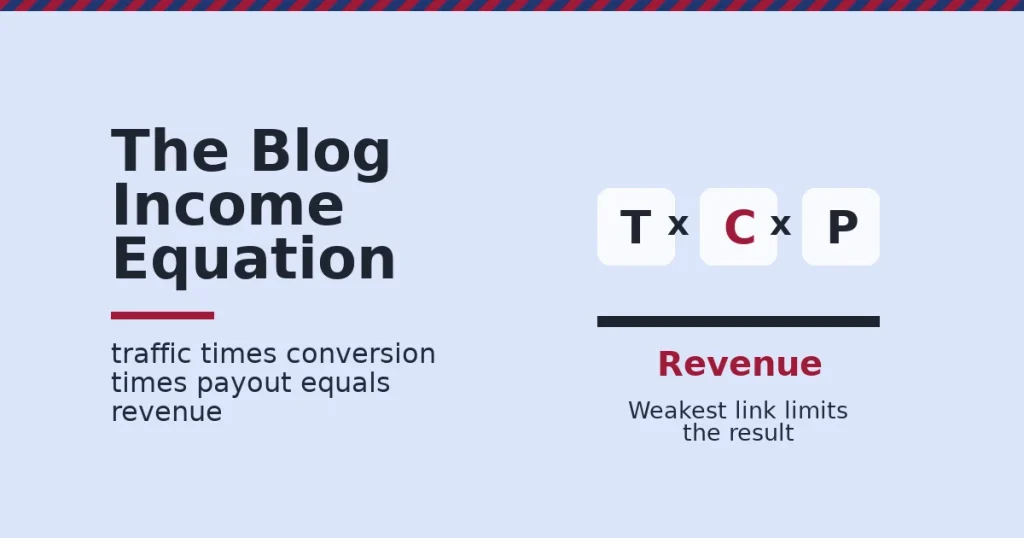
Blogs make money from blogging through one simple equation. Traffic, multiplied by a conversion rate, multiplied by a payout per conversion. Display ads, affiliate links and digital products all plug into that same equation differently. Once you see which part of the equation your blog is weakest on, you know exactly which revenue model to add next. You stop guessing from a generic list of ideas.
Key Takeaways
- Affiliate links out-earn display ads per visitor. Productive Blogging’s Blogging Income Survey, covering 129 bloggers, found affiliate marketing RPM at $34.66 against $33.16 for display ads.
- Digital products pay far more per visitor than either. The same survey put digital product RPM at $535.90, over fifteen times the display ad figure.
- More revenue streams compound, they do not just add up. Bloggers with four or more revenue streams averaged $129.92 RPM, against $27.33 for bloggers with only one stream.
- Affiliate conversion rates are low across the board. FirstPageSage, analysing more than 150 client campaigns, puts average affiliate marketing conversion at 2.0% for consumer audiences and 1.2% for business audiences.
- Traffic alone does not make money from blogging. Without a conversion path, an affiliate link or an ad placement that a visitor actually acts on, traffic just sits there unmonetised and earns nothing.
In this guide
- What Most Advice on How to Make Money From Blogging Gets Wrong
- The Mechanism: How You Actually Make Money From Blogging
- Which Revenue Model Fits Your Traffic Level
- How To Start Making Money From Blogging At Each Level
- Three Mistakes That Delay Making Money From Blogging
- How To Measure Whether Your Blog Monetisation Is Working
- The One Rule for Making Money From Blogging: Tune Before You Add
- A Real Case: Why Revenue Per Visitor Varies So Widely
- Frequently Asked Questions About Making Money From Blogging
- Make Money From Blogging By Fixing the Weakest Variable First
What Most Advice on How to Make Money From Blogging Gets Wrong
Most guides on how to make money from blogging list revenue ideas: ads, affiliates, courses, sponsorships. The list is not wrong, but it skips the part that actually matters. Which revenue model fits your traffic level right now, and in what order should you add them?
This guide replaces the list with the underlying mechanism. It names the gap first. Then it explains how blog monetisation actually works, and gives one rule for deciding when to add a second revenue stream.
A few ground rules. The RPM and conversion figures below come from two named sources: Productive Blogging’s self-reported survey of 129 bloggers, and FirstPageSage’s analysis of its own client campaigns. Treat both as useful benchmarks. Neither one guarantees results for your specific blog, niche or audience. Revenue per visitor varies hugely by topic, country and traffic source. Use these numbers to compare models, not to forecast your own income.
None of the three variables in the equation below are mysterious. Traffic can be measured in any analytics tool. Conversion rate is a simple percentage. Payout is whatever a click, a sale or a subscription is actually worth. What separates bloggers who make money from blogging from those who do not is usually not talent. It is usually not luck either. It comes down to whether they diagnose which variable is weak before spending more time on content, ads or a new product.
The Mechanism: How You Actually Make Money From Blogging
Every way to make money from blogging reduces to the same three variables. Traffic is how many people see the opportunity. Conversion rate is the share who act on it. Payout is what each action is worth. Multiply the three together and you get revenue.
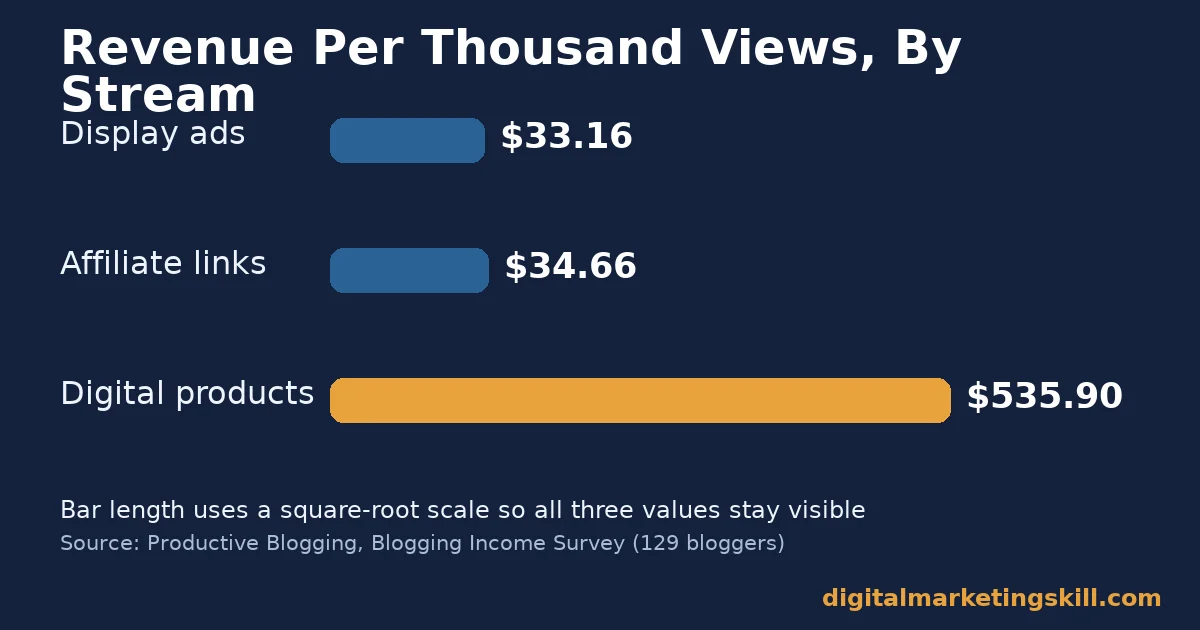
This matters because the three variables trade off differently by revenue model. Display ads need very little effort from the reader. They monetise even low-intent traffic, but the payout per view is small. Productive Blogging’s survey puts average display ad RPM at $33.16 per thousand page views. Affiliate links work differently. They need the reader to act, click and buy, so conversion is harder to earn. Payout per action runs higher to compensate. The same survey found affiliate RPM at $34.66, barely ahead of display ads overall. Strong affiliate placements can still beat that average by a wide margin, sometimes by several times over.
Why Digital Products Break the Pattern
Digital products, courses, templates, ebooks, flip the equation. They need far more trust. They also need a much narrower, more qualified audience to convert at all. Once that audience exists, the payout per conversion is enormous compared to ads or affiliate commissions. Productive Blogging’s data put digital product RPM at $535.90. That is more than fifteen times the display ad figure. A blog does not reach that number by accident. It reaches it after building an audience specific enough to trust a paid recommendation, something that takes months of consistent content, not a single viral post.
Which Revenue Model Fits Your Traffic Level
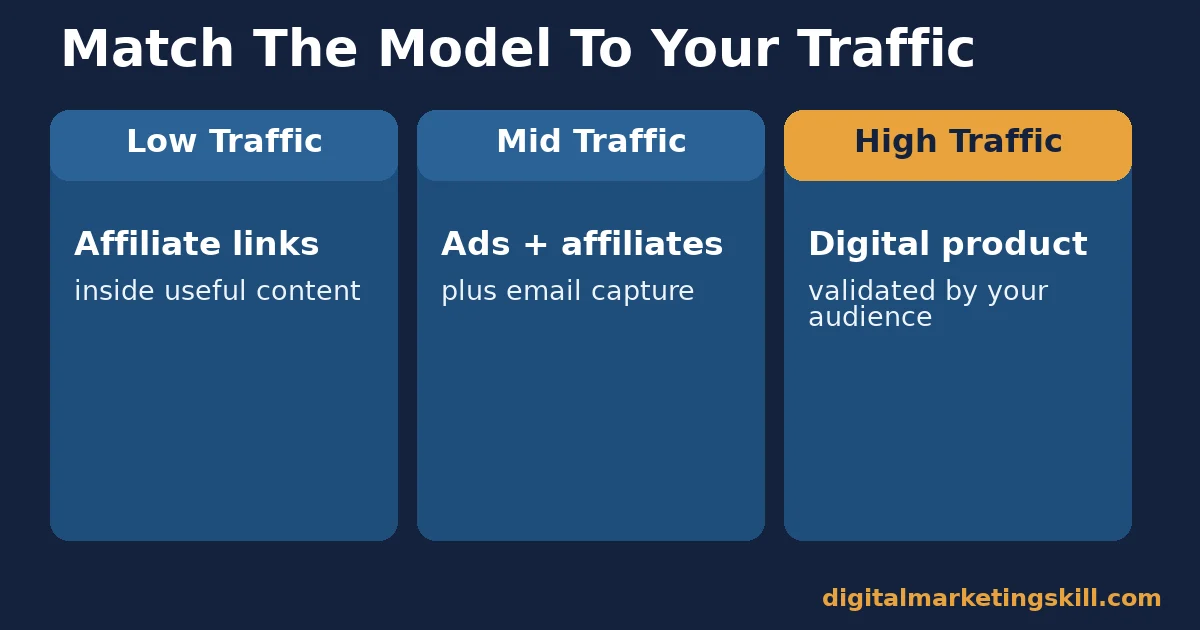
The right first revenue model for making money from blogging depends mostly on how much traffic you already have, not which model sounds most appealing. A model chosen for the wrong traffic level tends to underperform no matter how well it is executed.
Low Traffic: Built For Affiliate Links Inside Useful Content
With a small but focused audience, display ads pay very little in absolute terms. RPM is a per-thousand-view number, and you do not have thousands of views yet. Affiliate links work differently. Embedded naturally inside genuinely useful content, a comparison, a how-to, a recommendation, they can convert even a small, trusting audience. The content itself is doing the heavy lifting, not the traffic volume.
Mid Traffic: Built For Stacking Ads and Affiliates Together
Once a blog has enough consistent traffic for display ad revenue to add up, ads and affiliate links can run side by side. Neither one competes much for the reader’s attention. This is also where email marketing starts to matter. A growing list turns one-time visitors into a repeat audience you do not have to re-earn through search every time.
High Traffic or a Trusted Niche: Built For a Digital Product
A digital product needs an audience that already trusts your judgment on a specific topic. That usually means either real traffic volume or a narrow, highly engaged niche with a problem worth paying to solve. Once that trust exists, a digital product converts the same traffic at a payout multiple times higher than ads or affiliate links. That is why the RPM gap above is so wide.
How To Start Making Money From Blogging At Each Level
The sections below mirror the three traffic levels above, with the one practical step that matters most for each.
Low Traffic: Start With Three Honest Affiliate Recommendations
Pick three products or services you have genuinely used and can describe specifically, not generically. Write the content around the reader’s actual question first, and place the affiliate link as the natural answer, not an interruption. Disclose the affiliate relationship clearly, in line with the FTC’s endorsement guidance. A disclosed, trusted recommendation converts far better than a banner ad on a page nobody is reading closely yet.
Mid Traffic: Add Ads Without Hurting the Content
Add display ads only after confirming page speed and readability still hold up. Google AdSense’s own program policies set out the placement and content rules a blog needs to follow to stay eligible. A cluttered, slow page can quietly cost you the traffic the ads depend on. Start capturing email addresses at the same time, even before you have a clear digital product plan. The list takes time to build. It compounds in value the earlier you start it, since early subscribers become your most responsive readers later.
High Traffic or Niche: Validate a Digital Product Before Building It
Ask your existing audience directly what they would pay to solve, through a survey, poll or simply watching which questions repeat in comments and emails. Our guide to validating products before you build or buy them covers the same demand-check principle. It applies equally well to a digital product instead of physical inventory. Build the smallest version of the product that solves the core problem, then expand it once real buyers confirm the demand.
Three Mistakes That Delay Making Money From Blogging
These three mistakes show up again and again in blogs that struggle to make money from blogging, regardless of niche or traffic level. Fixing even one of them often unlocks more revenue than adding a new income stream on top of the same underlying problem.
Mistake 1: Trying Every Revenue Model At Once
Spreading thin traffic across ads, several affiliate programmes and a half-built digital product usually means none of them gets tuned properly, since attention and testing time end up divided too thinly to improve any single stream. Each model needs its own placement, copy and testing. A blog that commits to one model first earns more in practice. Tuning that one model toward benchmark RPM usually beats running four half-finished experiments at the same time.
Mistake 2: Adding Ads Before Traffic Justifies It
Display ads pay per thousand views. Adding them to a blog with only a few hundred monthly visitors produces a number too small to meaningfully change anything. Ads can also slow the page down. That can hurt the content experience that would have grown that traffic in the first place. Wait until traffic is consistent before treating ads as a real revenue stream, not a token one.
Mistake 3: Ignoring the Email List Until It Feels Necessary
An email list takes months to grow into something useful, so starting it only once you already need it means waiting months longer than necessary. Capture emails from day one, even with no clear plan yet for what to send. A list of a thousand engaged subscribers is worth far more at digital-product launch time than the same number of anonymous, one-time visitors.
How To Measure Whether Your Blog Monetisation Is Working
A handful of numbers tell you which part of the traffic-conversion-payout equation needs attention before you spend more time trying to make money from blogging in the wrong place.
Five Metrics That Show What To Fix Next
- RPM by revenue stream. Calculate revenue per thousand page views separately for ads, affiliates and any digital product, so you can see which stream is actually pulling its weight.
- Affiliate click-through rate. This is the share of readers who click an affiliate link at all. A low rate usually means the link is poorly placed or not relevant to what the reader came for.
- Affiliate conversion rate. This is the share of clicks that turn into a sale. FirstPageSage’s 2.0% consumer benchmark is a useful comparison point, though niche and offer quality move it a lot.
- Email list growth rate. Track new subscribers against total traffic. This shows whether you are building an audience you own, not just renting attention from search engines each time.
- Revenue per visitor, blended across all streams. This single number tracks whether total monetisation is improving over time, regardless of which individual stream is driving the change.
Reading These Metrics Together
Strong traffic with low RPM across every stream usually means a conversion problem, weak placements or the wrong offers, not a traffic problem. Strong RPM on a small number of visitors usually means you have found a genuinely well-matched offer. The real opportunity there is growing the traffic behind it, not changing the offer itself.
The One Rule for Making Money From Blogging: Tune Before You Add
Add a second revenue stream only after the first one is converting close to its realistic benchmark. Adding streams to traffic that is not converting the first one well just multiplies a weak foundation. Productive Blogging’s stream-count data shows why this matters. The RPM gain from one stream to two streams is real. It depends on the first stream already pulling its weight.
Here is an illustrative example with invented numbers. Picture a blog earning $15 RPM from affiliate links, well below the $34.66 survey average, while its owner considers adding display ads to diversify. Adding ads to traffic that is not converting the first stream well usually just adds a second weak stream instead of fixing the first one. Diagnosing why the affiliate RPM is low, wrong products, poor placement, mismatched audience, protects the time spent building the second stream.
A Real Case: Why Revenue Per Visitor Varies So Widely
Productive Blogging’s own survey data shows RPM ranging enormously even within the same revenue model. Some bloggers earn far above the $34.66 affiliate average, and many earn well below it. The survey’s own framing acknowledges this spread rather than presenting one number as typical for every blogger. That spread is the real lesson here: an average is a useful starting point for comparison, not a result any individual blogger should expect to land on exactly.
Treat the averages in this guide as a starting benchmark, not a target everyone should expect to hit. A travel blog recommending flights and hotels operates on different commission structures than a software blog recommending a tool with a recurring subscription. Niche, audience trust and offer quality move the real number far more than any generic advice on how to make money from blogging can predict in advance. Use the figures here to sanity-check your own numbers, not to set expectations for a niche they were never measured in.
Frequently Asked Questions About Making Money From Blogging
What is the fastest way to make money from blogging?
Affiliate links inside genuinely useful content are usually the fastest realistic path for a new blog. They need no large audience and no product to build. They do need real traffic and trust in the specific content they sit inside, so fast still means weeks or months, not days.
How much traffic do I need to make money from blogging?
There is no fixed threshold, since payout per visitor varies hugely by model and niche. A more useful frame matches the model to your traffic level instead. Use affiliate links for smaller, focused audiences. Add ads once volume is consistent. Add digital products once real audience trust exists, regardless of exact visitor counts.
Are display ads or affiliate links more profitable for a new blog?
Based on survey data, affiliate RPM runs slightly ahead of display ad RPM on average, but affiliate links need relevant, high-intent content to convert. Ads monetise almost any traffic passively. A new blog often benefits more from affiliates early, then adds ads once it has steady traffic.
Should I add multiple revenue streams right away?
Not right away. Survey data shows bloggers with more revenue streams earn more on average, but only once each stream is actually converting. Tune your first revenue stream close to benchmark levels before adding a second one, rather than spreading thin traffic across several unproven streams at once.
When is the right time to launch a digital product?
Launch once your audience already trusts your judgment on a specific, narrow topic. That usually shows up as repeated questions, requests or comments asking for exactly what the product would provide. Validating demand before building, the way you would validate any product, reduces the risk of building something nobody actually wants to buy.
Does SEO matter more than monetisation strategy?
They solve different problems. Search engine optimisation grows the traffic variable in the equation. Monetisation strategy decides how well that traffic converts into revenue. Strong traffic with poor monetisation and weak traffic with excellent monetisation both leave money on the table; you need both working together.
Does how long a blog has existed change which model works best?
Age itself matters less than accumulated trust and traffic, though the two often grow together. A newer blog with a narrow, highly engaged niche can validate a digital product faster than an older, broader blog that never built a specific enough audience to earn that trust.
What counts as a good RPM when you make money from blogging?
Treat the survey averages, $33.16 for display ads and $34.66 for affiliate links, as a baseline rather than a ceiling. A well-matched niche and offer regularly beats these averages by a wide margin, while a mismatched one can sit well below them even with decent traffic. If your own RPM sits far below these benchmarks after a reasonable testing period, treat that as a signal to revisit placement and offer fit, not a reason to simply add more content.
Does niche choice affect how much money you can make from blogging?
Significantly. Niches with naturally higher-value purchases, software, finance, business tools, tend to support higher affiliate payouts. They also support more viable digital products than niches built around low-cost, impulse purchases, even at similar traffic levels.
Make Money From Blogging By Fixing the Weakest Variable First
Making money from blogging comes down to traffic, conversion and payout. Almost every monetisation problem traces back to one of those three being weak. Diagnose which one before adding a new revenue stream, since a new stream built on the same weak foundation rarely fixes the underlying issue. The bloggers who make money from blogging consistently are usually not the most talented writers. They are the ones who keep testing which variable is actually holding their revenue back, one change at a time, instead of rewriting their whole strategy every few months.
Where to Go Next
If you want structured guidance on building traffic, conversion and monetisation together, the Digital Marketing Skill Institute’s Master Diploma in Digital & AI Marketing covers this inside its AI-Powered Google Specialist and AI-Powered Lead Generation and Email Automation tracks. These are two of the four AI-powered tracks that make up the ten-course programme, with a Full Stack option for completing all four. The programme includes unlimited 1-on-1 coaching and mentoring, a U.S. Project Internship with a verified U.S. Work Reference Letter, and dual US and UK accreditation recognised in more than 100 countries. It runs 100% online, so you can build and monetise a blog from anywhere in your country.
You can also browse related guides like our mobile marketing strategy guide, review real outcomes on the reviews page, or go straight to the application page to start. Learn more at digitalmarketingskill.com, wherever you live, or visit digitalmarketingskill.com to see the full Master Diploma structure.
Every figure in this guide was checked against its original source before publication. Figures marked as illustrative are invented examples, not real results.
![9 Amazing Digital Marketing Skills to Make Money Online [With Proof]](https://digitalmarketingskill.com/wp-content/uploads/2019/07/9-Amazing-Digital-Marketing-Skills-to-Make-Money-Online-With-Proof-17.png)






