
Products to sell online succeed or fail on validation, not luck. Before you commit to inventory, check four things: real search demand, margin after fees and shipping, a supplier you can rely on, and competition you can realistically beat. Skip any one check and the product usually fails for a predictable reason. This guide walks through each check in order, with one rule for the final decision.
Key Takeaways
- Most online shopping carts never convert. Baymard Institute, averaging 50 studies, puts the typical cart abandonment rate at 70.22%.
- Extra costs are the single biggest reason carts get abandoned. Baymard’s research found 40% of shoppers who abandon a cart cite costs, like shipping and fees, that felt too high at checkout.
- Returns eat into margin more than most sellers plan for. The National Retail Federation’s Retail Returns Landscape report puts the average ecommerce return rate at about 19.3% of orders, with categories like apparel running far higher.
- Shoppers will not buy products they cannot evaluate. PowerReviews, surveying more than 6,500 consumers, found 99.75% read reviews at least sometimes, and 45% will not purchase a product with none at all.
- Demand signals exist before you spend a cent. Google’s own Trends tool shows relative search interest over time and by region. It is free, so you can check it before you ever commit to buying stock.
In this guide
- What Most “Trending Products” Lists Get Wrong
- Why Validating Products to Sell Online Matters More Than the Idea Itself
- Four Checks, Done In Order
- Three Common Mistakes When Sourcing Products to Sell Online
- How To Measure Whether a Product Is Working
- The One Decision Rule: Do Not Buy Inventory Until All Four Checks Pass
- A Real Case: Why Returns Alone Can Sink a Product
- Frequently Asked Questions About Products to Sell Online
- Validate Before You Buy, Every Time
What Most “Trending Products” Lists Get Wrong
Most articles on products to sell online are lists. A list of hair accessories this month, phone gadgets next month, kitchen tools after that. Lists like these go stale within weeks. Worse, they skip the part that actually determines success: how to tell a good product from a bad one before you buy it.
This guide replaces the list with a method. It names the gap first. Then it walks through the four checks that matter for products to sell online, and ends with one rule for deciding when a product is ready to buy.
A few ground rules first. The figures below come from named research organisations: Baymard, the National Retail Federation and PowerReviews. Each one is a snapshot from its own study, not a universal guarantee for your specific product. Treat every number here as a benchmark to compare against, not a promise. Markets shift fast, so revisit these checks whenever you consider a new product, not just once at the start.
Why Validating Products to Sell Online Matters More Than the Idea Itself
A product idea feels exciting. A validated product idea is rare. The gap between the two is where most new online stores lose money. They buy inventory for something that looked promising but had no real demand, thin margin, or an unreliable supplier behind it.
None of the four checks in this guide are difficult on their own. Checking search demand takes minutes with a free tool. Working out margin is arithmetic, not guesswork. What actually separates sellers who succeed from sellers who do not is whether they run every check before buying, or skip one under time pressure because a product felt too promising to question.
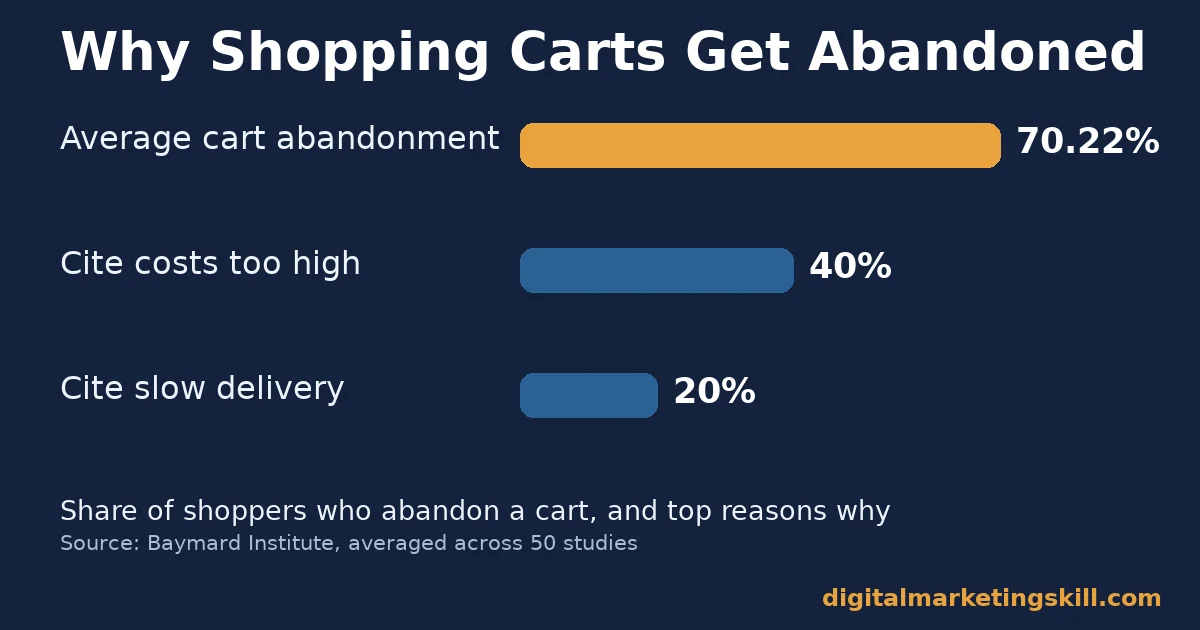
Two numbers show why validating products to sell online has to happen before the purchase, not after. Baymard Institute’s research is built from 50 separate studies. It puts average cart abandonment at 70.22%. Among shoppers who abandon, 40% point to costs, shipping, tax or fees, that felt too high once they reached checkout. Your margin needs to absorb a shipping cost shock without losing the sale. If it cannot, that weakness shows up at the worst possible moment. It appears after you have already bought the stock. By then, it is far more expensive to fix than it would have been to check beforehand.
The Margin Math Most Sellers Skip
Unit cost is only the starting point. A full margin check adds shipping to the customer, payment processing fees, and platform or marketplace fees. It also adds returns, and the cost of any ads needed to get a sale in the first place. The National Retail Federation’s Retail Returns Landscape report puts average ecommerce returns at roughly 19.3% of orders. Apparel runs as high as 20-40%, depending on the category. A thin margin paired with a high expected return rate is a warning sign. That combination can lose money on every sale, even while revenue looks healthy on the surface.
Four Checks, Done In Order
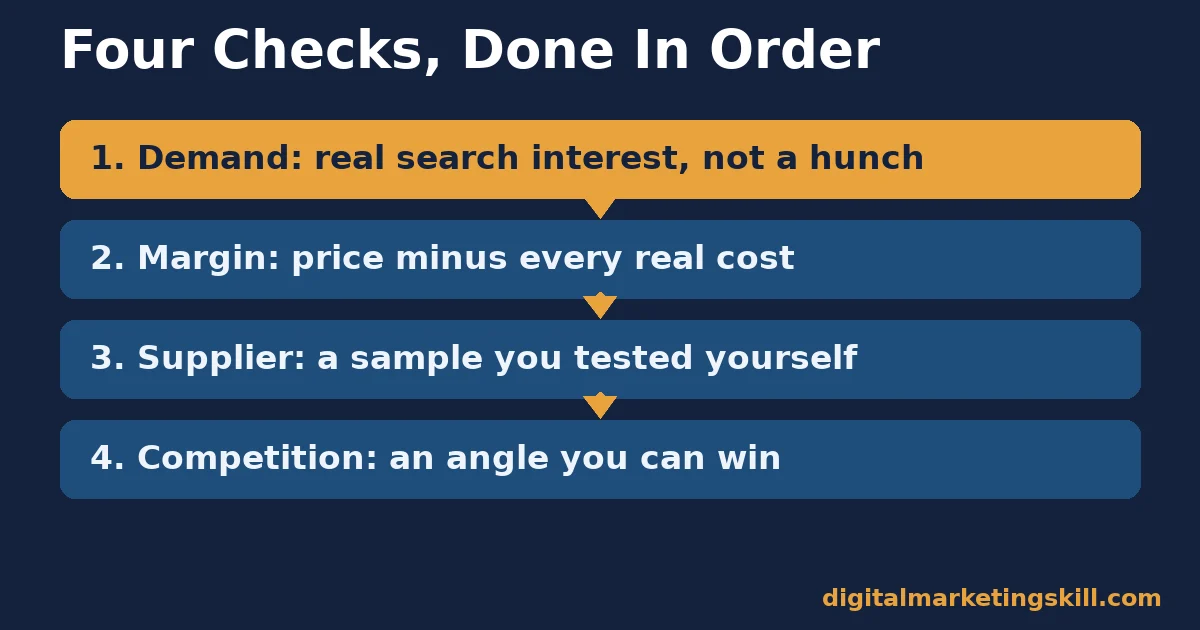
These four checks catch most of what makes products to sell online fail. Do them in this order. Each one is cheaper to run than the next, and an early failure saves you from wasting time on the checks that follow it.
Check 1: Real Search Demand, Not a Hunch
Before anything else, confirm people actually search for the product or the problem it solves. Google Trends shows relative search interest over time and by region, for free, built from Google’s own aggregated and anonymised search data. Rising interest across several regions, not just one short spike, is a far stronger signal than a single viral moment that fades within weeks.
Pair that with a direct look at the keywords people use to search for the product. Low or falling interest across every available source is a reason to stop before you spend on inventory. It is a signal to act on, not a detail to quietly work around later. A single strong week of search interest is not the same as sustained demand, so give any new signal a few weeks before you treat it as real.
Check 2: Margin After Every Real Cost
Add up unit cost, inbound and outbound shipping, payment processing fees, platform fees, and an estimated return rate for the category. Compare that total against a realistic selling price, not an optimistic one picked to make the numbers work. If the resulting margin cannot absorb a slow sales period or a supplier price increase, the product stays fragile, even if the first batch sells out quickly. Write the full calculation down rather than estimating it mentally; sellers consistently underestimate the combined weight of small fees when they are not added up on paper.
Check 3: A Supplier You Can Actually Rely On
Order a sample yourself before committing to a full batch. Time how long it actually takes to arrive, not how long you were told it would take. Ask about minimum order quantities and lead times during busy periods. Also ask what happens if a shipment arrives damaged or short. A supplier that cannot answer these questions clearly rarely improves once you depend on them for your whole catalogue. Keep a written record of every answer, since a supplier’s verbal promises are far easier to walk back than a quote or policy you have in writing. This record also becomes useful leverage if a dispute comes up later over a missed deadline or a damaged shipment.
Check 4: Competition You Can Realistically Beat
Search for the product the way a customer would, on both desktop and a phone. People shop differently by device. Our mobile marketing strategy guide covers that difference in more depth. Look honestly at who already ranks and sells well for that product. PowerReviews’ survey covered more than 6,500 consumers. It found that 99.75% of shoppers read reviews at least sometimes, and 45% will not buy a product with none at all. A crowded category with established sellers and thousands of reviews needs a genuinely different angle. A bundle, a niche audience, or better service usually works better than simply pricing lower. Competing purely on price rarely ends well against sellers with more volume and lower per-unit costs than a newer, smaller store can match.
Three Common Mistakes When Sourcing Products to Sell Online
Even sellers who run all four checks on their products to sell online still trip over a handful of avoidable mistakes. These three show up again and again across different categories and price points.
Mistake 1: Ignoring Shipping Speed, Not Just Shipping Cost
Cost is not the only shipping variable that matters. Baymard’s research found that 20% of shoppers who abandon a cart cite slow delivery specifically, separate from the 40% who cite cost. A supplier with a low unit price but a six-week shipping time can still lose the sale, even when your margin math looks fine on paper.
Mistake 2: Underestimating Customs and Import Costs
Sellers sourcing from overseas suppliers often price using the factory quote alone. That quote rarely includes customs duties, import taxes, or brokerage fees, all of which vary by destination country and product category. Build a buffer for these costs into your margin check, rather than discovering them on your first international shipment. If you sell into several countries, run this check per destination, since duty rates and thresholds differ enough between countries to turn a comfortable margin in one market into a thin one in another.
Mistake 3: Listing the Product Poorly Once It Arrives
A validated product can still underperform if the listing itself is weak. Google’s own Merchant Center guidelines set out the product data, clear titles, accurate images, complete attributes, that shopping listings need to perform well. Treat the listing as part of the validation process, not an afterthought once the product has already arrived. Write the title and description before the product even ships, using the exact words customers search with, rather than rushing a generic listing together on launch day.
How To Measure Whether a Product Is Working
Once a product is live, a handful of numbers tell you whether the validation checks actually held up in practice, rather than just looking good on paper.
Five Metrics That Show Whether a Product Is Actually Working
- Conversion rate on the product page. This is the share of visitors to that specific page who buy. A low rate despite decent traffic usually points to price, trust signals, or unclear product information, not weak demand.
- Return rate by product. Track this per product, not store-wide. One weak item can quietly drag down overall margin while hiding behind strong sellers elsewhere in the catalogue.
- Contribution margin after returns. This is revenue minus every direct cost, including the cost of expected returns. It shows whether a product is genuinely profitable, not just popular with browsers.
- Repeat purchase or review rate. This shows whether buyers are satisfied enough to come back or leave a review, which also feeds the trust signals new shoppers rely on before they buy.
- Cart abandonment on that product’s checkout path. If this runs well above the 70.22% average, suspect a cost or trust problem specific to that product, such as a shipping fee that only appears at the final step.
Reading These Five Metrics Together
Read these together over several weeks, not days. Early numbers can mislead you either way. A product with strong traffic and a low conversion rate usually has a demand or trust problem. It rarely has a traffic problem. One with good conversion but a high return rate usually has a sizing, quality or description problem instead. If your product page traffic is the weak link in this chain, our search engine optimization guide covers how to get found by people already searching for what you sell.
The One Decision Rule: Do Not Buy Inventory Until All Four Checks Pass
Buy inventory only once demand, margin, supplier reliability and competition have each passed their own check. A product that fails even one of the four needs fixing or dropping before you spend on stock. Treating these as a sequence, rather than a single gut-feel decision, is what separates a validated product from an expensive guess.
Here is an illustrative example with invented numbers. Picture a product with strong Google Trends interest and a healthy 45% margin on paper. Its supplier cannot confirm lead times during a busy season. On paper, the demand and margin checks pass easily. In practice, the unreliable supplier alone is enough to delay the launch and miss a selling window. That delay alone can turn a promising product into a loss. Fixing the supplier problem first protects the other three checks you already passed. A short delay now is cheaper than letting one weak link undo all of them later.
A Real Case: Why Returns Alone Can Sink a Product
The National Retail Federation’s own reporting puts the value of US retail returns at close to $850 billion in a single year. Ecommerce runs a noticeably higher return rate than in-store purchases do. Categories like apparel, where sizing and fit are hard to judge online, sit at the high end of that range.
Treat this as an industry-wide pattern, not a guarantee about any single product. A seller who validates demand and margin can still get hurt by skipping the return-rate question. In a high-return category like fitted clothing, a seemingly profitable product can turn unprofitable fast. Returns, restocking and reshipping costs add up quickly once counted properly. The fix is not avoiding those categories entirely. Instead, price and source with the category’s typical return rate built in from the start. Do not wait to discover it after the damage is already done.
Frequently Asked Questions About Products to Sell Online
How do I find profitable products to sell online?
Run the four checks in order: confirm real search demand with a tool like Google Trends, calculate margin after every real cost including returns, order a sample to test your supplier, and honestly assess the competition. A product that passes all four is far more likely to be profitable than one picked from a trending list.
Should I avoid trending products?
Not necessarily, but treat a trend as one signal among several, not a reason to skip validation. Once a product passes validation, our email marketing guide covers turning first-time buyers into repeat customers. A trending product with poor margin or an unreliable supplier behind it fails just as often as an untrending one. The checks matter more than the trend itself.
What margin should products to sell online target?
There is no single universal number, since margin needs vary by category, ad spend and return rate. The more useful test asks whether your margin, after shipping, fees and an estimated return rate for that category, can absorb a slow month or a cost increase without turning the product unprofitable.
How do I check if a supplier is reliable before ordering in bulk?
Order a sample yourself first and time the actual delivery against what you were told. Ask directly about minimum order quantities, lead times in busy periods, and their process for damaged or short shipments. Judge how clearly and quickly they answer before you commit to a larger order.
Why do products with no reviews struggle to sell, even if they are good?
Reviews are one of the main ways shoppers judge a product they cannot physically examine. With 45% of shoppers unwilling to buy a product with no reviews at all, a new product needs an early plan. Samples sent to trusted customers, or a small initial batch, can generate its first honest reviews quickly.
What is the most common reason products to sell online fail?
Skipping one of the four checks is the most common pattern: launching on a hunch instead of confirmed demand, under-pricing without accounting for real costs, trusting an unproven supplier, or ignoring how crowded the competition already is.
How many products to sell online should I test at once?
Test fewer products than feels comfortable at first. Running all four checks properly on two or three candidates usually beats a rushed version of the same checks across ten, because a shallow check on margin or supplier reliability tends to miss exactly the problem that would have stopped you from buying inventory at all.
Do seasonal products need a different validation process?
The same four checks apply, but timing matters more. Confirm demand early enough to secure a reliable supplier and place a reasonable order before the season starts, since rush orders usually mean weaker margin, higher shipping costs and less supplier leverage if something goes wrong.
Can I validate just one product, or should I test several at the same time?
Either approach can work, but the four checks matter more than how many products you test. A single well-validated product usually outperforms several half-checked ones, since partial validation tends to hide exactly the weakness, thin margin, a shaky supplier, a saturated category, that would have stopped you from buying inventory at all.
Validate Before You Buy, Every Time
Products to sell online rarely fail for one dramatic reason. They usually fail because one of four ordinary checks, demand, margin, supplier or competition, got skipped under time pressure. Running all four before you spend on inventory costs far less than discovering the gap after the stock has already arrived at your door.
If you want structured guidance on building a full ecommerce and marketing plan around validated products to sell online, the Digital Marketing Skill Institute’s Master Diploma in Digital & AI Marketing covers this inside its AI-Powered Lead Generation and Email Automation and AI-Powered Google Specialist tracks. These are two of the four AI-powered tracks that make up the ten-course programme, with a Full Stack option for completing all four. The programme includes unlimited 1-on-1 coaching and mentoring, a U.S. Project Internship with a verified U.S. Work Reference Letter, and dual US and UK accreditation recognised in more than 100 countries. It runs 100% online, so you can study and sell from anywhere in your country.
You can also browse related guides like our e-commerce strategies guide and our ecommerce sales funnel guide, review real outcomes on the reviews page, or go straight to the application page to start. Learn more at digitalmarketingskill.com, wherever you live, or visit digitalmarketingskill.com to see the full Master Diploma structure.
Every figure in this guide was checked against its original source before publication. Figures marked as illustrative are invented examples, not real results.
![9 Amazing Digital Marketing Skills to Make Money Online [With Proof]](https://digitalmarketingskill.com/wp-content/uploads/2019/07/9-Amazing-Digital-Marketing-Skills-to-Make-Money-Online-With-Proof-17.png)






