
You make money on Fiverr by building a seller profile, publishing a gig in one specific skill, and climbing the platform’s level system as orders and ratings grow. It is realistic. Fiverr keeps 20% of every sale, though, so most sellers who make money on Fiverr long-term specialise in one category instead of offering everything.
Key Takeaways
- The platform takes a flat cut. Fiverr charges a 20% service fee on every order, extra and tip, with no volume discount. Pricing has to account for that from the first gig.
- Levels gate how much you can make. Reaching Level 2 needs 20 completed orders, 10 unique clients and $2,000 in lifetime earnings. Top Rated needs 40 orders, 20 clients and $10,000, plus a manual review.
- Buyers judge gigs on six factors. Success Score, rating, response rate, completed orders, unique clients and earnings all feed the ranking that decides who gets found.
- Specialists make more money on Fiverr than generalists. Sellers who narrow to one in-demand skill and raise prices as reviews build tend to out-earn sellers who list many unrelated gigs at the minimum price.
- It can scale, slowly. Freelance writer Alex Fasulo made $63,000 on Fiverr in her first full year, then grew that to $273,000 the next year, after years of daily, structured work rather than overnight.
In this guide
- What Most “Make Money on Fiverr” Guides Leave Out
- How Fiverr Decides Who Gets Paid
- Three Kinds of Seller Trying to Make Money on Fiverr
- How to Win at Each Stage
- Eight Reasons Sellers Fail to Make Money on Fiverr
- How to Measure Progress as a Fiverr Seller
- The One Decision Rule: Price for Positioning, Not the Lowest Bid
- A Step-by-Step Plan to Make Money on Fiverr
- A Real Case: From $63,000 to $273,000 in One Year
- Frequently Asked Questions About Making Money on Fiverr
- Your Next Step
What Most “Make Money on Fiverr” Guides Leave Out
Most guides describe how to open an account and publish a gig. Then they stop. That covers the mechanics. It skips the part that actually decides whether a seller earns anything: how Fiverr’s ranking and level system chooses which gigs get seen.
This guide fills that gap. It explains the fee and level mechanics first. Then it shows how outcomes differ between generalist sellers, specialists and small agencies trying to make money on Fiverr, with a different fix for each. Treat every figure here as a snapshot, not a settled fact. Fiverr’s fee structure, level thresholds and category demand all change over time, and the real case below is one seller’s reported experience, not a guarantee.
How Fiverr Decides Who Gets Paid
Fiverr is a two-sided marketplace. Sellers publish “gigs,” which are fixed-scope service listings. Buyers either order directly or post a request that sellers respond to. Money only moves once an order is placed and marked complete, so a seller earns nothing from views, saves or messages alone. Understanding that mechanic is the real starting point for anyone trying to make money on Fiverr. If you are weighing Fiverr against other platforms first, our comparison of the best freelance websites covers how each one fits a different stage of a freelancing career.
The 20% Fee That Shapes Every Price
Fiverr applies a flat 20% service fee to every sale, including gig extras and tips. This applies regardless of order size or seller level, as Fiverr’s own help centre sets out. A $100 order nets the seller $80. There are no volume discounts, so work out your real hourly rate after that cut, not before it.
This fee is also why underpricing is risky if you want to make money on Fiverr long-term. A seller who prices a task at $20 to win the first sale keeps $16, which rarely matches the time involved. Most sellers who stay on the platform raise prices as soon as early reviews allow it, rather than competing on being the cheapest listing in the category.
How the Seller Level System Works
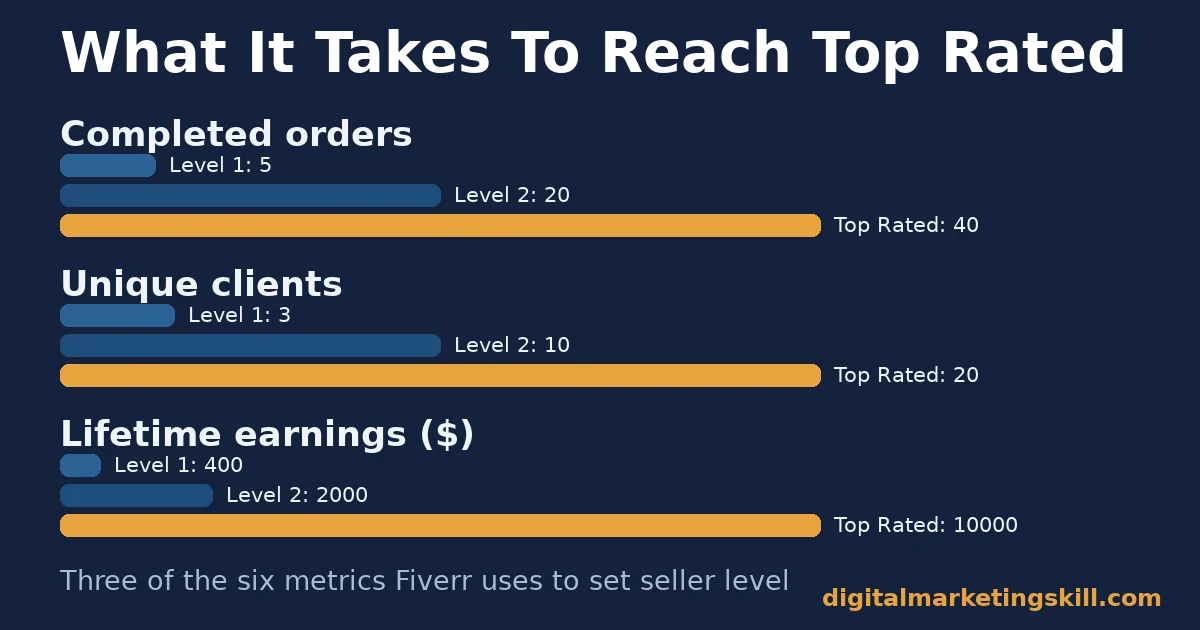
Fiverr moves sellers automatically through four tiers. The move is based on six measured factors, tracked in a published breakdown of Fiverr’s seller level requirements: Success Score, average rating, response rate, completed orders, unique clients and lifetime earnings. Level 1 needs a Success Score of 5+, a 4.4+ rating, an 80% response rate, 5 completed orders, 3 unique clients and $400 earned. Level 2 raises that to a Success Score of 7+, a 4.6+ rating, 90% response rate, 20 orders, 10 clients and $2,000 earned.
Top Rated is the highest tier most sellers can reach without an invitation-only Pro review. It requires a Success Score of 9+, a 4.7+ rating, a 90% response rate, 40 completed orders, 20 unique clients and $10,000 in lifetime earnings. It also requires a manual evaluation and at least 180 consecutive days at Level 2. Reaching Level 1 and Level 2 happens automatically within 24 hours of meeting every metric. Top Rated does not, because Fiverr staff review the account by hand.
Three Kinds of Seller Trying to Make Money on Fiverr
Not every seller is playing the same game. A brand-new seller, a narrow specialist and a small two-or-three-person agency each succeed and fail for different reasons. So the fix for one rarely works for another. Knowing which type you are right now, not which type you want to become, is the fastest way to pick the correct fix below.
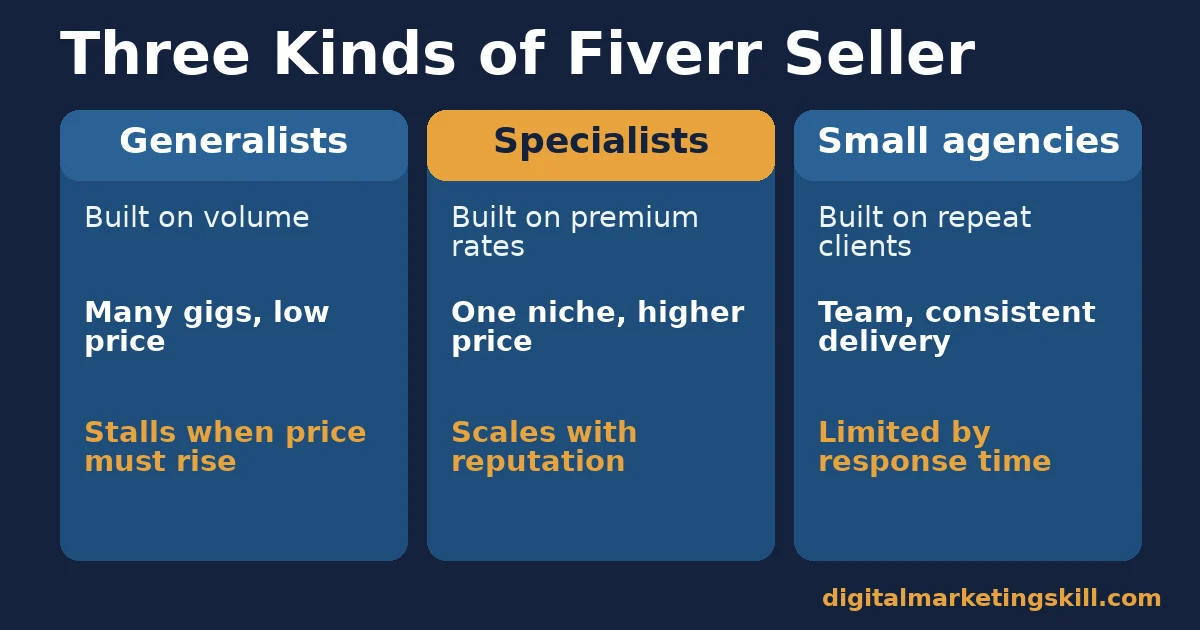
Generalists: Built on Volume
Generalist sellers list several unrelated gigs at or near the platform minimum, hoping volume makes up for low margins. This works briefly while a seller has no reviews, because low prices are often the only way to win a first order. It stops working once a seller needs to raise rates, because buyers who chose the listing on price alone have no reason to pay more next time.
Specialists: Built on Premium Rates
Specialist sellers narrow to one skill, one audience and usually one price tier above the category average. Their advantage is simple: buyers searching a specific term, such as “SaaS onboarding email sequence” rather than “email marketing,” face less competition. That listing also reads as expert work rather than a commodity task, so it converts at a higher price. Narrowing the niche usually means fewer total searches, but each one converts at a far higher rate and price.
Small Agencies: Built on Repeat Clients
A small team selling under one or more accounts earns most of its revenue from clients who return without searching again. Their constraint is not finding new buyers. It is keeping response time and quality consistent as order volume grows, since Fiverr’s level system punishes slipping response rates and ratings just as fast as it rewards fast ones. A single overloaded week can undo months of level progress if messages go unanswered for too long.
How to Win at Each Stage
The sections below mirror the three seller types above. Identify which one matches your situation now. Then apply the matching fix, rather than general advice aimed at a different stage.
Generalists: Lead With a Narrow First Gig
Pick the single skill from your CV or past work that has the clearest, most searchable demand. Publish one gig around it before adding others. A narrow gig title and description rank for more specific searches, which means less competition for the same buyer intent. If Fiverr is one of several options you are weighing for remote income, our guide to finding real online work and avoiding scams covers how to vet other platforms safely.
Specialists: Lead With Proof, Not Promises
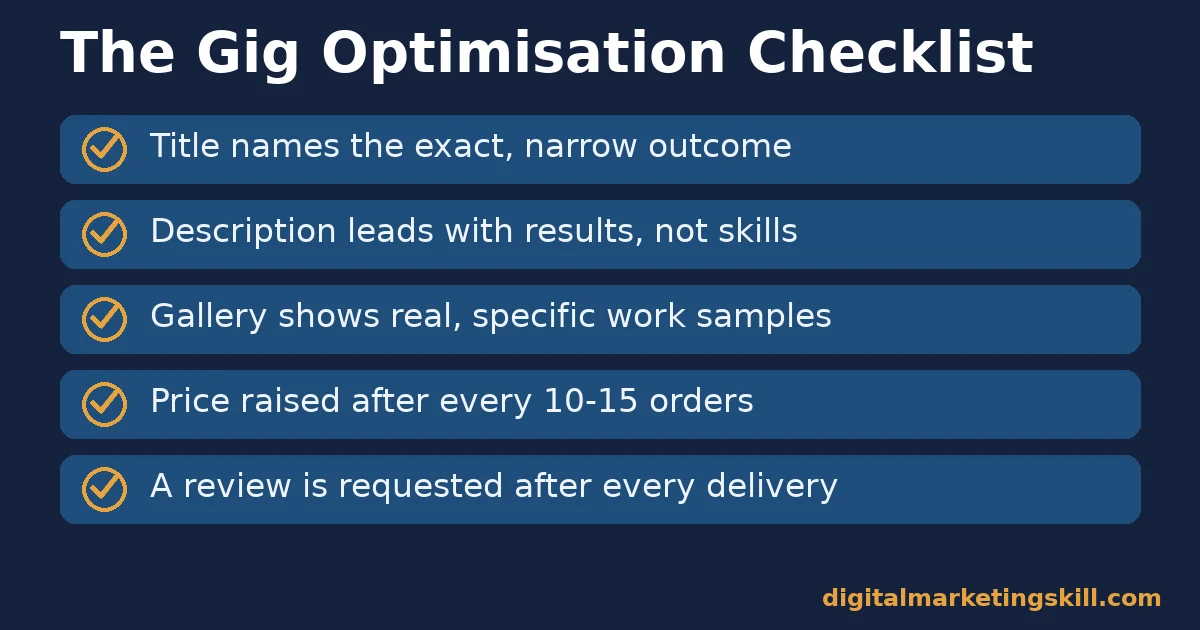
Buyers choosing a specialist want evidence, not adjectives. Use the gig gallery for real before-and-after samples or anonymised client results, rather than stock graphics. Let the first line of the description state a specific outcome instead of a list of skills.
Small Agencies: Lead With Response Speed
Response rate is one of the six metrics that decides seller level. Because of that, a small team should assign someone to check messages throughout the day rather than in batches. A fast first reply, even a short one promising a full answer soon, protects the metric that keeps the account visible.
Eight Reasons Sellers Fail to Make Money on Fiverr
When a seller account earns little after weeks of effort, the cause is usually one of these patterns.
- The gig title matches dozens of identical listings. Generic titles like “I will do SEO” compete with thousands of near-identical gigs on price alone.
- Pricing never moves. Many sellers keep the $5 starting price long after reviews justify charging more. That caps income regardless of order volume.
- Response rate slips. A falling response rate can drop a seller a level, which reduces how often the gig is shown to buyers.
- The gig description lists skills instead of outcomes. Buyers scan for what they will receive, not a list of software or techniques.
- No gig extras. Fiverr’s own guidance on offering extra services describes gig extras as add-ons, such as faster delivery or an added revision, that raise average order value without needing new buyers.
- Portfolio images are generic stock photos. Buyers hesitate when a gig gallery does not show real, specific work samples.
- Reviews are never requested. A polite request for a review after a good delivery meaningfully increases how often satisfied buyers leave one.
- The seller gives up before the first few sales. Early gigs typically convert at a lower rate than gigs with ten or more reviews. So the first weeks are naturally the slowest.
Which Mistake to Fix First
Fix discovery problems before pricing problems. A gig with almost no clicks needs work on the title and tags first, since no price adjustment matters if buyers never see the listing. One with clicks but few orders needs a description and gallery that build more trust. And a gig that sells reliably but barely covers your time is finally ready for a price increase.
How to Measure Progress as a Fiverr Seller
Fiverr’s own seller dashboard already reports most of what matters. Track these figures weekly, rather than reacting to any single day.
- Impressions and clicks. How often the gig appeared in search and category results, and how many of those views became clicks. A low click rate on high impressions usually points to a weak thumbnail or title.
- Conversion rate. The share of gig clicks that become paid orders. This is the clearest signal of whether the gig page itself, not just its visibility, convinces buyers.
- Response rate and response time. Both feed directly into the level system. A drop here has consequences beyond the immediate conversation.
- Order completion rate. The share of accepted orders delivered without cancellation. Cancellations hurt ranking more than one slow delivery.
- Repeat-buyer rate. The share of revenue from clients who ordered before. A rising repeat rate means you depend less on winning new buyers every month.
Read these five figures together, not one at a time. A seller trying to make money on Fiverr with strong impressions but a weak conversion rate has a gig-page problem, not a visibility problem. A seller with strong conversion but a falling response rate is about to lose the ranking boost that got those clicks in the first place. Checking all five weekly, rather than one in isolation, shows which lever actually moves income.
The One Decision Rule: Price for Positioning, Not the Lowest Bid
If you take one rule from this guide, make it this one: price your gig to match how specific it is, not the cheapest listing in the category. A narrow, well-proven gig earns more at a higher price than a broad gig earns at the minimum. It competes with fewer sellers for each search.
Here is an illustrative example, with invented numbers. A new seller offers generic “social media graphics” at $5 and completes 40 orders in four months, for $200 total before fees. A second seller instead offers “Instagram carousel templates for fitness coaches” at $35. That seller completes just 15 orders in the same period but earns $525 before fees, from far less design time per sale.
A Step-by-Step Plan to Make Money on Fiverr
- Choose one narrow skill. Pick the most specific, in-demand version of a skill you can already prove, not the broadest category it belongs to. Our guide to freelancing for beginners walks through how to identify that first marketable skill.
- Register and verify your profile. Create a seller account, confirm your email, and complete every profile field. Incomplete profiles convert worse.
- Publish one tightly scoped gig. Write the title around the exact phrase a buyer would search. Describe the outcome the buyer receives, not just the steps you follow.
- Price slightly below the specialist average at first. Undercutting generalists is unnecessary. Undercutting specialists in your exact niche helps you win the first reviews.
- Deliver early and ask for a review. A delivery ahead of the deadline, with a short, polite request for feedback, builds the rating that unlocks higher visibility.
- Add gig extras once you have five reviews. Faster delivery, extra revisions or an add-on service raise average order value without new buyers.
- Raise your base price every 10 to 15 orders. Pair each price increase with stronger proof in the gallery, rather than raising it alone.
- Track the five metrics above weekly. Adjust your title, gallery or price based on where the numbers show the real bottleneck.
A Real Case: From $63,000 to $273,000 in One Year
Freelance writer Alex Fasulo started on Fiverr selling $15 press releases. According to an interview published by entrepreneur Noah Kagan, she worked up through $50 and then $100-a-day income. She reached a stable $3,000 a month after roughly a year, around the time she hit Fiverr’s Level 2 tier with a dozen gigs listed.
She later specialised in ghostwriting ebooks for businesses and influencers, pricing a 10,000-word ebook at around $1,000. Her reported earnings grew from $63,000 in her first full year to $273,000 the next, and CNBC later reported her income reaching roughly $378,000 a year as the business matured further.
Treat this as one seller’s self-reported, platform-dependent income, not a typical outcome. She has described working 10 to 12 hours a day, seven days a week, in the early period. Her business still depends on one platform’s algorithm and policies. The pattern worth copying is the sequence: one niche, consistent delivery, then specialisation. The specific dollar figures are not.
Frequently Asked Questions About Making Money on Fiverr
How much money can you realistically make on Fiverr?
It ranges from a few dollars a month for inactive gigs to six figures a year for specialists with years of reviews, like the real case above. Most active sellers fall well below that high end. Fiverr itself does not publish an average seller income, so treat any specific promised figure, including the ones in this guide, as one data point rather than a typical result.
How long does it take to make money on Fiverr?
The first sale can happen within days of publishing a well-targeted gig. Reaching a steady, meaningful income typically takes months of consistent delivery and review-building, though, not a single viral gig.
Do you need a degree or certification to make money on Fiverr?
No. Fiverr does not require formal qualifications to sell a service. Buyers judge sellers on gig descriptions, portfolio samples and reviews rather than credentials.
What percentage does Fiverr take from sellers?
Fiverr takes a flat 20% service fee from every order, extra and tip. There is no discount for higher-earning sellers or higher order values.
Is it better to offer many gigs or one niche gig to make money on Fiverr?
One well-targeted, specific gig usually outperforms several broad, generic ones. It faces less direct competition for the exact phrase a buyer searches.
How do you withdraw money you make on Fiverr?
Fiverr pays through several withdrawal methods depending on your country. These can include direct bank transfer, PayPal where supported, or a payments partner such as Payoneer. Check Fiverr’s own payments page for the options available wherever you live, since availability varies by location.
Can you make money on Fiverr with no prior experience?
Yes, but you still need a real, demonstrable skill. You can learn that skill through free practice projects or structured training, then prove it with a small portfolio before you publish your first gig. Experience on other platforms, in a job or on personal projects all count as proof.
What is the fastest niche to make money on Fiverr in?
There is no single fastest niche, because demand shifts and competition rises wherever a niche looks easy. The more reliable approach is to pick a skill with provable results and steady search demand, then specialise within it, rather than chasing whichever category looks hot this month.
Your Next Step
Making money on Fiverr is realistic once you treat it as a narrow-niche business, not a side listing among many. Pick one specific service, publish a single gig built around it, and track impressions, conversion rate and response rate from the first week. Do not wait for results before measuring anything.
If you want structured training behind those skills, Digital Marketing Skill Institute runs the Master Diploma in Digital & AI Marketing. It spans four AI-powered tracks, including AI-Powered Lead Generation and Email Automation and AI-Powered WordPress and SEO Specialist, totalling ten courses, with a Full Stack option for completing all four. It includes unlimited 1-on-1 coaching and mentoring, plus a U.S. Project Internship with a verified U.S. Work Reference Letter. The diploma is dual US and UK accredited and recognised in more than 100 countries. It is entirely online, so you can study from anywhere in your country.
Explore more guides on the Digital Marketing Skill Institute blog, read real outcomes on the reviews page, and when you are ready, apply for the Master Diploma or start from the Digital Marketing Skill Institute homepage.
Every figure in this guide was checked against its original source before publication. Figures marked as illustrative are invented examples, not real results.
![9 Amazing Digital Marketing Skills to Make Money Online [With Proof]](https://digitalmarketingskill.com/wp-content/uploads/2019/07/9-Amazing-Digital-Marketing-Skills-to-Make-Money-Online-With-Proof-17.png)






