
Online jobs from home let you earn money using a laptop and an internet connection, instead of commuting to an office. They range from freelance platform gigs to full remote employee roles to small paid microtasks. The real opportunity is large, but so is the number of fake listings. This guide shows you how to tell them apart.
Key Takeaways
- Online jobs from home fall into three types: freelance platform work, remote employee roles, and microtask or survey work. Each pays and screens candidates differently.
- In the US, independent contractors made up 7.4% of total employment and contingent workers 4.3%, according to the Bureau of Labor Statistics. Both figures have risen over time.
- About 38% of the US workforce did some freelance work in a recent year, per Upwork’s Freelance Forward report, a US-only figure.
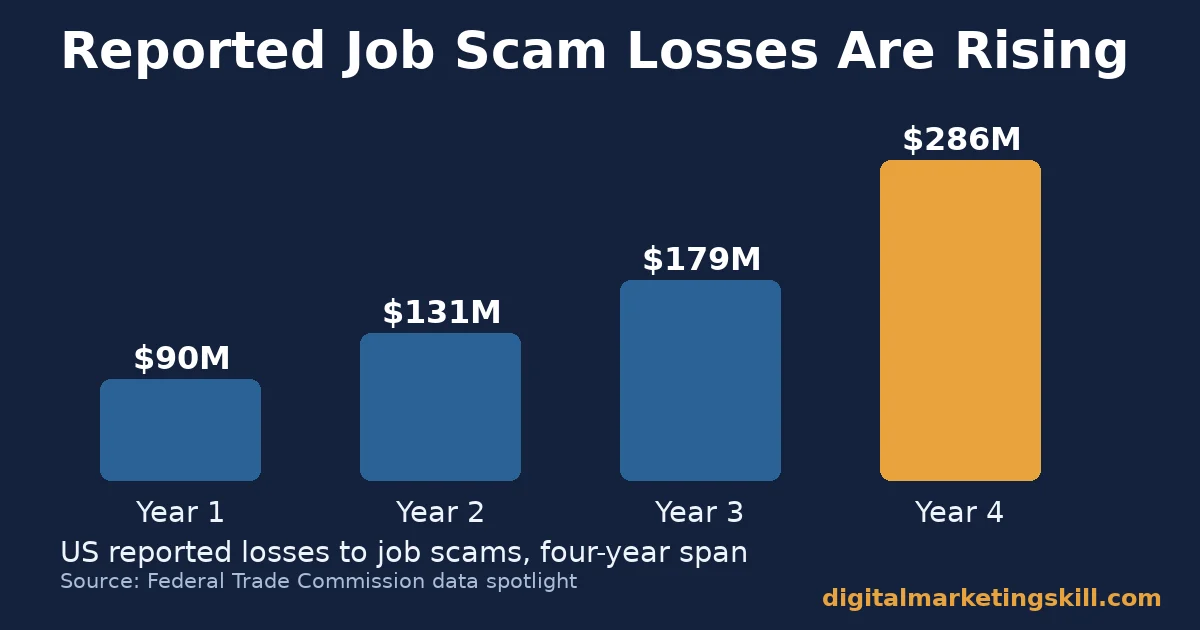
- Reported losses to job scams in the US rose from $90 million to $286 million over four years. They then topped $220 million in just six months the following year, according to the FTC.
- A legitimate employer never asks you to pay first. That single rule screens out most scams before you waste a single hour, per the FTC’s own job scam guidance.
In this guide
- Why Most “Find Online Jobs” Lists Fall Short
- Common Mistakes That Waste Time Or Money
- How Online Jobs From Home Actually Work
- What Differs By Job Type
- How To Win Each Type Of Online Job
- How To Judge An Opportunity Before You Commit
- The One Decision Rule: If They Ask You To Pay First, Stop
- A Worked Case: Checking Before Committing
- A Simple Weekly Routine For Job Searching
- Frequently Asked Questions About Online Jobs From Home
- What You Actually Need To Start
- How This Guide Was Put Together
- Build Skills That Make You Easier To Hire, Anywhere
Why Most “Find Online Jobs” Lists Fall Short
Most lists of online jobs from home just name a dozen job titles. They rarely explain how to tell a real listing from a fake one, or how pay actually works on each type of job. The job titles change constantly, but the underlying patterns behind real online jobs from home do not.
Here are the ground rules for this guide. Every number is attributed to its source, with its scope stated, since a US figure does not describe every country’s labor market.
One example later is labelled “illustrative, invented numbers,” because it is a worked calculation, not a report on a real person’s earnings. Nothing here promises a guaranteed income. Your results depend on your skills, your market, and the hours you put in.
This is also a snapshot, not a ranking of specific companies, since listings and platforms change constantly. Focus on the patterns below, not on any single site name.
One more ground rule: treat any income figure as a range, not a promise. Pay varies by skill, platform, and country. Our own earnings disclaimer page covers this in more depth. If you ever see a specific dollar result tied to a named student, treat it as one example. It is not a guarantee of your own results.
Common Mistakes That Waste Time Or Money
Five mistakes come up again and again when people search for online jobs from home.
- Paying an upfront fee. Real employers do not charge you for training, a starter kit, or a “processing fee.”
- Skipping the interview. A job offered with no call, no video chat, and no real screening is a major warning sign.
- Chasing every listing at once. Spreading effort across dozens of weak applications beats a few strong, tailored ones less often than people think.
- Ignoring the effective hourly rate. A task that pays well per piece can still work out to very little per hour once you count the time it takes.
- Trusting contact on personal chat apps only. Legitimate employers use a company email domain, not only Telegram or WhatsApp.
None of these mistakes are unusual, and most jobseekers make at least one of them at some point. The goal is not perfection on the first attempt. It is building a habit of checking before committing, so each new search gets a little faster and a little safer than the last.
How Online Jobs From Home Actually Work
There are three common structures behind the phrase “online jobs from home,” and they pay in different ways.
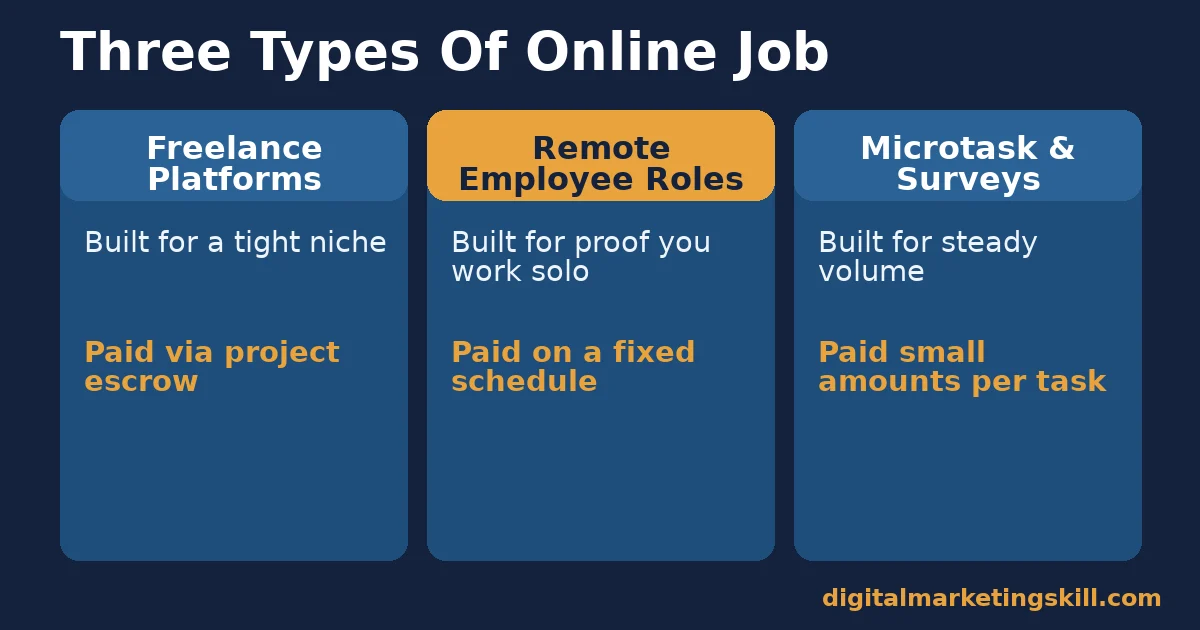
- Freelance platform work, where you win individual projects or contracts through a marketplace and the platform holds payment in escrow until you deliver.
- Remote employee roles, where a company hires you directly, pays a regular salary, and expects set hours or deliverables, just like an office job.
- Microtask and survey work, where you complete small, simple tasks for small payments, often through an app or task marketplace.
The pay model matters because it tells you what normal looks like. Platform escrow means you get paid once the client approves your work. A salaried remote role means you get paid on a fixed schedule either way. Microtask apps usually pay small amounts per task, so your real income depends on volume.
Remote employee roles are a smaller slice of the market than many lists imply. About 7.8% of US job postings advertised remote or hybrid work in a recent snapshot from the Indeed Hiring Lab, up from 2.6% a few years earlier. That is a US-only figure, and it still varies widely by industry. Expect more competition for a true remote employee role than for freelance platform work, simply because fewer of them exist relative to demand.
What Differs By Job Type
A single “best online job” list hides more than it reveals, because screening, pay, and risk differ by type.
Freelance Platform Work: Built For A Tight Niche
Clients hiring through a marketplace scan dozens of profiles fast. A narrow, specific skill wins more often than a broad “I can do anything” profile. Our own guide to freelancing for beginners covers how to pick that first niche.
Remote Employee Roles: Built For Proof You Can Work Unsupervised
A remote employer cannot watch you work. They screen hard for evidence that you deliver on your own, since the hiring risk is higher than for a short gig. This is also why many remote roles suit a digital nomad lifestyle, where async work is already the norm.
Microtask And Survey Work: Built For Steady Volume, Not High Pay
These tasks rarely pay well per hour. They work best as a small side income, or as a way to build a track record on a platform, not as a main income plan. A separate guide on making money from freelancing digs deeper into moving from small tasks to paid projects.
How To Win Each Type Of Online Job
Once you know which type fits your situation, the next step gets specific.
Freelance Platform Work: Lead With A Tight, Visible Portfolio
Pick one or two skills and show finished samples for exactly those skills. A short, focused profile beats a long list of vague abilities. Apply to fewer jobs, but tailor each pitch to the specific client’s request.
Remote Employee Roles: Lead With Proof You Can Work Async
Show a past project you finished with little supervision. Mention the tools you already use for remote collaboration. Be upfront about your time zone and your overlap hours with the employer’s team.
Microtask And Survey Work: Lead With Realistic Hourly Math
Before you commit real hours, time yourself on a handful of tasks. Divide the pay by the minutes it actually took, not the time the app promises. Treat any platform that cannot show this math honestly as a red flag.
How To Judge An Opportunity Before You Commit
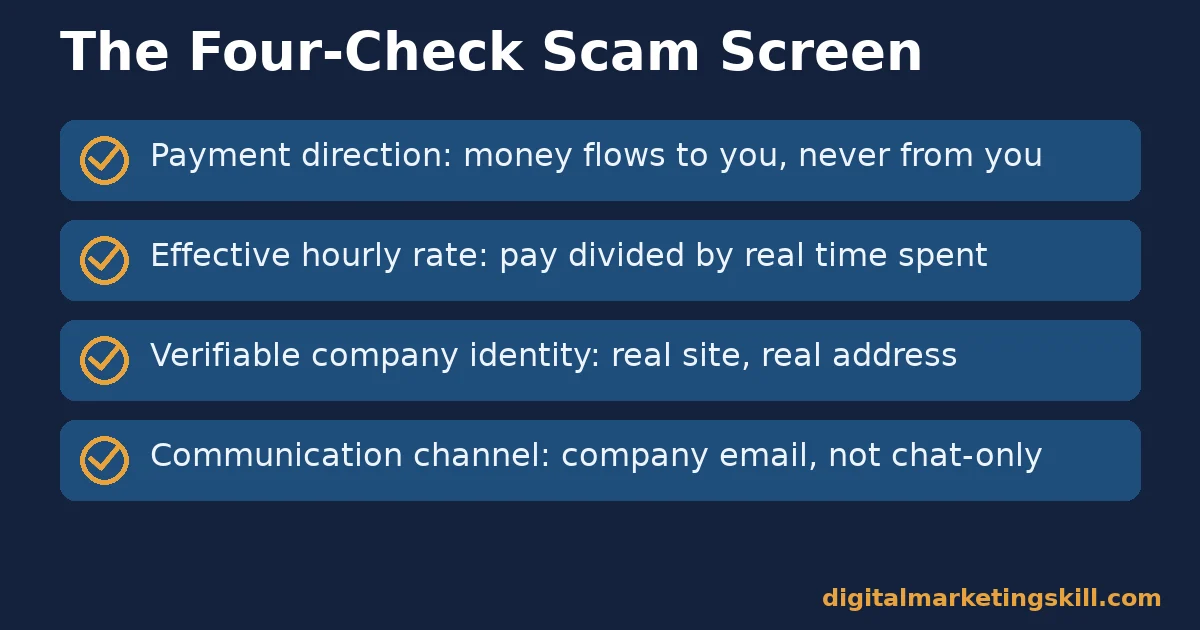
Four checks, each in one line, catch most problems before you lose time or money:
- Payment direction — money should flow to you, never from you. Any request for an upfront fee is disqualifying on its own.
- Effective hourly rate — total pay divided by total time spent, including unpaid tasks like tests or “trial work.” Compare it honestly against your local minimum wage.
- Verifiable company identity — a real company has a working website, a real address, and a presence beyond one job post. Search the company name plus the word “scam” before you apply.
- Communication channel — a company email domain is a good sign. Contact only through a personal chat app, with no company email at all, is not.
Run through all four before you share any personal information or accept any offer.
Keep a simple log of every application: the date, the platform, the pay offered, and whether the four checks passed. After a few weeks, that log shows you which platforms and job types are actually converting into paid work for you, rather than relying on memory or gut feel.
The same four checks work whether you are looking at freelance platform work, a remote employee role, or a microtask app. Only the details change. A freelance client who insists on an unusual, off-platform payment method before any work begins deserves the same suspicion as a recruiter who asks for a licence fee.
The One Decision Rule: If They Ask You To Pay First, Stop
If any step of the process asks you to pay money before you have been paid for work, stop and walk away. This single rule catches the overwhelming majority of job scams, according to the red flags named by the FTC and other consumer-protection researchers above.
Illustrative, invented numbers: imagine two listings. Listing A asks for a $40 “training fee” before you start. Listing B pays you after your first approved task, with no fee at any point. Only Listing B follows the normal pattern for every legitimate online job from home described in this guide, regardless of how convincing Listing A’s job description sounds.
A Worked Case: Checking Before Committing
Illustrative, invented numbers: a jobseeker finds a “data entry” listing promising $25 an hour with no experience required. Before applying, they run the four checks above. The company has no real website, contact happens only through a chat app, and the recruiter asks for a $60 “software licence fee.” All four checks fail, so the jobseeker walks away and applies instead to a freelance platform listing for simple data entry, which pays through escrow once a sample task is approved. The pay is lower per hour, but it is real.
Over the following month, the same jobseeker applies the same four checks to every new listing before spending any time on it. Roughly half of the “too good to be true” offers they find fail the payment-direction check alone. The time saved by rejecting those early gets reinvested into a small number of well-tailored applications on legitimate platforms instead, which is where real income actually starts to build.
A Simple Weekly Routine For Job Searching
A loose, repeatable routine beats random searching. Try a version of this each week:
- Set a time budget first. Decide how many hours you can realistically give to searching and applying, then stick to it.
- Search by skill, not by job title alone. Searching for the specific task you can do, such as “social media scheduling” instead of only “marketing job,” surfaces more relevant listings.
- Run the four checks on every listing before you apply. This takes minutes and saves hours.
- Tailor each application to the listing. A short, specific pitch that mentions the client’s actual need beats a copy-pasted generic message.
- Log the result. Note what worked and what did not, so next week’s search is a little sharper than this week’s.
This routine will not make every week successful. It does make your time more productive than applying to every listing you see with no filter at all.
Frequently Asked Questions About Online Jobs From Home
Are online jobs from home actually legitimate?
Many are. Freelance platform work, remote employee roles, and genuine microtask apps are all real and widely used. The risk is not the category; it is specific listings that show scam red flags, such as an upfront fee.
What is the biggest red flag in an online job listing?
Any request for you to pay money before you are paid for work. Legitimate employers and platforms never ask new workers to cover training costs, starter kits, or processing fees out of pocket.
How much can you realistically earn from online jobs from home?
It depends heavily on the type. Remote employee roles usually pay closest to normal salaries for the role and location. Freelance platform work varies with skill and niche. Microtask and survey work tends to pay the least per hour, so treat it as supplemental income.
Do I need a specific skill to start?
A specific, narrow skill helps far more than a general one, especially on freelance platforms where clients compare many profiles quickly. If you are starting from zero, microtask work can build initial experience while you learn a more specific skill.
How do I know if a remote employer is real?
Check for a working company website, a real street address, and some presence outside the single job post, such as reviews or a verifiable team. A real interview process, rather than an instant offer, is also a strong sign.
Why do some online jobs from home pay so little per hour?
Microtask and survey platforms often price individual tasks low because each one requires little skill and faces competition from a large pool of workers worldwide. Skill-based freelance work and remote employee roles typically pay more, because they require more specific ability and screen out more competition.
Should I mention that I am new to online jobs from home in my application?
Being new is not the problem; having nothing to show is. Instead of stating your experience level directly, show a small sample of relevant work, even an unpaid practice piece built specifically for the application. A focused sample often outweighs years of unrelated experience in a client’s decision.
What should I do if I already paid money to a scam?
Contact your bank or payment provider immediately to try to reverse the transaction. Then report the scam to the relevant consumer-protection authority in your country, following guidance such as the FTC’s advice referenced above. Acting quickly improves the odds of recovering funds.
What You Actually Need To Start
You do not need expensive equipment to start most online jobs from home. A reliable internet connection and a basic laptop cover the large majority of freelance platform work, remote employee roles, and microtask apps.
Beyond that, a few free or low-cost tools help. A simple portfolio page or document that shows your best work is one. Set up a dedicated email address for job applications too. Finally, a basic spreadsheet or note to track the applications you send rounds it out. None of these require upfront payment to any employer or platform. If a listing insists you must buy specific paid software before you can even apply, treat that as another version of the “pay first” red flag covered above.
How This Guide Was Put Together
We checked every statistic above directly against the page or report that produced it, and named the source next to the number. The worked examples are explicitly labelled illustrative, because they are demonstrations of how to apply the checks, not reports of a real person’s results. The Digital Marketing Skill Institute prepared this guide as part of its practical career and digital marketing resources, and will update it if the underlying data changes.
Where a figure comes from a single country, such as the United States, we say so directly. It never stands in for a global number. Job markets, pay scales, and typical remote-work rates differ widely by country. A figure that is accurate for one labor market can mislead in another.
Build Skills That Make You Easier To Hire, Anywhere
Finding safe online jobs from home is one skill. Building the kind of in-demand digital skills that make clients and employers choose you is another, bigger one. Digital marketing, content, and analytics skills consistently sit behind the highest-paying freelance and remote roles, and behind the online jobs from home that pay well enough to become a full career rather than side income.
The Digital Marketing Skill Institute’s Master Diploma in Digital & AI Marketing offers four AI-powered tracks, built around real, hireable skills rather than theory, totalling ten courses, with a Full Stack option for completing all four. It includes unlimited one-on-one mentoring with expert coaches, plus a U.S. Project Internship with a partner company that comes with a verified U.S. Work Reference Letter, so you graduate with real proof of work, not just a certificate. The program is dual US and UK accredited, recognised in more than 100 countries, and runs 100% online, so you can study from anywhere in your country.
Read how past students describe the program on our reviews page, then explore more practical guides on the digital marketing blog. Wherever you live, the scam-check framework in this guide applies the same way. So does the value of a specific, in-demand skill over a vague, general one. When you are ready to build a skill set employers actually compete for, apply to the Master Diploma program. Learn more about the Institute at digitalmarketingskill.com. For now, bookmark digitalmarketingskill.com and come back whenever you need another practical guide.
Every figure in this guide was checked against its original source before publication. Figures marked as illustrative are invented examples, not real results.
