
You can make money with WordPress in three broad ways. Build and sell products for other WordPress users. Offer your skills as a paid service. Or monetize the content on your own WordPress site. WordPress now powers 40.0% of all websites, so the market for each path is enormous. Pick one path, build proof for 30 days, then expand from there.
Key Takeaways
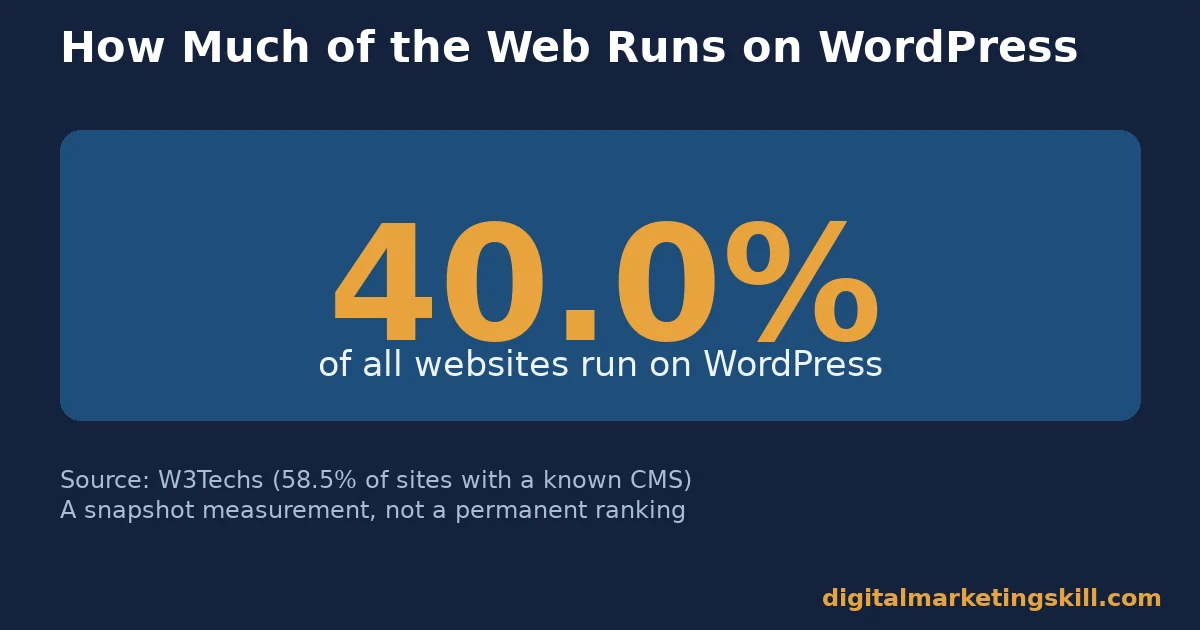
- WordPress runs almost half the web. W3Techs reports WordPress powers 40.0% of all websites and 58.5% of sites with a known content management system.
- There are three real ways to make money with WordPress. Build and sell products (themes, plugins, digital products), offer paid services (consulting, setup, writing, freelancing), or monetize your own content (ads, affiliate links, sponsorships, memberships).
- E-commerce is a proven path. WooCommerce says its software runs 4 million-plus online stores and powers 31% of the top 1 million e-commerce sites, based on Store Leads data.
- Services pay faster than products. A product needs an audience before it earns. A service can get paid from its very first client.
- Content monetization needs traffic first. Ad networks such as Mediavine set real thresholds, including a Tier-1 session minimum for newer sites, so build an audience before expecting ad income.
In this guide
- What Most “Make Money With WordPress” Lists Get Wrong
- Why the Right WordPress Path Matters More Than the Platform
- How Making Money With WordPress Actually Works
- What Differs by WordPress Income Type
- How to Start Strong in Each WordPress Income Type
- How to Measure Whether a WordPress Income Path Is Working
- The One Rule: Match the WordPress Path to What You Already Have
- A Real Case: Scaling One Service Into a Bigger Business
- Frequently Asked Questions About Making Money With WordPress
- Pick One WordPress Income Path and Build Proof First
What Most “Make Money With WordPress” Lists Get Wrong
Most lists of ways to make money with WordPress are just a long menu. Themes, plugins, ads, affiliate links and freelancing, all mixed together with no order and no sense of sequence. That treats a brand-new WordPress user the same as someone who has run a profitable site for five years.
But the right starting path to make money with WordPress depends entirely on what you already have, not on which list you happened to read first.
A word on the ground rules first. The market-share and store-count figures below are snapshots from when they were measured, not permanent rankings you can rely on forever. Platform fees and marketplace rules change often, sometimes with little notice. So always check a platform’s own current terms before committing real time and effort to it.
This guide sorts the real ways to make money with WordPress into three types. It explains the mechanism behind each one. Then it gives you a decision rule for picking a starting point: a skill, an audience, or neither yet.
Why the Right WordPress Path Matters More Than the Platform
WordPress itself does not pay you directly, and no single WordPress skill guarantees income on its own. WordPress is simply the software underneath whichever path you choose.
W3Techs puts its reach at 40.0% of all websites, or 58.5% of sites with a known content management system. That scale means every path below has real demand behind it. But scale alone does not tell you which path fits you right now.
Someone who can already design or code should look first at building and selling products. That skill is the hardest part of the build-and-sell path, so it is already solved. Someone who can already write, consult or set up sites should look first at offering a service instead. Services get paid almost immediately, which matters most when you need income soon.
Someone with neither skill yet, but the patience to build an audience over months, should look at content monetization. That path rewards steady consistency more than any single skill you bring to it on day one. If you are starting from zero, our guide to building a WordPress website covers the setup itself.
The Cost of Picking the Wrong WordPress Path
Picking the wrong type for your situation wastes real months. A beginner who spends a year building a plugin nobody wants earns nothing for that year. A beginner who spends the same year freelancing small WordPress setup jobs earns from week one. Even the early jobs pay something, however modest.
The three types also fail in different ways. A product fails quietly, with no sales and no feedback to learn from. A service fails loudly instead, with a client who tells you directly what went wrong. Knowing your path’s likely failure mode in advance helps you catch trouble earlier.
How Making Money With WordPress Actually Works
Every path to make money with WordPress reduces to the same basic exchange. Someone else needs a WordPress outcome they cannot or will not produce themselves. You supply it for a fee, a commission, or an ad impression instead. The three types below differ mainly in who pays you to make money with WordPress, and when they pay.
Product sellers get paid once per customer, usually through a marketplace such as CodeCanyon or ThemeForest, or directly from their own site. The marketplace takes a cut of each sale in exchange for bringing buyers to you, the same tradeoff freelance platforms make with freelancers.
Service providers get paid directly by a client for time or expertise. That could mean building a WooCommerce store, writing content for a blog, or consulting on a site redesign. Payment arrives faster here, because there is no audience-building step standing between you and the client.
Content monetizers get paid by advertisers or affiliate partners, based on the traffic their own site generates. WooCommerce alone says it powers 4 million-plus stores and 31% of the top 1 million e-commerce sites, using data from Store Leads. That single figure shows how much of the make-money-with-WordPress ecosystem already runs through commerce content on this platform.
What Differs by WordPress Income Type
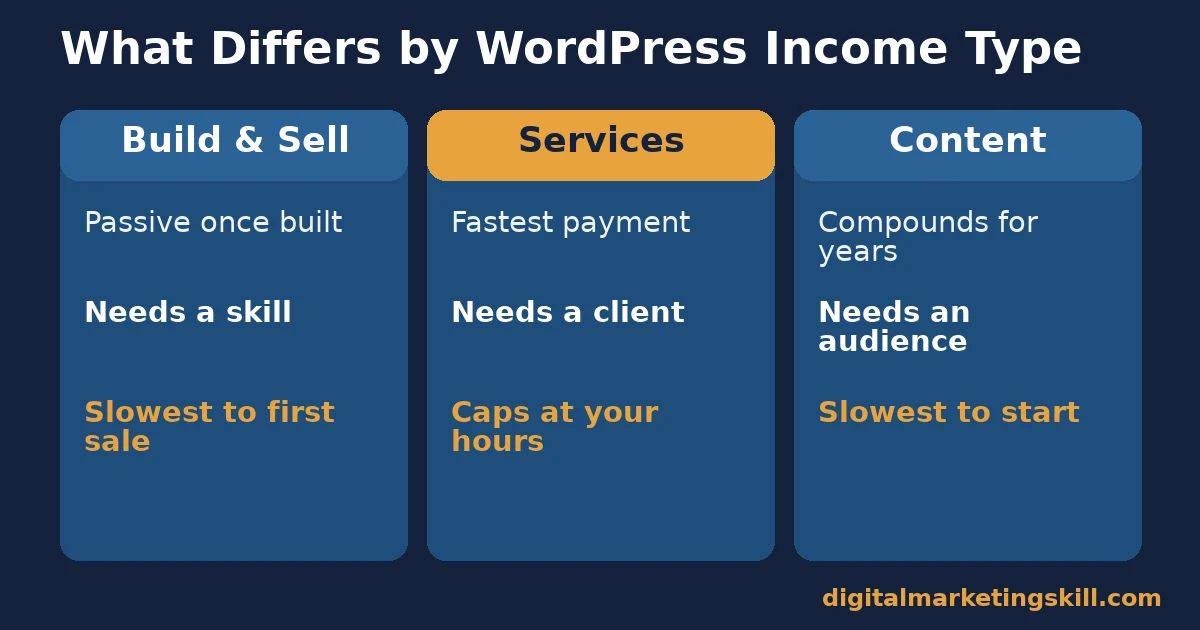
Three realistic types cover almost every way to make money with WordPress: building and selling products, offering paid services, and monetizing your own content. Each pays on a different timeline, and each needs a different starting asset before it can earn anything at all.
None of the three is universally the best choice. Products can become a passive income stream, but need design or development skill plus an audience willing to buy. Services pay the fastest of the three, but trade your time directly for money, hour by hour. Content monetization can compound for years once it works, but needs real traffic before it earns a single dollar.
Build and Sell: Built Around a Skill You Package Once
This type covers WordPress themes, plugins, and digital products such as templates or courses sold to other WordPress users. You build the thing once, then sell it repeatedly through a marketplace such as ThemeForest or CodeCanyon, or straight from your own site.
The appeal is that income can keep arriving long after the initial build is finished. The tradeoff is real, though. You need a specific, marketable skill to build something worth buying. A crowded marketplace also means a generic plugin or theme competes against thousands of others already listed there.
Offer Services: Built Around Getting Paid Immediately
This type covers WordPress consulting, blog and store setup, content writing, and general freelance work such as design or development. A client pays you directly for your time or expertise, whether that is a one-off project or an ongoing monthly retainer.
The appeal is speed, plain and simple. You can land your first paid client within weeks, with no audience and no marketplace approval required first. The tradeoff is that your income caps out at the hours you can personally work, at least until you build a team around you.
Monetize Content: Built Around an Audience You Grow
This type covers display ads, affiliate marketing, sponsored content and paid memberships on a WordPress site you run yourself. None of it pays a cent until the site has real traffic or a real list of engaged, returning readers.
The appeal is that a successful content site can compound for years with only modest ongoing effort. The tradeoff is the slowest start of the three types by far. Ad networks and sponsors both require a real traffic threshold before they will even consider working with you.
How to Start Strong in Each WordPress Income Type
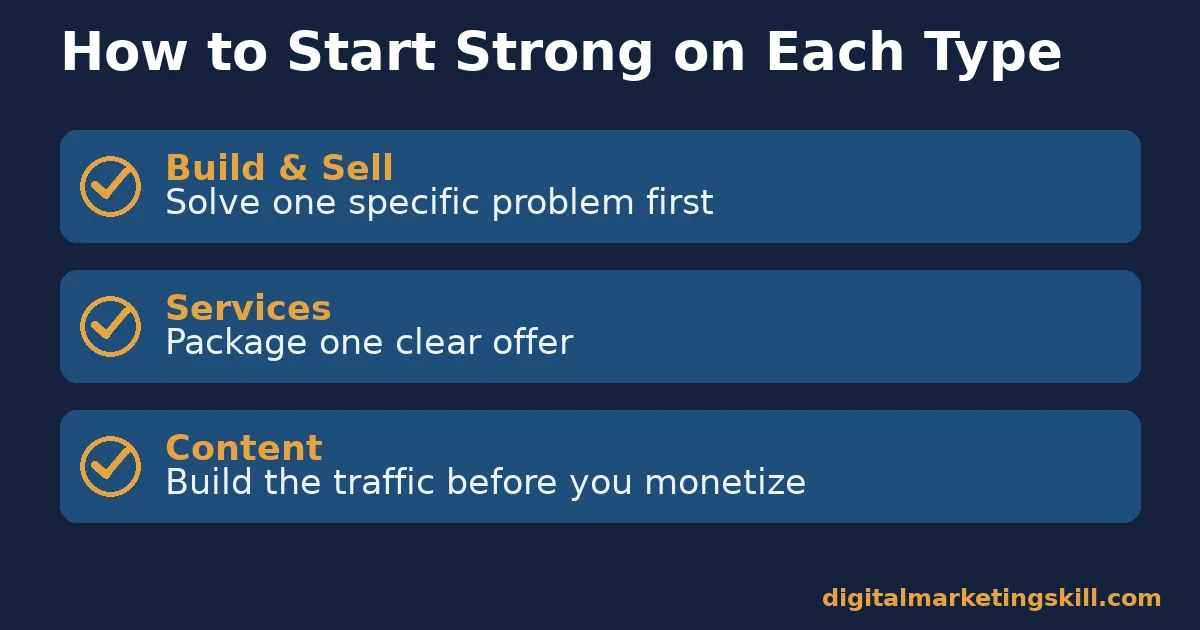
Pick the type that matches what you already have: a buildable skill, a sellable service, or the patience to grow an audience over time. The sections below mirror the three types above, with the first real step to take if you want to make money with WordPress through each one.
Build and Sell: Solve One Specific Problem First
Pick a narrow, specific problem to solve, rather than building a generic theme or plugin that tries to do everything at once. A plugin that fixes one annoying, common problem is easier to market, and easier for buyers to understand, than a broad toolkit competing against established names.
Study a few existing listings on CodeCanyon or ThemeForest before you build anything at all, to see what already sells well and where the real gaps are. Price your first product modestly to gather early reviews. Raise prices only once you have genuine buyer feedback and a track record on the marketplace.
Offer Services: Package One Clear Offer
Write your offer as one sentence: what you do, for whom, and what they get. For example, “I set up a WooCommerce store in two weeks for small retail brands.” A specific offer converts far better than a vague list of everything you can technically do.
The US Bureau of Labor Statistics puts median pay for web developers and digital designers at $99,520 a year. Treat that as a ceiling for experienced specialists, not a starting rate.
Start with WordPress setup or consulting work if you are new to this, since the barrier to entry is lower than specialized development work.
If you need your first clients, see our guide to the best freelance websites for finding online work. Use your first few projects to build a portfolio and collect testimonials, even at a lower rate than you want long-term. Raise your prices once you have proof you can deliver.
Monetize Content: Build the Traffic Before You Monetize
Publish consistently on a narrow topic before adding any monetization at all. Most ad networks and sponsors will not consider a site without real, sustained traffic. Mediavine’s own requirements page asks for a minimum of $5,000 in annual ad revenue to join its main program. Its Journey program for growing sites asks for at least 1,000 sessions from Tier-1 countries within 30 days instead.
Add affiliate links naturally, and only to products you have actually used yourself, well before you reach an ad network’s traffic threshold. Our guide to starting affiliate marketing covers how to pick programs and disclose links properly. Affiliate programs generally have a lower entry bar than display-ad networks do.
Treat sponsorships and paid memberships as a later stage, once you have built a loyal, engaged audience worth a brand’s attention. See our guide on content marketing for how to grow that audience first. If a brand does pay for a post, the FTC’s own disclosure guidance requires clear, hard-to-miss language such as “ad” or “sponsored,” not vague terms.
How to Measure Whether a WordPress Income Path Is Working
Track one number that matches your chosen type, rather than chasing vague progress across all three at once. Each type has a different honest signal of whether it is actually working for you.
Three Numbers That Tell the Real Story
- Products: sales per listing, after the marketplace’s cut. A marketplace fee changes your real take-home rate, so compare net income per sale, never the listed sticker price.
- Services: effective hourly rate, including unpaid time. Count proposal writing, revisions and admin work, not just billable hours, to see your true return on the work.
- Content: revenue per thousand sessions, tracked monthly. This normalizes ad and affiliate income against your traffic, so you can tell whether growth or monetization itself is the bottleneck.
What the Numbers Tell You to Change
If your product sales are low despite marketplace approval, the problem is usually positioning or price, not the product’s quality. Study which competing listings are outselling yours, and what their screenshots and descriptions promise differently from yours.
If your service’s effective hourly rate stays low despite steady client work, you are likely under-pricing, or absorbing scope creep without charging for it. Raise your rate for new clients first, since existing clients are always harder to renegotiate with mid-project.
If your content revenue per thousand sessions stays flat even as traffic grows, the fix is usually ad placement or affiliate relevance, not more content. Review both of those before publishing even more posts into the same underperforming setup.
The One Rule: Match the WordPress Path to What You Already Have
If you remember one decision rule from this guide, make it this one. Someone with a design or development skill should start with build-and-sell. A person with a sellable skill but no finished product yet should start with services instead, since services pay fastest with the least upfront work.
Anyone with neither skill, but the patience to publish consistently, should start with content monetization. Expect that path to pay the slowest of the three, by a wide margin.
Here is an illustrative example, with invented numbers. A beginner web designer starts by offering WordPress setup services to small businesses at a modest rate. After ten finished projects, they have a real portfolio and genuine testimonials to show new clients.
They then package their best setup process into a small plugin, sold on the side while the service work keeps going. The service income funded the time needed to build that product. The product income, in turn, does not need new clients arriving every month to keep paying out.
Neither path replaced the other here. The service work built the proof and the spare time that made the product possible in the first place.
The lesson generalizes well beyond WordPress. Services prove you can deliver, and they pay you while you are still learning. Products and content both compound once you already have free time, a sellable skill, or an audience to point them at.
A Real Case: Scaling One Service Into a Bigger Business
Olajire Jacob, a Digital Marketing Skill Institute student, started by charging an average of $500 to set up email marketing flows for clients in the US, UK and Canada. As published in the Institute’s own student reviews, Jacob used the course’s library of resources and templates to expand that service offering and scale it to $5,000 a month.
The useful detail here is the expansion itself, not just the end number. Jacob did not start at $5,000 a month. The first paid service built a client relationship and a proven process that supported adding more services later on. That exact pattern, start with one paid service and expand once it works, applies directly to a WordPress consulting or setup business too.
Keep the limits in mind, though. This is one published, named result in email marketing, not a WordPress-specific case, and not a guarantee of similar income for anyone else reading this. See the Institute’s earnings disclaimer for the full context behind it. Treat it as evidence that starting with one service and expanding it can genuinely work, not as a promise of any specific outcome.
Frequently Asked Questions About Making Money With WordPress
What is the fastest way to make money with WordPress?
Offering a service, such as WordPress setup, consulting or content writing, is usually the fastest path to make money with WordPress. You can get paid by your first client within weeks, sometimes days. Building a product or monetizing content both take longer, because they need a buyer base or a real, engaged audience first.
Can I make money with WordPress without coding skills?
Yes, easily. Services such as content writing, consulting, blog setup and client management need no coding at all. Content monetization through ads, affiliate links or memberships also needs no development skill, only consistent publishing over time.
How much can I realistically earn selling WordPress plugins or themes?
Earnings vary enormously by product quality, marketplace competition and marketing effort. Check a marketplace’s own current fee structure, and browse comparable listings, before estimating anything. A single average figure would be misleading across such different products and niches.
Do I need a lot of traffic before I can monetize a WordPress blog?
For display ad networks, usually yes. Mediavine’s own requirements page asks for a minimum of $5,000 in annual ad revenue for its main program. Its Journey program for growing sites asks for at least 1,000 sessions from Tier-1 countries in 30 days instead. Affiliate marketing generally has a lower entry bar than display ads do.
Is selling WordPress themes still profitable with so much competition?
It is harder than it once was, since established marketplaces are already crowded with themes. A narrow, specific theme built for one clear use case competes far better than a generic multipurpose theme entering an already saturated category.
What is the difference between a WordPress service business and a product business?
A service business trades your time directly for client payment, and can start earning almost immediately. A product business works differently: it needs an upfront build and a real buyer base before it earns anything at all, but it can then earn repeatedly from the same product without new hours spent each time.
Can I combine more than one way to make money with WordPress?
Yes, and plenty of people do exactly that. A common pattern among people who make money with WordPress is starting with services to earn quickly, then using that income, and the proof it builds, to fund a product or a content site that can grow without trading more hours for more money later.
Pick One WordPress Income Path and Build Proof First
Choose the type that matches what you already have today: a buildable skill, a sellable service, or the patience to grow an audience. Track the one number that matches your path from the very first week, and give your attempt to make money with WordPress real time before judging whether it is working.
If you want the underlying skills built properly, including the service and content skills this guide covers, Digital Marketing Skill Institute runs its Master Diploma in Digital & AI Marketing across four AI-powered tracks and ten total courses, or all four as Full Stack. It comes with unlimited 1-on-1 mentoring and coaching, plus a U.S. project internship with its partner company from day one. The diploma is dual US and UK accredited, and recognized in more than 100 countries.
The program is fully online, so you can build a WordPress-based income from anywhere in your country. Browse more guides on the Digital Marketing Skill Institute blog, and when you are ready, apply for the Master Diploma or start from the Digital Marketing Skill Institute homepage.
Every figure in this guide was checked against its original source before publication. Figures marked as illustrative are invented examples, not real results.
![9 Amazing Digital Marketing Skills to Make Money Online [With Proof]](https://digitalmarketingskill.com/wp-content/uploads/2019/07/9-Amazing-Digital-Marketing-Skills-to-Make-Money-Online-With-Proof-17.png)






