
A marketing strategy is the plan a business follows to reach the right buyers, convert them into customers, and keep them coming back. Done well, it directs every channel you use. Done badly, it leaves each channel fighting for budget with no shared goal.
Key Takeaways
- Email still returns the most per dollar. Litmus reports email drives an average ROI of $36 for every $1 spent, higher than any other channel it tracks.
- Most content never gets found. Ahrefs analysed about 14 billion pages and found 96.55% get zero organic traffic from Google.
- Trust still beats ads. Nielsen’s global study found 88% of people trust recommendations from someone they know over any other channel.
- Fewer marketers are writing their strategy down. Content Marketing Institute’s own B2B survey found 32% of marketers have a documented content marketing strategy, down from 35% the prior year.
- A strategy only works if someone owns it. Without a named owner and a review date, a written marketing strategy tends to drift back into ad-hoc activity within a quarter.
In this guide
- The Marketing Strategy Gap: Why Most Plans Stall
- How A Marketing Strategy Actually Works
- What Differs By Marketing Strategy Channel
- How To Lead With Each Channel’s Strength
- Measuring Whether Your Marketing Strategy Is Working
- The One Decision Rule For Sequencing Your Marketing Strategy
- A Real Case: Charging More By Narrowing The Service
- Frequently Asked Questions About Marketing Strategy
- Your Next Step Toward A Working Marketing Strategy
The Marketing Strategy Gap: Why Most Plans Stall
Most marketing strategy guides list channels. Do SEO. Run ads. Send emails. Post on social. That is a tactics list, not a strategy. A real marketing strategy says which channel to lead with, why, and when to add the next one.
This guide groups the common channels into three working types. It names what each is built for, and gives one rule for sequencing them. Treat every figure below as a snapshot. Benchmarks shift as platforms and algorithms change, and a study from one market does not describe every market.
How A Marketing Strategy Actually Works
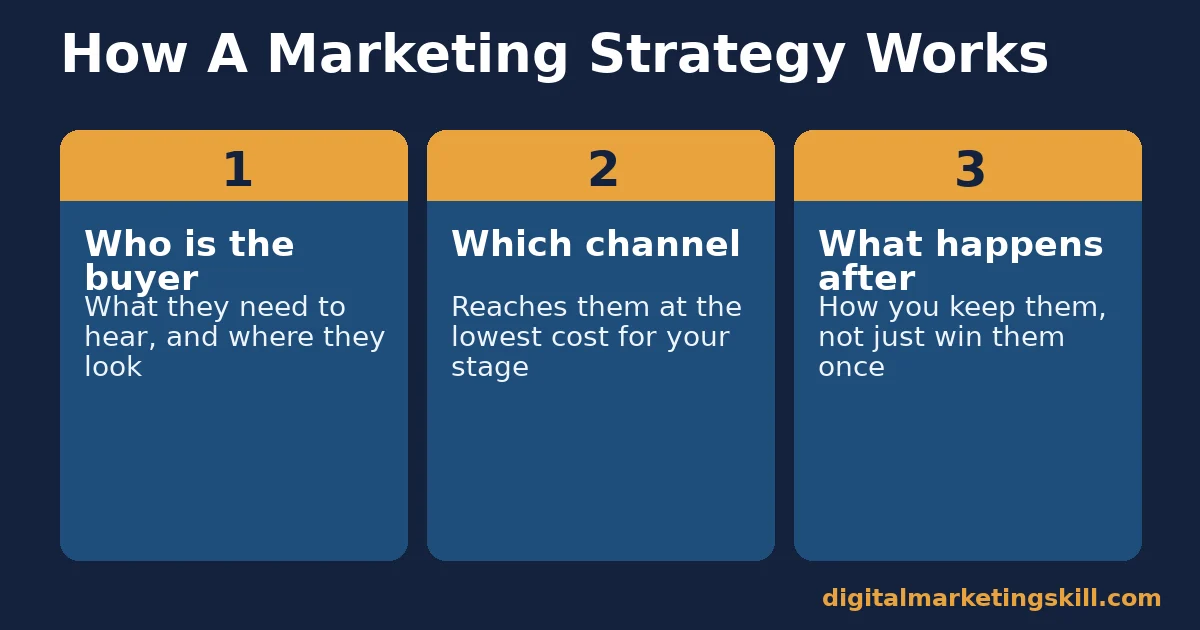
Every working marketing strategy answers three questions. Who is the buyer, and what do they need to hear? Which channel reaches them at the lowest cost for your stage? And what happens after the first sale, so the relationship does not end there?
Skip the first question and your message fits no one well. Skip the second and you overspend on the wrong channel. Skip the third, and you keep paying full price to win back customers you already had.
A marketing strategy is not the same as a marketing plan. The strategy sets the direction and the sequence. The plan is the calendar of campaigns that executes it. Businesses that document the strategy first tend to spend the plan’s budget more consistently, because every campaign can be checked against the same goal.
The U.S. Small Business Administration’s own marketing guidance makes a similar point: it frames a marketing plan as something built on top of clear goals and a defined audience, not the other way around. Skipping that order is a common reason campaigns underperform even when the execution looks polished.
What Differs By Marketing Strategy Channel
Not every channel behaves the same way, or pays off on the same timeline. The three types below differ in three ways: how fast they produce a result, how much they cost upfront, and how long the effect lasts after you stop paying for it.
Organic Content and SEO: Built For Compounding Reach
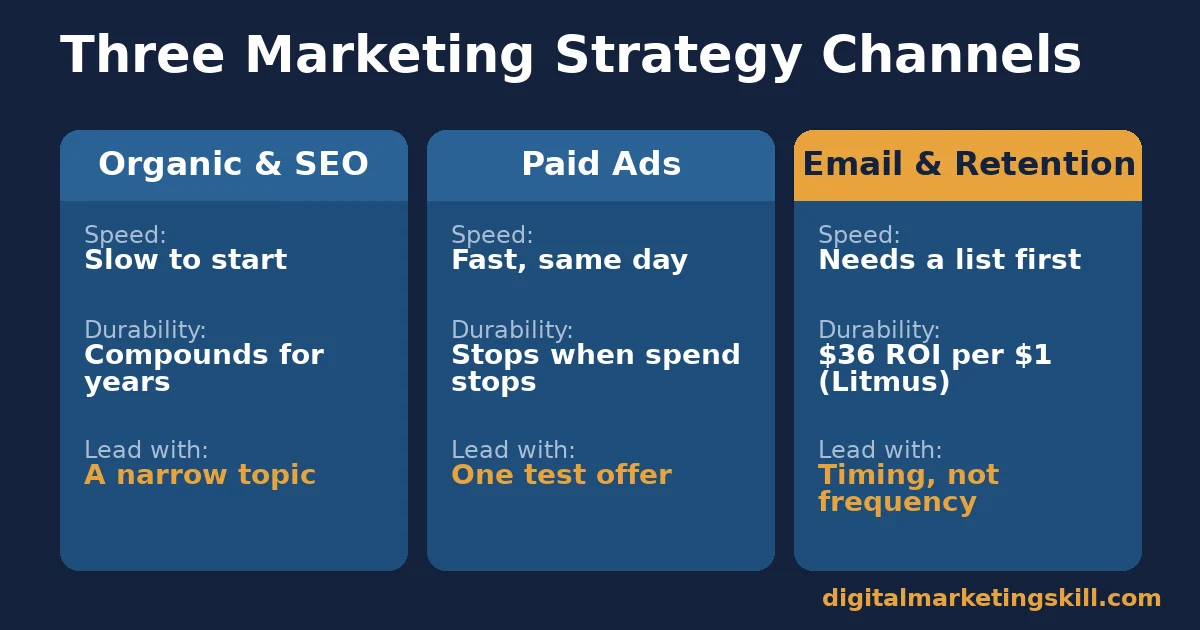
Organic content and search visibility grow slowly, but they keep working after you publish. A page that ranks well can keep bringing visitors for years with little extra spend. That is why this channel compounds in a way paid channels do not.
The trade-off is real, though. Most content never gets found. Ahrefs’ analysis of roughly 14 billion pages found that 96.55% get zero organic traffic from Google, and 1.94% get ten visits a month or fewer. A marketing strategy that leans on search engine optimization needs patience, a narrow topic focus, and enough volume to beat that ratio.
Google’s own guidance on helpful, people-first content asks whether a visitor leaves “feeling they’ve learned enough” to solve their problem. That single test filters out most of the thin, keyword-stuffed content that never earns a ranking in the first place.
Paid Advertising: Built For Immediate Volume
Paid search and paid social can produce traffic and leads the same day you launch a campaign, because you are buying placement instead of earning it. That makes paid advertising the fastest way to test whether an offer converts, before you invest months in organic content.
The cost, however, stops the moment the budget does. Paid advertising rarely compounds the way organic content does. A marketing strategy built only on paid spend needs a growing budget to keep growing results, which is a fragile position if the budget ever gets cut.
Paid channels are also the most sensitive to rising costs. As more businesses bid for the same keywords or audiences, the price per click or per thousand impressions tends to climb. A marketing strategy that treats paid spend as permanent, rather than as a bridge to organic or retention channels, usually sees its margins shrink over time.
Ad quality affects cost too, not just the bid itself. Google Ads’ own documentation explains that a higher Quality Score, based on expected click-through rate, ad relevance and landing page experience, can lower the price you pay for the same ad position. A rushed, generic ad usually costs more per click than a relevant, well-targeted one.
Email and Retention: Built For Repeat Revenue
Email and other owned channels talk to people who already chose to hear from you. That is why the return is so different from channels built for cold reach. Litmus reports email drives an average ROI of $36 for every $1 spent, the highest of any channel it tracks. Our email marketing strategy guide covers the sequences that produce most of that return.
Retention channels do not replace organic or paid reach, though. They need a list to email and a product worth repeating. Their job in a marketing strategy is to keep the customers that organic and paid already won, so the business is not paying full acquisition cost on every single sale.
How To Lead With Each Channel’s Strength
Picking a channel mix is step one. Succeeding in it means leading with what each channel is actually good at, instead of expecting every channel to do the same job.
Organic Content and SEO: Lead With A Narrow Topic
Pick one problem your buyer searches for, and own it before you add a second topic. A narrow, well-answered topic beats a wide, shallow one. Search engines and readers both reward depth over breadth.
Publish on a schedule you can sustain for months, not weeks. Our list of content marketing tools can help you plan and track that schedule. Given how much content gets no traffic at all, consistency and topic focus matter more than publishing volume.
Paid Advertising: Lead With A Single Offer To Test
Test one offer, one audience and one landing page before you scale the budget. Paid advertising’s speed is only useful if you are learning something from each test, not just spending faster. Pair it with a social media marketing presence, so paid clicks land on a brand people recognise, not a stranger’s ad.
Set a maximum cost per result before you launch, and stop or adjust the campaign the moment it crosses that line. Because paid results stop when spend stops, an undisciplined paid budget can drain a marketing strategy’s resources fast.
Email and Retention: Lead With Timing, Not Frequency
Send the right message at the right moment in the customer relationship, rather than a high volume of generic messages. A welcome sequence, a post-purchase follow-up and a win-back message for lapsed customers will outperform a weekly newsletter with no triggers behind it.
Segment your list by what someone actually did, not just when they joined. A retention strategy built on behaviour, not just a send schedule, protects the high ROI that email channels are capable of.
Why Trust Still Beats All Three Channels
Underneath organic, paid and retention sits a fourth force that a marketing strategy should plan for, even without a dedicated budget line: word of mouth. Nielsen’s global study found that 88% of people trust a recommendation from someone they know more than any advertising channel it measured.
You cannot buy word of mouth directly, but you can make it more likely. A product worth talking about, a simple way to refer a friend, and visible proof from other customers all raise the odds that your organic, paid and retention work gets amplified for free.
Who Should Run Each Channel
A single generalist can run all three channels at a very small scale. But each channel rewards a different kind of skill. Organic content rewards patient writers and researchers. Paid advertising rewards people comfortable testing and cutting weak campaigns quickly. Retention rewards people who think in sequences and triggers, not single sends.
As a business grows, specialising these roles, even informally, tends to outperform asking one person to be equally strong at all three. If you can only hire or train for one skill first, match it to the channel your decision rule below points you toward.
Measuring Whether Your Marketing Strategy Is Working
Four numbers tell you whether a marketing strategy is working better than “traffic feels higher this month.” Track them by channel, not only in total, from your very first campaign.
The Four Metrics To Track
- Customer acquisition cost (CAC). Total spend on a channel, divided by the customers it produced. Track this per channel. A cheap channel that converts poorly can cost more per customer than an expensive one that converts well.
- Conversion rate. The share of visitors or leads from a channel who become paying customers. A falling conversion rate, even with rising traffic, usually means the channel is reaching the wrong audience.
- Customer lifetime value (LTV). The total revenue one customer brings before they stop buying. This number decides how much you can afford to spend acquiring them in the first place.
- LTV to CAC ratio. Lifetime value divided by acquisition cost. A ratio below 3:1 usually means a channel is not sustainably profitable, once support and delivery costs are included.
Read these four together, not alone. A low CAC with a low LTV:CAC ratio often means a channel is attracting cheap but low-value customers. That points you toward a retention fix, not more acquisition spend.
The One Decision Rule For Sequencing Your Marketing Strategy
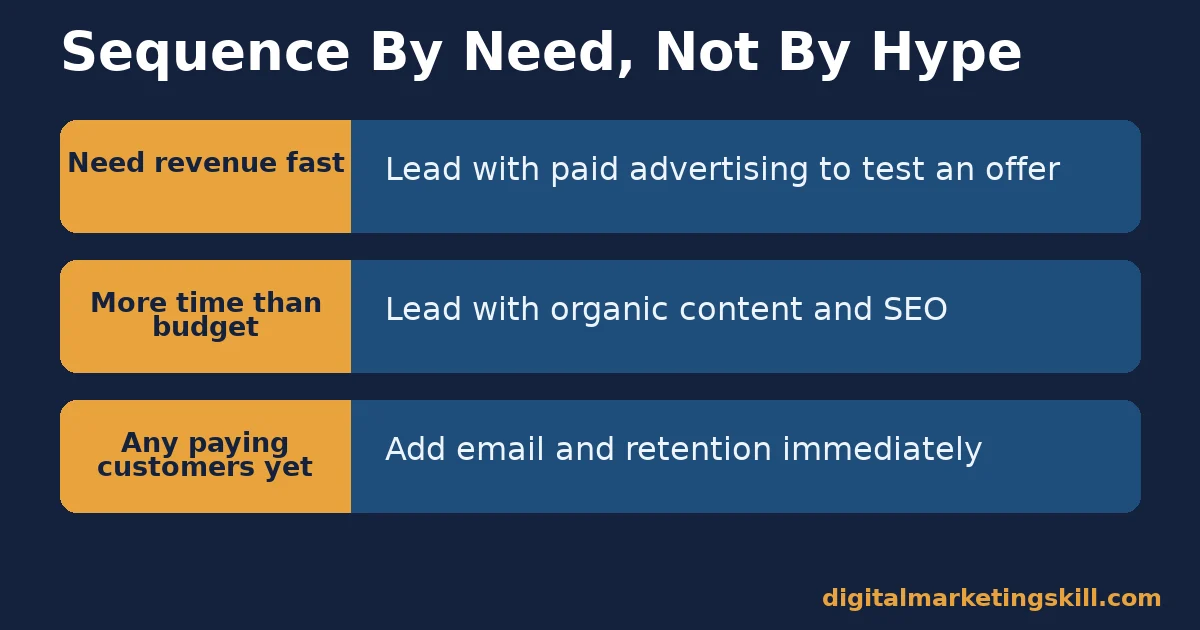
Lead with paid advertising when you need revenue fast and have budget to test with. It is the only channel of the three that can produce a result inside a single week.
Lead with organic content and SEO when you have more time than budget. Its slow start is repaid by reach that keeps compounding long after you stop actively promoting a given page.
Add email and retention as soon as you have any paying customers at all, regardless of which channel led. It is cheap to run, and it protects every dollar the other two channels already spent to win that first sale.
A Worked Example
Illustrative, invented numbers: picture a small business with a $2,000 monthly budget. It puts $1,200 into paid search and gets 40 customers at $30 CAC in month one.
It puts $500 into content that produces almost nothing for two months. By month six, that content starts ranking and brings in 15 customers a month at close to $0 extra cost. The remaining $300 funds an email flow that lifts repeat purchases from those first 40 customers by 20%, without any new ad spend at all.
A Simple Starting Split
If you have no data of your own yet, a reasonable starting split is roughly 50% paid, 30% organic content, and 20% retention and email. Adjust every month based on your own CAC and LTV numbers, not on the split itself.
Businesses with a longer sales cycle, such as higher-priced services, often shift that split toward more organic content and less paid spend, because buyers research for longer before they purchase.
Seasonality can justify a temporary shift too. A business with a clear peak season can afford to lean harder into paid advertising right before that peak, since the higher short-term cost is offset by a shorter path to revenue when demand is already high. Outside that window, the same budget usually works harder funding organic content or retention instead.
Three Mistakes That Undo A Good Marketing Strategy
The first mistake is changing channels too soon. Organic content can take three to six months to show real traffic, and judging it after three weeks guarantees disappointment. Give each channel the time its mechanism actually needs before deciding it failed.
The second mistake is measuring vanity numbers instead of the four metrics above. Likes, followers and raw traffic can rise while revenue stays flat, because none of those numbers says anything about whether a visitor became a paying customer.
The third mistake is copying a competitor’s channel mix without checking whether your buyer behaves the same way. Their heavy reliance on paid social only makes sense to copy if your own audience spends time there too, and responds to that format.
A Real Case: Charging More By Narrowing The Service
Damola Akanbi, a graduate of Digital Marketing Skill Institute’s training programme, now averages around $1,500 per client for running digital marketing campaigns, as described on the Institute’s own reviews page.
The limits of this case are real. It is one self-reported account, published by the training provider itself, not an independent audit, and results like this are not typical or guaranteed for everyone. Income depends on the niche, the client’s budget and local competition. See DMSI’s own earnings disclaimer before treating any single story as your own benchmark.
What the case does illustrate, reliably, is the “lead with a narrow topic or offer” rule above. Pricing rose alongside a clearer, more specialised service, not from taking on more generalist work.
Frequently Asked Questions About Marketing Strategy
What is the difference between a marketing strategy and a marketing plan?
A marketing strategy sets the direction: who you serve, which channel leads, and why. A marketing plan is the calendar of campaigns that carries that strategy out. Skipping the strategy and jumping straight to a content calendar is the most common reason channels feel disconnected from each other.
Which marketing strategy channel should a small business start with?
Start with whichever channel matches your budget and timeline, not the channel that sounds most exciting. Paid advertising suits a business that needs revenue inside weeks. Organic content suits one with more time than cash to spend right now.
How much should a marketing strategy cost?
Cost varies hugely by industry, channel mix and competition, so no single figure applies to every business. Track your own customer acquisition cost from the first campaign, and compare it against your customer lifetime value, rather than trusting an industry-wide average.
Can a marketing strategy work without any paid advertising?
Yes, though it will likely grow more slowly at first. Organic content, email and referrals can build a full marketing strategy on their own. They simply take longer to reach the volume that paid advertising can produce immediately.
How often should a marketing strategy be reviewed?
Review the channel mix and the key metrics at least quarterly, and sooner if a channel’s cost per customer changes sharply. A marketing strategy that is never reviewed tends to keep funding whatever channel was popular when it was written, not whatever is working now.
Does a marketing strategy need to cover every channel?
No. A marketing strategy that tries to cover every channel at once usually executes all of them poorly. Choosing two or three channels that fit your budget, timeline and audience, and doing them well, outperforms a thin presence everywhere.
Who should own a marketing strategy inside a small team?
One person should hold final responsibility, even on a tiny team, so the strategy does not quietly drift as different people make ad-hoc decisions. That person does not have to execute every channel personally. They just need to own the quarterly review and the final call on budget shifts.
What is the biggest sign a marketing strategy needs to change?
A rising customer acquisition cost on your main channel, with no matching rise in lifetime value, is the clearest signal. It means you are spending more to win customers worth the same as before. That erodes margin even while revenue looks steady.
Your Next Step Toward A Working Marketing Strategy
Whichever channels you lead with, building and running them well is exactly what Digital Marketing Skill Institute’s Master Diploma in Digital & AI Marketing teaches.
The programme runs four AI-powered tracks: AI-Powered Social Media Management and Advertising, AI-Powered Lead Generation and Email Automation, AI-Powered Google Specialist, and AI-Powered WordPress and SEO Specialist, with a Full Stack option covering all four. Every track includes unlimited one-on-one coaching and mentoring, plus a U.S. Project Internship that leads to a verified U.S. Work Reference Letter.
The diploma is dual accredited and recognised in more than 100 countries, and the whole programme runs 100% online, so you can build your marketing strategy skills from anywhere in your country.
Learn more at digitalmarketingskill.com, see the full structure on the Master Diploma programme page, or browse more guides on the blog. When you are ready, you can apply here — wherever you live, the application process is the same. You can also simply visit https://digitalmarketingskill.com/ and explore the curriculum yourself.
Every figure in this guide was checked against its original source before publication. Figures marked as illustrative are invented examples, not real results.
![9 Amazing Digital Marketing Skills to Make Money Online [With Proof]](https://digitalmarketingskill.com/wp-content/uploads/2019/07/9-Amazing-Digital-Marketing-Skills-to-Make-Money-Online-With-Proof-17.png)






