
A newbie digital marketer faces three real obstacles: no experience to point to, no visible proof of skill, and no network to open doors. None of the three are permanent. Each one has a specific, learnable fix, and this guide covers all three in order.
Key Takeaways
- Job postings asking for a degree fell sharply between recent years, but actual hiring without a degree moved far less. Skills-based hiring claims are growing faster than skills-based hiring itself (LinkedIn Talent Blog).
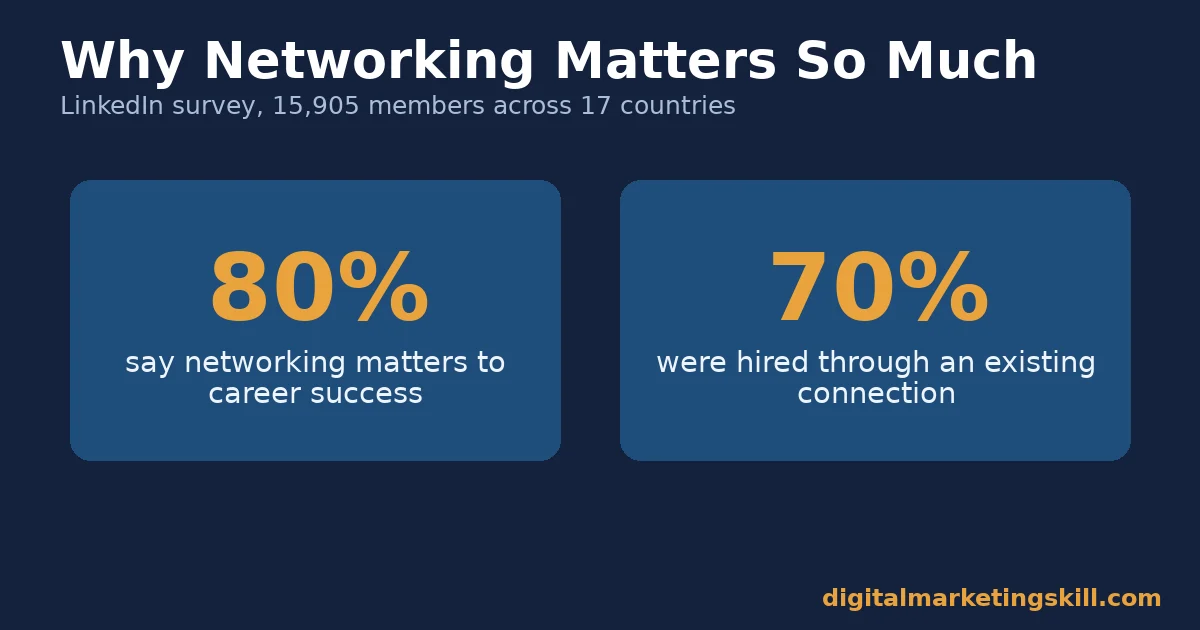
- About 80% of professionals say networking matters to career success. 70% of people hired joined a company where they already had a connection (LinkedIn survey, 15,905 members across 17 countries).
- A real, specific portfolio piece beats a long list of certifications, because it is the only thing that shows you can actually do the work.
- More than half of marketers surveyed say LinkedIn is their primary channel for B2B marketing and reaching decision-makers (Databox). That makes it a reasonable place to build a newbie digital marketer’s first visible presence.
- Confidence is not a prerequisite for starting. In published student accounts, it consistently arrives after the first real project, not before it.
In this guide
- Why Being a Newbie Digital Marketer Feels Harder Than It Should
- What Actually Builds a Career: The Three Inputs
- What Differs by Starting Point
- How to Lead at Each Starting Point
- How to Measure Your Progress as a Newbie Digital Marketer
- The One Decision Rule: What to Do With Your Next Free Hour
- A Real Case: From Not Tech-Savvy to Paid Client Work
- Frequently Asked Questions About Being a Newbie Digital Marketer
- Your Next Step as a Newbie Digital Marketer
Why Being a Newbie Digital Marketer Feels Harder Than It Should
The obstacles are real. Lack of experience, self-doubt, and a flooded job market are not imagined problems. The gap is in how most beginners respond to them: by consuming more content instead of producing any proof of skill.
A newbie digital marketer often assumes the field is unusually hard to break into, harder than other careers. In reality, most skilled careers share the same entry problem: employers want proof before they will hire, but you cannot get proof without being hired somewhere first. The way around that loop is not a credential. It is finding small, low-stakes ways to produce real proof before anyone is paying you for it.
The Content Trap
Reading another guide, watching another course, or collecting another certificate feels like progress. It rarely is. None of these things show an employer or client what you can actually do. A single small, finished project outweighs a stack of unfinished courses.
This happens because consuming content feels productive and carries no risk. A finished project can fail publicly. A certificate cannot. So beginners gravitate toward the safer, less useful activity, often without noticing the trade-off they are making.
This guide treats the newbie digital marketer’s challenge as solvable with three specific inputs: real experience, visible proof, and a working network. The facts below are checked at the source and apply worldwide. Your own market will still set the pace, but the method works the same everywhere.
The job market itself supports this approach. In the United States, roles like advertising, promotions, and marketing manager are projected to grow about 6%. That beats the 3% average across all occupations, according to the Bureau of Labor Statistics. The same source is explicit about what separates candidates. Employers consistently look for hands-on experience in marketing, sales, or related roles before handing over management responsibility. Formal education sets a floor. Demonstrated work sets you apart.
What Actually Builds a Career: The Three Inputs
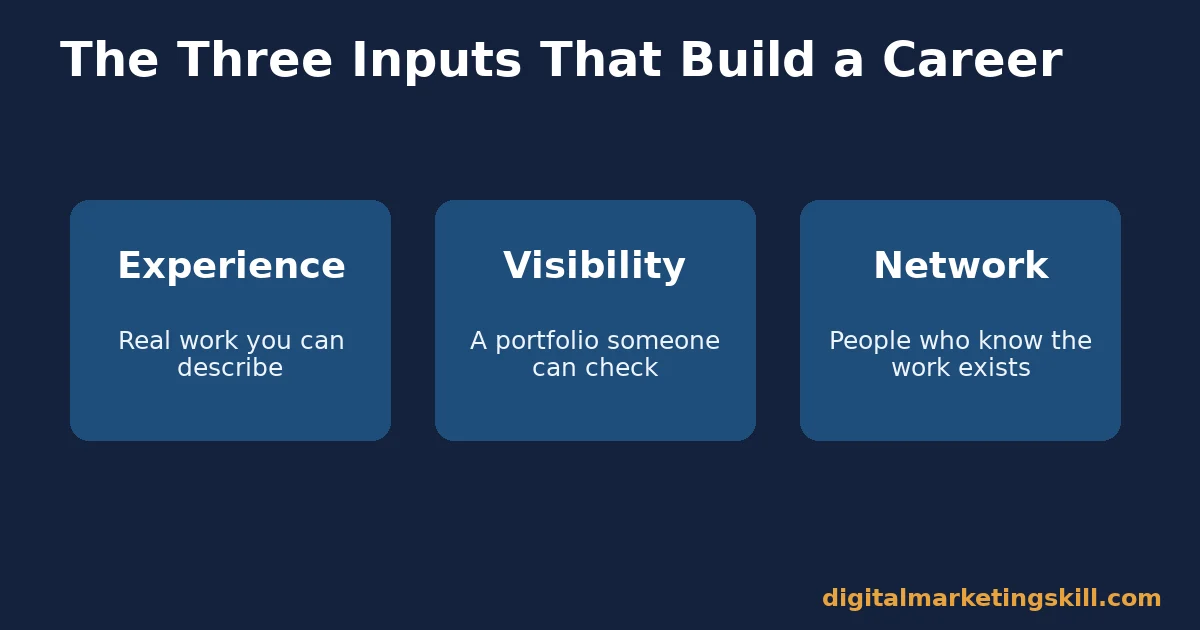
Strip away the generic advice and a new career in digital marketing rests on three inputs working together.
The Three Inputs
- Experience: real work, even small or unpaid, that you did and can describe in detail.
- Visibility: a portfolio, profile, or body of work that someone else can actually see and check.
- Network: people who know your work exists and might recommend or hire you.
Why This Breakdown Matters
Most newbie digital marketers over-invest in one input and starve the other two. Someone might take course after course, building knowledge but no visible proof of it. Someone else might build a strong portfolio but never show it to a single person who could hire them. A third person might network constantly, collecting connections and coffee chats, without ever producing the work those new contacts could actually vouch for. All three inputs need attention, not just the one that feels most comfortable.
Think of it as a three-legged stool. Knowledge without proof cannot be verified by anyone else. Proof without a network sits unseen. A network without any real work to show has nothing to recommend. Remove any one leg and the other two cannot hold the weight alone.
What Differs by Starting Point
A newbie digital marketer rarely starts from zero. Most people bring something transferable, even if it does not look like marketing experience on the surface. The mistake is assuming your starting point does not matter, then following generic advice meant for someone in a completely different situation.
Career Switchers: Built For Leveraging Transferable Skills
Someone switching from sales, teaching, writing, or customer service already has skills that map directly onto marketing. Persuasion, research, clear writing, and reading an audience all count. The fastest path is naming those skills explicitly, then connecting them to one specific marketing task. Do not start from scratch as if none of that experience counts.
Fresh Starts: Built For Fast, Visible Portfolio Work
Someone with no prior professional experience at all has one advantage: no bad habits to unlearn. The fastest path here is speed to a first visible project, even a small one. A fresh start has nothing yet to point to, so it needs that proof more urgently than a career switcher does.
This does not mean a fresh start is at a disadvantage. It simply means the order of operations matters more. Spend the first few weeks producing one real piece of visible work, before spending months collecting knowledge that nobody outside your own head can verify.
How to Lead at Each Starting Point
Knowing your starting point only helps if it changes what you do this week. Here is the practical fix for each.
Career Switchers: Lead With Translation, Not Reinvention
- Write down your transferable skills explicitly. Sales became persuasive copywriting. Teaching became clear content explanation. Name the link, do not assume anyone else will make it for you.
- Apply those skills to one real marketing task immediately. Write an email sequence, audit a small business’s social presence, or draft ad copy for a product you like.
- Use your existing network first. A career switcher often already has professional contacts who do not know about the pivot yet. Tell them. A short, direct message explaining the shift and asking for one introduction usually works better than a vague announcement to everyone at once.
- Pick one niche close to your old industry. A former teacher marketing education products has a credibility head start a generalist does not.
- Keep the old job title out of the pitch, keep the old results in it. A hiring manager does not need to know you used to be a teacher. They do need to know you grew an audience from nothing, because that is the transferable result, not the job title.
Fresh Starts: Lead With Speed to a First Project
- Offer to manage one small business’s social media for free or low cost. A local shop, a friend’s side project, or a community group all count as real, citable experience.
- Treat it like a real job from day one. Set a goal, track a metric, and report back. That discipline is what separates a real project from a favor.
- Build a one-page marketing portfolio before you feel ready. Waiting for confidence first gets the order backward. The project builds the confidence, not the other way around.
- Join one active community and participate, not just lurk. Answering a question or sharing a result gets you noticed far faster than silently reading posts.
- Document the project as you go, not after. Screenshots, a short write-up of what you tried, and the actual numbers make a far more convincing portfolio piece than a polished summary written from memory weeks later.
How to Measure Your Progress as a Newbie Digital Marketer
Progress in a career search is harder to measure than a marketing campaign, but it is not immeasurable. Track these on their own, since combining them into one vague sense of “how it’s going” hides exactly which input needs more attention.
Output Metrics
- Finished projects: the count of real, complete pieces of work you can show, not courses started or certificates collected.
- Portfolio views or profile visits: whether people are actually finding and looking at your work, available on most portfolio and LinkedIn tools.
- Applications sent versus replies received: your personal conversion rate. A very low reply rate usually points to the portfolio or resume, not your underlying skill.
Network Metrics
- New relevant connections made per month: people in the industry who now know you exist, not just a follower count.
- Conversations started, not just connections accepted: a connection that never leads to a conversation rarely leads to an opportunity either.
- Referrals or introductions received: the clearest sign your network is actually working for you, not just sitting idle.
Track these numbers weekly, not daily. Career progress moves slower than a marketing campaign, and checking daily just creates noise and discouragement. A weekly check still catches problems early enough to fix them.
None of these numbers matter in isolation. A newbie digital marketer with ten finished projects and zero network connections will still struggle. Nobody who could hire them knows the work exists.
The One Decision Rule: What to Do With Your Next Free Hour
When time is limited, use this rule: spend it on whichever of the three inputs is weakest right now, not whichever one feels most comfortable.
In practice, that usually means closing the laptop on another course. Instead, finish a real project, publish a piece of visible work, or reach out to one real person. Comfort and progress are not the same thing.
It helps to name the weak input honestly before picking the activity. Someone with plenty of finished projects but no network should spend the hour reaching out, not building a fourth portfolio piece nobody has seen. Someone with a strong network but nothing to show them should spend the hour finishing one real project, not scheduling another coffee chat.
Illustrative, invented numbers: imagine two beginners who each spend ten hours a week on their careers. One spends all ten hours on courses and has forty hours of certificates but zero visible projects. The other splits five hours on one real project and five hours reaching out to people in the industry. The second beginner will almost always get hired faster, because they have built two of the three inputs instead of one.
This does not mean courses are worthless. A structured course that forces you to build something real, rather than just watch videos, counts as the experience input too. The distinction is not courses versus no courses. It is passive learning versus active, visible output.
A Real Case: From Not Tech-Savvy to Paid Client Work
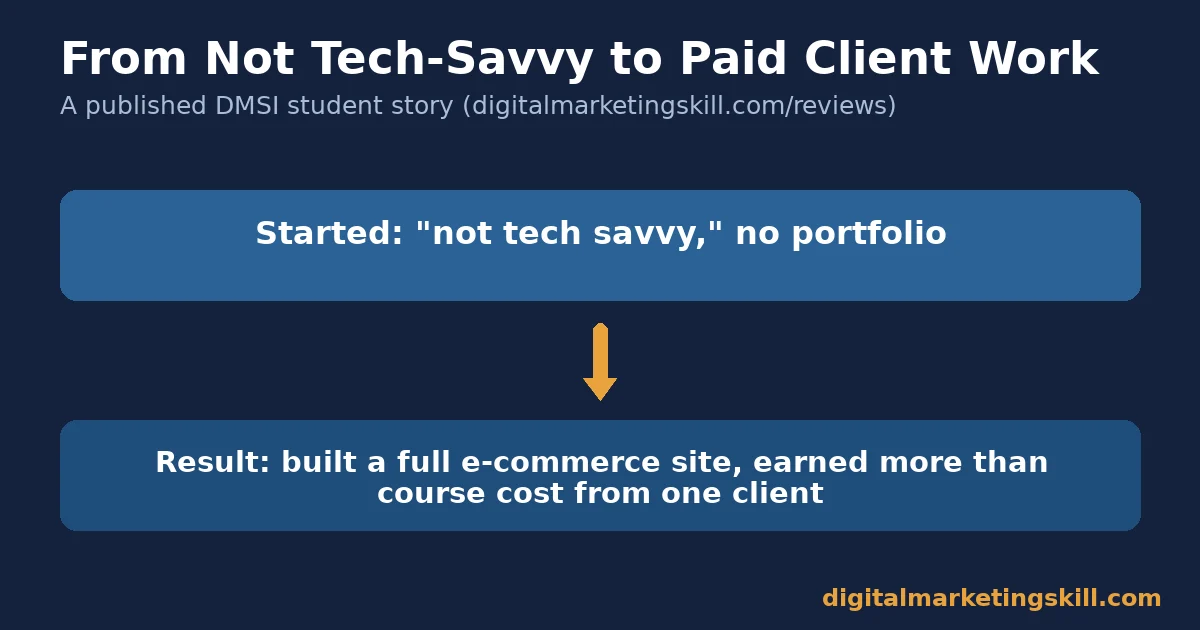
Eunice Bolaji, a published student story on Digital Marketing Skill Institute’s own reviews page, describes starting without a technical background. In her words, she was “not tech savvy.” That is a common starting point for many newbie digital marketers who assume the field requires skills they do not yet have.
Through structured training and hands-on projects, she built a full e-commerce site from scratch while still learning. She reported getting back more than the cost of the course from a single client. The specific skill mattered less than the pattern. She produced real, finished work early, instead of waiting until she felt fully ready.
The Limits Worth Naming
This is one published, self-reported student account, not an independently audited case study, and results vary by effort, market, and niche. Treat it as a credible illustration of the fast-start pattern recommended throughout this guide, not a guaranteed outcome.
The pattern echoes across other published student accounts on the same reviews page too. William Michael described a structured, step-by-step approach that built his confidence gradually, rather than requiring confidence upfront. Oluwatobi Vaughan started with no prior knowledge of digital marketing at all and finished the program fully equipped. None of these accounts describe confidence arriving before the work. In every case, it followed the work.
Princess Ukandu’s account follows the same shape. With no background in marketing or web design, she described being able to follow along step by step, with questions answered quickly enough to keep moving. The obstacle was never talent. It was the absence of a clear, structured first step, which a guided project or program can supply.
Frequently Asked Questions About Being a Newbie Digital Marketer
Is digital marketing hard for a complete beginner?
It is challenging but learnable. The field covers many skills, from SEO to content to paid ads, but nobody needs to master all of them at once. Starting with one skill and building a real project around it works better than trying to learn everything first.
How long does it take to become job-ready as a newbie digital marketer?
There is no fixed timeline, since it depends on hours invested and prior transferable skills. A focused beginner can usually produce a credible first portfolio piece within weeks, though becoming genuinely strong at the work typically takes sustained practice over several months. The timeline matters less than the sequence. Someone who produces a small project in week two and keeps iterating on it will generally outpace someone still studying theory at month three.
Do I need a degree to become a digital marketer?
Not necessarily. Many employers have relaxed formal degree requirements in job postings. Actual hiring patterns have shifted more slowly than the postings suggest. Either way, a strong portfolio and demonstrated results carry real weight.
What is the fastest way to get first experience with no prior work?
Offer to manage a small, real project, such as a local business’s social media or a friend’s side project. Treat it exactly like paid client work, including setting goals and reporting results.
How important is networking for a newbie digital marketer?
Very important, alongside a solid cover letter. Most people get hired through an existing connection rather than a cold application alone. That makes consistent, genuine networking one of the highest-leverage activities available to a beginner.
Is it normal to feel like an impostor as a beginner?
Yes. Self-doubt shows up in published accounts from experienced marketers as well as beginners. It fades with real, finished projects, not with more studying, so the fix is usually action rather than more preparation. Waiting for the feeling to pass before starting almost always backfires, since the feeling tends to fade only after the first project is already done.
Should I specialize early or learn everything?
Specializing early, even loosely, usually works better, which is also the fastest way to find your digital marketing niche. A newbie digital marketer who can clearly say “I focus on social media for local businesses” stands out more than one who claims to do everything equally well. LinkedIn’s own skills-on-the-rise analysis, based on actual hiring outcomes rather than self-reported skill claims, consistently rewards specific, named skills over broad, generic ones. You can always broaden later, once the first specific niche has opened a door.
Do I need to work for free to get started?
Not necessarily, though a free or low-cost first project can shortcut the usual chicken-and-egg problem. If free work does not fit your situation, a cheap, small paid project for a real client works just as well. The goal is a real result you can describe honestly, not the price attached to it.
Your Next Step as a Newbie Digital Marketer
Becoming a confident digital marketer is less about talent and more about producing real, visible work early, while building a genuine network alongside it. Pick whichever of the three inputs is weakest right now, and give it this week’s attention before adding a fourth course to the pile.
Want structured training instead of piecing skills together alone? The Master Diploma in Digital & AI Marketing at Digital Marketing Skill Institute is built around four AI-powered tracks covering ten courses in total, with a Full Stack option for completing all four. Every student gets unlimited 1-on-1 coaching and mentoring, plus a U.S. Project Internship with a verified U.S. Work Reference Letter, which solves the experience and visibility problems covered in this guide at the same time. The program is dual US and UK accredited, recognised in more than 100 countries, and 100% online, so you can build your first real project from anywhere in your country.
Explore the full program on the Master Diploma page. Browse more guides on the digital marketing blog. Read more student outcomes on the reviews page. Or go straight to the application page when you are ready. Wherever you live, learn more at digitalmarketingskill.com. Support is available to beginners anywhere, including anywhere in your country, through digitalmarketingskill.com.
Every figure in this guide was checked against its original source before publication. Figures marked as illustrative are invented examples, not real results.
![9 Amazing Digital Marketing Skills to Make Money Online [With Proof]](https://digitalmarketingskill.com/wp-content/uploads/2019/07/9-Amazing-Digital-Marketing-Skills-to-Make-Money-Online-With-Proof-17.png)






