
A product description is the marketing copy on a product page that explains what an item is. It also explains why a shopper should buy it. A strong one answers a specific question the shopper already has. A weak one lists features and hopes the shopper connects the dots alone.
Key Takeaways
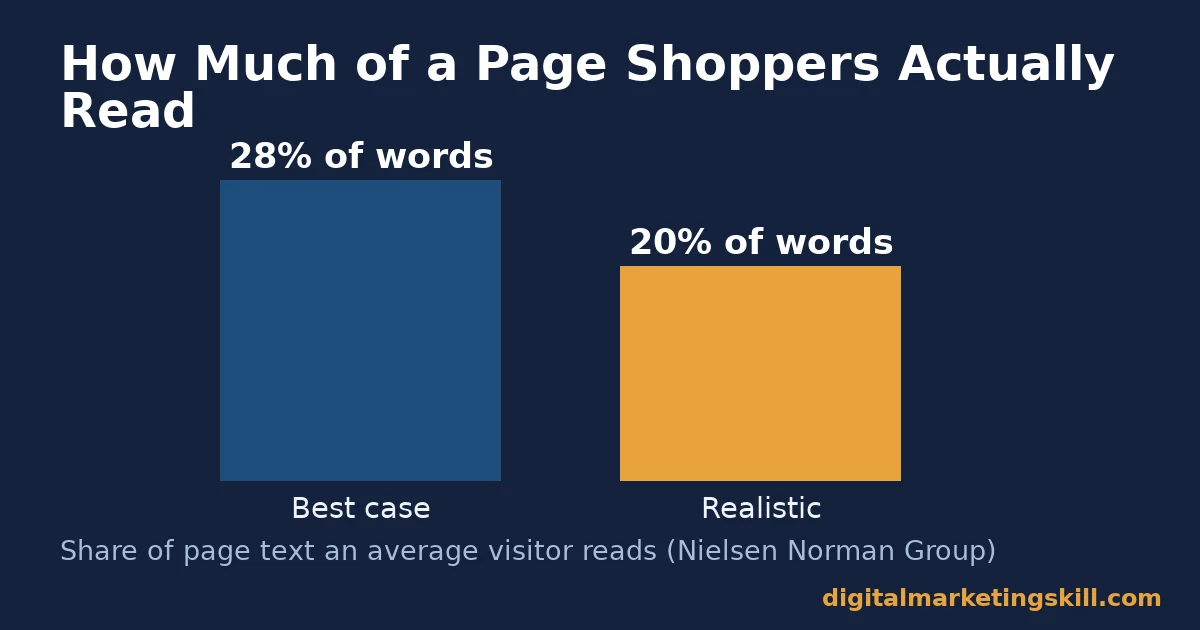
- Shoppers read at most 28% of the words on an average page, and realistically closer to 20%. Scannable writing is not optional (Nielsen Norman Group).
- 10% of e-commerce sites have product descriptions that are inadequate for shopper needs, enough to cause abandonment on their own (Baymard Institute).
- 54% of shoppers have abandoned a sale because product content was not consistent from one channel to another (Salsify).
- Baymard’s product page research rates 52% of desktop sites and 62% of mobile sites as mediocre or worse on usability (Baymard Institute).
- A description built around one clear buyer, one real problem, and one honest benefit consistently outperforms a longer list of generic features.
In this guide
- Why Most Product Descriptions Get Skipped, Not Read
- What a Product Description Actually Has To Do
- How a Good Description Differs by Product Type
- How to Write a Description That Actually Converts
- What a Strong Opening Line Actually Looks Like
- Common Mistakes That Quietly Kill Conversion
- How to Measure Whether Your Descriptions Are Working
- The One Decision Rule for Product Descriptions
- What a Clear Description Can Do for a Real Business
- Frequently Asked Questions About Product Descriptions
- Where to Go From Here With Product Descriptions
Why Most Product Descriptions Get Skipped, Not Read
Most advice on product descriptions focuses on adjectives. Punchier words. More sensory language. A catchier headline. Word choice matters, but it is not the real problem on most product pages.
The real gap is structure. Shoppers do not arrive ready to read a paragraph. They scan for the one fact that answers their specific question, then decide. A description written as flowing prose forces them to read everything to find that one fact. A description built for scanning lets them find it in seconds, which matters given how little of a page most people actually read.
One ground rule before we go further. Conversion figures in this guide come from specific studies and specific product categories, not a universal law. Your own numbers will vary by product, price point, and audience. Nothing here guarantees a sale. A better product description improves your odds of being understood. It does not replace a product people actually want.
What a Product Description Actually Has To Do
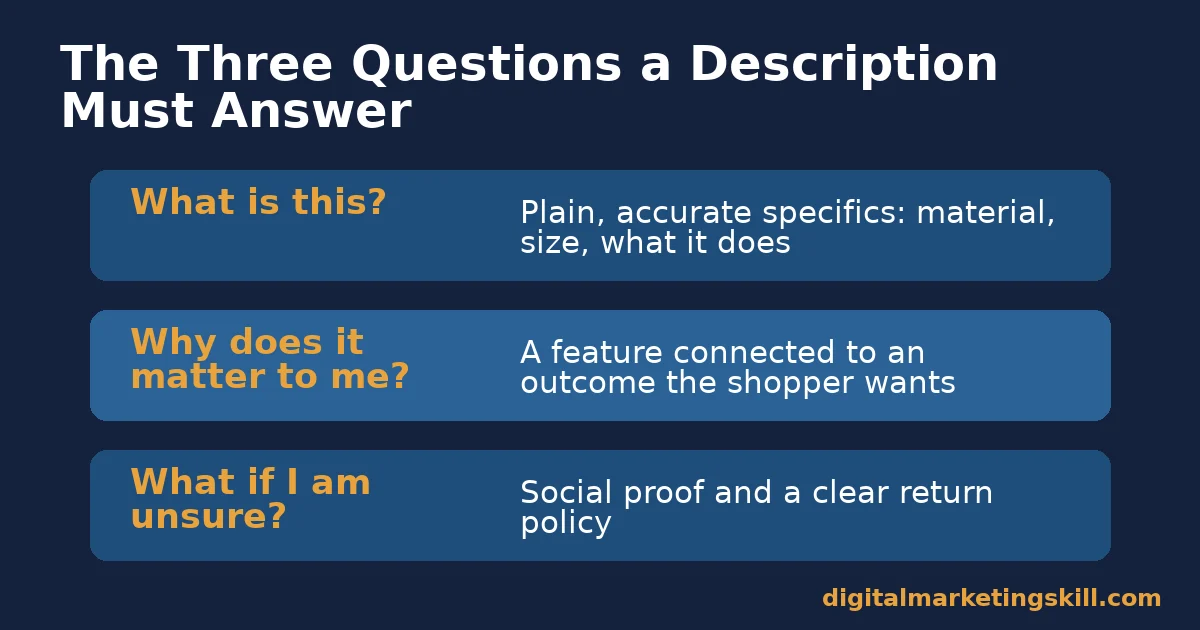
A product description has one job. It has to give a shopper enough confidence to add the item to their cart. That confidence comes from answering three questions, usually in this order. What is this? Why does it matter to me? What happens if I am unsure?
Plain, accurate specifics answer the “what is this” question: material, size, what it does. Connecting a feature to an outcome the shopper actually wants answers the “why does it matter” question.
Confidence that any doubt is covered comes from social proof, a clear return policy, or both. Each question needs its own answer. Skipping one leaves a gap the shopper has to fill with guesswork, and guesswork rarely ends in a purchase.
Skipping straight to features without the “why” is the single most common mistake. A shopper reading “100% merino wool” has to do the translation work themselves. A shopper reading “100% merino wool, so it stays warm without feeling bulky” does not. This is the same benefit-first logic behind strong content creation generally, not just product pages.
How a Good Description Differs by Product Type
The right structure for a description depends on what is actually being sold. It also depends on how much the shopper already knows going in. A shopper buying their fifth pair of the same running shoe needs almost no persuasion, just confirmation of size and stock. A shopper comparing an unfamiliar product against three competitors needs considerably more reassurance before they commit.
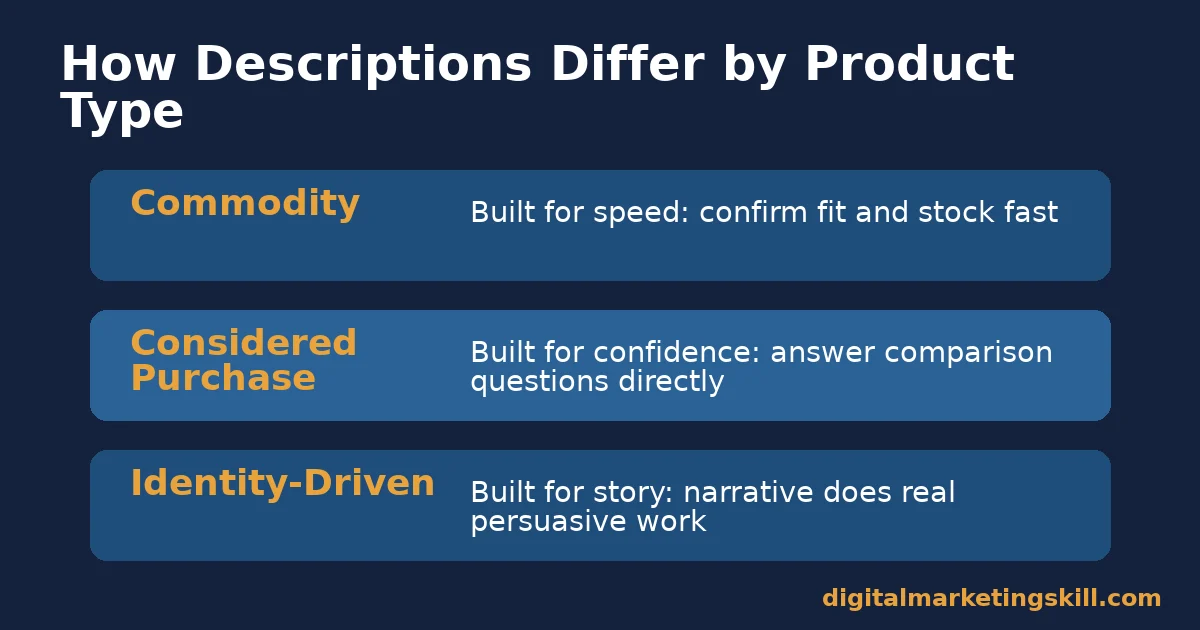
Commodity Products: Built For Speed
Take a commodity item, like a phone charger or a basic t-shirt. It is bought on trust and speed, not persuasion. The shopper already knows what they want. The description’s job is to confirm fit, size, and compatibility fast, with minimal friction standing in the way.
Considered Purchases: Built For Confidence
A considered purchase, like a mattress or a laptop, involves real research and real hesitation. The description needs to answer harder comparison questions directly. How is this different from the obvious alternative? What happens if it is the wrong choice?
Identity-Driven Products: Built For Story
Some products get bought partly for what they say about the buyer, like a hobby item or a design piece. These descriptions carry more narrative weight. The story of why the product exists does real persuasive work here, more than it would for a phone charger.
How to Write a Description That Actually Converts
Whatever the product, the same sequence of moves makes a description more likely to work. Research the buyer first, translate features into benefits, and structure the result so it can be scanned, not just read.
Lead With the Buyer, Not the Brand
Define who is actually buying this before writing a word. Their habits matter. Their real question matters. The words they would use to search for this product should shape every sentence that follows. If the product serves more than one distinct buyer type, write for the dominant one first, then adjust secondary details rather than trying to speak to everyone equally in the same opening line.
Lead With Benefits, Backed By Features
State the outcome first, then the feature that makes it true. “Stays warm without feeling bulky, thanks to 100% merino wool” does the translation work the shopper would otherwise have to do themselves. Lead with the result, not the spec sheet.
Lead With Scannable Structure
Since shoppers read at most 28% of the words on a page, put the most important fact first. Use short paragraphs. Add bullet points for specs. A headline, one short paragraph, then bullets is a reliable structure across almost every product category.
What a Strong Opening Line Actually Looks Like
The opening line carries more weight than any other sentence on the page, because it is often the only sentence a scanning shopper reads before deciding whether to keep going. Three illustrative, invented examples show the difference between a weak opener and a strong one, for three different product types.
Commodity example
Weak: “This charger is made from durable materials and features fast charging technology.” Strong: “Charges a phone to 50% in 20 minutes, and fits in a jacket pocket.” The strong version answers a real question, speed and size, in the same breath it introduces the product.
Considered purchase example
Weak: “Our mattress uses advanced foam layering for a better night’s sleep.” Strong: “Built for side sleepers who wake up with a sore shoulder, with three foam layers that keep pressure off the joint.” The strong version names the specific person it is built for, not just a vague promise of comfort.
Identity-driven example
Weak: “Handcrafted ceramic mug made by a small studio.” Strong: “Made by a potter who throws every mug by hand in small batches, so no two are exactly alike.” The strong version turns a production fact into a reason the product feels personal, which matters more for this category than for a phone charger.
Common Mistakes That Quietly Kill Conversion
A handful of mistakes show up across most underperforming product pages. Each one is easy to miss because the page still looks finished.
Listing features with no benefit attached
A spec sheet is not a description. Every feature worth including should answer “so what” in the same sentence, or the one right after it.
A wall of text with no scan path
Dense paragraphs get skipped, not read carefully. Break the description into a short opening line, a short paragraph, and a bulleted list of specifics.
Generic, brand-agnostic language
Copy that could describe any competitor’s product at the same price tells the shopper nothing new. A specific detail, even a small one, signals the product is real and the seller actually knows it well.
Inconsistent details across channels
More than half of shoppers in the research cited above have walked away from a purchase because the product information did not match from one place to another. Keep the core facts, dimensions, materials, compatibility, identical everywhere the product appears.
No social proof near the decision point
A rating, a review count, or a specific testimonial placed near the add-to-cart button reduces the hesitation a generic description cannot resolve on its own. This overlaps with the broader idea of building trust online, which matters well beyond a single product page.
Missing or generic image alt text
Alt text is read by screen readers and search engines, not just by people who cannot see the image. The W3C’s guidance on image alt text is to describe what the image actually communicates, not just label it “product photo.” A generic alt tag wastes a chance to reinforce the product’s name and one key benefit, and it makes the page less accessible to shoppers using assistive technology.
Jargon the target buyer does not actually use
Industry terms that feel precise to the seller can read as noise to a first-time buyer. Match the vocabulary your actual customers use when they search or ask questions, not the vocabulary your team uses internally. Pull real phrases from support tickets, reviews, or search queries, instead of guessing at what sounds professional.
No reason to decide now
Not every product needs urgency, but every description benefits from a clear next step. Stock levels, a simple comparison to what the buyer already uses, or a plain statement of what happens after checkout all give the shopper a reason to stop deliberating and act.
How to Measure Whether Your Descriptions Are Working
Track these in order, since a change higher up the funnel can mask a problem lower down.
- Product page conversion rate: the share of product page visitors who add the item to cart. This is the most direct signal a description is doing its job.
- Bounce rate on the product page: a high bounce rate often means the opening line failed to confirm the shopper found the right product fast enough.
- Return rate: a high return rate, especially with “not as described” as the reason, points to a description overselling or omitting a key detail.
- Organic search rankings for the product: search engines reward pages that fully answer a query. A thin description tends to rank poorly for its own product name and category terms. Our guide on keyword research covers how to find the terms shoppers actually search before they land on your page. Adding Google’s product structured data also helps search engines understand the page beyond the visible text.
- On-page time versus scroll depth: short time with shallow scroll suggests shoppers are leaving before reaching key details. Combine this with heatmap or scroll-tracking tools for a fuller picture.
Review these together, not in isolation. A page with healthy traffic but a weak conversion rate usually points to the description, not the ad or the search ranking that brought the visitor there. Therefore, resist the urge to pause ad spend or rework a keyword strategy before checking whether the page itself is the actual bottleneck.
The One Decision Rule for Product Descriptions
Before rewriting the whole page, diagnose where the problem actually sits. Is the shopper failing to find the answer, or is the answer itself not compelling?
Decision rule: if traffic is healthy but conversion is low, check whether the key fact a shopper needs is visible within the first few scanned lines before rewriting the full description. If it is visible and conversion is still low, the product’s actual fit or price is the more likely problem. Treating a positioning problem as a copywriting problem wastes an entire rewrite cycle.
Illustrative, invented numbers: imagine a product page with strong traffic and a 1% add-to-cart rate, well below the site average. A quick scan test shows the key compatibility detail is buried in paragraph three.
Moving that single fact into the first line is a higher-leverage fix than rewriting the whole page. It is also the first thing worth testing, since it takes minutes, not days. Only after that change has run for a full measurement cycle does a deeper rewrite of the rest of the copy become worth the time.
What a Clear Description Can Do for a Real Business
Clear, benefit-led writing is not only a product-page skill. Fola Adefolawe, a professional copywriter and a graduate of the Digital Marketing Skill Institute, described in a published story how pairing her writing background with digital marketing training changed her work.
“Combining these skills with my copywriting expertise allows me to not only write compelling content but also ensure it is strategically placed and optimized for search engines, maximizing its impact and reach.”
That is a specific, skills-based claim about how writing and strategy combine. It is not an income promise. Results from applying copywriting skills vary by niche, effort, and the product itself. See the Institute’s earnings disclaimer for the full context behind any student outcome mentioned on this site.
Frequently Asked Questions About Product Descriptions
How long should a product description be?
Long enough to answer the shopper’s real question, and no longer. A commodity item might need two sentences and three bullet points. A considered purchase might need several short paragraphs. Length should follow the decision’s complexity, not a fixed word count.
Should a product description include keywords for SEO?
Yes, naturally. Include the product’s actual name and the terms a shopper would search for in the title, the opening line, and an image alt tag. Do this without repeating the phrase so often that it reads awkwardly.
Do bullet points actually help conversion?
They help shoppers find the one fact they need quickly, which matters given that most visitors only read a fraction of the words on a page. Bullet points do not replace a clear opening line. They support it.
What is the difference between a feature and a benefit?
A feature is a fact about the product, like “waterproof to 30 metres.” A benefit is what that fact means for the buyer, like “safe to wear while swimming.” Strong descriptions state the benefit first, then back it with the feature.
Does product description writing matter if the images are good?
Yes. Images and description work together, not as substitutes for each other. Images show what a product looks like, while the description answers questions a photo cannot, such as material, fit, or compatibility.
Should every product on a site have a unique description?
Wherever possible, yes. Duplicate or templated descriptions across many similar products tend to rank worse. They also give shoppers less reason to trust the specific detail they are reading.
How do I know if a description is actually working?
Track product page conversion rate and return rate together. A description that converts well but drives high “not as described” returns is overselling. Fix the honesty gap before touching anything else. Chasing conversion rate alone, without watching returns, is how a page ends up looking successful on paper while quietly damaging trust with every sale it makes.
What is the biggest difference between B2C and B2B product descriptions?
A B2C description usually sells to one person making a personal decision, so emotional and identity-driven language tends to work well.
A B2B description often has to satisfy several stakeholders with different concerns: budget, technical fit, and implementation risk. It typically needs more specifics and fewer purely emotional claims to move a group decision forward. Writing for a committee rather than a single buyer changes which details actually close the sale, and that shift is worth planning for deliberately rather than discovering halfway through a draft.
Where to Go From Here With Product Descriptions
In the end, a product description earns a sale by answering the shopper’s real question faster than they expected to find it. Structure beats cleverness. One specific, honest detail beats a page of generic adjectives.
If you want copywriting, content marketing, and conversion skills taught step by step, the Master Diploma in Digital & AI Marketing at Digital Marketing Skill Institute is built around four AI-powered tracks covering ten courses in total. A Full Stack option exists for learners who want all four tracks together.
The programme pairs unlimited 1-on-1 coaching and mentoring with a U.S. Project Internship and a verified U.S. Work Reference Letter. It is dual US and UK accredited, and recognised in more than 100 countries, so you can study and apply it anywhere in your country, entirely online.
Explore the full Master Diploma programme, read more stories like Fola’s on the reviews page, browse the blog for more guides like this one, or go straight to the application page when you are ready to start, wherever you live. The Institute keeps everything about itself, including the current programme structure, up to date on digitalmarketingskill.com.
Every figure in this guide was checked against its original source before publication. Figures marked as illustrative are invented examples, not real results.
![9 Amazing Digital Marketing Skills to Make Money Online [With Proof]](https://digitalmarketingskill.com/wp-content/uploads/2019/07/9-Amazing-Digital-Marketing-Skills-to-Make-Money-Online-With-Proof-17.png)






