
To reduce website bounce rate, fix the reason visitors actually leave, not the reason you assume. Most bounces trace back to one of four causes: slow load time, confusing design, content that doesn’t match intent, or missing trust signals. This guide ranks them by evidence, then shows what to fix first, in the order that actually moves the number.
Key Takeaways
- 53% of mobile visitors leave a page that doesn’t load within three seconds, per Google’s “The Need for Mobile Speed” research, reported by Marketing Dive.
- Pages that load in 5 seconds instead of 19 seconds see 35% lower bounce rates and 70% longer sessions, per the same Google research.
- The average bounce rate across sectors is 44.04%, per a benchmark analysis reported by Oberlo, ranging from about 36% in apparel and footwear to 45% in construction.
- Visitors decide whether to stay within the first 10 seconds, per the Nielsen Norman Group, and leave in 10 to 20 seconds without a clear value proposition.
- Past 30 seconds of real engagement, visitors often stay 2 minutes or more. The first 10 seconds decide far more than the rest of the page combined.
In this guide
- Most “Why People Leave Your Website” Lists Skip The Ranking
- How Bounce Gets Decided In The First 10 Seconds, And Why It’s Hard To Reduce Website Bounce Rate By Guessing
- What Differs By Cause: Four Reasons To Reduce Website Bounce Rate
- What To Fix First For Each Cause
- Common Mistakes When People Try To Reduce Website Bounce Rate
- How To Measure Whether Your Fixes Reduce Website Bounce Rate
- The One Rule: Fix Your Slowest High-Traffic Page First
- What Doing This Right Looks Like
- Frequently Asked Questions About How To Reduce Website Bounce Rate
- To Reduce Website Bounce Rate, Fix One Page, Then Expand
Most “Why People Leave Your Website” Lists Skip The Ranking
Search why people leave a website and every list names the same six or seven reasons: slow speed, bad design, weak content, broken trust. None of it is wrong. None of it tells you which one to fix first when you only have a week.
The missing piece is evidence: which cause loses the most visitors, and what order to fix them in. This guide ranks causes by the size of the evidence behind them.
Treat any single ranking as a snapshot, not a fixed law. What drives bounces shifts as device mix, traffic sources and page types change across a site.
How Bounce Gets Decided In The First 10 Seconds, And Why It’s Hard To Reduce Website Bounce Rate By Guessing
A bounce happens the moment a visitor leaves without taking a second action. That decision gets made fast. The Nielsen Norman Group found that the first 10 seconds of a page visit are critical.
Visitors without a clear value proposition leave in 10 to 20 seconds. Past the first 30 seconds, the pattern flips. Visitors who stay that long often stay 2 minutes or more.
That window is why generic advice to “improve engagement” rarely helps anyone trying to reduce website bounce rate. Engagement is a lagging result. The first 10 seconds are the actual lever.
That means a page’s design has one real job in the opening seconds: prove, fast, that it has what the visitor came for. Everything else on the page matters only after that first proof lands.
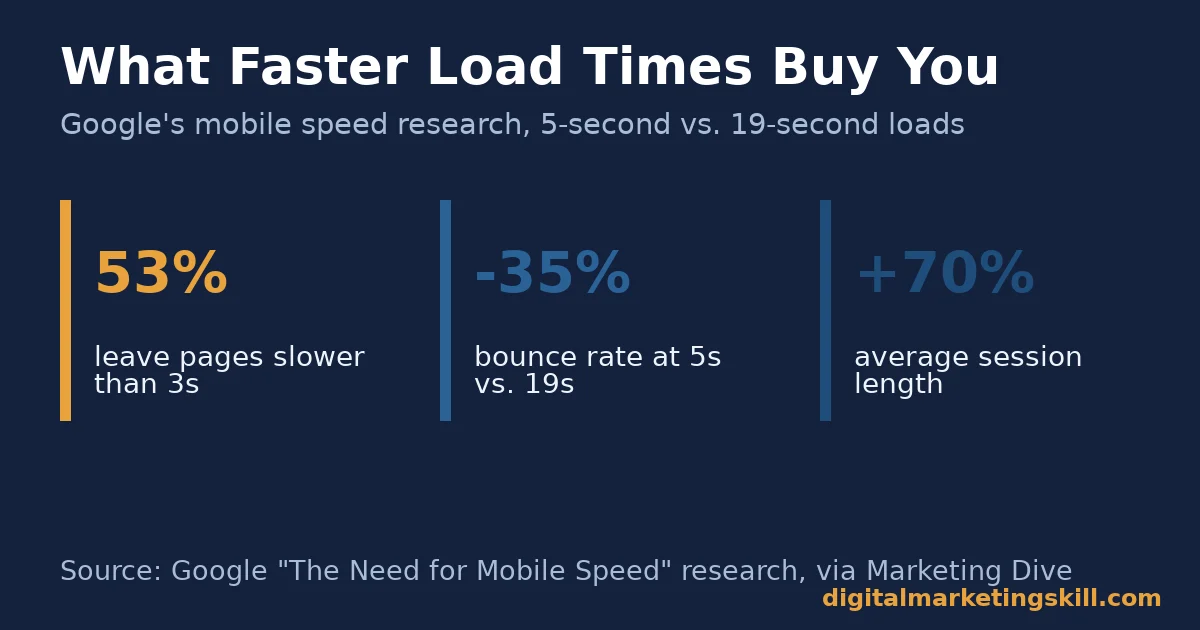
Speed sits underneath all of this, because a slow page never gets the chance to prove anything. Google’s mobile speed research found that 53% of visitors leave a page that takes longer than three seconds to load.
Comparing 5-second and 19-second load times in the same research, the faster pages saw 35% lower bounce rates, 70% longer sessions and 25% higher ad viewability. Speed alone moved every other metric on the page.
What Differs By Cause: Four Reasons To Reduce Website Bounce Rate
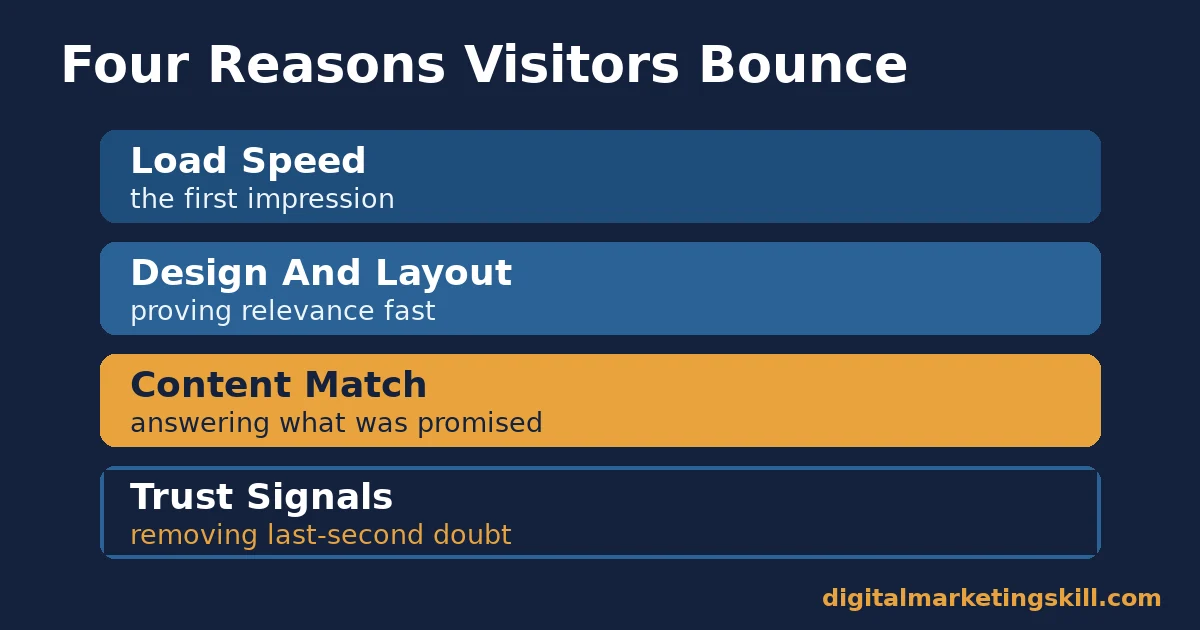
Four causes account for most lost visitors, and each needs a different fix. Treating all bounces as one problem is why generic advice rarely moves the number for long.
Load Speed: The Fastest Lever To Reduce Website Bounce Rate
Speed determines whether a visitor ever sees your value proposition at all. A page that takes six or more seconds loses a large share of visitors before any design or content choice even matters.
No amount of good copy fixes a page nobody waited to read. Speed is the gate every other fix has to pass through first, which is also why Google’s own Core Web Vitals documentation treats loading performance as a ranking and experience signal, not just a technical detail.
Design And Layout: Built For Proving Relevance Fast
Once a page loads, layout decides whether a visitor can tell, at a glance, that they’re in the right place. A cluttered page or an unclear hierarchy forces visitors to work for an answer they expected in seconds.
Clean layout isn’t about looking polished. It is about removing every extra decision between a visitor landing and understanding what the page offers.
A navigation menu with twenty items, three competing calls to action, or a headline that describes the company instead of the visitor’s problem all add friction at the exact moment a page needs to remove it.
Content Match: Built For Answering What Was Promised
Visitors arrive with an expectation set by a search result, an ad or a link. When the page doesn’t deliver on that specific expectation, even a fast, well-designed page bounces.
The mismatch is the problem here, not the execution. A beautifully built page that answers the wrong question still loses the visitor.
This is the most overlooked cause because it rarely looks like a content problem from the inside. The page can read well, load fast and look professional, and still lose most visitors if it was never the answer they were searching for.
Trust Signals: Built For Removing Last-Second Doubt
Outdated design cues, missing contact information, broken links or no social proof plant doubt right when a visitor is deciding whether to act. Trust problems rarely cause the first bounce.
They cause the second one, on a page that otherwise did everything right. A visitor who makes it past speed, design and content can still leave over one broken link or one missing review.
Stanford’s Persuasive Technology Lab studied this directly. Its research, covering more than 4,500 people over three years, found that credibility judgments are driven first by how a site looks, with verifiable contact details and third-party evidence mattering once a visitor is already engaged.
What To Fix First For Each Cause
Knowing the four causes is the easy part. Fixing them in the wrong order wastes the most common resource every website owner is short on: time.
To Reduce Website Bounce Rate Fastest: Fix The Slowest, Highest-Traffic Page
Don’t audit the whole site at once. Find the one landing page with the most traffic and the slowest load time. Fix that page’s images, scripts and hosting first, then move to the next page.
Design: Lead With The Above-The-Fold Value Proposition
Before touching color schemes or fonts, fix what a visitor sees without scrolling: one clear sentence that says what the page offers and to whom. Everything else is secondary to that one sentence being instantly readable.
Content Match: Lead With Auditing Your Top Entry Pages
A good list of free SEO tools can help pull that traffic data if you do not already track it.
Pick your five highest-traffic landing pages. For each, check what the visitor was promised by the search query or ad, against what the page actually delivers in the first screen. Fix the biggest mismatches first.
Strong SEO content writing practices make this easier, since the opening section is usually where a content-match problem first shows up. If a page ranks for a question it doesn’t actually answer, rewrite the opening section to answer it directly before changing anything else on the page. The rest of the content only gets read once that first answer lands.
Trust: Lead With The Page Closest To A Conversion
Add contact details, real reviews or case studies, and working links to the pages nearest a sign-up or purchase first. Trust fixes matter most exactly where a visitor is about to commit to something.
A visible phone number or address, a handful of specific, attributed reviews rather than generic star ratings, and a working support link do more for a checkout or sign-up page than another round of copy edits.
Common Mistakes When People Try To Reduce Website Bounce Rate
- Redesigning the whole site before testing one change. A full redesign hides which specific change actually moved the number. Change one thing on one page, measure it, then expand to the next.
- Chasing a lower bounce rate on pages that should bounce. A single-answer blog post or a store hours page is supposed to satisfy a visitor in one view. Forcing extra clicks there can hurt the experience without helping the business.
- Fixing design before fixing speed. A beautifully redesigned page that still loads in eight seconds loses the same visitors the old page did. Most of them never waited long enough to see the redesign at all.
None of these fixes require a full rebuild. They require working on the right page, in the right order, before moving to the next one.
A fourth, quieter mistake undercuts the other three: never writing down what changed. Without a simple log of what you fixed and when, it becomes impossible to tell which change actually helped reduce website bounce rate and which one did nothing.
How To Measure Whether Your Fixes Reduce Website Bounce Rate
Four numbers tell you whether a fix actually worked, rather than just feeling like an improvement:
- Bounce rate by landing page, not site-wide. A site-wide average hides which specific pages are actually bleeding visitors.
- Load time for the exact page you changed. Measure before and after, on both mobile and desktop, since mobile load times are usually the worse of the two.
- Scroll depth on the page. If visitors now scroll further than before, your above-the-fold value proposition is doing its job.
- Time to first meaningful action. How long before a visitor clicks, scrolls or submits something. A falling number usually means the page proved its relevance faster.
None of these numbers need a new dashboard. A monthly check of these four, by page, shows whether last month’s fix actually moved anything.
Pair each number with the change log from the mistakes above. A falling bounce rate on a page where nothing changed usually means a shift in traffic source, not a genuine fix, and that distinction matters when deciding what to work on next.
The One Rule: Fix Your Slowest High-Traffic Page First
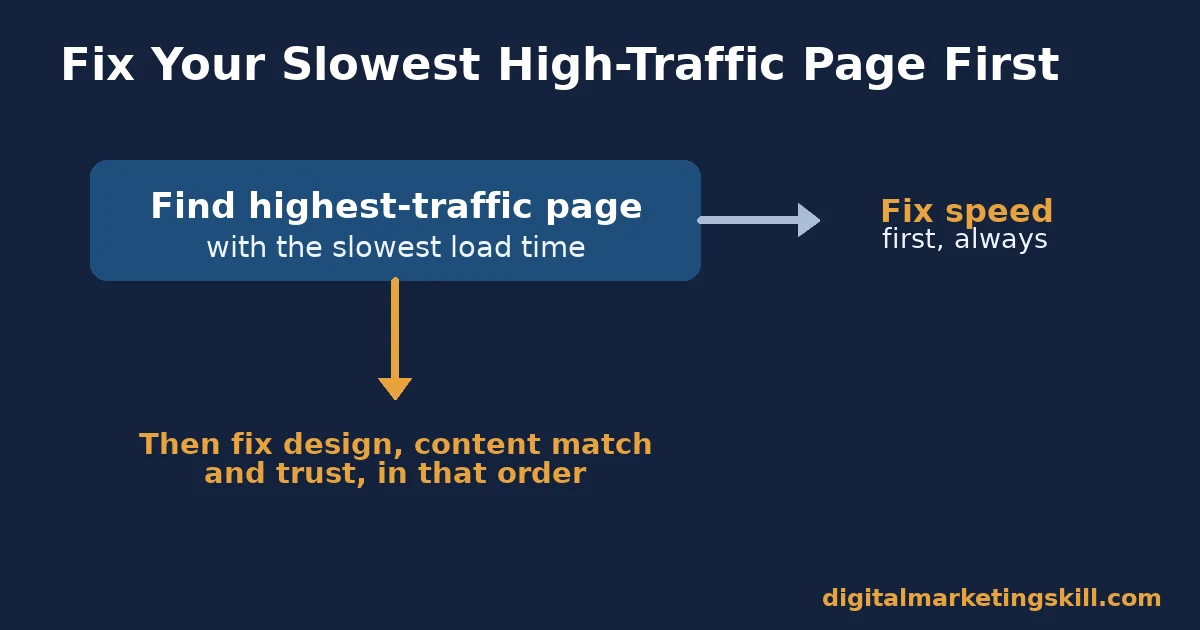
Here is the single most useful filter before you touch design, copy or trust signals. Find your highest-traffic page with the slowest load time. Fix that one page’s speed first.
Every other fix on that page is wasted on visitors who never waited long enough to see it. Speed buys every later fix the chance to actually matter.
Illustrative, invented example: a small business fixes its homepage design first, adding testimonials and a clearer layout. Bounce rate barely moves, because the page still takes seven seconds to load on mobile.
Months later, after fixing image compression and hosting, load time drops to two seconds. The same design changes from before finally show their full effect, because visitors now stay long enough to see them.
What Doing This Right Looks Like
Real improvements usually start with someone learning to actually build and optimize a page, not just decorate one.
Esther Elueme, a Digital Marketing Skill Institute graduate, describes an early result this way: “In just a month, I am able to build a website, post scheduled ads on social media platforms, added my business niche on google search engine and optimized my page for keywords search on google,” as published on the Institute’s reviews page.
That combination, a working site, content matched to real search terms, and active promotion, is exactly what the evidence above says it takes to reduce website bounce rate in practice rather than in theory.
It also shows the limit of any single tactic. A fast page with mismatched content still loses visitors, and well-matched content on a slow page never gets seen. The fixes in this guide work because they target the specific cause, not because any one of them is a silver bullet on its own.
The pattern matters more than any single number here: building a page with intent, matching it to search terms, and promoting it correctly, rather than publishing a page and hoping it performs on its own.
See the Institute’s earnings disclaimer for the full context; individual results are not typical or guaranteed, and a single project is a learning exercise, not a repeatable formula.
Frequently Asked Questions About How To Reduce Website Bounce Rate
What is a good bounce rate for a website?
It depends on the page type. A benchmark analysis puts the average around 44% across sectors, but a single-answer blog post can bounce at 70% or more and still be doing its job. A product page bouncing that high usually signals a real problem.
Does page speed really matter that much for bounce rate?
Yes. Google’s research found 53% of mobile visitors leave a page that takes longer than three seconds to load. Pages loading in 5 seconds instead of 19 saw 35% lower bounce rates in the same study.
How long do I have to capture a visitor’s attention?
About 10 seconds, per Nielsen Norman Group research, before a visitor without a clear value proposition starts to leave. Past 30 seconds of real engagement, visitors tend to stay much longer.
Should I fix design or speed first to reduce website bounce rate?
Speed first. A redesigned page that still loads slowly loses visitors before they ever see the new design, so a speed fix protects the value of every change made after it.
Can a high bounce rate ever be a good sign?
Yes, on pages built to answer one question, like a store hours page or a single-topic blog post. A high bounce rate there can mean the page did its job in one view, not that it failed.
What tools show which pages have the worst bounce rate?
If you are new to the tool, this Google Analytics beginner guide covers the basics. Google Analytics shows bounce or engagement data by individual landing page, which is more useful than a single site-wide number because it shows exactly where to start fixing first.
Will reducing bounce rate automatically increase sales?
Not automatically, but it removes a ceiling. A visitor who leaves in three seconds never gets the chance to convert at all, so fixing bounce rate is usually a precondition for better conversion, not a guarantee of it.
How often should I check whether a change worked?
Monthly is usually enough for most small sites. Checking more often than that mostly measures normal day-to-day noise in traffic rather than the actual effect of a change you made to reduce website bounce rate.
To Reduce Website Bounce Rate, Fix One Page, Then Expand
Reducing website bounce rate comes down to order: fix speed on your highest-traffic page first, prove the value proposition above the fold, match content to intent, then layer in trust signals. Pick one page, make one change, measure it, then move to the next.
Building and optimizing pages that actually hold attention, speed, design, content and SEO together, is exactly what the Digital Marketing Skill Institute’s Master Diploma in Digital & AI Marketing teaches, including the AI-Powered WordPress and SEO Specialist track, with a Full Stack option to complete all four tracks.
It includes unlimited 1-on-1 coaching, a U.S. Project Internship with a verified U.S. Work Reference Letter, and dual US and UK accreditation recognised in more than 100 countries. It runs entirely online, so you can start fixing real pages from anywhere in your country, through digitalmarketingskill.com.
Explore the full program at the Master Diploma in Digital & AI Marketing, browse more guides on the digitalmarketingskill.com blog, read outcomes like Esther’s on the reviews page, or apply to start at digitalmarketingskill.com today.
Every figure in this guide was checked against its original source before publication. Figures marked as illustrative are invented examples, not real results.
![9 Amazing Digital Marketing Skills to Make Money Online [With Proof]](https://digitalmarketingskill.com/wp-content/uploads/2019/07/9-Amazing-Digital-Marketing-Skills-to-Make-Money-Online-With-Proof-17.png)






