Remote vs in-office work is not one choice with one right answer. The best mode depends on the role’s need for collaboration, not on a general opinion about offices. A large randomized trial found hybrid work had zero effect on output. This guide separates the real levers, so you can match the mode to the job.
Key Takeaways
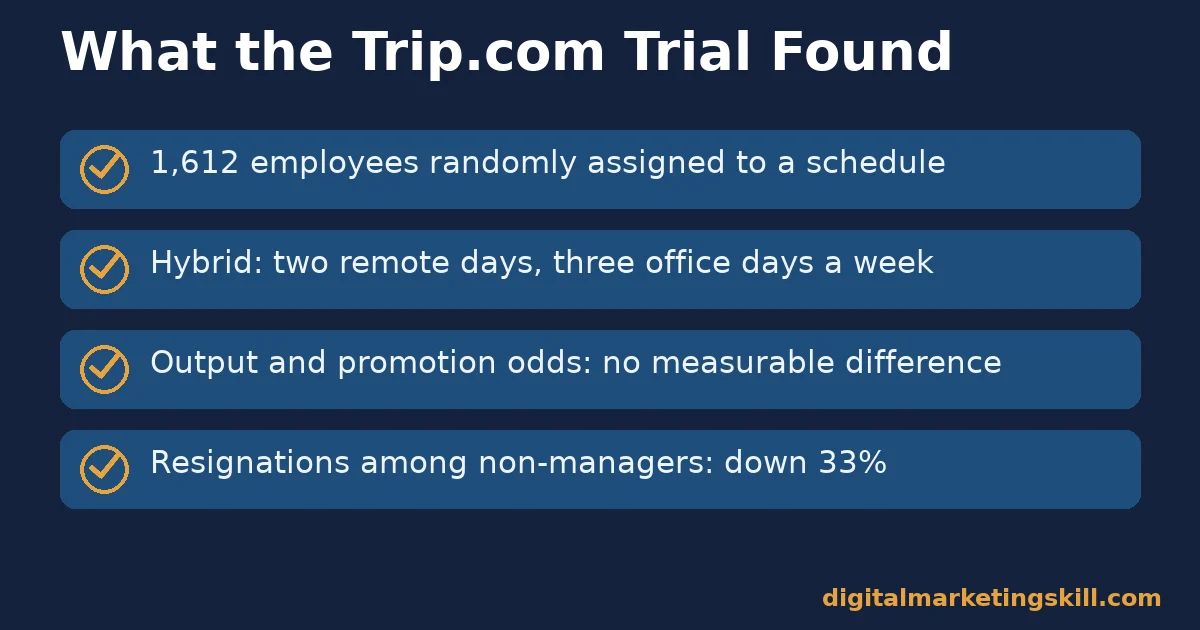
- Hybrid does not hurt output. A Stanford-led randomized trial of 1,612 employees at Trip.com found hybrid work, two remote days a week, had zero effect on productivity or promotion compared with full-time office work.
- But it changes who stays. The same trial found resignations fell 33% among non-manager hybrid workers. Managers did not see the same drop.
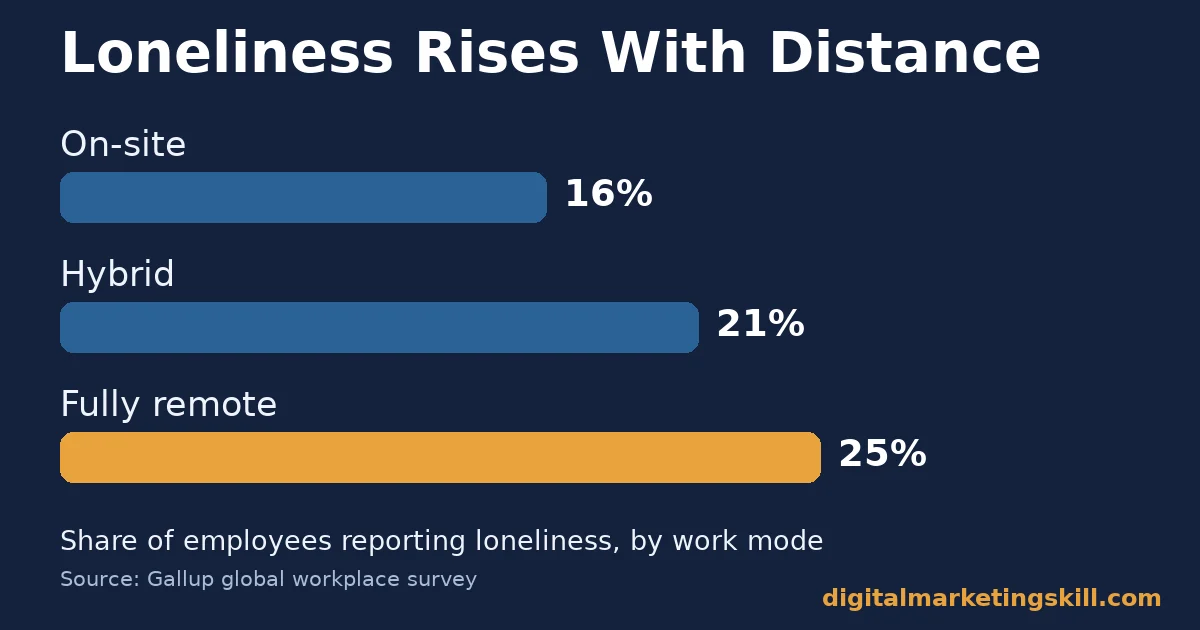
- Isolation rises with remote work. Gallup’s global workplace survey found 25% of fully remote workers reported loneliness, versus 21% of hybrid workers and 16% of on-site workers.
- Commuting is a real, measurable cost. The US Census Bureau’s American Community Survey found the average one-way commute is 26.8 minutes. That figure is US-only.
- Most advice frames the debate wrong. Most writers treat remote vs in-office work as a culture question. The data points to a role-by-role question instead.
In this guide
- What Most Remote vs In-Office Work Debates Get Wrong
- What Actually Changes When You Switch Work Mode
- What Differs by Work Mode
- How to Lead With Each Mode
- How to Measure Whether Your Work Mode Is Working
- The One Decision Rule: Let the Role’s Collaboration Need Decide
- A Real Case: What the Trip.com Hybrid Trial Showed
- Frequently Asked Questions About Remote vs In-Office Work
- Build Skills That Work in Any Mode
What Most Remote vs In-Office Work Debates Get Wrong
Most articles treat this as a culture war. Most writers frame remote work as freedom. They frame office work as commitment. But neither framing holds up well against the evidence.
So the real question is narrower. Does this specific role need spontaneous, in-person collaboration? If yes, in-office or hybrid usually wins. If no, remote usually wins, with no cost to output.
Read the Evidence With Limits in Mind
The Stanford-led trial above is strong evidence. But it studied one company, Trip.com, in one industry, over six months. So treat its findings as a well-controlled data point, not a universal law. Gallup’s loneliness figures come from a global survey spanning many countries. Read them as a broad pattern, not a guarantee for every single workplace.
This guide assumes you already have some choice in the matter. If your employer sets a fixed policy, instead use the measurement section below to advocate for change. And if you are weighing a move into a remote digital marketing job, the evidence below applies just as directly.
One more ground rule before you compare remote vs in-office work for your own situation: separate the role from the person. A role can suit remote work well in general, but a specific new hire on that role might still need office time to learn the ropes fast. Treat the role and the individual as two separate questions, not one.
It also helps to separate the employee’s preference from the role’s actual need. Someone can prefer office life and still do their best work alone at home, or prefer remote work and still struggle without daily structure. Preference and performance are related, but they are not the same measurement, and a good remote vs in-office work decision checks both.
What Actually Changes When You Switch Work Mode
Three things change when you move between remote and in-office work: collaboration speed, personal cost, and connection. So everything else is really just a downstream effect of these three.
First, collaboration speed changes. A question answered by turning around in a chair is not the same as a question answered over chat. So in-person work wins on speed for complex, unclear problems. But it loses almost nothing for simple tasks handled on your own time.
Next, personal cost changes. Commuting, work clothes, and daily meals out all disappear with remote work. For context, the US Census data above puts the average US one-way commute at 26.8 minutes. So a five-day office schedule can mean over four hours a week just travelling. This is not only a US pattern. The UK government’s own Transport Statistics Great Britain put the average one-way commute at 29 minutes, a close match to the US figure. Wherever you live, this cost tends to land in a similar range, even though the exact minutes vary by country and city.
Finally, connection changes. Proximity builds trust faster than a video call does. Gallup’s figures show this directly: fully remote workers reported loneliness at roughly 1.5 times the rate of on-site workers.
None of these three levers is good or bad on its own. Fast collaboration matters less for a role that works alone most of the week. A real commute cost matters less if that commute also builds a routine you value. Weigh each lever against the actual role in front of you, not against a general opinion about remote vs in-office work.
What Differs by Work Mode
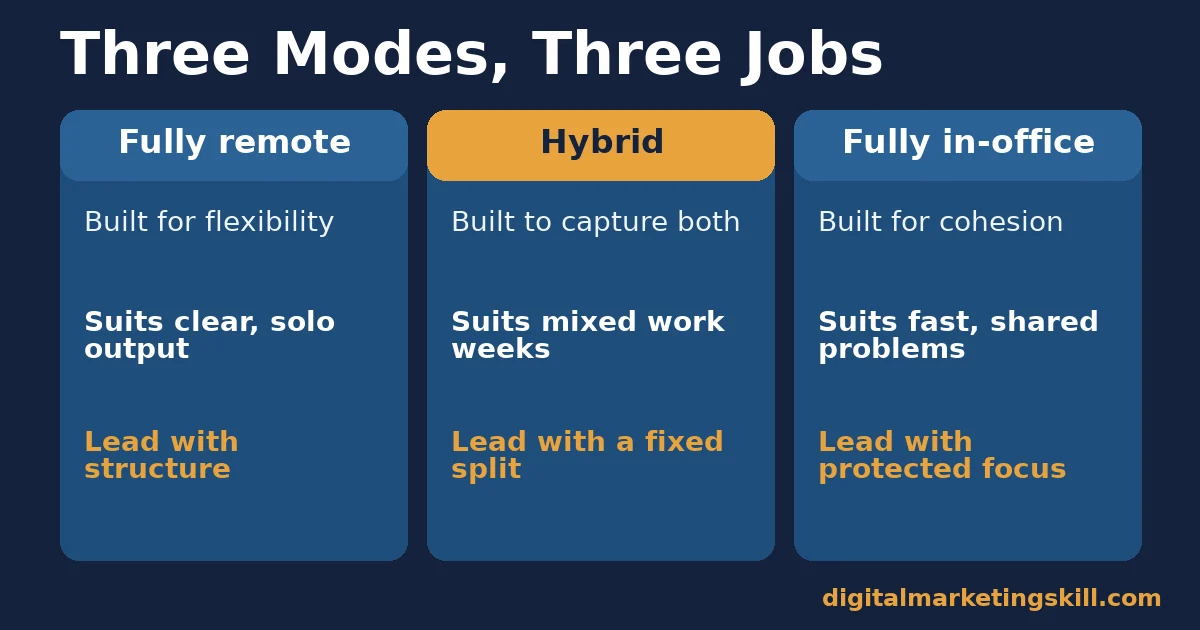
To choose well between remote vs in-office work, treat these three modes as separate tools, not points on one scale. Each one solves a different problem, and each one creates a different cost. The sections below name what each mode is actually built to do.
Fully Remote: Built for Flexibility
Fully remote work removes location, and often fixed hours, from the equation. So it is built around individual output, not shared presence. This suits roles with clear, measurable goals and few quick dependencies on teammates. For example, many people making a digital marketing career change choose it for that flexibility specifically.
Fully In-Office: Built for Cohesion
Fully in-office work is built around shared presence instead. So it suits roles that depend on fast, informal problem-solving. It also suits mentoring junior staff, or work that is easier to explain at a whiteboard than in writing.
New hires often benefit from this mode early on, even in roles that later move remote. Watching a senior colleague work, in real time, teaches habits that are hard to pick up from a written guide alone. So many companies that are otherwise remote-first still bring new starters into a shared space for the first few weeks.
Hybrid: Built to Capture Both
Hybrid work is built to get collaboration days and focus days without fully committing to either extreme. For instance, the Stanford-led trial above used a simple split: two remote days, three office days a week. Still, output did not fall.
Hybrid also tends to suit roles that swing between two modes of work during a normal week. A content strategist, for example, might need quiet, solo time to write and plan, then a shared room to pitch ideas and get fast feedback. Hybrid lets that person get both without compromising on either.
How to Lead With Each Mode
Fully Remote: Lead With Structure
First, replace spontaneous check-ins with scheduled ones. Then set clear weekly goals, not visible hours; after all, visible hours cannot be observed remotely anyway. Also build in deliberate social contact, since Gallup’s data shows loneliness is the real risk, not output. A dependable remote work stack removes most of the friction that makes structure hard to maintain.
Make the social contact specific, not vague. A standing weekly call with no agenda, just conversation, does more for connection than another work meeting squeezed into the calendar. Treat it as protected time, the same way you would protect time for a client deadline. Skipping it when busy defeats the purpose, since the busiest weeks are usually when isolation creeps in fastest.
Fully In-Office: Lead With Autonomy Inside the Day
Start by protecting blocks of quiet time, even in a shared space. After all, constant interruptions are the main cost of office work, not the office itself. Also use the commute on purpose, for example by handling calls during it rather than losing that time twice.
Push back on meetings that could have been a message. Office work makes it easy to call a meeting out of habit, simply because everyone is already in the building. That habit is the real tax on in-office productivity, not the commute or the open floor plan.
Hybrid: Lead With a Fixed Split
So pick specific days for office time, not a vague “a few days a week.” The Trip.com trial’s fixed, steady split is part of why it worked, because everyone could plan around it. Otherwise, an unpredictable hybrid schedule creates the costs of both modes, with the benefits of neither.
Use office days for the work that genuinely needs a room, such as planning sessions, pitches, or onboarding a new teammate. Save remote days for deep, solo work that a busy office floor would only interrupt.
Matching the day’s task to the day’s mode is what makes hybrid work, not the split itself. Write the rule down and share it with your team. Otherwise office days quietly turn into another set of solo-work days, spent at a desk you commuted to reach.
How to Measure Whether Your Work Mode Is Working
Four Signals Defined in One Sentence
- Output against deliverables is whether your actual work product, not hours logged, lands on time and at quality.
- Voluntary turnover intent is whether you, or your team, are actively looking elsewhere. The Trip.com trial linked this directly to work-mode satisfaction.
- Reported connection is a simple, honest check-in on loneliness or isolation, the same factor Gallup measured at scale.
- Total weekly cost is commute time and money combined, measured against the 26.8-minute US average as a rough benchmark.
How to Read These Signals Together
Strong output with rising isolation signals a fully remote setup needs more deliberate connection, not a return to the office. Flat output with high commute cost and no connection benefit signals an in-office policy is not earning its cost. Read all four signals together before changing anything.
Review these signals on a fixed schedule, not only when something feels wrong. A monthly check, even a short one, catches a drifting work mode before it becomes a resignation or a burnout problem. Treat the review itself as part of your remote vs in-office work strategy, not a separate task.
The One Decision Rule: Let the Role’s Collaboration Need Decide
Before choosing a mode, answer one question honestly: does this specific role need fast, in-person collaboration to do its best work? Everything else, preference, habit, company culture, should follow that answer, not lead it.
Illustrative, invented example: picture two marketers on the same team. One runs paid-ad experiments, mostly solo, data-driven work with few live dependencies. Remote suits that role well. The other leads brand workshops that depend on reading a room in real time. That role benefits from in-person time. One blanket policy for both roles wastes the advantage either mode offers.
The same rule applies at the team level, not just the individual level. A team that mostly does ambiguous, fast-moving work benefits from defaulting to in-office or hybrid. A team that mostly does independent, well-scoped work loses little by defaulting to remote. Let the shape of the work decide the default, then make individual exceptions where a specific role or person genuinely differs.
Hidden Costs Both Sides Often Miss
Remote advocates often undercount the cost of lost mentoring and slower onboarding. In-office advocates often undercount the real cost of commuting and the loneliness gap Gallup measured. A fair comparison of remote vs in-office work has to weigh both sets of hidden costs, not just the obvious ones each side likes to quote.
Office real estate is a cost too, though it falls on the employer rather than the employee. A company running a large in-office policy carries ongoing rent, utilities, and equipment costs that a remote-first company avoids. That cost does not change whether remote work is right for a given role, but it does shape why some employers push harder for one mode than the evidence alone would justify.
A less obvious hidden cost sits with career changers specifically. Someone moving into digital marketing from an unrelated field often benefits from more structured early feedback than a fully remote setup naturally provides. That does not mean remote work is wrong for a beginner. It means the structure has to be built deliberately, through scheduled reviews and clear milestones, rather than assumed to happen on its own the way it might in a shared office. A thoughtful remote vs in-office work decision for a beginner should factor that need in explicitly.
Zoom out further and engagement, not location, is the bigger problem most workplaces face. Gallup’s broader State of the Global Workplace research, drawn from surveys across more than 140 countries, has tracked engagement falling worldwide in recent years. A remote vs in-office work decision matters, but it is one input into engagement, not the whole story.
A Real Case: What the Trip.com Hybrid Trial Showed
The Stanford-led trial, cited above, randomly assigned 1,612 employees at Trip.com to a full office schedule or a hybrid schedule. The split was two remote days a week, based on even or odd birthdays. That random assignment is what makes the result trustworthy. It removes the usual bias of letting employees self-select into remote work.
Hybrid workers were just as productive as full-time office workers. They were just as likely to be promoted too. Resignations fell 33% among non-managers in the hybrid group, with the biggest gains among women and employees with long commutes. Managers did not see the same drop, according to the underlying working paper, a limit worth noting if your role involves people management.
This single trial does more to settle the remote vs in-office work debate than most opinion pieces, precisely because it was randomized.
Earlier research on this topic often compared people who chose remote work with people who chose office work. That makes the two groups different from the start. A randomized trial removes that problem. A coin flip, not a preference, decides who gets which schedule.
That said, six months is still a short window for judging career-level outcomes like promotion. Longer-run data, tracking the same hybrid and office groups for several years, would strengthen the case further. Treat the trial as the best available evidence so far, not the final word on the subject.
One detail worth underlining: the trial measured a fixed, predictable split, not an ad hoc arrangement where employees picked random days. That predictability is probably doing real work here. A team that knows exactly which days are shared and which are solo can plan collaboration and deep work around the schedule, instead of guessing week to week who will be in the room. That predictability is itself a lesson for anyone weighing remote vs in-office work on their own team.
Frequently Asked Questions About Remote vs In-Office Work
Is remote work actually more productive than in-office work?
The best controlled evidence, the Stanford-led Trip.com trial, found hybrid work had zero effect on productivity compared with full-time office work. That is closer to “no measurable difference” than “remote wins.”
Does remote work really cause more loneliness?
Gallup’s global workplace survey found fully remote workers reported loneliness at 25%, versus 21% for hybrid workers and 16% for on-site workers. The gap is real and holds across the many countries Gallup surveyed, though any single employer can still differ from the average.
What is the biggest benefit of hybrid work specifically?
Lower voluntary turnover without a productivity cost. The Trip.com trial found a 33% drop in resignations among non-manager hybrid workers, with output unchanged.
Which digital marketing roles work best remotely?
Roles built around individual, deliverable-based output, such as an SEO specialist, content strategists, email marketing specialists and PPC specialists, tend to suit remote work well. Their core tasks rarely need a shared room to progress.
How do I know if my team should go hybrid instead of fully remote or fully in-office?
Check whether your team mixes solo, deliverable-based tasks with occasional collaborative, ambiguous problems. If both types of work show up regularly, a fixed hybrid split usually serves the team better than either extreme.
Does company size change which work mode is best?
The evidence above comes from one large company. Smaller teams should treat it as a starting benchmark, not a guarantee. A small team with constant ambiguous problems may lean more in-office than the trial’s averages suggest.
Is hybrid work just a compromise, or does it have real advantages?
It has real advantages of its own, not just a split-the-difference outcome. The Trip.com trial found hybrid work cut resignations by 33% among non-managers while leaving output unchanged, a genuine result rather than a compromise between two weaker options.
What should a manager do if the team disagrees about remote vs in-office work?
Separate the disagreement by role first, not by vote. Some roles on a team may genuinely need more office time than others, and treating the whole team as one block forces an unnecessary compromise that satisfies no one fully.
Should new hires start in the office even on a remote team?
Often, yes. Watching a senior colleague work in real time teaches habits a written guide cannot. Many otherwise remote-first teams still bring new hires into a shared space for the first few weeks, then shift them fully remote once the basics are solid.
How do I bring up a remote vs in-office work change with my manager?
Lead with the specific role’s needs, not a general preference. Show how your actual tasks split between solo, deliverable-based work and collaborative, ambiguous work, and propose a schedule that matches that split rather than asking for a blanket policy change. A manager is far more likely to approve a specific, evidence-backed request than a general wish for more flexibility.
Build Skills That Work in Any Mode
Whichever side of the remote vs in-office work question suits you, the underlying skills travel with you. SEO, content strategy, email automation, and paid media are all taught hands-on inside the Digital Marketing Skill Institute’s Master Diploma in Digital & AI Marketing. The program is built from four AI-powered tracks and ten execution-first courses in total, with a Full Stack option for learners who complete all four.
You also get unlimited one-on-one coaching and mentoring, a U.S. Project Internship, and a verified U.S. Work Reference Letter. The diploma carries dual US and UK accreditation, recognised in more than 100 countries. It runs 100% online, so you can build a career that works wherever you live.
Read more of our work on the Digital Marketing Skill Institute blog. See outcomes on our reviews page. When you’re ready, apply here. Visit Digital Marketing Skill Institute to build skills that travel with you, at digitalmarketingskill.com.
Every figure in this guide was checked against its original source before publication. Figures marked as illustrative are invented examples, not real results.