Skills-based hiring means an employer judges what you can do, not which degree you hold. For digital marketing, that opens real doors. But research shows most “no degree needed” pledges barely change who gets hired. This guide explains how skills-based hiring works in practice and what proof each route into marketing work rewards.
Key Takeaways
- Pledges are not hires. A Burning Glass Institute and Harvard Business School study found that dropping degree requirements changed the outcome for fewer than 1 in 700 US hires.
- Where it is real, it pays. At firms that truly hire for skills, workers without degrees had a retention rate 10 percentage points higher than graduate colleagues and saw pay rise about 25%.
- Tests are now the gate. In a TestGorilla survey of 1,084 UK and US hiring staff, 76% said they use skills tests, so proof beats a polished CV.
- Marketing roles are open to non-graduates. In O*NET’s US survey for search marketing strategists, 48% said a bachelor’s degree is required, so roughly half of respondents did not.
- The need is global. The ILO puts youth unemployment at 12.4%, or 67 million people aged 15 to 24, so showing skills is a practical route for many.
In this guide
- Why “Skills Over Degrees” Advice Leaves Job Seekers Stuck
- How Skills-Based Hiring Actually Works Inside a Hiring Process
- What Each Route Into Digital Marketing Work Rewards
- How to Lead With Proof on Each Route
- How to Measure Whether Your Proof Is Working
- The Proof-Before-Volume Rule for Skills-Based Hiring
- What Doing This Right Looks Like: Proof That Opened a Role
- Frequently Asked Questions About Skills-Based Hiring
- Build Proof Employers Can Check
Why “Skills Over Degrees” Advice Leaves Job Seekers Stuck
Most advice on skills-based hiring stops at “learn a skill and employers will notice”. That is only half true. The missing half is how employers actually check a skill, and what proof gets you past each check. Without that, people learn for months and still hear nothing back.
The pressure to get this right is high. The International Labour Organization’s Global Employment Trends for Youth report puts the global youth unemployment rate at 12.4%. That equals 67 million people aged 15 to 24, while 20% of young people are not in work, education or training.
Ground Rules for This Guide
First, most hard data on skills-based hiring comes from the US and UK. So we say when a figure covers one country, and we treat global claims with care. Next, several surveys come from companies that sell hiring tools, and we flag that each time.
Finally, where we go beyond the data, we call it an informed inference, not a settled fact. We also note that unemployment pressure varies widely by country and by sector, so treat the global figure above as useful context, not a direct, ready-made measure of your own local market or industry.
How we checked this: the Digital Marketing Skill Institute team opened every source linked here, read the method notes and noted sample sizes. Hiring practices shift quickly, so treat these figures as a snapshot, not a permanent rule.
How Skills-Based Hiring Actually Works Inside a Hiring Process
A hiring process is a series of filters. Each filter removes people for a reason, and a degree used to be the first and cheapest one. Skills-based hiring only helps you when an employer replaces that filter with a real test of skill.
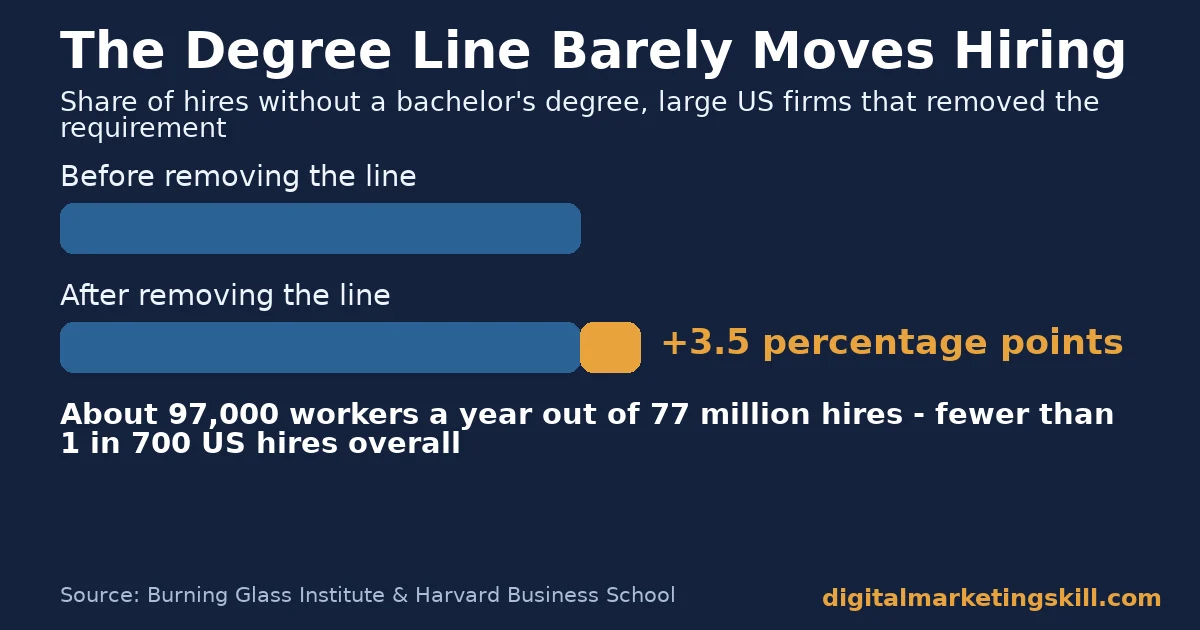
The Burning Glass Institute and Harvard Business School report shows why the ad alone is not enough. Researchers tracked 11,300 roles at large US firms that removed degree requirements. On average, the share of hires without a bachelor’s degree rose by only about 3.5 percentage points. Across all hiring, that meant new opportunity for roughly 97,000 workers a year out of 77 million hires.
Before researchers could measure this, they first had to define it. A change only counted as real skills-based hiring when the share of non-graduates actually hired went up, not simply when a job ad dropped the degree line. That distinction between words and outcomes runs through every figure in this section.
Three Kinds of Employer Behind the Same Job Ad
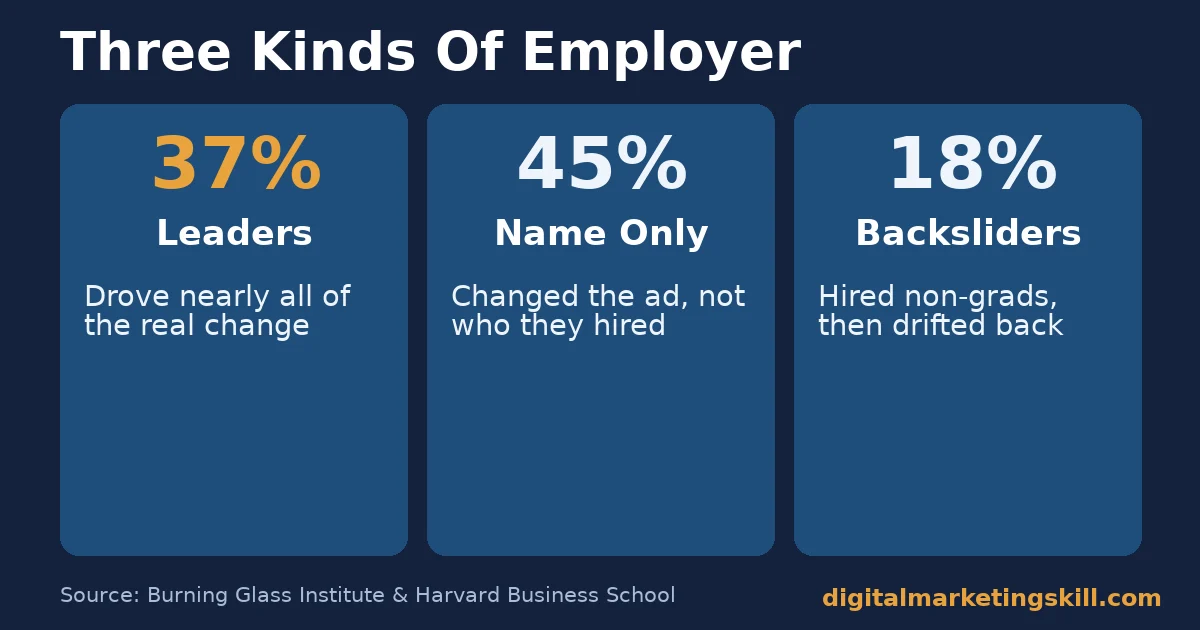
The same report sorted firms into three groups. About 37% were leaders, and they drove nearly all of the real change. Around 45% changed their ads in name only, with no difference in who they hired. Roughly one in five were backsliders, because they hired more non-graduates at first and then drifted back.
Backsliders often respond to a sudden hiring crunch by widening their net, then tighten it again once the urgency fades. A role posted without a degree requirement can quietly start requiring one again. That is one more reason to verify proof requirements directly in the application, rather than trusting the ad’s wording alone.
This pattern matters more for skills-based hiring in marketing than in many other fields, because marketing job titles already blur together.
A “growth marketer,” “digital marketing executive” and “performance marketing associate” can do nearly the same work. So a recruiter often screens on credentials simply because the title does not tell them much else. That is one more reason proof of a specific, named skill carries more weight than a job title alone.
My reading is simple: a job ad without a degree requirement is an invitation, not a promise. So your proof has to survive the filter that replaced the degree, which is usually a CV screen, a skills test or a work sample.
Where Skills Tests Now Fit
Tests are becoming the main gate. TestGorilla’s State of Skills-Based Hiring surveyed 1,084 people who make hiring decisions and 1,076 job seekers in the UK and US. Of the employers, 76% said they use skills tests, and 53% said they had dropped degree requirements. TestGorilla sells skills tests, so read those numbers as a vendor survey.
The same survey shows the gap from the other side. Overall, 59% of job seekers said they struggle to stand out with their CV. Also, 41% of employers said a degree matters more than it did five years ago, so old habits have not gone away.
Marketing-specific tests usually check a narrow slice of the job: writing a short ad from a brief, reading a mock analytics dashboard, or prioritising a list of SEO fixes. None of this requires a degree, but it does require practice with the actual tools. A paid-ads platform or a common analytics tool matters more than course certificates that only describe them.
What Each Route Into Digital Marketing Work Rewards
Digital marketing work comes through three main routes: employers, agencies and freelance clients. Each one checks skill in its own way. Once you know what each route rewards, you can build the right proof instead of a generic CV.
Employers: Built on Screening Filters
In-house marketing teams usually screen with software and a recruiter before anyone tests your skill. That makes the job ad’s wording the first filter. The O*NET profile for search marketing strategists, run by the US Department of Labor, shows the education picture. Of respondents, 48% said a bachelor’s degree is required, 22% an associate’s degree and 17% some college with no degree.
The same profile lists a US median wage of $78,760 a year for the wider group of marketing specialists. It also projects much faster than average growth. These are US figures, so check your own country’s labour data before you plan around them.
Agencies: Built on Speed and Tool Fluency
Agencies sell hours to clients, so they hire people who can deliver from week one. They care less about where you learned and more about whether you can run a campaign, report on it and fix it fast. As a result, a practical task is common at agencies, and our informed inference is that tool fluency often matters more there than credentials.
A typical agency skills check looks like this: build a one-week content calendar from a sample brief, or diagnose why a cost-per-lead figure doubled using a provided spreadsheet. Agencies rarely wait for a formal degree check, because the practical task already tells them what they need to know.
Freelance Clients: Built on Visible Results
Freelance clients rarely run formal tests. Instead, they judge you on visible results, reviews and how clearly you explain your plan. A client paying a few hundred dollars for a project wants low risk, so a small, proven result usually beats a long list of courses.
LinkedIn’s research shows why this route can be wide open. Its Skills-First report found talent pools grow nearly 10 times on average when employers hire on skills.
The same report found a skills-first approach expands candidate pools of non-graduates by about 9%. It also lifts female candidate pools by roughly 24% in roles where women are under-represented. That is based on LinkedIn’s own member data, so it shows potential, not actual hiring.
Freelance platforms work the same way in practice: a client searching for “email marketing” cares about your sample emails, not your transcript.
How to Lead With Proof on Each Route
Each section below mirrors one route above. It gives you the first piece of proof to build, so skills-based hiring works in your favour rather than staying a slogan.
Employers: Lead With a Work Sample Matched to the Job Ad
Pick five job ads you would genuinely apply for. Next, list the three skills that appear in most of them, such as paid social, SEO or email automation. Then build one short work sample for each skill and link it near the top of your CV, so a recruiter sees proof in the first 30 seconds.
Keep each sample short: one page or a two-minute video beats a ten-page deck, because a recruiter spends seconds, not minutes, on a first look. Our guide to getting a digital marketing job covers the application steps in detail.
Agencies: Lead With Tool Fluency and Speed
Record a five-minute screen video of you setting up a campaign or a report in a common tool. Then add a one-page summary of what you changed and why. Agencies value speed, so show the steps you take, not just the final dashboard.
If you have never run the tool with a paying client, a free trial account and a demo dataset are usually enough to produce a believable, honestly-labelled sample.
Freelance Clients: Lead With a Small Paid Result
Offer a small, fixed-scope project first, such as fixing a landing page or setting up an email welcome series. Once it delivers, ask for a short written review that names the result. Then add it to a simple marketing portfolio that shows the problem, your action and the outcome.
Make Every Piece of Proof Measurable
Proof works best when it has numbers a hiring manager can check. For example, Google’s Search Console metric definitions explain clicks, impressions and click-through rate. Use those exact terms in your work samples, because they show you can read real data, not just describe tactics.
If your work sample is a mock search campaign, report its click-through rate and cost per click using those definitions rather than a vague claim like “drove great results.” A hiring manager who has screened hundreds of CVs can check a defined metric in seconds, which is exactly why it works better than a general claim.
How to Measure Whether Your Proof Is Working
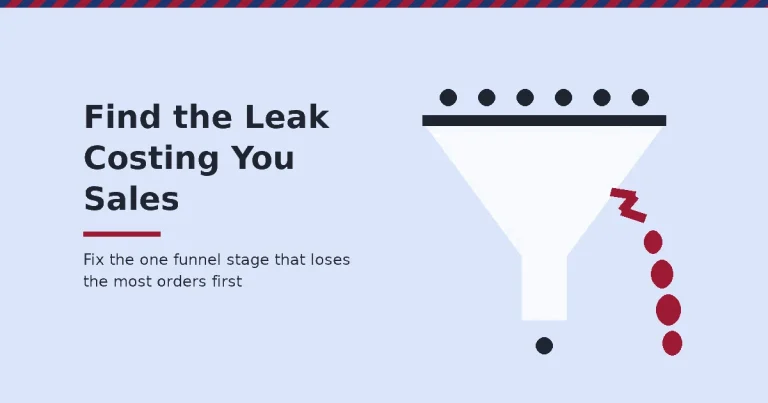
A job search is a funnel too, so measure it like one. Track every application in a simple sheet for four weeks before you change anything. Treat each number below as a diagnostic, not a scorecard, because the goal is to find the one stage that is actually broken. Then read each measure against the stage it describes:
- Response rate: replies divided by applications sent. A low rate means your CV or proof fails the first screen.
- Interview rate: interviews divided by replies. If replies come but interviews do not, your proof does not match the role.
- Test pass rate: skills tests or tasks passed divided by tests taken. This tells you whether the skill itself needs work.
- Proposal win rate: freelance projects won divided by proposals sent. A low rate usually means your result is not visible enough.
- Time to first yes: days from your first application to your first offer or paid project. Use it to judge whether a change sped things up.
Each measure points to one fix. That is the point: instead of sending more applications, you change the stage that is failing.
The Proof-Before-Volume Rule for Skills-Based Hiring
If you take one idea from this guide, take this one. It is the most useful rule for anyone relying on skills-based hiring, because it stops the most common mistake: sending more of the same applications.
Decision rule: do not raise your application volume until you have three work samples that match the ads you target. If your response rate stays below one in ten after 20 applications, change your proof, not your volume.
A Worked Example: Fixing the Stage That Fails
Here is a worked example with illustrative, invented numbers. A job seeker sends 40 applications in a month with a CV that lists courses but no samples. They get two replies, a response rate of 5%, and no interviews.
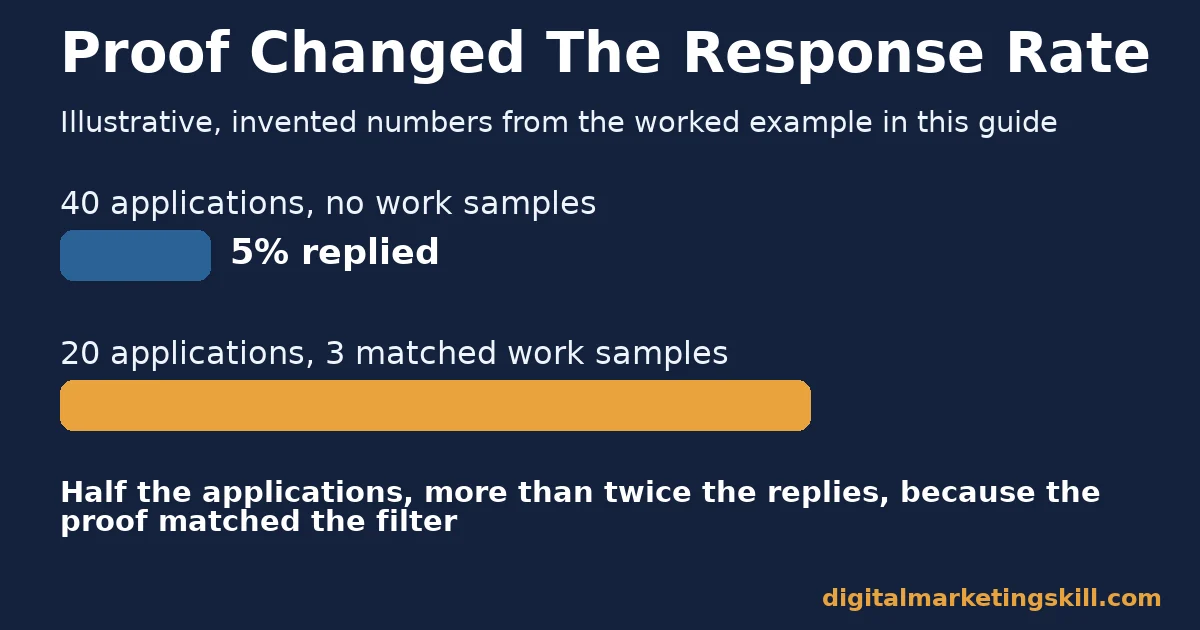
Next, they build three work samples that match the skills in their target ads. In the following month, they send 20 applications with the samples linked near the top. This time they get five replies, a 25% response rate, and two interviews. Half the effort produced more than twice the replies, because the proof matched the filter.
Your numbers will differ. But the method holds: measure each stage, fix the weakest one first, and only then send more applications.
If your response rate is still below one in ten after fixing your proof, look one stage further down the funnel. A low interview rate despite steady replies usually means your proof does not match the seniority or tools named in the ad. Swap one work sample for a closer match before adding more applications.
What Doing This Right Looks Like: Proof That Opened a Role
Grace A., a Digital Marketing Skill Institute graduate, describes this pattern on our student reviews page. After moving to the USA, Grace was stuck in survival jobs because employers wanted local experience. Grace says the U.S. project experience “gave me the portfolio I needed to become a Digital Marketing Manager.”
Why did it work? The missing piece was not a qualification but proof that matched what employers checked: local, real-world work. Once Grace had that proof, the same applications started to land. Her experience is a small, real illustration of the proof-before-volume rule above: the missing piece was not more applications, but proof matched to what the market actually checks.
This case has clear limits. It is one self-reported testimonial, it does not show how long the search took, and it is not a typical or guaranteed result. Outcomes depend on your skills, effort and market, as our earnings disclaimer explains.
Frequently Asked Questions About Skills-Based Hiring
What is skills-based hiring?
Skills-based hiring is an approach where employers judge candidates on what they can do, using tests, work samples or structured interviews, rather than on degrees or job titles. It works for candidates only when the employer actually tests skills, not just removes a line from the ad.
Can I get a digital marketing job without a degree?
Yes, many digital marketing roles are open to people without a degree. In O*NET’s US survey for search marketing strategists, only 48% of respondents said a bachelor’s degree is required. Strong work samples and test results matter most.
Do employers really use skills-based hiring?
Many say they do, but fewer change who they hire. A Burning Glass Institute and Harvard Business School study found only about 37% of firms that dropped degree requirements drove real change, while about 45% changed in name only.
What counts as proof of digital marketing skills?
Good proof is a work sample with a clear problem, your action and a measured result, such as more clicks, sign-ups or sales. Screen recordings, campaign reports and client reviews also work well.
How long does it take to build enough proof?
Three focused work samples usually take a few weeks of part-time effort, depending on the skill. Start with the skill that appears most often in the job ads you want.
Are certificates useless in skills-based hiring?
No, certificates still help, especially when they are accredited and widely recognised. They work best alongside proof, because a certificate shows you learned the skill and a work sample shows you can use it.
Does skills-based hiring work the same for employers, agencies and freelance clients?
No. Employers usually screen with software and a skills test, agencies care most about speed and tool fluency, and freelance clients look at visible, reviewed results. Build a different piece of proof for each route rather than relying on one generic CV.
Build Proof Employers Can Check
Skills-based hiring rewards people who can show their work. So the best next step is to pick three job ads, list their shared skills and build one work sample for each. Then measure your response rate and fix the stage that fails.
If you want structured practice and real projects, the Digital Marketing Skill Institute can help. The Master Diploma in Digital & AI Marketing offers AI-powered tracks in social media and ads, lead generation and email, Google Ads and analytics, and WordPress and SEO.
Every track includes project-based work experience with a U.S. partner company, so you build a portfolio as you learn. Because that work is real client work, you leave with the kind of named, measurable proof this guide recommends, not just a certificate.
You also get unlimited 1-on-1 coaching and mentoring. The diploma is dual US and UK accredited and recognised in more than 100 countries, and the programme is fully online, so you can join from anywhere in your country.
Browse more guides on the Digital Marketing Skill Institute blog, or read about how to learn digital marketing step by step. When you are ready, apply for the Master Diploma or start from the Digital Marketing Skill Institute homepage.
Every figure in this guide was checked against its original source before publication. Figures marked as illustrative are invented examples, not real results.
![9 Amazing Digital Marketing Skills to Make Money Online [With Proof]](https://digitalmarketingskill.com/wp-content/uploads/2019/07/9-Amazing-Digital-Marketing-Skills-to-Make-Money-Online-With-Proof-17.png)