A small scale business usually fails at digital marketing for one of seven reasons. Most owners post content, run a few ads and build a website. Then they wonder why growth stalls. This guide names each mistake, shows the fix, and gives you a way to measure whether the fix is working.
Key Takeaways
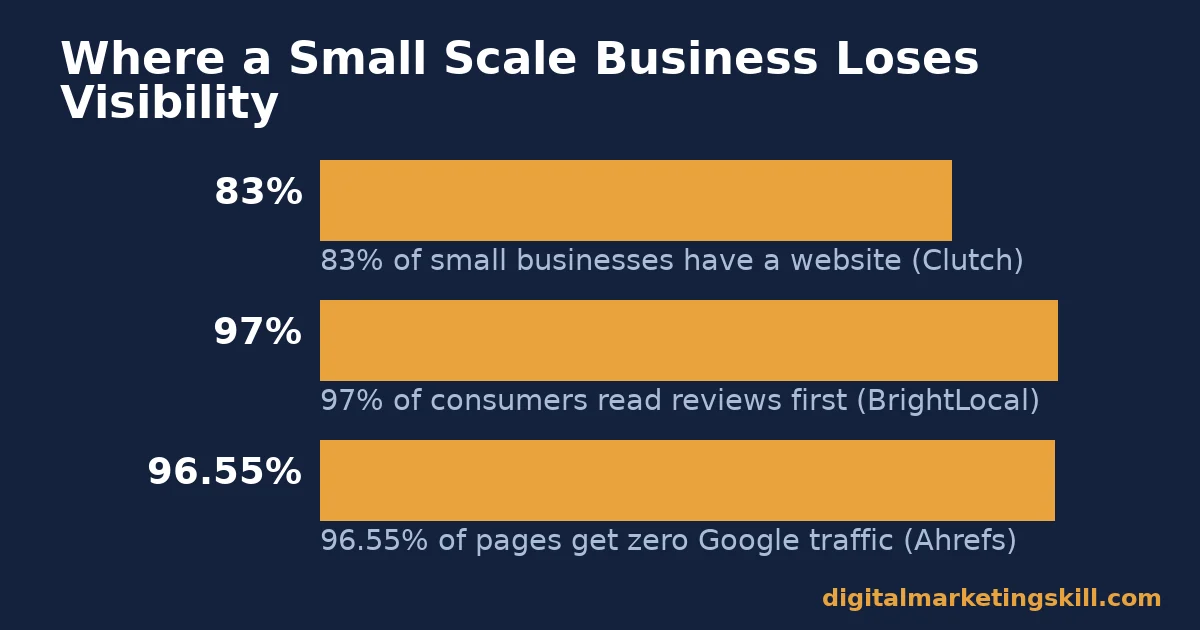
- Visibility is still a gap, not a given. Clutch’s small business survey found 83% of small businesses now have a website. That means 17% are still invisible to anyone searching for them online.
- Reviews decide trust before a sale happens. BrightLocal’s Local Consumer Review Survey, a panel of 1,002 US consumers, found 97% read reviews for local businesses and 41% always do.
- Most content never gets found. Ahrefs studied roughly one billion pages and found 96.55% get no traffic from Google. Publishing without a search strategy wastes most of the effort.
- Owners think they measure results; most do not. Intuit’s Small Business Advertising Trends Report found 95% of small businesses say they measure ad ROI, but only 25% do it consistently.
- Silent customers are the costliest ones. A Coveo survey cited by Zendesk found 56% of consumers rarely complain about a bad experience. They quietly switch to a competitor instead.
In this guide
- What Most Small Scale Business Marketing Advice Misses
- Why Digital Marketing Mistakes Cost a Small Scale Business So Much
- The Seven Mistakes That Hold Back a Small Scale Business
- How to Fix Each Mistake and Grow a Small Scale Business
- Target Audience: Build a One-Page Buyer Persona
- Competitors: Turn Competitive Research Into an Advantage
- Tracking: Set Up Three Numbers You Check Weekly
- SEO: Target the Searches Your Customers Actually Use
- Paid Ads: Start Small and Test Before You Scale
- Platforms: Pick Two Channels and Go Deep
- Feedback: Build a Response Habit
- How to Measure Whether the Fixes Are Working
- The One Decision Rule Worth Remembering
- A Real Case: Turning One Skill Into Recurring Income
- Frequently Asked Questions About Small Scale Business Marketing Mistakes
- Start by Fixing One Mistake This Week
What Most Small Scale Business Marketing Advice Misses
Most advice for a small scale business repeats the same list: build a website, post on social media, start an email list. None of that is wrong. But it treats every business as if it starts from zero knowledge and endless time. It rarely explains why so much marketing effort produces so little revenue.
This guide takes a different angle. It names the seven decisions small scale business owners get wrong most often. It shows what each mistake costs, then pairs it with a fix you can apply this week.
A few ground rules first. Every statistic here names the company or study behind it, with its scope stated, because a self-reported survey and a direct traffic study carry different weight. Treat each number as a snapshot of current behaviour, not a permanent ranking. Treat the one invented example in this guide as exactly that: a labelled illustration, not a real result.
Why Digital Marketing Mistakes Cost a Small Scale Business So Much
A small scale business has less room for error than a larger company. It usually runs on one marketing budget, one or two people, and no brand recognition to fall back on. A mistake a large company absorbs quietly can consume a small scale business’s entire monthly budget.
The mistakes also compound. A business with no clear audience wastes money on ads aimed at the wrong people. It then concludes “ads do not work” and avoids the channel for good. The real mistake was never the ads. It was skipping the audience step that would have made them profitable.
This is why order matters more than effort. Fix mistakes in sequence, not all at once. The next section names each one plainly, so you can check your own small scale business before you spend another dollar on promotion.
A quick self-audit helps before you read further. Open your website analytics, your ad account and your review profile in three tabs. If any of the three is missing, unread or untouched for months, you have already found your first mistake to fix. Write that one mistake down now, before the next section tries to convince you there are seven equally urgent problems.
The Seven Mistakes That Hold Back a Small Scale Business
These seven mistakes show up again and again in small business marketing research. They also match what small scale business owners report when results plateau. Read through once, and mark which ones apply to you right now.
1. No Clearly Defined Target Audience
A small scale business without a defined audience markets to everyone. In practice, that means it markets well to no one. HubSpot’s State of Marketing research found that only 65% of marketers have high-quality data about their target audience. More than a third are guessing.
Without a defined audience, every other decision gets harder. Picking the right platform becomes a guess. Writing copy that resonates becomes harder too. And judging whether an ad is working is almost impossible, because you never defined who it should work for.
2. Ignoring the Competition
Some small scale business owners avoid looking at competitors. It feels discouraging, or too close to copying. But ignoring competitors means missing free information about what your shared audience already responds to. It also means missing warning signs when a tactic has stopped working.
Competitors are not something to copy or insult. They are free market research, showing you the price points, offers and messages your audience already reacts to.
3. Not Tracking Results
Intuit’s Small Business Advertising Trends Report found that 95% of small businesses believe they measure advertising ROI. Only 25% actually do it consistently. That gap, between believing and doing, is where budgets quietly leak away.
Without consistent tracking, a small scale business cannot tell a profitable channel from an expensive habit. The same report found only 57% of respondents felt confident their ads reached the right audience at all.
4. Skipping Search Engine Optimization
A small scale business that never optimizes its website for search competes in the most crowded, most expensive channels. Meanwhile, it ignores the one channel where customers are already looking for a solution. Ahrefs studied roughly one billion pages and found 96.55% earn zero traffic from Google. Usually, the content never targeted a real search term in the first place.
Search engine optimization is not a one-time task. It means choosing keywords customers actually type. It means structuring pages so search engines and readers can both follow them. Our guide on on-page SEO breaks down the technical side of this.
5. Avoiding Paid Ads Entirely
Many small scale business owners avoid paid advertising because early results felt expensive or confusing. That reaction is understandable. But it removes a channel that, tested correctly, can out-perform organic reach within weeks, not months.
Cost is a real constraint, not an excuse to skip the channel. WordStream and LocaliQ’s 2025 benchmark report, built from more than 16,000 campaigns, put the average cost per click on Google’s Search Network at $5.26. Costs rose across 87% of the industries studied. That makes a small test, before you scale, the only responsible move.
6. Spreading Thin Across Every Platform
It feels safer to be everywhere, so a small scale business opens an account on every platform its competitors use. The result is usually five channels run poorly, instead of two run well. The owner’s time never multiplied along with the platform count.
A clearly defined audience, from mistake one, tells you which one or two platforms actually matter. Everywhere else is optional. An optional channel that drains your time is worse than no channel at all.
7. Ignoring Customer Feedback and Criticism
Negative feedback feels uncomfortable. So it is tempting to delete it, argue with it, or simply not look. A Coveo survey, reported by Zendesk, found that 56% of consumers rarely complain when something goes wrong. They quietly switch to a competitor instead. The customers who complain in public are doing you a favor by surfacing a problem you would never otherwise see.
Ignoring criticism does not make it disappear. It removes your only chance to respond, fix the issue, and show every future customer how your small scale business handles problems.
How to Fix Each Mistake and Grow a Small Scale Business
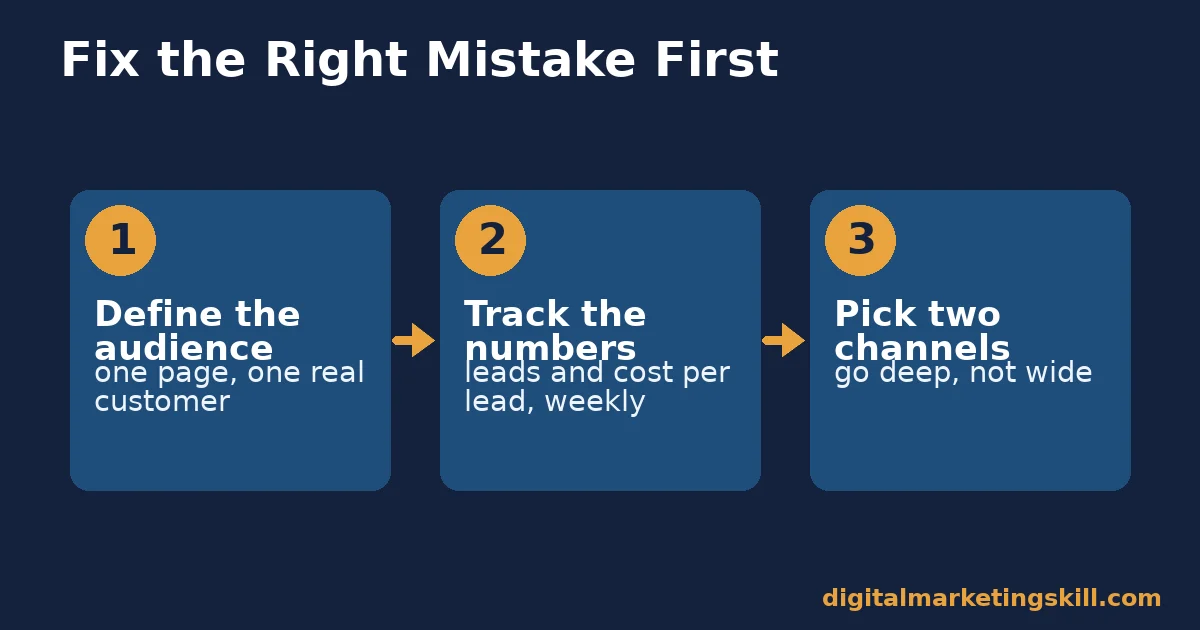
Each fix below mirrors the mistake above it. Work through them in order, because the early fixes make the later ones more effective.
Target Audience: Build a One-Page Buyer Persona
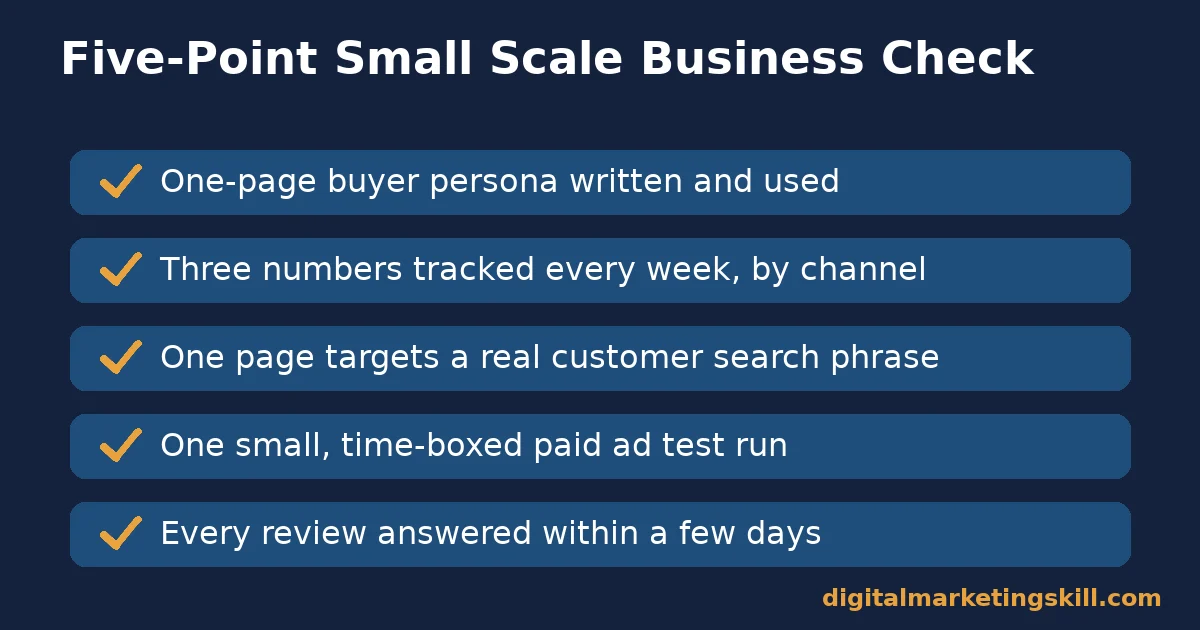
Write one page describing your most valuable existing customer. Cover their role or situation, the problem that brought them to you, where they spend time online, and what almost stopped them from buying. If you have no customers yet, base it on the closest comparable person you can interview.
Use this page to filter every marketing decision from now on. If a platform, a piece of content or an ad does not fit this person, skip it for now. Our walkthrough on building a buyer persona gives a template you can fill in within an hour.
Competitors: Turn Competitive Research Into an Advantage
List three direct competitors. Spend thirty minutes reading their reviews, both positive and negative. The negative reviews show you exactly what gap in service or product you could fill. The positive ones show you what your shared audience already values.
Repeat this check every few months, not just once. Competitors change pricing, messaging and offers. A small scale business that checks quarterly catches shifts early, instead of discovering them from a drop in sales.
Tracking: Set Up Three Numbers You Check Weekly
Pick three numbers that match how your small scale business actually makes money. For most businesses, that is visitors, leads and sales, tracked by channel. Write them in a simple spreadsheet every week, even before the numbers feel perfectly accurate.
Consistency beats precision at this stage. A rough weekly number you actually look at teaches you more than a perfect report you build once and never open again.
You do not need paid software to start. A free analytics tool on your website, a notes field in your ad account, and a shared spreadsheet are enough for the first few months. Upgrade to dedicated tracking tools only once you know which channels deserve the extra cost.
SEO: Target the Searches Your Customers Actually Use
Before writing new content, list the exact phrases a customer would type when they have the problem your business solves. Write one page or post that answers that exact phrase clearly, with a direct answer near the top.
Then check the basics: a readable page title, one clear heading structure, and a page that loads quickly on a phone. Technical polish matters less than answering the real question your customer typed.
Paid Ads: Start Small and Test Before You Scale
Set a small test budget. It should be enough to get real data, but not enough to hurt if the first version fails. Run one ad at the audience you defined earlier. Measure the cost per lead, and only increase spend once that number works for your margins.
Give the test enough time to produce a real sample before you judge it. A single day of mixed results tells you very little. A week or two, tracked against the numbers from the fix above, tells you whether the channel works for this audience.
Platforms: Pick Two Channels and Go Deep
Choose the one or two platforms where your defined audience already spends time, based on your buyer persona. Commit to posting there consistently for a full quarter before you judge results. Close or pause accounts outside that list.
Depth beats breadth for a small scale business with limited time. Two channels run well generate more leads than five channels run occasionally, because consistency is what builds audience trust.
Feedback: Build a Response Habit
Set a fixed time each week to read every review and comment. Respond to the negative ones calmly and specifically. Thank the positive ones by name where you can. A short, honest reply to criticism often builds more trust than the original complaint ever damaged.
Treat repeated complaints as product data, not noise to manage. If three customers mention the same issue, that is a pattern worth fixing, not three unrelated opinions to forget.
How to Measure Whether the Fixes Are Working
Each metric below is defined in one sentence, with a note on how to read it. Use them alongside whatever basic analytics your website or ad platform already gives you.
- Qualified leads per week. This is the number of inquiries that match your buyer persona, not just any form submission. A rising number here means your targeting fix is working.
- Cost per lead by channel. Divide what you spent on a channel by the leads it produced. Compare channels monthly to see where a dollar goes furthest.
- Organic search impressions. Most website analytics tools report how often your pages appeared in search results. A rising trend shows your SEO fix is starting to earn visibility.
- Review response rate. This is the share of reviews, positive and negative, that got a reply within a few days. It shows whether the feedback fix has actually become a habit.
- Repeat customer rate. This is the share of customers who buy again within a few months. Because silent switching is common, a flat or falling repeat rate is often the first sign a fix is not working, even when new customer numbers look fine.
Read these together, not one at a time. When qualified leads are flat but cost per lead is falling, the targeting fix is working and the channel fix needs attention next. When leads are rising but repeat customers are not, revisit the feedback fix.
The One Decision Rule Worth Remembering
Fix the target audience mistake first, if you fix only one thing after reading this guide. Every other mistake on this list gets cheaper and easier to fix once you know exactly who you are marketing to.
Here is an illustrative example, with invented numbers, to show the arithmetic. A small scale business spends $400 a month on ads with no defined audience. It gets 20 leads at $20 each, and few turn into sales.
The owner writes a one-page buyer persona and narrows the ad targeting to match it. The same $400 now produces 14 leads at $28.50 each. Over half convert to paying customers, against roughly one in ten before. Fewer, better-matched leads beat more, poorly matched ones.
A Real Case: Turning One Skill Into Recurring Income
Olajire Jacob, a graduate of the Digital Marketing Skill Institute profiled in its published student reviews, started by charging around $500 to set up email marketing automation for individual clients. He applied what he learned about running that service consistently, rather than one project at a time. The work scaled into roughly $5,000 a month in recurring income.
The lesson generalizes beyond email marketing. A small scale business, or a freelancer serving one, grows fastest by taking one skill and turning it into a repeatable, trackable service. That beats offering a little of everything to everyone. Read his full story and other outcomes on the DMSI reviews page; results vary by effort, market and starting point, and are not a guarantee of income, consistent with our earnings disclaimer.
Frequently Asked Questions About Small Scale Business Marketing Mistakes
What is the biggest marketing mistake a small scale business makes?
Not having a clearly defined target audience. It makes every other marketing decision, from platform choice to ad targeting, harder to get right.
Do small scale businesses really need paid ads?
Not immediately. But avoiding the channel entirely usually means missing a fast way to reach a defined audience. Start with a small, time-boxed test instead of ruling it out.
How much should a small scale business spend on marketing?
There is no single correct figure, because it depends on margins and growth stage. Whatever the budget, tracking cost per lead by channel matters more than the total spent.
Is social media enough for a small scale business?
Rarely on its own. Social media alone seldom reaches customers who are actively searching for a solution right now. Pair one or two social platforms with basic search engine optimization to cover both kinds of customer.
How do I know if my small scale business is ignoring its audience?
If you cannot describe your ideal customer in one paragraph, including their problem and where they spend time online, that is a clear sign the audience step got skipped.
Should a small scale business respond to negative reviews?
Yes. A calm, specific response shows future readers how problems get handled. Most unhappy customers never say so publicly, which makes the public complaints you do get valuable, not just annoying.
How long does it take to see results after fixing these mistakes?
Search engine optimization and content usually take months to compound. A paid ad test or a review response habit can show a signal within weeks. Track weekly, but judge each channel on its own realistic timeline.
Can a small scale business fix all seven mistakes at the same time?
It is possible, but not advisable with a limited team. Fixing the audience mistake first makes every later fix more effective, so a sequential approach usually beats trying to do everything in the same week.
Start by Fixing One Mistake This Week
Growing a small scale business with digital marketing does not require fixing all seven mistakes at once. Pick the one from this guide that matches your biggest gap. Apply the fix, then measure it for a month before you move to the next.
If you want structured, hands-on training instead of piecing this together alone, the Digital Marketing Skill Institute’s Master Diploma in Digital & AI Marketing is built around four AI-powered tracks: AI-Powered Social Media Management and Advertising, AI-Powered Lead Generation and Email Automation, AI-Powered Google Specialist, and AI-Powered WordPress and SEO Specialist. Together they total ten courses, with a Full Stack option for completing all four.
The program includes unlimited 1-on-1 coaching and mentoring, a U.S. Project Internship with a verified U.S. Work Reference Letter, and dual US and UK accreditation recognised in more than 100 countries. It is 100% online, so you can study from anywhere in your country.
Learn more about the Master Diploma program, browse the digital marketing blog for more practical guides, or go straight to the application page to get started. Explore everything the Institute offers at digitalmarketingskill.com, wherever you live, and come back to digitalmarketingskill.com any time you need the next guide.
Every figure in this guide was checked against its original source before publication. Figures marked as illustrative are invented examples, not real results.