Social media job search works when you treat your profile like a storefront, not a diary. Recruiters check candidates’ social profiles before they call. What shows up there can open a door, or quietly close one. This guide explains how recruiters actually use each platform, what to fix on yours, and how to measure whether it is working.
Key Takeaways
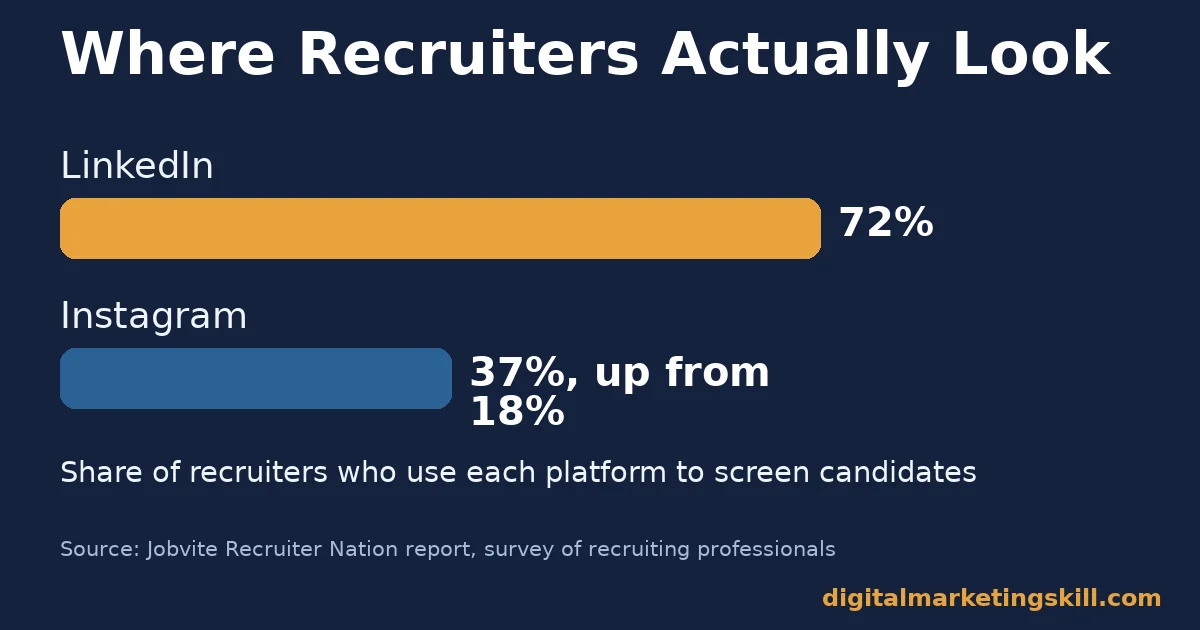
- Screening is now routine. In Jobvite’s Recruiter Nation survey, 72% of recruiters use LinkedIn for recruiting, and 37% now use Instagram, up from 18% a few years earlier.
- Social media already finds people jobs. Pew Research found that 35% of social media users have used social media to look for or research a job, and 13% say something they posted helped them get hired.
- Networking beats cold applying. The same Pew Research survey found 21% of social media users applied for a job they first heard about through a social contact, not a job board.
- Investment keeps growing. 78% of recruiters in Jobvite’s survey expect social media recruiting budgets to grow, so visibility on these platforms will matter more, not less.
- A profile is read in parts. Recruiters scan the headline, photo and first three posts first. Your weakest section usually sits lower down, so fix those three before anything else.
In this guide
- What Most Social Media Job Search Advice Misses
- How Recruiters Actually Screen a Social Media Profile
- Three Platforms, Three Different Jobs to Do
- How to Fix Each Platform for a Real Search
- Common Mistakes That Quietly Cost You the Interview
- How to Measure Whether Your Social Media Job Search Is Working
- The One Rule: Message Before You Apply
- A Four-Week Plan to Run a Social Media Job Search
- A Real Case: Visibility Mattered More Than Location
- Frequently Asked Questions About Social Media Job Search
- Start With One Platform, Then Expand
What Most Social Media Job Search Advice Misses
Most advice on this topic says the same three things: optimise your LinkedIn headline, post consistently, and network with strangers. None of that is wrong. But it treats every platform the same way, and recruiters do not.
This guide breaks the job search down by platform, because a LinkedIn recommendation and an Instagram highlight reel prove different things to different people. It also separates what recruiters check from what they ignore, so you spend effort where it actually gets read.
A few ground rules first. The recruiter figures below come from Jobvite’s own survey of recruiting professionals. They describe recruiter behaviour, not a promise that one specific recruiter checks your profile. The Pew Research figures describe US social media users broadly, and they are a snapshot, not a permanent ranking of platforms. Treat every tactic here as an informed inference from that evidence, tested against what actually gets interviews.
How Recruiters Actually Screen a Social Media Profile
Social media job search starts the moment a recruiter searches your name, which now happens before most first calls. A recruiter rarely reads a whole profile top to bottom. Instead they scan for three things in under a minute: proof you can do the job, proof you are easy to work with, and a reason to disqualify you fast.
Jobvite’s Recruiter Nation report found that 72% of recruiting professionals use LinkedIn specifically for recruiting, which makes it the default first stop for most hiring teams. Instagram use for recruiting has climbed to 37%, up from 18% a few years earlier, largely because visual and creative roles are easier to judge from a feed than from a resume alone.
Your Headline Gets Read Before Your Experience
Recruiters scan rather than read in full, so the headline under your name carries more weight than the job history below it. A headline that lists a job title and nothing else wastes the single line most likely to be seen. A headline naming a specific skill, result, or specialism gives the recruiter a reason to keep reading past the first second.
Networking Finds Jobs Before Job Boards Do
Pew Research’s survey of social media users found that 35% have used social media to look for or research a job. Of those users, 21% applied for a role they first heard about through a social contact rather than a posting. A social media job search is not only about being found by a recruiter. It is also about hearing of openings earlier, through people, before those roles ever go public.
Three Platforms, Three Different Jobs to Do
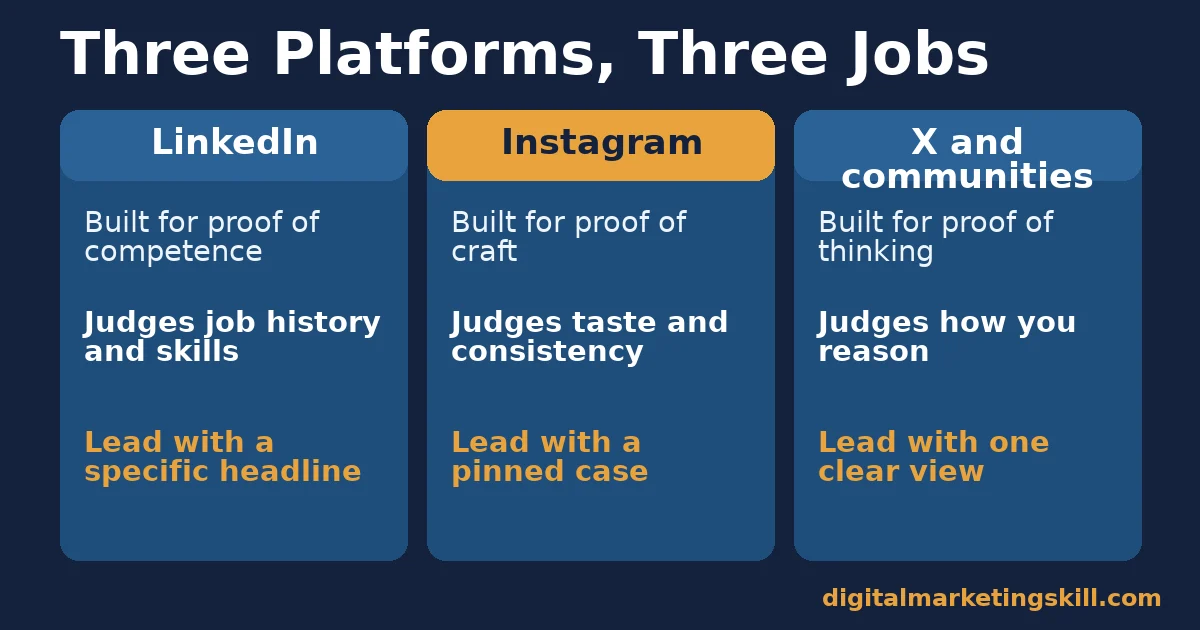
Each major platform proves something different to a recruiter, so content that works on one does not automatically work on another. Treat each platform as a different stage of the same pitch, not a copy-paste of the same update.
LinkedIn: Built For Proof of Competence
LinkedIn is where recruiters expect a structured case for your competence: job history, skills, recommendations, and activity that shows you understand your field. It is the platform Jobvite found most recruiters already rely on. A thin or outdated LinkedIn profile is the single biggest social media gap most job seekers carry into a search. It is the first place almost every recruiter looks.
Instagram and Visual Platforms: Built For Proof of Craft
For design, content, social media, and creative marketing roles, Instagram or a portfolio site does one thing a resume cannot do. It shows the actual work. Recruiters checking these profiles are judging taste and consistency, not reading captions word for word. The visual quality of your first six grid images matters more than how often you post. Google’s own guidance on helpful content makes a related point for any public writing you do: a reader, or a recruiter, should come away feeling they learned something real, not that they read filler.
X and Niche Communities: Built For Proof of Thinking
Platforms built around short public commentary let a recruiter see how you reason about your field in public, which a resume cannot show at all. A handful of genuinely useful posts about your specialism do more here than frequent posting with no point of view. One sharp opinion, backed by a reason, beats ten generic shares.
How to Fix Each Platform for a Real Search
Understanding the differences only helps if you change what you actually publish. Here is what to lead with on each platform once you are actively searching, mirroring the three jobs each platform already does above.
LinkedIn: Lead With a Specific, Searchable Headline
Replace a generic job title with a headline naming your specialism and a result you can defend in an interview, such as a skill paired with a measurable outcome. Then add two or three recent posts or comments in your field. Recruiters scan recent activity to judge whether you are current, not just credentialed, so a headline alone is not enough.
Instagram: Lead With a Pinned Case, Not a Grid
Pin three posts that each show one finished piece of work with a one-line result, rather than leaving a recruiter to scroll a full grid for proof. A short highlight labelled with your specialism, whether that is campaigns, writing, or design, turns a personal feed into a scannable portfolio in seconds instead of minutes.
X and Communities: Lead With One Clear Opinion a Week
Pick one real debate in your field and state a clear, defensible view on it weekly, rather than reposting other people’s takes without comment. A recruiter who reads three of these learns more about how you actually think than a dozen generic motivational posts ever could show them.
Common Mistakes That Quietly Cost You the Interview
Some mistakes do not just fail to help. They actively work against a social media job search, often without the candidate noticing until the interviews stop coming.
- An empty or outdated profile photo and headline. This reads as inactive, even when you are actively job hunting right now.
- Job titles with no context. A list of titles without one line of impact per role gives a recruiter nothing concrete to remember you by.
- Posting only when job hunting. A profile that goes quiet between searches signals that networking is not a habit, and recruiters notice the gap.
- Applying publicly before messaging privately. A direct, specific message to someone at the company almost always outperforms a public comment on their job post.
- One platform, one identical message. Posting the same update everywhere ignores that each platform is read differently, exactly as the sections above show.
- No proof of recent learning. A profile frozen at your last job title, with no new skill or certificate added since, suggests you have stopped growing in your field.
Which Mistake to Fix First
If you can fix only one thing this week, fix the headline on your most-used platform. It is read first, and read by everyone who visits your profile. It is also the fastest edit on this entire list to make. Harvard Business School’s guidance on personal branding makes the same point: small, inconsistent signals do more damage to a search than any single bad post.
How to Measure Whether Your Social Media Job Search Is Working
Track a social media job search like a short campaign, not a feeling. Three numbers show whether your changes are working before a single interview happens, so you can adjust early instead of waiting weeks.
Three Numbers Worth Watching
Profile views over the last 90 days. This counts how many people viewed your profile, available on most platforms’ own analytics. A rising trend after you update your headline or activity means the edit is working. A flat line means the edit was not seen widely enough or was not strong enough to stop a scroll.
Reply rate to outbound messages. This is the share of direct messages to recruiters or hiring managers that get a reply within a week. Track it in a simple spreadsheet. A reply rate under one in ten usually means the message, not the platform, is the problem worth fixing next.
Warm introductions per month. Count conversations that came from someone else tagging, sharing, or introducing you, rather than you reaching out cold yourself. This number should rise as your visible activity becomes more specific and more consistent over time.
Reading These Numbers Together
Rising profile views paired with a low reply rate usually means your headline works but your outbound message does not land. A low view count with a decent reply rate usually means your network is too small, so the fix is targeted connecting, not a better message.
The One Rule: Message Before You Apply
If you change only one habit, change this. Before you apply through a job board, find one person connected to that team and send a short, specific message first. Pew Research’s finding that 21% of social media users got jobs through contacts, not postings, holds because people vouch faster than any algorithm screens. Name the role, say why you fit in one sentence, and ask one specific question. That message beats a cold application almost every time anyone tries it.
As an illustrative, invented example: picture two candidates applying for the same marketing coordinator role. Candidate A applies cold through the job board. Then they wait. Candidate B messages the hiring manager directly, names the role, and asks one specific question about the team’s current campaign. Recruiters consistently report remembering candidate B first, simply because a specific question is harder to ignore than a generic application in a pile of a hundred.
A Four-Week Plan to Run a Social Media Job Search
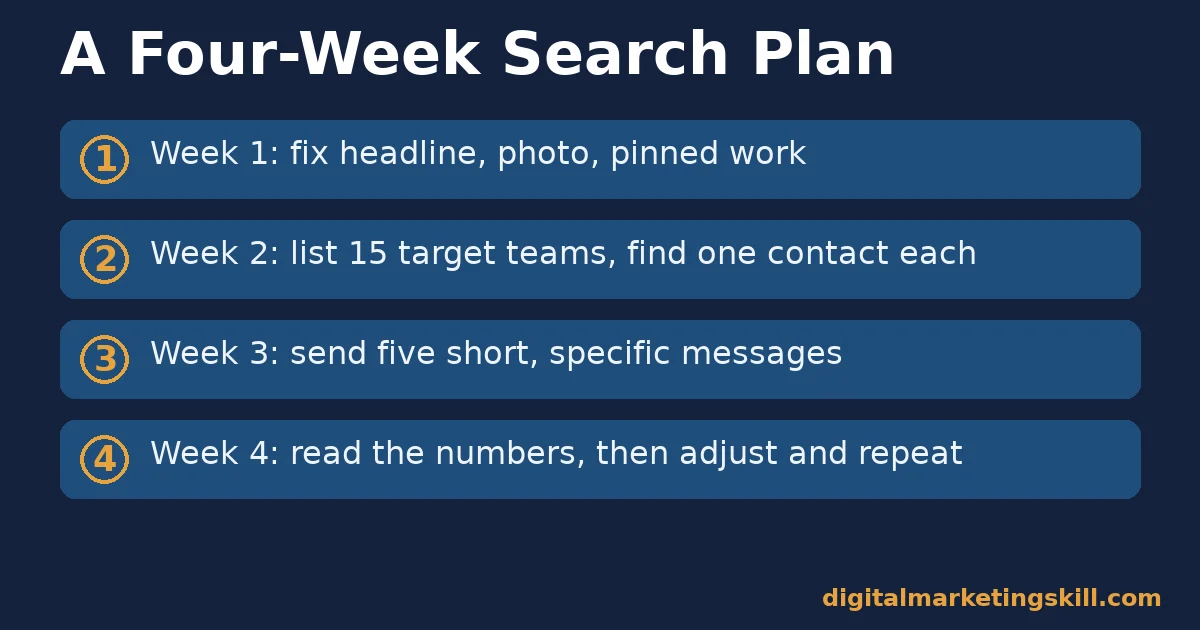
A social media job search works best as a short, scheduled project, not an open-ended habit squeezed between applications. Harvard Business Review’s guidance on personal branding treats this the same way: define your value proposition first, then show it consistently, rather than posting at random. Here is a simple four-week version built around that idea.
Week One: Fix the First Three Things Seen
Rewrite your headline to name a specific skill and result. Swap your profile photo if it is more than a couple of years old. Pin or feature your single best piece of work. Do nothing else until these three are done, because they are read before anything you write next.
Week Two: Build a Short, Specific Target List
List fifteen companies or teams you actually want to work with, not fifty generic ones. For each, find one person already connected to that team. A short list researched well beats a long list messaged carelessly.
Week Three: Send Five Specific Messages
Message five people from your list. Name the role or team, say why you fit in one sentence, and ask one specific question about their work. Track every reply in a simple spreadsheet so week four has real numbers to act on.
Week Four: Read the Numbers and Adjust
Check profile views, reply rate, and any warm introductions, the same three numbers described above. If replies are low, rewrite the message. If views are low, the headline or network still needs work. Repeat the cycle rather than abandoning it after one pass.
A Real Case: Visibility Mattered More Than Location
One digital marketing graduate, Kofi B., described this in a review on the Institute’s site. A specific, visible skill set won a remote role over other candidates: “What won me the remote role in Canada was my AI marketing knowledge. I could do the work of a 3-person team. My location became irrelevant.” The lesson is not the specific skill itself. A sharply defined, visible specialism let a recruiter judge fit quickly. That is exactly the job a scannable profile should do for any candidate.
Frequently Asked Questions About Social Media Job Search
Which platform matters most for a social media job search?
LinkedIn, for most roles, because Jobvite’s survey found 72% of recruiters already use it to screen candidates before a first call. Creative and visual roles should also treat Instagram or a portfolio site as equally important, since recruiters there judge finished work, not job titles.
Should I delete old personal posts before job hunting?
Review anything public and remove posts you would not want a hiring manager to see, but do not delete your whole history. An empty, brand-new-looking profile can look less trustworthy to a recruiter than an imperfect but genuinely active one.
How often should I post while job searching?
Consistency beats frequency every time. One genuinely useful post or comment a week, kept up for a month, outperforms a burst of ten posts published the week you start applying.
Do recruiters really read comments, not just profiles?
Yes. A thoughtful comment on a hiring manager’s or company’s post is often more visible than a cold application. It appears directly in front of people who already follow that account. Indeed’s career advice on networking for a job gives the same tip: engage publicly with a company’s own content before you ever message its recruiter.
Is it worth messaging someone I do not know at all?
Yes, if the message is short and specific. Name the role, say why you fit in one sentence, and ask one clear question. A vague “let’s connect” message gets ignored far more often than a specific one.
What if my current employer might see I am job hunting?
Keep public activity focused on your skills and field, not visible job-search language. Direct messages to contacts stay private and will not appear anywhere on your public profile or feed.
Can a strong profile replace a weak resume?
No. A profile earns the first look. The resume and interview still have to prove the rest of the case. Treat the profile as what gets your resume opened, never as a substitute for it.
How does this differ from a LinkedIn-only job search?
A LinkedIn job search covers one platform in depth. This guide compares LinkedIn against Instagram and public commentary platforms, so you know where to put effort if your target role is visual or opinion-driven rather than purely credential-driven.
Start With One Platform, Then Expand
Pick the one platform your target recruiters already use most, fix its headline and first three posts this week, then send five specific messages before applying anywhere cold. Measure profile views and reply rate for two weeks before judging whether it worked. A well-built LinkedIn profile, a focused marketing portfolio, and a resume that passes both screens all reinforce the same story, so fix them together rather than one at a time.
Want a structured way to build the specific, visible skills that make a profile worth clicking on? The Digital Marketing Skill Institute’s Master Diploma in Digital & AI Marketing covers that ground. It runs across four AI-powered tracks: AI-Powered Social Media Management and Advertising, AI-Powered Lead Generation and Email Automation, AI-Powered Google Specialist, and AI-Powered WordPress and SEO Specialist. Together they total ten execution-first courses, with a Full Stack option for completing all four. The program adds unlimited 1-on-1 coaching and mentoring, a U.S. Project Internship with a verified U.S. Work Reference Letter, and a dual US and UK accredited diploma recognised in more than 100 countries. It runs 100% online, so you can build a profile worth finding from anywhere in your country, starting today at digitalmarketingskill.com.
Explore the Master Diploma program, read more on the digital marketing blog, see outcomes on the reviews page, or go straight to apply at digitalmarketingskill.com. Anyone in your country can complete this 100% online.
Every figure in this guide was checked against its original source before publication. Figures marked as illustrative are invented examples, not real results.