
Social media mistakes are the small, repeatable errors that quietly drain engagement and trust: no plan, no response, no clear voice, no real metrics. Each one is easy to miss day to day, but together they cap how far any account can grow. This guide groups the mistakes by root cause, gives a fix for each, a way to measure it, and one rule for deciding which to fix first.
Key Takeaways
- 68% of US consumers expect a reply to a social media complaint within 24 hours. 24% expect it within 1-2 hours, and 14% expect it within an hour, per Sprout Social’s latest Pulse Survey.
- 55% of consumers would rather move a complaint into direct messages than keep it public, per the same survey.
- Social media mistakes cluster into four root causes: no strategy, no clear voice, no response plan, and no outcome metrics.
- A systemic mistake (no strategy) damages every post. An isolated mistake (one bad tweet) damages one post. Fix systemic mistakes first.
- Posting more is not a fix for any of these mistakes. Volume cannot repair a missing plan, voice, response habit, or metric.
In this guide
- Why Lists of Social Media Mistakes Rarely Help
- Why Social Media Mistakes Compound Over Time
- What Differs by Social Media Mistake Type
- How to Fix Each Social Media Mistake Type
- Measuring Whether the Fixes Are Working
- The One Decision Rule for Fixing Social Media Mistakes
- A Real Case: Consistency Over Cleverness
- Frequently Asked Questions About Social Media Mistakes
- Fix the Root Causes With a Structured Skill Set
Why Lists of Social Media Mistakes Rarely Help
Most lists of social media mistakes read the same way. They name ten or twenty things not to do. They rarely say why each one happens, or which one to fix first.
That approach treats a brand-new intern account and a ten-year-old corporate page as if they have the same problems. They usually do not. A new account’s mistakes are often about missing basics. An old account’s mistakes are often about drift, a voice or process that slowly stopped matching the brand.
That is the real gap. A missing posting plan and one badly worded reply are both “mistakes.” They are not the same size of problem. Treating them the same wastes the limited time a small team has to fix things.
This guide sorts social media mistakes into four root causes instead of a flat list. Each cause gets one matching fix, one way to measure whether the fix worked, and a rule for deciding which cause to tackle first when time is short.
A ground rule before the detail: fixing a social media mistake does not guarantee growth by itself. It removes a cap on growth. The strategy, content and paid budget behind an account still decide how far it goes once the caps are removed.
A second ground rule: this is a practical framework, not a universal formula. What counts as a mistake on one platform, posting several times a day, can be normal practice on another. Match any fix to the platform and audience in front of you, not to a generic rulebook.
Why Social Media Mistakes Compound Over Time
A single social media mistake rarely sinks an account. The damage comes from repetition. A platform’s algorithm reads weak engagement as a signal to show a post to fewer people. Fewer people see it, so it gets less engagement. The cycle repeats on the next post too.
Response mistakes compound the same way, but with people instead of algorithms. One unanswered complaint rarely costs a brand much. A pattern of unanswered complaints teaches an audience that nobody is listening, and they stop trying to reach the brand at all, in public or in private, the same pattern Meta’s own business messaging guidance warns against.
Strategy and voice mistakes compound more quietly, through opportunity cost rather than visible damage. Nobody can point to a single lost sale from an inconsistent posting schedule. The cost shows up slowly, as an account that never quite builds the audience its content quality should have earned.
What Differs by Social Media Mistake Type
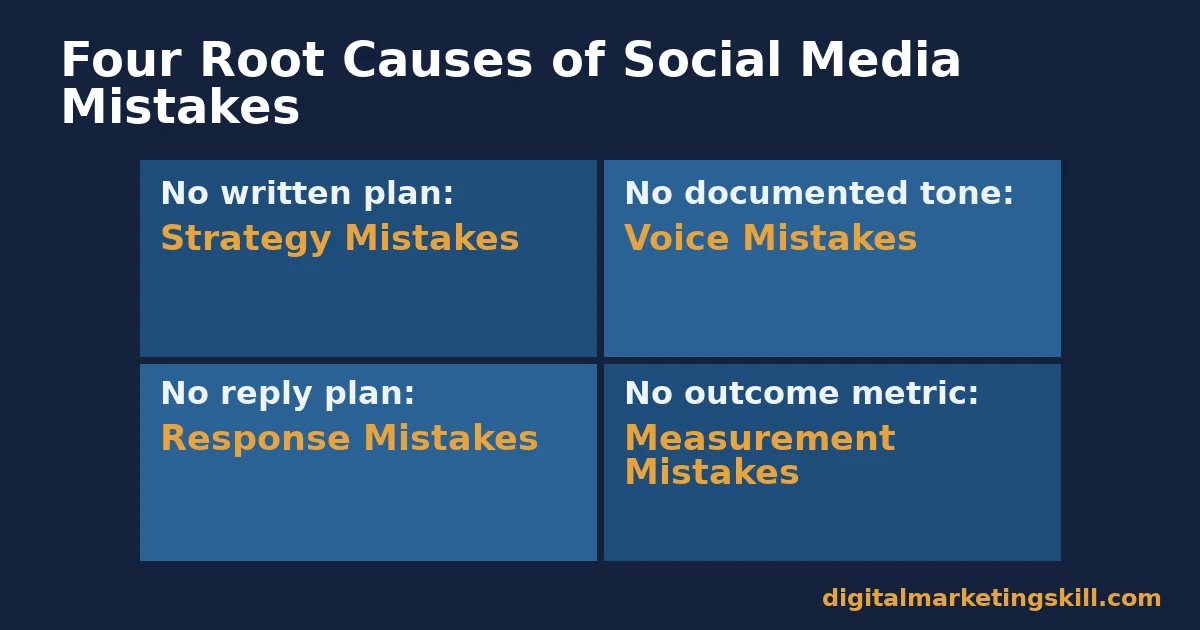
Four root causes explain most social media mistakes. Each needs a different fix, so lumping them together under “try harder” rarely works. The order below is not a priority order; the priority order comes later, in the decision-rule section.
Strategy Mistakes: Rooted in No Written Plan
Posting without a plan is the most common social media mistake, and the root of several others. Without a goal, an audience definition and a content calendar, every post is a one-off guess. Guesses are inconsistent, and inconsistency is what algorithms and audiences both punish.
This mistake is easy to miss because posting itself still happens. Content goes out on schedule, or close to it. What is missing is the reason behind each post, so nobody can say whether a given week’s content actually moved the account toward its goal. A quick test: ask why the last three posts went out, in that order. If the honest answer is “it was Tuesday,” the strategy gap is confirmed.
Voice Mistakes: Rooted in an Undefined Personality
A brand with no documented voice drifts. One post is jokey, the next is stiff and corporate, and neither matches what the last ten posts did. Followers cannot form a clear sense of who they are following, so they engage less and unfollow more easily.
Voice drift often happens gradually, through several different people posting over time, each with their own instinct for tone. No single post looks wrong on its own. The problem only shows up when someone scrolls back through a month of posts at once, and notices the account reads like three different writers took turns without ever comparing notes.
Response Mistakes: Rooted in No Reply Plan
Many accounts post content well but never plan for the comments and messages that follow. Nobody owns replies, so questions and complaints sit unanswered. Silence after a complaint reads as indifference, even when the business is simply short-staffed. The same gap shows up in customer service work more broadly, not just on social.
This mistake is quietly expensive because the same complaint often gets repeated. A question nobody answers once gets asked again by the next customer, and the next, with no record anywhere of what the right answer should have been. Over time this multiplies the workload instead of reducing it, since every new question starts from zero rather than building on a known answer.
Measurement Mistakes: Rooted in Vanity Metrics
Tracking only likes and follower count hides whether social media actually supports the business. A post can collect hundreds of likes and send zero visitors anywhere useful. Without outcome metrics, a team cannot tell a good post from a merely popular one.
This mistake survives because vanity numbers feel good to report. A rising like count is an easy win to show a manager or client, even when it has no connection to revenue, leads or any other goal the account was built to support. Nobody wants to be the one who asks the uncomfortable follow-up question: what did all those likes actually produce.
How to Fix Each Social Media Mistake Type
Naming the category is only step one. Each root cause needs its own specific fix, not a generic “post better” instruction. Fixing the wrong category first, polishing voice when the real gap is response time, wastes effort that a correctly targeted fix would have used well.
Strategy Mistakes: Fix With a One-Page Written Plan
Write down the goal, the target audience, and which two or three platforms matter most. Build a simple content calendar from that plan. One page is enough. The point is not length; it is having something every post can be checked against before it goes out.
Review the plan every quarter, not every week. A plan that changes too often stops functioning as a plan. It should flex with real results, but it should not be rewritten every time one post underperforms.
Voice Mistakes: Fix With a Documented Tone, Not a Mood
Write three or four lines describing the brand’s voice: formal or casual, how much humor, which topics to avoid. Anyone posting should be able to read those lines and match the tone without guessing. Consistency matters more than any single clever post.
Test the written voice against three recent posts. If a post would not fit the description, either the post was off-brand or the description needs a rewrite. Either way, that mismatch is worth catching before the next post goes out.
Response Mistakes: Fix With a Response-Time Rule
Set an explicit target, such as replying within a few hours during business hours, and name who owns it. Per Sprout Social, a large share of consumers expect an answer within one to two hours of a complaint, so a next-day reply habit is already behind what many people expect.
Write two or three template answers for the most common questions, then let the owner personalize them rather than starting from a blank reply box every time. That alone can cut response time without adding staff.
Measurement Mistakes: Fix With One Outcome Metric per Goal
Pick one outcome metric tied to the actual goal: link clicks for traffic, leads for lead generation, response time for service. Google Analytics documents how to build these events. Track the outcome metric next to the vanity numbers, not instead of them, so the team can see when popular content is not actually doing its job.
Review the outcome metric monthly, next to the vanity numbers, in the same report. Seeing both side by side, every month, is what breaks the habit of reporting only the flattering number.
Measuring Whether the Fixes Are Working
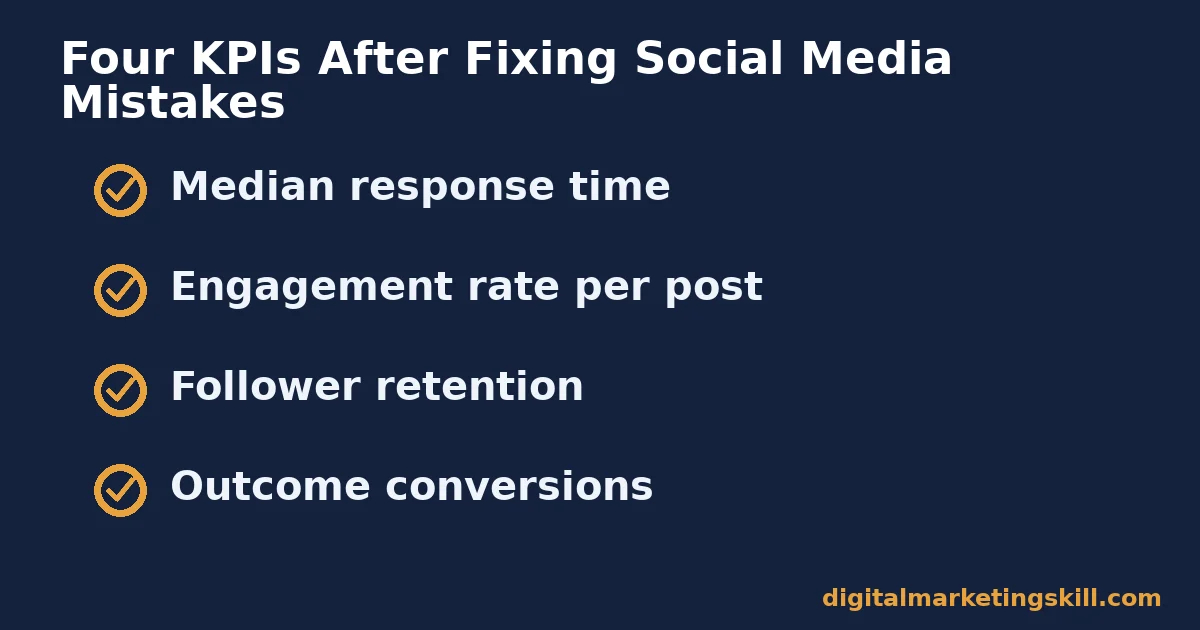
Four numbers show whether the fixes for these social media mistakes are taking hold, beyond raw post counts. None require a paid dashboard; a shared spreadsheet checked monthly is enough for most small teams.
- Median response time — the typical gap between an incoming comment or message and the first reply, measured in hours, not days. Falling response time is the clearest sign a response mistake is being fixed, and it is one of the simplest numbers to pull from most inboxes.
- Engagement rate per post — engagement (likes, comments, shares) divided by reach or followers, expressed as a percentage. A rising rate after a voice or strategy fix suggests the content is landing better with the audience it was written for.
- Follower retention — new followers minus unfollows, tracked monthly as a net number, not just gross growth. A shrinking gap between the two often tracks a voice or quality fix taking effect, since people stop leaving as fast as they arrive.
- Outcome conversions — clicks, leads or replies tied to a specific goal, not just raw engagement. This is the number a measurement fix is meant to surface, and it is the one most likely to be missing before that fix.
Track all four for at least a month after any fix, on the same platforms, before judging whether it worked. Social platforms are noisy week to week, so a single good or bad week rarely proves that a fix for one of these social media mistakes succeeded or failed.
The One Decision Rule for Fixing Social Media Mistakes
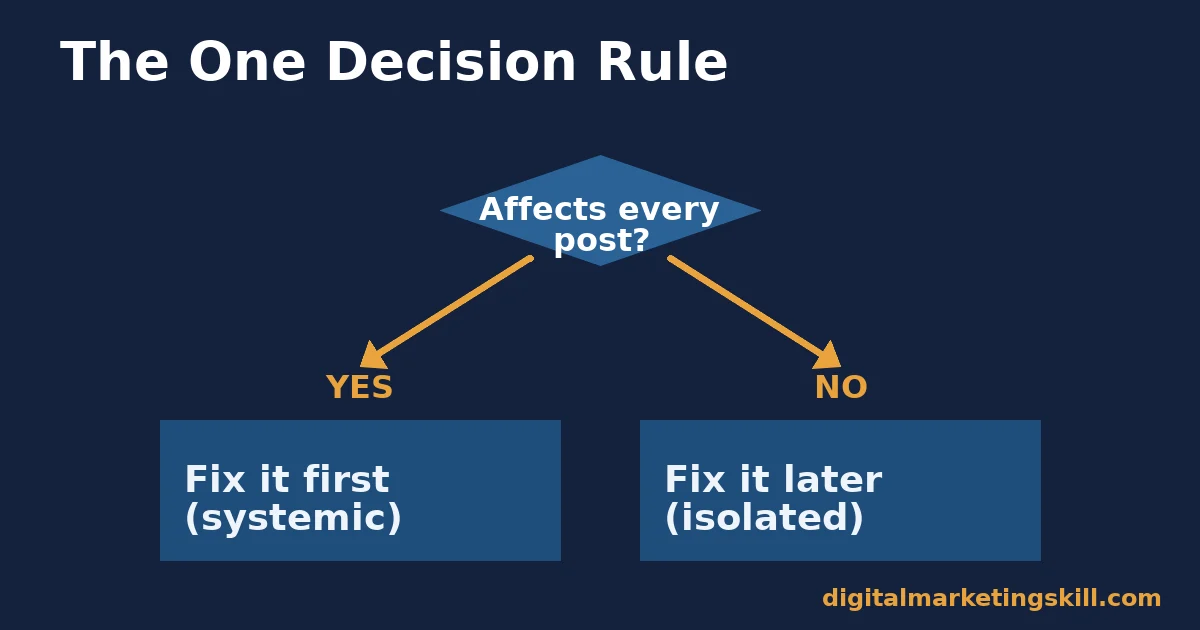
Fix the mistake that affects every post before fixing the mistake that affects one post. A missing strategy or response plan is systemic; it caps every single post. A single off-tone post or one slow reply is isolated; it costs one post’s worth of trust.
Illustrative, invented example: a small team has a one-page strategy and documented voice, but no reply-time rule. They also just posted one joke that landed badly. Fixing the reply-time rule first helps every future post and every future complaint. Fixing the one joke only helps that single post. The systemic fix wins under the rule above.
A second illustrative example: an account has a reply-time rule and an outcome metric in place, but no written strategy. Every post still gets a reply, and the team can see what converts. Without a strategy, though, nobody can say why today’s post exists at all. The missing strategy is systemic and comes first, even though the other two fixes already look solid on paper.
A Real Case: Consistency Over Cleverness
Digital Marketing Skill Institute student Damola Akanbi built a client-facing social media and marketing practice that now averages $1,500 per client for running campaigns, a figure published on the Institute’s student reviews page. The jump did not come from one viral post. It came from applying a repeatable process, strategy, consistent voice and tracked outcomes, to every client account.
This mirrors the decision rule above. A practitioner managing several client accounts cannot afford to repeat the same social media mistakes across each one. Fixing the systemic habits once, a plan, a voice, a response rule and a real metric, pays off on every account managed afterward, not just the next post.
Limits: this reflects one practitioner’s client pricing over time, built on specific skills and market conditions, and is not typical or guaranteed. Results vary by niche, experience and market; see the Institute’s earnings disclaimer before treating any single case as a forecast.
Frequently Asked Questions About Social Media Mistakes
What is the most common social media mistake?
Posting without a written strategy is the most common social media mistake, because it is the root cause behind several others, including inconsistent voice and random posting times.
How fast should a business respond to a social media complaint?
Per Statista’s survey data on response-time expectations and Sprout Social’s newer figures, most US consumers expect a reply within 24 hours, and a meaningful share expect one within one to two hours, so a response-time target inside that window is a reasonable starting point for most accounts.
Does posting more often fix low engagement?
No. Posting more often cannot fix a missing strategy, unclear voice, slow responses or absent metrics; it usually just repeats the same mistake more times and can tire out the existing audience.
Why do some social media mistakes hurt more than others?
A mistake that affects every post, like having no strategy, compounds across the whole account. A mistake on one post, like an off-tone joke, stays contained to that post unless it is unusually offensive or widely shared.
Can a single bad post seriously damage a brand?
It can, particularly if the content is insensitive or controversial enough to spread beyond the usual audience, but most single posts are recoverable. A pattern of similar mistakes is the bigger long-term risk.
Who should manage a company’s social media replies?
Someone should be explicitly assigned to own replies, with a clear escalation path for complaints that need another team’s input, rather than leaving it to whoever happens to notice a comment.
What metric matters most for social media success?
The metric tied to the actual business goal, such as leads or link clicks, matters more than likes or follower count alone; vanity metrics can rise while the outcome metric stays flat.
Should every platform use the same content?
No. Reposting identical content everywhere is itself a common social media mistake, because each platform’s audience and format expectations differ. Adapt the length, tone and format per platform, even when the underlying message stays the same.
How long does it take to fix a social media mistake?
A process fix, like a documented voice or a response-time rule, can be written in a day, but it takes weeks of consistent use before its effect on engagement or trust becomes measurable.
Is it a mistake to delete a bad post?
Not automatically. Deleting a post that is factually wrong or genuinely offensive is usually right. Deleting a post just because it got a few negative comments can look evasive, and an honest reply often repairs more trust than silent removal does.
Do small accounts make the same social media mistakes as large brands?
Mostly yes. The four root causes, no strategy, no voice, no response plan, no real metrics, show up at any account size. Small accounts simply have less room for error, since one person often owns every part of the process at once.
Fix the Root Causes With a Structured Skill Set
Spotting social media mistakes is one skill. Building the strategy, content, ads and reporting system that prevents them is a bigger one. A course or checklist can flag the mistakes above; turning that into a repeatable, income-ready skill set usually takes structured practice and feedback.
Digital Marketing Skill Institute’s Master Diploma in Digital & AI Marketing is built around four AI-powered tracks: AI-Powered Social Media Management and Advertising, AI-Powered Lead Generation and Email Automation, AI-Powered Google Specialist, and AI-Powered WordPress and SEO Specialist.
Together they cover ten courses, with a Full Stack option to complete all four. Every track includes unlimited 1-on-1 coaching and mentoring, a U.S. Project Internship with a verified U.S. Work Reference Letter, and dual US and UK accreditation recognised in more than 100 countries. The program runs 100% online, so you can build these skills from anywhere in your country.
Read verified outcomes like the one above on the reviews page, browse more guides on the digital marketing blog. When you’re ready, see the full program on the Master Diploma page, or start your application at Digital Marketing Skill Institute.
Wherever you live, the training runs fully online, so your location never has to be the obstacle. The same structured approach behind the case study above, strategy, voice, response and measurement, is what the program is built to teach, alongside the coaching to apply it to a real account rather than a hypothetical one.
Every figure in this guide was checked against its original source before publication. Figures marked as illustrative are invented examples, not real results.
![9 Amazing Digital Marketing Skills to Make Money Online [With Proof]](https://digitalmarketingskill.com/wp-content/uploads/2019/07/9-Amazing-Digital-Marketing-Skills-to-Make-Money-Online-With-Proof-17.png)






