A digital marketer promotes a business, product or service through online channels such as search engines, social media, email, websites and online ads, with the aim of attracting the right audience, turning them into leads and customers, and keeping them coming back. Day to day, that means planning campaigns, creating and publishing content, running ads, improving websites for search, sending emails, analysing data and reporting results. In a small business one person may do all of this; in larger organisations the work is split between specialists. This guide explains what digital marketers actually do, what a typical day looks like, how the role differs in-house, at an agency and as a freelancer, the skills and tools involved and how to start.
Key Takeaways
- Digital marketers use online channels to build brand awareness, generate leads and drive sales.
- Core work areas include SEO, paid advertising, social media, content, email marketing and data analysis.
- Oral Roberts University’s career guide highlights market research, email campaigns and promoting products and services on websites as common responsibilities.
- In small businesses, digital marketers are often generalists; in larger organisations, roles split into specialists such as SEO, paid media and email.
- Western Governors University cites U.S. Bureau of Labor Statistics projections of growth for advertising, promotions and marketing management roles.
- What a Digital Marketer Does
- Core Responsibilities
- A Typical Day
- In-House, Agency or Freelance
- Specialist Roles
- Skills You Need
- Tools Digital Marketers Use
- How Success Is Measured
- How to Become a Digital Marketer
- FAQ
What Most Explanations of the Role Miss
Many descriptions list channels: SEO, social media, email, ads. That is accurate, but it misses what the job is really about. Digital marketing is problem-solving. A digital marketer’s real job is to understand a business goal, such as more enquiries, more online sales or more sign-ups, and then work out which audience, message and channel will achieve it at a sensible cost.
- Channels are tools, not the job. Good digital marketers choose channels based on the goal and audience, rather than doing everything everywhere.
- Testing and learning are constant. Much of the work is trying something, measuring it and improving it.
- Communication matters as much as technical skill. Digital marketers explain results to managers and clients, brief designers and work with sales teams.
What Does a Digital Marketer Do?
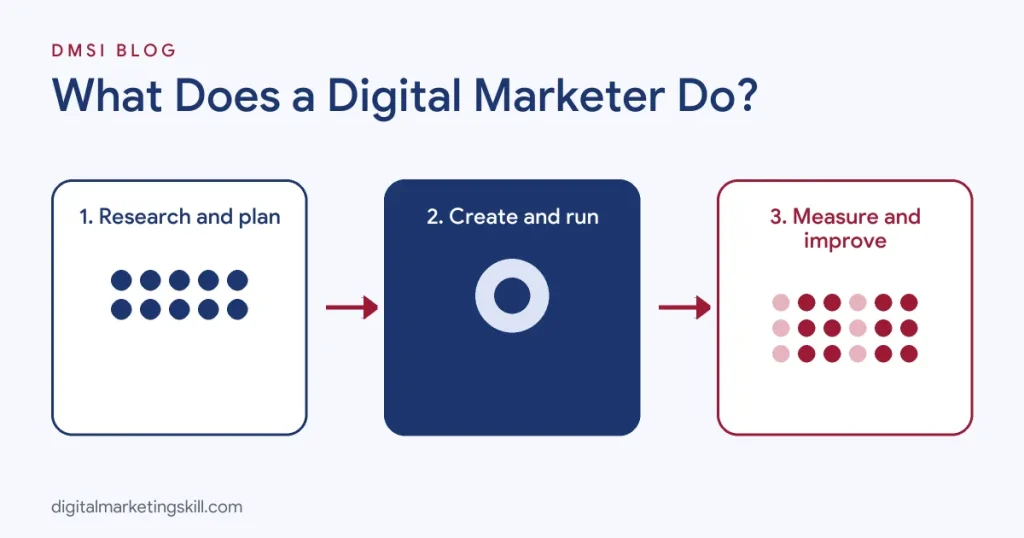
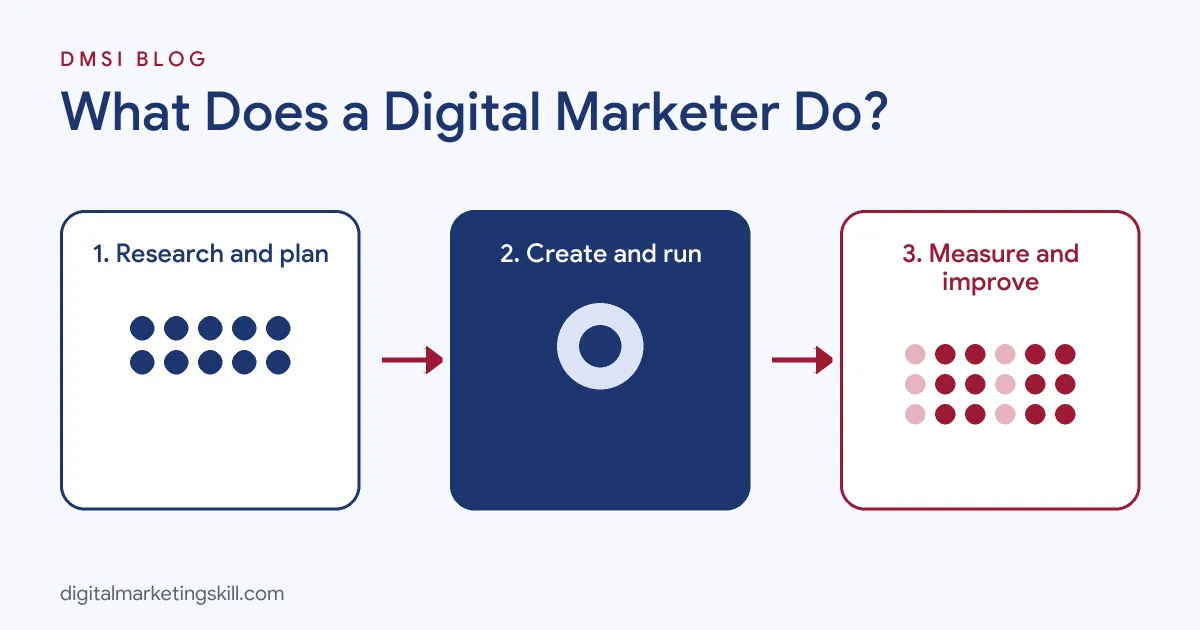
A digital marketer plans, creates, runs and measures marketing activity online. The purpose is usually to move people through a journey: from discovering a brand, to considering it, to buying or enquiring, and then to returning and recommending it.
To do that, a digital marketer typically:
- researches the audience, competitors and market;
- sets goals and plans campaigns;
- creates or coordinates content, such as posts, videos, emails, ads and web pages;
- publishes and promotes that content on the right channels;
- manages budgets for paid advertising;
- tracks results using analytics tools;
- reports on performance and recommends improvements.
The balance between these tasks depends on the role, the organisation and its goals.
Core Responsibilities of a Digital Marketer
Market and audience research
Oral Roberts University’s guide lists conducting market research as a key responsibility. Digital marketers study who their customers are, what they need, how they search and where they spend time online. They look at competitors, keyword data, social media conversations, website analytics and customer feedback to find opportunities.
Search engine optimisation (SEO)
SEO is the work of helping a website appear in organic search results. Digital marketers research keywords, improve website content and structure, fix technical issues, earn links from other sites and track rankings and traffic. SEO results take time but can bring steady traffic without paying for each click. In larger teams, this work is done by an SEO specialist or SEO manager.
Paid advertising
Paid advertising includes search ads, such as Google Ads, and paid social ads on platforms like Facebook, Instagram, LinkedIn and TikTok. Digital marketers choose audiences, write ad copy, work with designers on creative, set budgets and bids, and optimise campaigns to reduce cost per lead or sale. Specialists in this area are often called PPC specialists or paid media managers.
Social media marketing
Social media work includes planning content, creating posts and videos, scheduling, replying to comments and messages, managing communities, working with creators and analysing results. Read more about the role of a social media manager.
Content marketing
Content marketing creates useful content that attracts and educates potential customers: blog posts, guides, videos, podcasts, case studies, infographics and landing pages. Digital marketers plan content around audience questions and search demand, and repurpose it across channels.
Email marketing
Oral Roberts University also highlights creating email marketing campaigns. Email work includes growing a subscriber list, writing newsletters and promotional emails, building automated sequences, such as welcome and abandoned basket emails, segmenting audiences and testing subject lines. See our guide to the role of an email marketing specialist.
Website and conversion optimisation
Promoting products and services on websites is another core task. Digital marketers update web pages, create landing pages for campaigns and test changes, such as headlines, forms and calls to action, to increase the share of visitors who take action.
Analytics and reporting
Digital marketers track performance using tools such as Google Analytics, platform dashboards and CRM systems. They measure traffic, conversions, cost per acquisition, return on ad spend and engagement, then turn data into insights and recommendations for managers or clients.
A Typical Day for a Digital Marketer
No two days are identical, but a typical day for a generalist digital marketer at a small or mid-sized business might look like this:
- Morning check-in: review overnight results from ad campaigns, website traffic and email sends; check social media comments and messages; flag anything unusual.
- Campaign work: adjust ad budgets, pause underperforming ads, test new ad copy or audiences.
- Content creation: write a blog post, plan next week’s social media posts, edit a short video or brief a designer.
- Meetings: catch up with the sales team on lead quality, agree campaign plans with a manager or present results to a client.
- Email and automation: build next week’s newsletter, set up an automated sequence or segment a list.
- Website tasks: update a landing page, check page speed or fix tracking.
- Analysis and reporting: pull weekly numbers into a report, look for trends and write recommendations.
- Learning: read about platform updates, new features or industry changes.
Specialists spend most of their time in one area. A paid media specialist might spend the whole day in ad accounts and reporting tools; a content marketer might spend most of it researching and writing.
Where Digital Marketers Work: In-House, Agency or Freelance
| Setting | What the work looks like | Pros | Challenges |
|---|---|---|---|
| In-house | Marketing one company’s products or services | Deep knowledge of one business, close work with sales and product teams | Can mean doing everything in small teams; less variety |
| Agency | Working on campaigns for several clients | Variety, fast learning, experienced colleagues | Deadlines, juggling clients, time tracking |
| Freelance | Working independently for your own clients | Flexibility, choice of clients, potential to work remotely | Finding clients, irregular income, running a business |
Many digital marketers move between these settings during their careers. Agency experience builds breadth quickly; in-house roles build depth; freelancing builds independence. Many roles can be done remotely, which is why digital marketing appeals to people who want location flexibility. Our guide to remote digital marketing jobs covers this in more detail.
Specialist Digital Marketing Roles
As teams grow, the work splits into specialist roles. Common job titles include:
- Digital marketing executive or coordinator: an entry-level generalist role supporting campaigns across channels. See marketing coordinator.
- SEO specialist: improves organic search visibility.
- PPC or paid media specialist: manages paid search and paid social advertising.
- Social media manager: runs social media strategy, content and community.
- Content marketer or content manager: plans and creates content.
- Email marketing specialist: manages email campaigns and automation.
- Marketing analyst: analyses data and measures performance.
- CRM or marketing automation specialist: manages customer data and automated journeys.
- Digital marketing manager: leads strategy, budgets and teams across channels. See digital marketing manager.
For a fuller list, see our guide to digital marketing job titles.
How the Role Changes With Seniority
What a digital marketer does changes as they progress. At entry level, such as assistant, executive or coordinator roles, the focus is on execution: scheduling posts, building emails, updating web pages, pulling reports and supporting campaigns planned by others. The goal is to learn the tools and build reliable habits.
At mid level, such as specialist or senior executive roles, digital marketers own channels or campaigns. They plan activity, manage budgets, run tests, analyse results and recommend changes. They may brief designers, writers or agencies and mentor junior colleagues.
At manager level, the focus shifts to strategy and people. Digital marketing managers set goals, allocate budgets across channels, manage teams and agencies, report to leadership and connect marketing activity to business results. They still need to understand the channels well enough to challenge and guide specialists.
At head of or director level, the role becomes about long-term strategy, brand, organisation design, technology choices and working with other departments such as sales, product and finance. Strong communication and business understanding matter as much as channel expertise at this stage.
Skills a Digital Marketer Needs
Technical and channel skills
- understanding of SEO, paid advertising, social media, content and email marketing;
- ability to use analytics tools and interpret data;
- basic website skills, such as using a content management system and creating landing pages;
- familiarity with AI tools for research, content drafts and analysis, used with good judgement.
Creative skills
- copywriting for ads, emails, social posts and web pages;
- basic design and video editing, or the ability to brief designers well;
- storytelling and understanding what makes content engaging.
Strategic and business skills
- understanding customers and their buying journey;
- setting goals and choosing channels to match them;
- managing budgets and understanding return on investment.
Soft skills
- clear communication and presentation;
- organisation and time management;
- curiosity and willingness to keep learning;
- resilience, because many tests fail before one succeeds.
Our guide to in-demand digital marketing skills explains which skills employers ask for most.
Tools Digital Marketers Use
Tools vary by company, but common categories include:
- Analytics: Google Analytics, Google Search Console, platform analytics dashboards.
- Advertising: Google Ads, Meta Ads Manager, LinkedIn Campaign Manager, TikTok Ads Manager.
- SEO: keyword research and site audit tools.
- Social media management: scheduling, listening and reporting tools.
- Email and automation: email marketing platforms and CRM systems.
- Content and design: content management systems such as WordPress, design tools such as Canva and video editing apps.
- AI tools: AI assistants for research, ideas, first drafts and data summaries.
- Project management: tools for planning campaigns and collaborating with teams.
Employers usually care more that you understand what the tools are for and can learn new ones quickly than that you know every tool already.
How a Digital Marketer’s Success Is Measured
Digital marketers are judged on results, which is one reason the role appeals to people who like seeing the impact of their work. Common measures include:
- Traffic: visitors to the website from search, social, email and ads.
- Leads and conversions: enquiries, sign-ups, downloads, purchases or bookings.
- Cost efficiency: cost per click, cost per lead, cost per acquisition and return on ad spend.
- Engagement: email open and click rates, social media engagement and time on site.
- Revenue and retention: sales attributed to marketing, repeat purchases and customer lifetime value.
- Brand measures: search volume for the brand, share of voice and sentiment.
A strong digital marketer connects these measures to business goals. A campaign with high engagement but no leads may need a different call to action; a campaign with many cheap leads that never buy may be targeting the wrong people.
Digital Marketer vs Traditional Marketer
Traditional marketing uses offline channels such as print, television, radio, billboards and events. Digital marketing uses online channels. The principles are the same: understand customers, craft a strong message and reach the right people. The differences are mainly in speed, targeting and measurement. Digital campaigns can be launched, tested and changed quickly, aimed at specific audiences and measured in detail. Many modern marketing roles combine both, using digital channels alongside offline activity in integrated campaigns.
Is Digital Marketing a Good Career?
Digital marketing suits people who enjoy a mix of creativity and analysis, like learning new tools and want to see the results of their work. Western Governors University cites U.S. Bureau of Labor Statistics projections of growth for advertising, promotions and marketing management roles, and businesses of every size and sector need people who can market online. The work can also be done in many industries and, often, remotely.
It is not without challenges. Platforms change frequently, results can be unpredictable and there is pressure to show return on investment. Pay and opportunities vary widely by country, experience, specialism and employer, so it is worth researching roles and salaries in the markets you want to work in.
How to Become a Digital Marketer
- Learn the fundamentals. Understand how the main channels work and how they fit together in a marketing strategy.
- Get hands-on practice. Run a small project: build a simple website, grow a social media account, run a small ad campaign or help a local business or charity.
- Earn credible certifications. Free platform certifications, such as those offered by Google and Meta, show you understand specific tools.
- Choose an area to go deeper. Many people start as generalists and then specialise in an area they enjoy, such as paid ads, SEO, content or email.
- Build a portfolio. Show real work and results, explaining the goal, what you did and what happened. Our guide to building a marketing portfolio shows how.
- Apply for entry-level roles, internships or freelance work. Titles to look for include digital marketing assistant, executive, coordinator and junior specialist roles.
- Keep learning. Follow platform updates, read industry news and test new ideas.
Common Mistakes New Digital Marketers Make
- Trying to master every channel at once. Learn the basics broadly, then go deep in one or two areas.
- Focusing on vanity metrics. Likes and followers matter less than leads, sales and customer value.
- Learning only theory. Employers want to see practical work and results.
- Ignoring analytics. Without measuring results, you cannot improve them.
- Copying tactics without understanding the audience. What works for one business may fail for another.
- Not explaining results clearly. Managers and clients need insights and recommendations, not just numbers.
One Rule to Remember
A digital marketer’s job is not to post, email or advertise; it is to choose and run the online activity that moves a real business goal, and to prove it with data.
Example: a digital marketing executive at a small online furniture shop is asked to increase sales of a new range. She looks at analytics and sees that most buyers find the shop through search and Pinterest. She writes buying guides targeting relevant search terms, creates pins linking to the new range, sets up a small search ad campaign and adds a welcome email offering styling tips to new subscribers. Each week she reports traffic, conversion rate and sales from each channel, pausing the ads that do not convert and expanding the guides that do. This example is illustrative and not a real business.
Why This Career Path Matters
Digital marketing skills are useful in almost every industry, from retail and technology to healthcare, education and charities, and many roles can be done from anywhere with an internet connection. If you are in your country, digital marketing can be a route into in-house roles with local businesses, agency work, freelancing for international clients or remote roles with companies abroad. The key is building practical skills and a portfolio that shows you can deliver results.
Frequently Asked Questions
What does a digital marketer do in simple terms?
A digital marketer uses online channels, such as search, social media, email and ads, to attract customers and grow a business, then measures what works and improves it.
What are the main responsibilities of a digital marketer?
Researching audiences, planning campaigns, creating content, managing SEO, social media, email and paid ads, tracking results and reporting on performance.
Do you need a degree to be a digital marketer?
Not always. Many employers value practical skills, certifications and a portfolio of real results as much as, or more than, a degree, although some roles and companies do ask for one.
Is digital marketing a hard job?
It can be demanding because platforms change often and results must be proven, but the basics are learnable, and many people find the mix of creativity and analysis rewarding.
Can digital marketers work from home?
Many digital marketing roles can be done remotely or in hybrid arrangements, and freelancers often work entirely online. It depends on the employer and the role.
What is the difference between a digital marketer and a social media manager?
A social media manager focuses on social platforms. A digital marketer may cover social media alongside SEO, email, paid ads, content and analytics.
What tools does a digital marketer use?
Common tools include Google Analytics, Search Console, ad platforms such as Google Ads and Meta Ads Manager, email marketing platforms, social media schedulers, content management systems, design tools and AI assistants.
What does an entry-level digital marketer do?
Entry-level roles usually involve supporting campaigns: scheduling posts, building emails, updating web pages, collecting data for reports and helping with research.
Do digital marketers need to code?
Most do not need to code, but basic HTML, an understanding of tracking tags and comfort with website tools are useful.
How long does it take to become a digital marketer?
It varies. With focused learning and practice, many people can build enough skills and portfolio work to apply for entry-level roles within months, though becoming highly skilled takes ongoing experience.
Is AI replacing digital marketers?
AI is automating some tasks, such as first drafts and data summaries, but businesses still need people to set strategy, understand customers, judge quality and take responsibility for results. Marketers who use AI well are likely to be in a stronger position.
Your Next Step
Want to do this work yourself? Learn practical digital marketing skills step by step. The Master Diploma in Digital & AI Marketing at Digital Marketing Skill Institute covers AI-powered Social Media Management and Advertising, Lead Generation and Email Automation, Google, and a WordPress and SEO track where you build and rank a real website.
From day one, you work on a real U.S. company’s project through the U.S. Project Internship, so you finish with real results and a verified U.S. work reference letter. You also get unlimited one-on-one coaching. The program carries dual US and UK accreditation, is recognised in more than 100 countries, and runs 100% online over three months.
You can build those skills wherever you live, anywhere in your country. Read student reviews, then apply for the 65% partial scholarship to see if you qualify.
Sources checked November 2026: Oral Roberts University: What do digital marketers actually do?, Western Governors University: Digital marketer career guide, U.S. Bureau of Labor Statistics: Advertising, promotions and marketing managers, Indeed career guide (page blocked for full review). We have no connection with these organisations.