
To write a marketing email that gets opened and clicked, you need four things: a subject line worth stopping for, an opening line that matches it, one clear call to action, and a layout that renders cleanly on a phone. Miss any one of these, and the rest of the email rarely gets read at all.
Key Takeaways
- Mobile devices account for the largest single share of email opens, ahead of desktop. So an unreadable mobile layout quietly kills emails before anyone reaches the offer (Litmus Email Analytics).
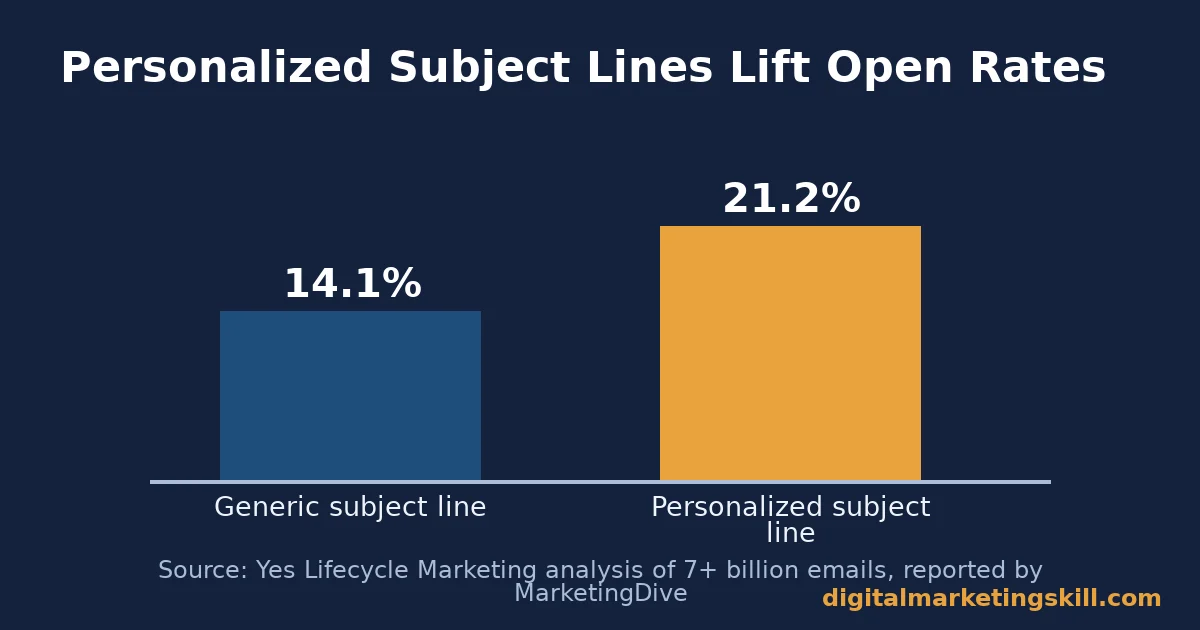
- Subject lines personalized with the recipient’s name lifted open rates from 14.1% to 21.2%, a roughly 50% relative gain. Yet under 2.3% of senders personalize at all (Yes Lifecycle Marketing, 7+ billion emails).
- Across 12 million cold outreach emails, only about 8.5% got any reply. Personalized subject lines still lifted response rates by roughly 30% (Backlinko and Pitchbox).
- Personalized calls to action convert 202% better than generic ones, across an analysis of 330,000+ CTAs (HubSpot).
- Marketing leaders report a $10-$36 return for every $1 spent on email, one of the highest returns of any channel measured, according to 35% of respondents in Litmus’s State of Email survey.
In this guide
- The Gap: Why Most People Write a Marketing Email the Wrong Way Round
- How a Marketing Email Gets Read
- What Differs When You Write a Marketing Email For Each Goal
- How to Write a Marketing Email That Leads With the Right Opening
- Measuring Whether Your Marketing Email Worked
- The One Decision Rule For Writing a Marketing Email
- A Checklist to Write a Marketing Email You Can Send With Confidence
- Real Case: What One Marketer Built on the Fundamentals
- Frequently Asked Questions About How to Write a Marketing Email
- Put This Into Practice
The Gap: Why Most People Write a Marketing Email the Wrong Way Round
Here is an informed inference, not a settled fact. Most marketing emails fail before anyone reads a single word of the body copy. The subject line and preview text never earn the open in the first place.
Yes Lifecycle Marketing’s analysis of more than 7 billion emails, sent in a single quarter, found something striking. Fewer than 2.3% of senders personalized their subject lines at all. Yet personalizing lifted open rates from 14.1% to roughly 21.2%.
That gap between what works and what most senders actually do has not closed. Newer studies, cited throughout this guide, keep finding the same pattern: specificity and personalization beat generic blasts. Treat any single percentage here as a snapshot, not a permanent ranking. Benchmarks drift as inboxes, filters and reader habits change.
One more ground rule before we go further: there are no guarantees in this guide. Open rates, click rates and reply rates vary by industry, list quality, sending reputation and offer. A warm list can outperform a cold one by a factor of five or more. What follows is a repeatable process to write a marketing email, not a promise of a specific number, and it sits one level below the wider email marketing strategy that decides who is on your list in the first place.
How a Marketing Email Gets Read
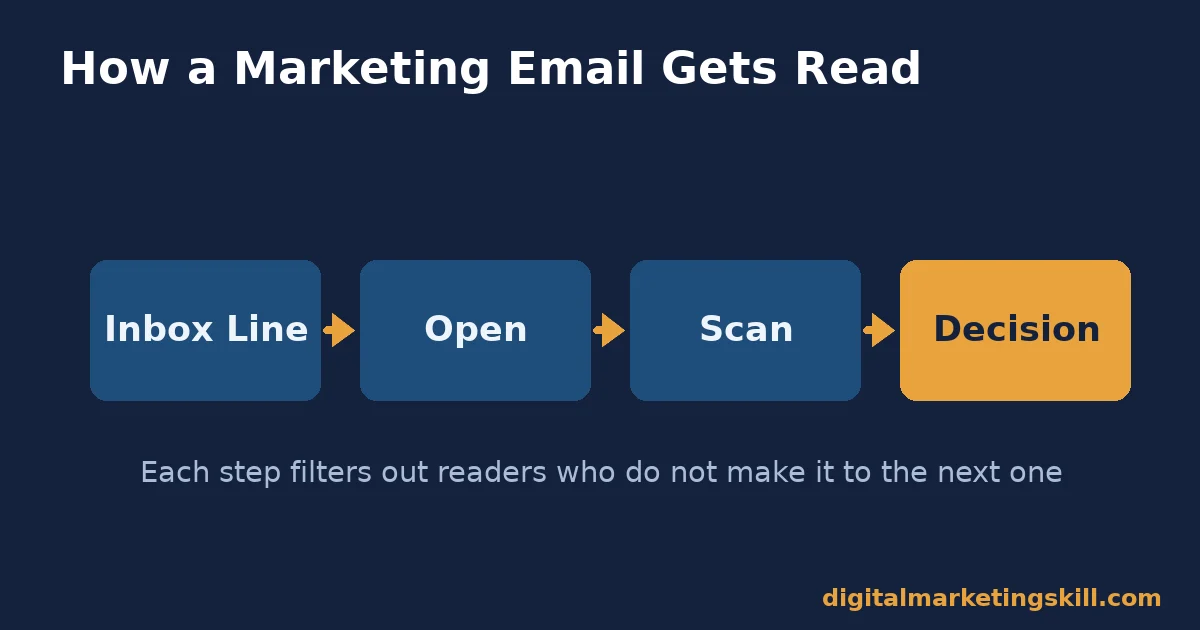
A marketing email gets read in a strict sequence. Each step filters out some readers, and most emails fail at the very first step.
Step one is the inbox line. That means the subject line plus preview text, usually under 60 characters combined on a phone screen. Readers make this yes-or-no decision in under two seconds, so there is no room for a slow build-up.
Step two is the open. The first ten to fifteen words of the body are visible before any scrolling happens. Those words either confirm the promise of the subject line, or they break trust with it immediately.
Step three is the scan. Most readers skim rather than read every word. As a result, headings, bold phrases and short paragraphs carry more weight than one clever sentence buried in a long paragraph.
Step four is the single decision point. There is one call to action, and the reader either clicks it or ignores the email entirely.
Nielsen Norman Group’s eye-tracking research, across 232 users, backs this up. In that study, 79% of people scanned a new page instead of reading every word, and only 16% read in full. Email behaves the same way. Write for the scanner first, and the full reader second.
Rendering Matters as Much as Wording
Most opens now happen on a phone, so a marketing email that looks fine on a laptop screen but breaks into an unreadable column on mobile loses readers at step two, before the message even gets a fair chance.
Keep images small, keep paragraphs short, and preview every send on a real phone before it goes out. A single-column layout, a large tappable button, and short line lengths cost nothing to add, yet they decide whether a reader who opens your email on the train can actually finish it.
What Differs When You Write a Marketing Email For Each Goal
Not every marketing email does the same job. Writing every send as if it were the same mistake is the single most common one marketers make. Three goals cover almost every reason you will sit down to write a marketing email. Each one needs its own structure.
Cold Outreach Emails: Built For a First Reply
A cold outreach email reaches someone who has never heard from you before. Its only job is to earn a reply, not a sale. Keep that bar realistic.
Backlinko and Pitchbox’s analysis of 12 million outreach emails found an average reply rate of just 8.5%. That is the real bar to measure against, not 100%, and not even 50%. In the same dataset, personalized subject lines lifted response rates by roughly 30% over generic ones.
Nurture Emails: Built For Repeat Opens
A nurture email reaches someone already on your list who has not bought yet. Its job is simple: get opened again next week. Because of that, consistency matters more than any single clever line when you write a marketing email meant to build a long-term relationship. Use the same sending name. Keep a similar length. Stick to one topic per send.
One weak nurture email rarely costs you a subscriber. A pattern of broken promises in the subject line, however, will. If your nurture sequence lives inside a newsletter, the structure you choose when you set up the newsletter itself will shape how consistent each individual send can be.
Promotional Emails: Built For One Click
A promotional email reaches warm subscribers with a specific offer and a reason to act now. Its job is one click on one call to action, nothing more.
Mailchimp’s all-industry benchmark puts the average click rate at 2.62%. So a promotional email that clears even half that is behaving like a normal, healthy send, not a failure.
How to Write a Marketing Email That Leads With the Right Opening
Each of the three goals above needs a different opening move. Mirroring each claim with a fix keeps this guide honest. The fix always matches the job the email is doing.
Cold Outreach Emails: Lead With a Specific Reason
Open with one specific, true, checkable reason you are writing to this person. Skip the company introduction entirely. “I read your piece on X and noticed Y” beats “I wanted to reach out” every single time.
Why? Specificity is the only signal a stranger has that you are not sending the same email to a thousand other inboxes. Keep the ask to one sentence, and make it easy to say yes to. A short reply beats a 30-minute call request.
Nurture Emails: Lead With Consistency
Open with the single idea the email covers, stated in the first sentence. Skip the story and the preamble. Readers decide whether to keep reading in that first line.
A nurture subscriber who has already opened ten of your emails is not looking for a fresh introduction. They are scanning for one thing: is this one going to be useful? Repeat your format, too. The same section order and the same sign-off help returning readers know exactly where to look.
Promotional Emails: Lead With One Clear Action
Open with the offer or the benefit, not the backstory. State the one action you want taken within the first two sentences, then repeat it at the bottom.
HubSpot’s analysis of 330,000+ calls to action found that personalized CTAs convert 202% better than generic, one-size-fits-all buttons. A button that names the specific benefit, such as “See your discount” instead of “Click here,” is worth the extra minute it takes to write.
Measuring Whether Your Marketing Email Worked
Four numbers tell you almost everything about whether a marketing email did its job. Each one isolates a different part of the email, so read them together, not one at a time.
- Open rate is the share of delivered emails opened at least once. It measures the subject line and sender name alone. A rising open rate with a flat click rate usually means the subject line is working, but the body is not.
- Click-through rate is the share of delivered emails that got at least one click. It measures the body copy and the call to action together. Mailchimp’s benchmark of roughly 2.62% is a reasonable baseline to track your own sends against over time.
- Click-to-open rate is clicks divided by opens, not deliveries. In other words, it isolates the body copy from the subject line, because it only counts people who already opened. A low click-to-open rate on a high-open email usually means the subject line over-promised.
- Complaint and unsubscribe rate is the share of recipients who opted out or marked an email as spam. Gmail’s bulk sender guidelines treat a complaint rate above roughly 0.3% as a deliverability risk for the entire sending domain. This number protects every future email you send, not just the current one.
Reading These Four Numbers Together
A healthy pattern looks like this: open rate stable or rising, click-to-open rate stable, complaint rate under 0.3%. If click-to-open falls while open rate rises, the subject line is drifting ahead of what the body actually delivers. Fix the body before you touch the subject line again.
Check these numbers weekly, not daily. A single send is noisy, especially on a small list, so one unusual result rarely means much on its own. A trend across five or six sends is the signal worth acting on. This weekly habit, more than any single tactic, is what separates marketers who steadily improve from marketers who guess. The right email marketing tools make this tracking close to automatic, rather than a manual export every week.
The One Decision Rule For Writing a Marketing Email
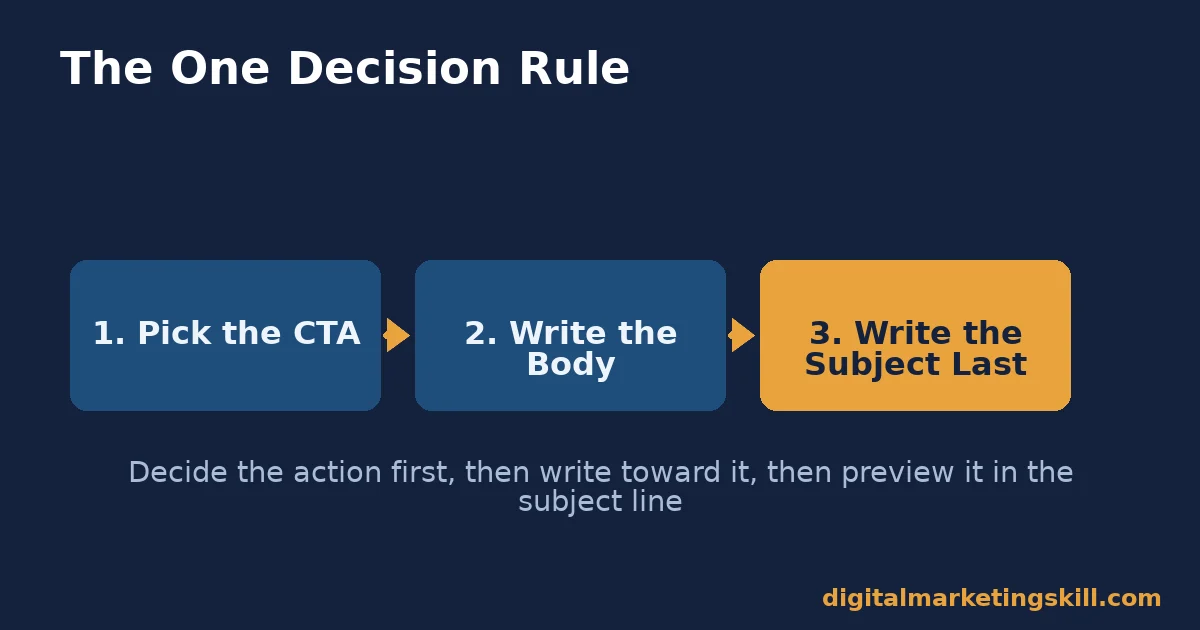
If you remember just one rule from this guide, make it this one. Decide the single call to action before you write a single sentence of body copy. Then write the subject line only after the body is finished.
Why this order? Writing the CTA first forces every paragraph to earn its place. Each one has to move the reader toward that one action, or it gets cut. Writing the subject line last matters too, because it then accurately previews what the email delivers, instead of promising something the body never pays off.
Here is an illustrative example, with invented numbers, not a real study. Picture two drafts of the same promotional email. Draft A gets written subject-line-first. Halfway through, it picks up a second “by the way” CTA, and it ends with two competing buttons. Draft B gets written CTA-first. It keeps one button throughout, and the subject line gets written last to match it exactly.
In this illustrative scenario, Draft B’s single-CTA structure would be expected to concentrate clicks on one action. Draft A’s two buttons would likely split them instead. That is the mechanism behind “one CTA per email” as a rule of thumb. It is a reasonable default, not a guaranteed lift every time.
Use this order every time you sit down to write a marketing email, and the rest of this guide’s advice slots neatly around it.
A Checklist to Write a Marketing Email You Can Send With Confidence
Run through this short list before you hit send on any marketing email:
- Pick the single goal: a reply, a repeat open, or one click.
- Write the one call to action first, then build the body around it.
- Open with a specific line, not a company introduction.
- Keep paragraphs short enough to scan on a phone screen.
- Write the subject line last, so it matches what the body actually delivers.
- Preview the send on an actual phone before it goes out.
None of these steps takes long on its own. Together, they are the difference between a marketing email that gets read and one that gets deleted unopened. Print this checklist out, or pin it next to your email editor, and run through it every time you write a marketing email, even a short one.
Real Case: What One Marketer Built on the Fundamentals
Olajire Jacob, as published on the Digital Marketing Skill Institute reviews page, described starting out small. After learning the fundamentals, they began “charging an average of $500 to set up email marketing flows for clients.” From there, they scaled that single service to “$5K/mo.”
The published review does not break down which specific email-writing tactics drove that growth. It is one self-reported result, not a controlled study, and dollar figures appear exactly as published, with no currency conversion applied. Treat this as evidence that email marketing skills can translate into a sellable, scalable service. It is not a promise of any specific income. See the earnings disclaimer for the full context behind any student income result mentioned on this site.
What the case does illustrate is the shift this guide has walked through: write a marketing email as a service, not a one-off chore, and the fundamentals (a clear goal, one call to action, a subject line that matches the body) are what clients are actually paying for when they hire someone to run their list. They are also, as the wider list of benefits of email marketing for a small business shows, the same fundamentals a business owner needs even when nobody else is writing the emails for them.
Frequently Asked Questions About How to Write a Marketing Email
What makes a marketing email subject line effective?
An effective subject line is specific, honest about what is inside, and short enough to survive truncation on a phone screen. Personalization, such as a name or a detail specific to the recipient, consistently outperforms generic phrasing in the studies cited in this guide. That only holds, though, when the body of the email actually delivers on the promise. When you sit down to write a marketing email subject line, draft three or four options and pick the most specific one, not the cleverest one.
How long should a marketing email be?
Make it long enough to build the case for the one call to action, and no longer. A promotional email can often do this in under 150 words. A nurture email that teaches one idea may run longer, but it should still cover a single topic rather than several. If you cannot state the email’s one point in a single sentence, it is probably trying to do too much. Length is never the goal when you write a marketing email; clarity is.
How many calls to action should a marketing email have?
One, repeated at most twice. For example, place it once mid-email and once at the end, both pointing to the same action. Multiple different CTAs split attention. Per the decision rule in this guide, that usually reduces the click rate on each individual link, rather than increasing total clicks.
Is personalization worth the effort for a small email list?
Yes, arguably more so than for a large list. A small list makes true, specific personalization realistic to do by hand, such as referencing what someone actually did, bought or asked. The lift documented in the large-scale studies cited here comes from exactly that kind of name-level and behavior-level personalization.
What is a good open rate for a marketing email?
There is no single universal number. It depends heavily on your list’s age, how it was built, and your industry. Instead of chasing an external benchmark, track your own open rate over time. Treat a sustained drop, not a single send, as the real signal that something needs attention.
Should marketing emails be written in first or second person?
Use second person, meaning “you” and “your,” for the parts addressed directly to the reader. Pair that with a named individual sender rather than a department or company name; it tends to read as more personal. First person, meaning “I” and “we,” works well for the parts where you explain what you are offering and why.
How often should I send marketing emails?
Send often enough to stay useful, and rarely enough to stay welcome. There is no fixed number that works for every list. Watch the complaint and unsubscribe rate from the measurement section above as your real-time signal. A rising complaint rate at a stable send frequency usually points to the content. A rising complaint rate right after you increase frequency usually points to the opposite problem. When in doubt, send less often but make every single one count more.
What is the fastest way to get better at writing a marketing email?
Send more, and measure every send against the four numbers in this guide. Learning to write a marketing email well is a skill built on feedback from your own list, not from theory alone. Each send is a small, low-risk test of a subject line, an opening line, or a call to action, and the fastest learners simply run more of these small tests than everyone else.
Put This Into Practice
Learning to write a marketing email that gets opened, read and clicked is a skill that compounds. Every single send teaches you something about your specific list that no industry benchmark can.
If you want to build that skill properly, alongside the wider toolkit of lead generation and email automation, look at the Digital Marketing Skill Institute’s Master Diploma in Digital & AI Marketing. It includes an AI-Powered Lead Generation and Email Automation track among its four AI-powered tracks, built from ten execution-first courses in total, with a Full Stack option for completing all four. The program pairs unlimited 1-on-1 coaching and mentoring with a U.S. Project Internship and a verified U.S. Work Reference Letter. It is dual US and UK accredited, and recognised in more than 100 countries. Because it runs 100% online, you can study and apply what you learn anywhere in your country.
Read more real outcomes on the reviews page, browse the digital marketing blog for more practical guides, or go straight to the application page to see if the program fits. Wherever you live, the fundamentals in this guide apply the same way the next time you sit down to write a marketing email. Learn more at digitalmarketingskill.com, or start your application at digitalmarketingskill.com today.
Every figure in this guide was checked against its original source before publication. Figures marked as illustrative are invented examples, not real results.
![9 Amazing Digital Marketing Skills to Make Money Online [With Proof]](https://digitalmarketingskill.com/wp-content/uploads/2019/07/9-Amazing-Digital-Marketing-Skills-to-Make-Money-Online-With-Proof-17.png)






