
Difficult customers are not all the same problem. A chronic complainer, a price fighter and an abusive customer each drain a business in a different way, so each needs a different response. Spot the type first. Then apply one firm, documented standard instead of hoping the relationship improves on its own.
Key Takeaways
- Keeping the wrong customer is expensive. Acquiring a new customer costs 5 to 25 times more than retaining an existing one, according to a widely cited Harvard Business Review synthesis. The exact range varies by study and industry.
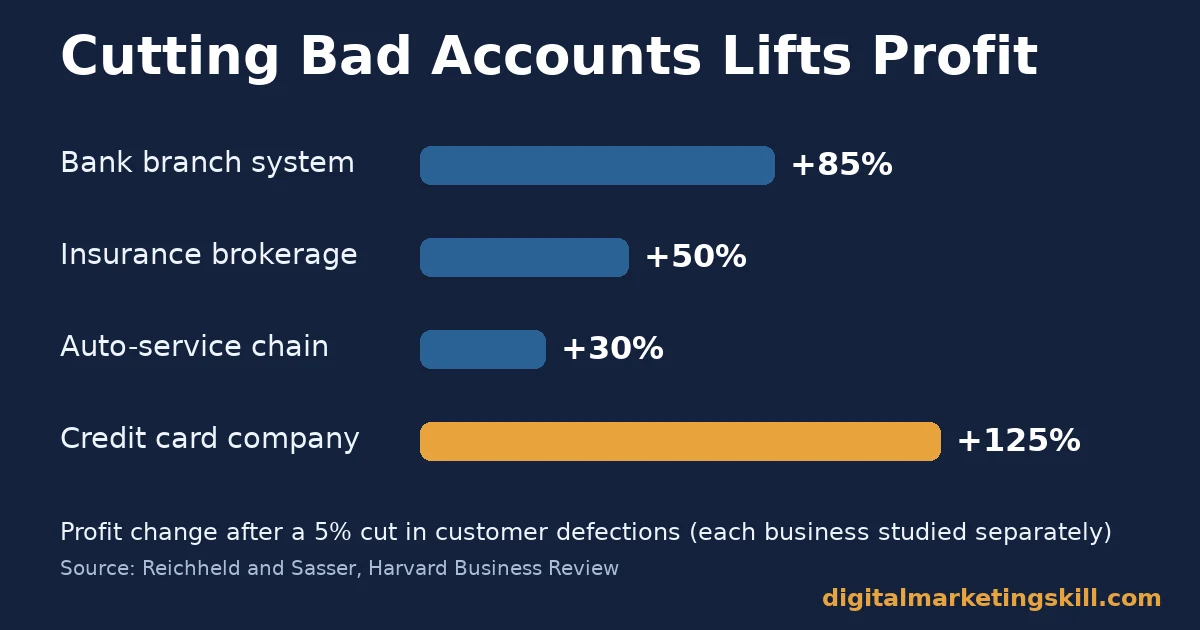
- Cutting the worst accounts can raise profits sharply. A classic Harvard Business Review study found that a 5% cut in customer defections raised profits by 25% to 85% across the service businesses studied. One credit card company that halved its defection rate saw profits rise by 125%.
- Abuse has a measurable cost on staff. A Perceptyx survey of 21,000 frontline employees found 53% had met a verbally abusive, threatening or unruly customer within six months. Those employees were 1.3 times more likely to be job hunting.
- Your best customers carry the business. Harvard Business School research on the “whale curve,” by professors Kaplan and Narayanan, studied customer profitability. It found that the most profitable 20% of customers typically generate 150% to 300% of total profit, while the least profitable slice actively destroys value.
- Difficult customers push good staff out the door. An ASAPP report cited by SHRM found 8 out of 10 customer service staff have faced a verbally abusive interaction. Replacing a lost employee can then cost one-half to two times their annual salary, per Gallup.
In this guide
- What Most Advice on Difficult Customers Gets Wrong
- Why Difficult Customers Cost More Than They Pay
- Difficult Customers Come in Three Forms
- How to Respond to Each Type of Difficult Customer
- How to Measure the Cost of a Difficult Customer
- The One Decision Rule: Profit Per Hour, Not Revenue
- A Real Case: Cutting the Worst Accounts at a Credit Card Company
- Frequently Asked Questions About Difficult Customers
- Build the Habit, Not Just the Policy
What Most Advice on Difficult Customers Gets Wrong
Most articles on difficult customers offer the same scripts. Stay calm. Listen. Apologise. Offer a discount. None of that is wrong. But it treats every difficult customer as one problem with one fix.
In practice, a chronic complainer, a price fighter and an abusive customer cost a business in different ways. A script built for one type of difficult customer often fails for the others. A business that applies the wrong fix wastes time, and still loses the account.
This guide separates the three types of difficult customer. It explains why each one costs more than it pays. It gives a matching response for each, and shows how to measure the cost of difficult customers in your own numbers. One decision rule and a real case close it out.
A ground rule first. The studies below each have their own sample and limits, so read them as evidence, not universal law. The three-type model is an informed framework built from that evidence, not a scientific classification. Treat every figure as a snapshot, not a permanent ranking of your business.
Why Difficult Customers Cost More Than They Pay
Every business relationship has a cost side and a revenue side. For most customers, the two balance in the business’s favour. The goods or services cost less to deliver than the customer pays, and the relationship stays simple.
A difficult customer breaks that balance. One of three things usually happens. The account eats far more staff time than its value justifies. Or the price it pays no longer covers the cost to serve it. Or the relationship carries a human cost no price can offset.
The pattern researchers call the whale curve shows this clearly. A company’s most profitable 20% of customers typically generate 150% to 300% of total profit. A tail of unprofitable customers quietly cancels out some of those gains. The lesson is not that most customers are worthless. A small group at the bottom actively subtracts from profit, and most businesses never isolate who they are.
Why Owners Keep Difficult Customers Anyway
Most owners can describe their worst customer without hesitation. Yet they keep serving them. The usual reason is that revenue feels safer than it is. A customer who pays something, even slowly or after an argument, looks better on a statement than an empty slot.
That comparison ignores the staff hours, the stress and the opportunity cost of not serving a better customer instead, the kind our guide to customer retention strategies focuses on keeping. There is also a trust problem inside teams. When a difficult customer is tolerated at the top, frontline staff learn that standards are optional. The Perceptyx figures above show what that normalisation costs in morale and turnover risk.
Difficult Customers Come in Three Forms
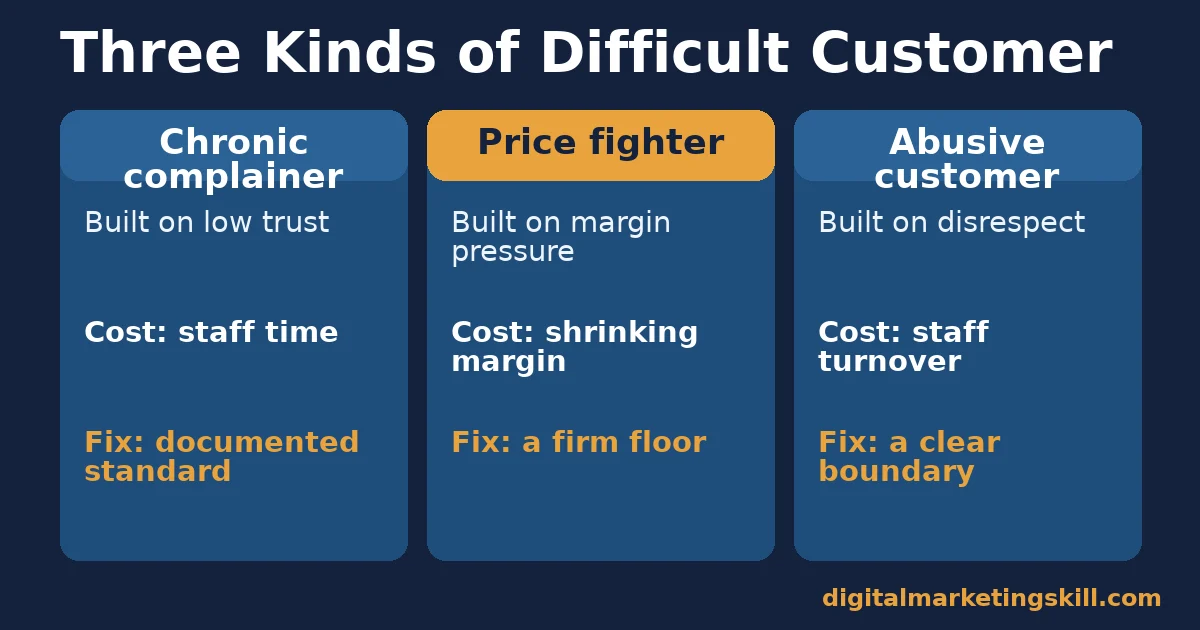
Naming the type of difficult customer you are actually facing matters, because a fix for one type can make another worse. These three forms cover most of what businesses report, and most owners will recognise all three from their own customer list.
The Chronic Complainer: Built on Low Trust
The chronic complainer raises a problem on almost every order, often moving the goalposts after each concession. The cause is usually low trust rather than bad luck. Something early in the relationship, maybe a missed deadline or an unclear quote, convinced this customer to fight for fair treatment every time.
This type of difficult customer is the most recoverable of the three, because the complaints are at least information. The cost is staff time. Each complaint consumes attention a well-matched customer would not require. The business often discounts repeatedly just to end the conversation, which teaches the pattern to continue.
The Price Fighter: Built on Margin Pressure
The price fighter negotiates every invoice down, asks for free extras as a condition of staying, and compares your price with competitors at every renewal. Unlike the complainer, the relationship can run smoothly day to day.
The damage only shows up when you calculate margin per account rather than revenue per account. This type of difficult customer is common in businesses that compete partly on price. The behaviour that won them in the first place keeps working after the sale, long after the margin has gone.
The Abusive Customer: Built on Disrespect
The abusive customer is rude, threatening or demeaning toward staff, and the pattern repeats no matter how the issue gets resolved. This is the only one of the three types where the cost is not primarily financial.
The direct cost shows up in staff turnover and sick days. Most owners underreact to this type of difficult customer, because the customer may still be profitable on paper. That misses the point. The cost is paid by employees, not the balance sheet, until the resulting turnover shows up months later.
How to Respond to Each Type of Difficult Customer
The sections below mirror the three types of difficult customer above. Match the response to the type you are actually dealing with. A discount aimed at a price fighter will not calm an abusive customer. A firm boundary aimed at an abusive customer is overkill for an honest complainer.
The Chronic Complainer: Lead With a Documented Standard
Write down what your product or service includes and does not include. Share it before the next disagreement, not during one. A documented standard turns a vague argument into a specific check, so the goalposts stop moving.
Track every complaint from this customer in one place, with dates. It is the same habit our guide to customer retention management recommends for any account worth keeping. After a few cycles, you will know whether the complaints catch real problems worth fixing company-wide, or whether this one account just needs a clearer contract.
The Price Fighter: Lead With a Firm Floor
Calculate a minimum acceptable margin for the account type before the next renewal, then hold it. Offer a trade instead of a straight discount: a longer contract, a smaller scope or less customisation, so any concession still protects the floor.
If the price fighter will not move off an unprofitable floor, let the account go in a scheduled, polite way rather than an abrupt one. A business that holds its floor with every account sends a clearer signal than one that holds it with some and folds with others.
The Abusive Customer: Lead With a Clear Boundary
Write a short standard for acceptable conduct and apply it the same way for every customer, with no exceptions for size or spend. State the boundary once, calmly and in writing. Make the consequence of crossing it clear and immediate, not a growing list of warnings.
Protect the staff member in the moment, not only in policy. Give frontline employees a simple way to end an abusive interaction and hand it to a manager without arguing for permission first. A team that trusts the boundary will hold is a team that stays.
How to Measure the Cost of a Difficult Customer
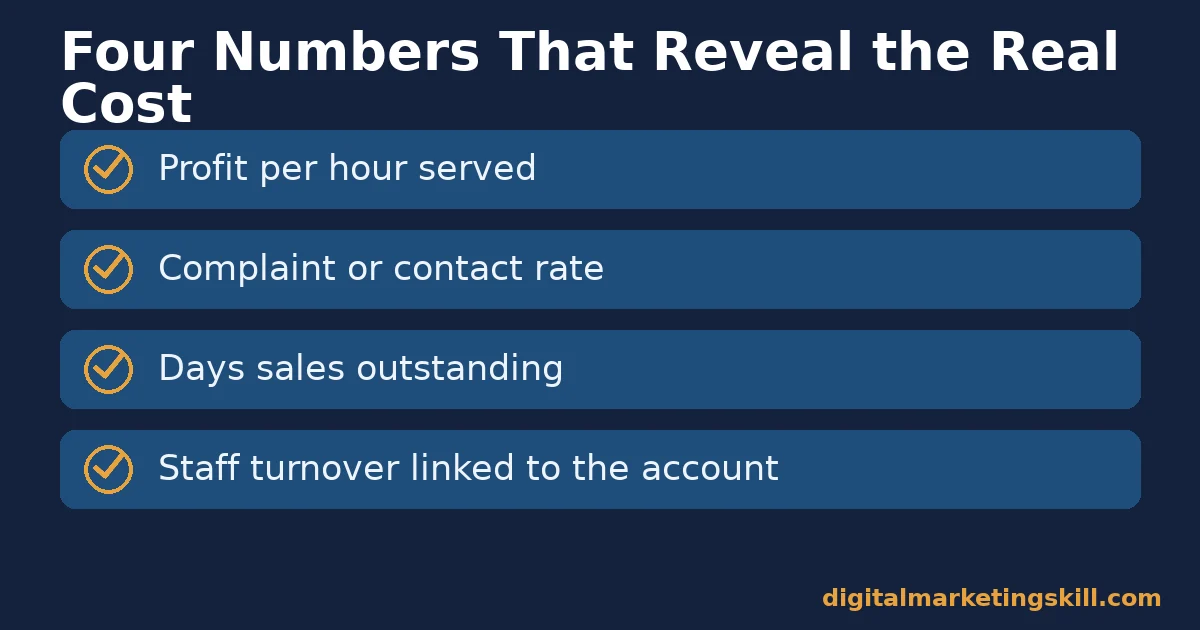
Difficult customers are easier to manage with numbers behind the decision. A single bad week can feel bigger than it is, and a slow-draining account can feel smaller than it is. Track these four numbers alongside whatever accounting or CRM system you already use, so the review takes minutes, not a new spreadsheet.
Four Numbers That Show the Real Cost
- Profit per hour served. Divide the account’s margin for a period by the staff hours it consumed, including calls, emails and internal meetings about it. This is the clearest number for comparing accounts of different sizes.
- Complaint or contact rate. Count support contacts per account per month. A rising rate, with no new issue being solved, signals that the relationship, not the product, is the problem.
- Days sales outstanding. This tracks how long the customer takes to pay after being invoiced, on average. An account that consistently pays late is quietly funding itself at your expense, interest-free.
- Staff turnover linked to the account. Note which employees ask to be moved off a specific account, and why, in exit conversations. A pattern pointing at one account is a cost that never shows up on its invoice.
How to Read These Numbers Together
Start with profit per hour, because it strips out the comforting size of the top-line invoice. If that number is weak, check the complaint rate and days sales outstanding to see whether the cause is time, cash flow, or both.
If staff turnover points at one account, treat that as a standalone reason to act, since no spreadsheet captures the full cost of losing trained staff. Review these four numbers quarterly for your ten largest or most time-consuming accounts. Our guide to CRM in digital marketing covers how to set up the fields and pipelines that make this kind of per-account tracking routine rather than a special project.
A Simple Triage for a Full Customer List
If you have never triaged difficult customers this way, do not try to measure all four numbers for every account at once. Start with a short list: your ten largest accounts by revenue, plus your five most time-consuming by support contacts.
Score each one on profit per hour alone, for a single typical month, using rough figures if exact ones are not available yet. Sort from highest to lowest. The bottom two or three usually explain most of a small team’s stress, and they are the accounts to run through the matching response first.
Early Warning Signs Worth Tracking Now
You do not need a full quarter of data to spot most difficult customers forming. A handful of early signals show up well before the four numbers above turn negative, and catching them early makes every response in this guide easier to apply.
- The first invoice dispute arrives within the first month. Early disputes often predict a chronic complainer, especially if the stated reason keeps changing.
- A new client asks for a discount before seeing any work. This is a common opening move from a price fighter, and it rarely stops after the first concession.
- A staff member mentions dreading a specific call or account by name. Treat this as an early signal of an abusive customer, not a complaint about the employee’s attitude.
- A client reframes every agreed deadline as flexible. This usually signals low trust rather than a scheduling problem, and benefits from the same documented standard as a chronic complainer.
None of these signals alone proves a customer will become difficult. Together, two or more in the first few weeks are worth a direct, calm conversation about expectations before the relationship settles into a costly pattern.
The One Decision Rule: Profit Per Hour, Not Revenue
If you take one decision rule from this guide, make it this one. Judge every account by profit per hour served, not by revenue. Revenue flatters accounts that are merely large. Profit per hour exposes the difficult customers who are merely loud.
Here is an illustrative example, with invented numbers. A small design agency has two clients paying the same $2,000 monthly fee. Client A takes four hours of work with no late payments. Client B takes eighteen hours of revisions, disputes and calls, and pays three weeks late every month.
Both show $2,000 in revenue. But client A returns roughly $500 per hour of staff time, while client B returns about $111. Once the agency applied a firm scope and a documented change-request process to client B, its hours dropped to eight within two months. Treat that drop as a reasonable illustrative outcome of a consistent standard, not a guaranteed result for every account.
The rule works because it forces a like-for-like comparison. A small, well-behaved account can quietly beat a large, difficult one, and only profit per hour makes that visible before the end of the year.
A Real Case: Cutting the Worst Accounts at a Credit Card Company
The Harvard Business Review study on service defections linked above studied what happened when companies reduced the share of customers who left or were let go each year. A bank’s branch system saw profits rise 85% after cutting its defection rate by just 5%. An insurance brokerage saw a 50% profit rise from the same 5% cut. An auto-service chain saw a 30% rise.
The most striking single case was MBNA America, a credit card company that cut its 10% annual defection rate in half. Profits rose by 125%. The researchers tie the gain to the mechanism described earlier in this guide: a smaller, better-matched customer base costs less to serve and returns more per account, even with fewer total customers.
The limit is worth stating plainly. This is one well-known study, covering specific service industries, and the exact percentages will not transfer to every business. Treat it as evidence that the mechanism is real and can be large, not as a promise of a specific result for yours.
Frequently Asked Questions About Difficult Customers
These are the questions owners ask most often once they start sorting difficult customers by type instead of by instinct.
How do I know if a customer is worth keeping?
Calculate profit per hour served, not revenue. An account that pays well but consumes disproportionate staff time, pays late, or drives staff turnover is often worth less than its invoice suggests.
Is it ever okay to turn away business?
Yes, when an account’s true cost, including staff time and the toll on your team, is higher than its margin. Because retaining a customer costs far less than winning a new one, replacing one draining account rarely requires as much new revenue as owners fear.
What is the difference between a demanding customer and a difficult one?
A demanding customer asks for a lot but pays fairly and respects staff, and the relationship can still be profitable with clear boundaries. A difficult customer, in the chronic complainer, price fighter or abusive sense used here, costs more than it pays once staff time, margin or wellbeing is counted properly.
How should staff handle an abusive customer in the moment?
Give staff a short, pre-agreed script to end the interaction and hand it to a manager immediately, with no need to ask permission first. A written standard, applied consistently, protects staff better than a judgement call made under stress.
Will firing a difficult customer hurt my reviews or reputation?
It can, briefly. But a documented standard applied consistently is defensible if a dispute becomes public. Keep records of the standard you shared and the specific issues raised, so your side of the story is easy to show.
How often should I review which customers are unprofitable?
Quarterly is usually enough for a small or mid-sized business. Review profit per hour, contact rate, payment delay and staff feedback for your largest or most time-consuming accounts. Act on patterns rather than single bad weeks.
Can a difficult customer become a good one?
Sometimes, especially the chronic complainer type. A documented standard, applied consistently for a few billing cycles, often rebuilds the trust that was missing. A price fighter or an abusive customer is far less likely to change, because the behaviour is working for them, not against them.
Build the Habit, Not Just the Policy
Difficult customers are easier to manage once you can name the type, measure the real cost and apply one documented standard consistently. Start with your ten most time-consuming accounts, calculate profit per hour for each, and apply the matching response above to whichever ones fall short.
A single quarter of consistent practice usually changes how a business talks about its difficult customers. The conversation shifts from frustration to a short, specific plan for each one.
For structured practice building these systems, Digital Marketing Skill Institute teaches them hands-on. Its Master Diploma in Digital & AI Marketing offers four AI-powered tracks totalling ten courses, including AI-Powered Lead Generation and Email Automation, which covers the client-relationship systems this guide describes.
The diploma has a Full Stack option covering all four tracks, unlimited 1-on-1 coaching, a U.S. Project Internship with a verified U.S. Work Reference Letter, and dual US and UK accreditation, recognised in more than 100 countries.
The programme is fully online, so you can build these systems from anywhere in your country. Browse more guides on the Digital Marketing Skill Institute blog, read real outcomes on the reviews page, and when you are ready, apply for the Master Diploma or start from the Digital Marketing Skill Institute homepage.
Every figure in this guide was checked against its original source before publication. Figures marked as illustrative are invented examples, not real results.
![9 Amazing Digital Marketing Skills to Make Money Online [With Proof]](https://digitalmarketingskill.com/wp-content/uploads/2019/07/9-Amazing-Digital-Marketing-Skills-to-Make-Money-Online-With-Proof-17.png)






