
Online forum marketing means promoting a business inside niche communities, among roughly 5.66 billion active social and community identities worldwide, by answering real questions before you ever mention your product. Done badly, it reads as spam and gets you banned within a week. Done well, it builds trust that outperforms most paid ads. 92% of consumers trust personal recommendations over advertising. This guide covers how to do online forum marketing well, on any forum, in any niche.
Key Takeaways
- 92% of consumers trust word-of-mouth and personal recommendations over advertising, and 70% trust online consumer reviews, per Nielsen’s Global Trust in Advertising survey.
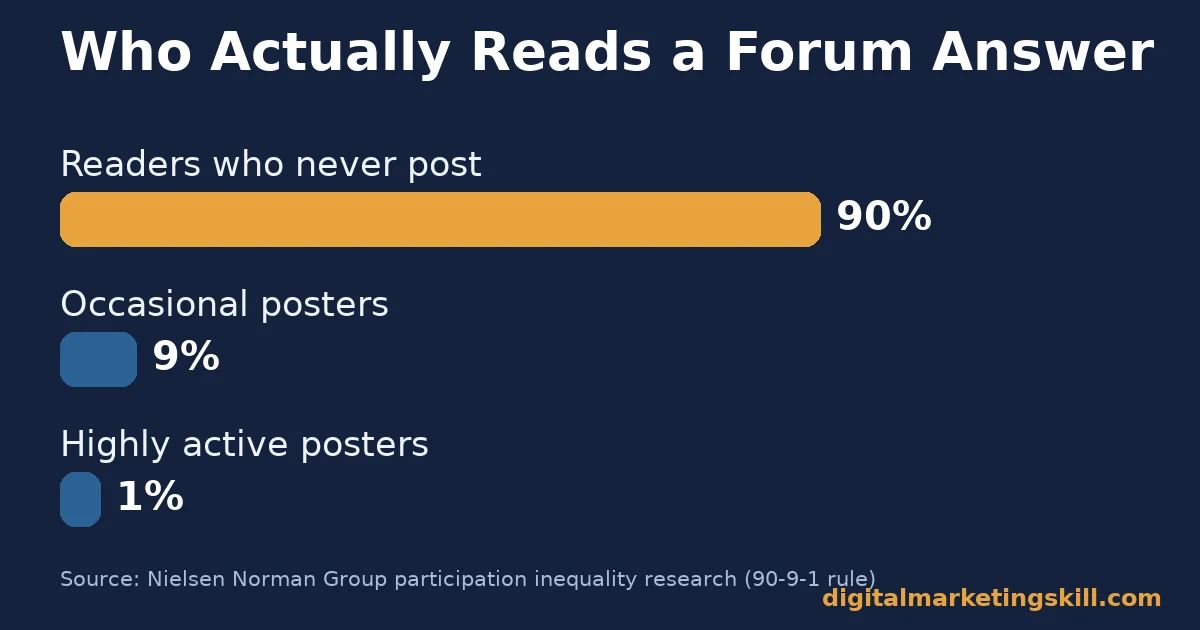
- In a typical online community, 90% of members only read, 9% post occasionally, and 1% account for most of the activity, per the Nielsen Norman Group’s participation inequality research.
- That 90% matters more than the 1% for online forum marketing. A genuinely useful answer gets read by far more people than the ones who ever reply to it.
- Marketers who document their approach are 674% more likely to report success, per CoSchedule’s State of Marketing Strategy survey, and forum marketing needs a plan as much as any other channel.
- Most forums ban self-promotional posting outright. The accounts that succeed build a visible answer history before they ever link to a business.
In this guide
- Most Forum Marketing Advice Skips the Platform Rules
- Why Online Forum Marketing Works Differently From Social Ads
- What Differs by Platform Type
- How to Work Each Platform Type
- Common Mistakes in Online Forum Marketing
- What Differs by Business Stage
- How to Measure Online Forum Marketing
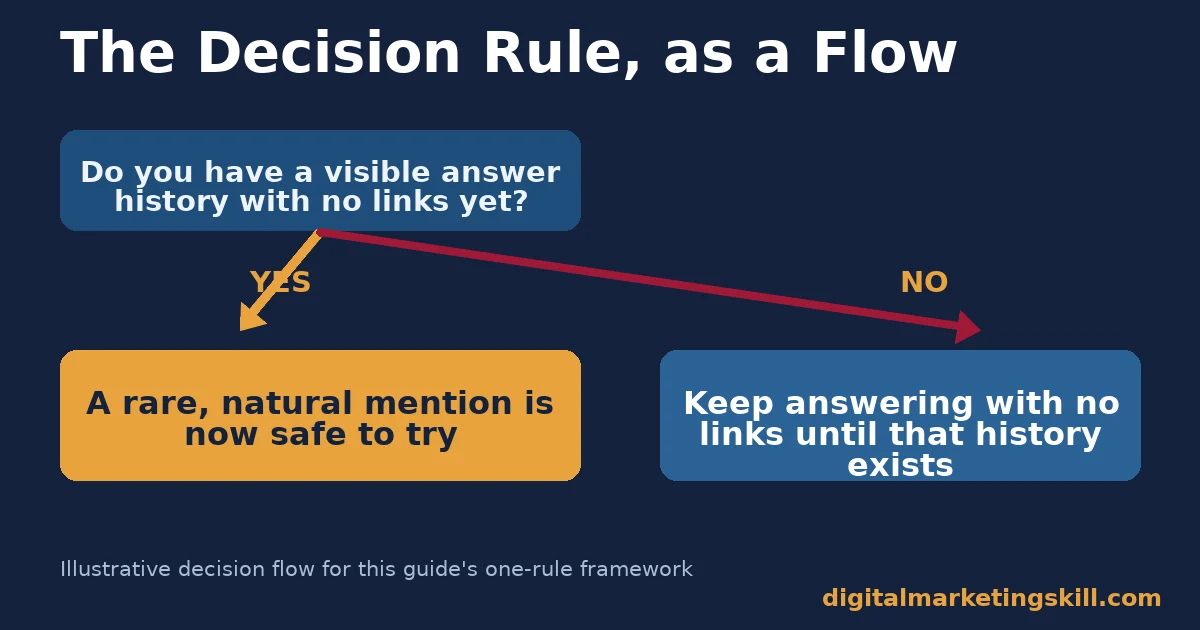
- The One Decision Rule: Build History Before You Link Anything
- What to Do If a Post Gets Removed
- What Trust-First Promotion Looks Like With Real Numbers
- Frequently Asked Questions About Online Forum Marketing
- Your Next Step
Most Forum Marketing Advice Skips the Platform Rules
Search for forum marketing advice and you get generic tips. Be helpful. Don’t spam. Build relationships. All true, but useless without specifics. Most guides never explain why 90% of a community never posts at all, or how that changes your strategy. This guide names the specific numbers and the specific checks, not just the general advice.
This guide names real platform types: large general-interest discussion boards, niche subreddits, topic-specific Quora Spaces, and industry forums. The mechanics stay the same everywhere even though the audience differs.
Treat the examples as illustrations of a method, not a ranked list of where to post. Forum popularity shifts, so a snapshot today is not a permanent map. Re-check which communities your actual customers use before you commit real time to one.
The underlying skill transfers even when a specific platform fades. Answering a stranger’s real question well, in public, with no immediate payoff, is a durable skill. It keeps working on whatever community replaces today’s most popular one.
Why Online Forum Marketing Works Differently From Social Ads
A forum is a place where people arrive already searching for a solution to a specific problem. They are not scrolling for entertainment. That single difference changes everything about how promotion should work there. The person reading your answer already wants the information you have. They do not need to be interrupted and persuaded first.
The Nielsen Norman Group’s 90-9-1 rule explains the real audience. In most online communities, 90% of members read without posting. 9% post occasionally. Only 1% account for most of the visible activity. A useful, honest answer you post gets read by that silent 90%, even though only a handful of them ever reply or upvote it. That is why one good answer in the right thread can keep sending readers to a business for years. It is the same compounding effect that makes evergreen content marketing work for startups with small budgets.
Trust is the other half of the mechanism. Nielsen’s Global Trust in Advertising survey found that 92% of consumers trust word-of-mouth and personal recommendations above every other form of advertising. 70% trust online consumer reviews specifically. Separately, BrightLocal’s Local Consumer Review Survey found that 97% of consumers read reviews before deciding to use a business, and about 49% trust those reviews as much as a personal recommendation. A forum answer that genuinely helps functions like both at once: a review and a recommendation from someone with no reason to lie. That is a trust level most paid ads cannot buy.
What Differs by Platform Type
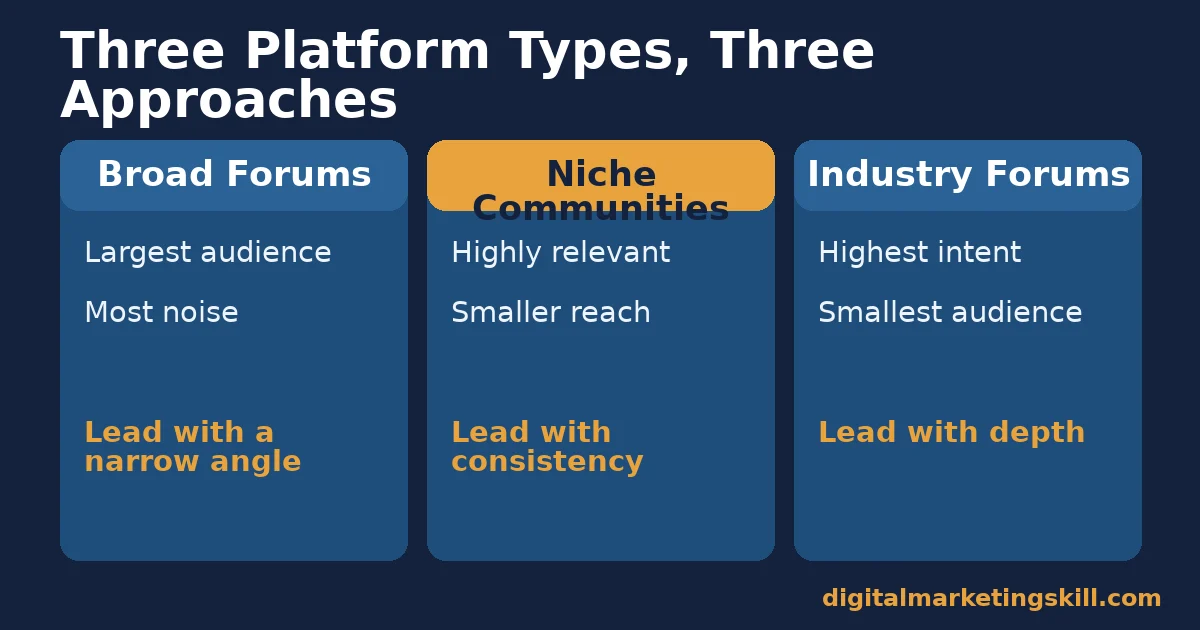
Not every forum works the same way. Three platform types cover most of what a business will encounter. Each rewards a different approach, and confusing the three is one of the fastest ways to waste the effort you put into online forum marketing.
Broad General Forums: Built for Reach
A broad general forum covers everything from politics to business to relationships inside one community. It gives you the largest possible audience inside one platform. Most countries and regions have at least one large, general-interest discussion board with a dedicated business or money-making section.
The tradeoff is competition and noise. Your post sits next to thousands of unrelated threads, so it needs a genuinely specific, useful angle to stand out at all. A broad forum also tends to have the loosest, most varied moderation. Different sections often run under different unwritten norms, even inside one platform.
Niche Subreddits and Spaces: Built for Relevance
A niche subreddit or a topic-specific Quora Space gathers people around one narrow interest. The audience is smaller than a broad forum. But every reader already cares about your exact topic. That raises the odds that a useful answer turns into real interest, not just a view.
Industry and Professional Forums: Built for Authority
An industry-specific forum is built around one trade or profession. It gives you the smallest audience of the three but the highest-intent one. People here are often peers or potential clients evaluating expertise directly. A thoughtful, detailed answer does more reputational work than it would anywhere else. Professional communities remember who gave good advice long after the thread itself goes quiet.
How to Work Each Platform Type
Each platform type pairs with a different first move. Match the tactic to the platform before you post anything. The same message, delivered the same way across all three types, will underperform on at least two of them.
Broad Forums: Lead With a Narrow, Specific Angle
Find the handful of threads where someone is asking a precise question, not a general one. Answer that exact question in detail before you say anything about what you do. A broad forum rewards the post that stands out from the noise, not the post that blends in.
Niche Communities: Lead With Consistent, Small Contributions
Post useful answers on a regular cadence rather than one long promotional post. A niche community notices repeat, genuinely helpful contributors, much like the consistency that underpins good social media marketing principles. That reputation compounds in a way a single post never does.
Industry Forums: Lead With the Most Detailed Answer in the Thread
Write the longest, most specific, most technically correct answer in the thread, even when a short answer would technically suffice. On a professional forum, depth is the credibility signal that gets your profile clicked. A short, generic answer in this setting reads as unserious, even when it is technically accurate. The readers evaluating it already know the basics and are looking for the detail that proves real experience.
Common Mistakes in Online Forum Marketing
These mistakes show up across platforms, in every version of online forum marketing.
Most failed forum campaigns trace back to a handful of repeated habits, and none of them require a platform redesign to fix. Each one is a choice a poster made, which means each one is a choice the next poster can make differently.
- Posting a link before earning any history. A brand-new account with a link in its first post is the single clearest spam signal moderators look for.
- Copying the same answer across multiple threads. Forum search tools and experienced moderators both catch repeated text fast, and it reads as automated even when a human wrote it.
- Answering questions nobody asked. A detailed reply to a five-year-old thread with no recent activity reaches almost nobody and can read as an obvious plant.
- Treating every platform the same way. A tactic that works on a niche subreddit can get an account banned on a stricter industry forum with tighter self-promotion rules, one of several social media marketing risks worth planning around.
- Disappearing after the first promotional mention. A one-time pitch followed by silence undoes the credibility that consistent posting built, and it signals to the community that the earlier helpfulness was only ever a means to an end.
What Differs by Business Stage
The three platform types above stay useful at every stage of a business. What changes is how much of your time each one deserves.
Early-Stage: One Niche Community, Most of the Time
A brand-new business has no reputation anywhere yet. Spreading a handful of hours across five platforms builds a thin presence on all of them and a real one on none. Pick the single niche community where your exact customers already ask questions, and put most of your available time there until you have a genuine history.
Growing: Add a Broad Forum for Reach
Once a niche community is producing real referral traffic, a broad general forum becomes worth the added effort. The audience is larger and noisier. But by this stage you likely have real answers, worked examples, and a track record to draw on, exactly what stands out in a crowded thread.
Established: Industry Forums for Authority, Not Just Traffic
An established business can afford to treat an industry forum as a reputation investment rather than a traffic source. The direct click-through may be small, but the credibility built there often shows up indirectly, in referrals, partnerships, and press, more than in analytics. That is a slow payoff, and it is still a real one.
How to Measure Online Forum Marketing
Online forum marketing is slow to show up in standard analytics, so track it with its own KPIs. Each one answers a different question about whether the effort is working.
- Referral clicks from forum profiles or links: the number of visits your site’s analytics attributes to a specific forum domain, one input into the same lead generation measurement you would apply to any channel. Track this per platform, since one forum almost always outperforms the others.
- Account standing: karma, reputation score, or post history length, depending on the platform. A thin or negative history is often the real reason a promotional post gets removed, not the post itself, so check this before assuming the content was the problem.
- Answer-to-click ratio: how many people who viewed your answer actually clicked through, where the platform reports it. A low ratio usually means the answer was not specific enough to earn the click.
- Time to first ban or removal warning: how long an account lasts before moderators flag it. A short time here is the clearest signal the posting pace or tone needs to change.
- Repeat mentions by other members: how often other people reference your answer or business unprompted in later threads. This is the clearest sign a reputation, not just a post, is forming, and it is the metric no paid channel can buy directly.
The One Decision Rule: Build History Before You Link Anything
Do not post a single link to your business until you have a visible history of genuinely useful, non-promotional answers on that platform. Most forums enforce this formally with minimum post counts or account age before links are even allowed. The rest enforce it informally through moderator judgment and community suspicion of brand-new accounts.
Illustrative, invented numbers: picture two accounts on the same niche forum, both eventually mentioning the same product, aimed at the same audience, with the same price point. Account A spends three weeks answering questions with no links at all, then mentions the product once, naturally, inside a detailed answer. Account B creates a profile and posts a product link within the first day.
The outcome diverges fast. Account A’s post stays up and gets referenced in later threads, while Account B’s post is removed within hours and the account is flagged. The product and the pitch were nearly identical. The sequence was not.
What to Do If a Post Gets Removed
A removed post is not the end of an account’s standing, but it is a signal worth reading carefully. How you respond to it matters more than the removal itself.
- If it was removed for a broken rule you did not know about: read the community’s posting guidelines in full before posting again. Most removals trace back to a rule the poster never read, not a judgment call moderators got wrong.
- If it was removed for being too promotional: wait, then return with several purely helpful posts before trying again. A pattern of promotional removals followed by more promotional posts is what gets accounts permanently banned.
- If it was removed with no explanation: message the moderators directly and ask, politely, what rule applied. Many will explain, and the answer often reveals an unwritten norm specific to that community.
None of these responses require abandoning the platform. They require treating the removal as information about that specific community’s norms, not as a verdict on the idea itself. Most experienced forum marketers have at least one early removal in their history. What separates a long-term presence from a banned account is how the poster responded to that first signal.
What Trust-First Promotion Looks Like With Real Numbers
A Digital Marketing Skill Institute graduate, Joy Akosa, built an online presence inside relevant communities before running any paid promotion. That work achieved over a 300% return within two weeks of starting, as published on the Institute’s own reviews page.
That result reflects a short, specific campaign window, not a guaranteed outcome, and the full context of the figure is not published beyond the review itself. The pattern it illustrates still holds: building credibility inside a relevant community before asking for anything tends to compress the distance between a first post and a first sale. Read the Institute’s earnings disclaimer before treating any single result as typical.
Frequently Asked Questions About Online Forum Marketing
What is online forum marketing?
Online forum marketing is promoting a business inside niche communities and discussion boards by contributing genuinely useful answers first. Reputation and occasional, honest mentions drive interest, rather than direct advertisements.
Is forum marketing still worth the time compared to paid social ads?
It depends on your timeline. Paid ads produce faster, more predictable results. Forum marketing produces slower but more trusted results, since 92% of consumers rate personal recommendations above any form of advertising. Many businesses use both, at different stages.
Will I get banned for mentioning my business on a forum?
Not if you follow the platform’s specific rules on self-promotion, usually a minimum post count or account age before links are allowed, and keep promotional mentions rare relative to genuinely helpful posts.
Which forums are worth the effort for a small business?
Whichever ones your actual customers already use to ask questions about your topic. A small, highly relevant niche community usually outperforms a large general forum for a business with a narrow focus.
How long does it take to see results from online forum marketing?
Expect weeks, not days, before an account has enough history to post promotional content without suspicion. It takes longer still before that translates into measurable traffic or sales.
Does forum marketing help with search engine rankings?
Indirectly. A genuinely useful, frequently referenced forum answer can drive durable referral traffic over a long period. A consistent presence under one name also builds the kind of recognizable expertise that supports a business’s broader reputation online.
Should I use my business name or a personal account for forum marketing?
Use a personal account that discloses the business connection when relevant; it usually performs better. Forum members tend to trust a named person over an obvious brand account, which lines up with why personal recommendations outperform advertising in the first place.
How many communities should a small business try to maintain at once?
One or two, done consistently, almost always outperforms five done sporadically. A thin presence across many platforms rarely builds the account history or reputation that online forum marketing depends on.
Your Next Step
Pick one niche community or forum where your actual customers already ask questions. Spend the next few weeks answering those questions honestly, with no links, before you mention your business at all. Help first, mention later. That sequence is the entire method behind online forum marketing. It works the same way whether the community has a hundred members or a million, and it costs nothing but time to start.
The Digital Marketing Skill Institute’s Master Diploma in Digital & AI Marketing covers community and content strategy alongside the rest of a full marketing toolkit. It packs in ten practical courses, unlimited 1-on-1 coaching and mentoring, and real project work inside a U.S. partner company from day one. It is dual US and UK accredited and recognized in more than 100 countries, 100% online, so you can apply this approach to communities anywhere in your country.
Visit digitalmarketingskill.com to start with the Institute’s blog, or go straight to the application page to see if the program fits your business. Wherever you live, the same sequence applies: find the community, help first, build history, then mention your business sparingly. Learn more at digitalmarketingskill.com.
Every figure in this guide was checked against its original source before publication. Figures marked as illustrative are invented examples, not real results.
![9 Amazing Digital Marketing Skills to Make Money Online [With Proof]](https://digitalmarketingskill.com/wp-content/uploads/2019/07/9-Amazing-Digital-Marketing-Skills-to-Make-Money-Online-With-Proof-17.png)






