

Blogging goals fail most often because they are vague, not because the blogger lacks effort. “Post more” and “grow traffic” give you nothing to measure against. This guide uses data from a decade of blogger surveys to show which specific goals actually predict strong results, and which popular ones do not.
Key Takeaways
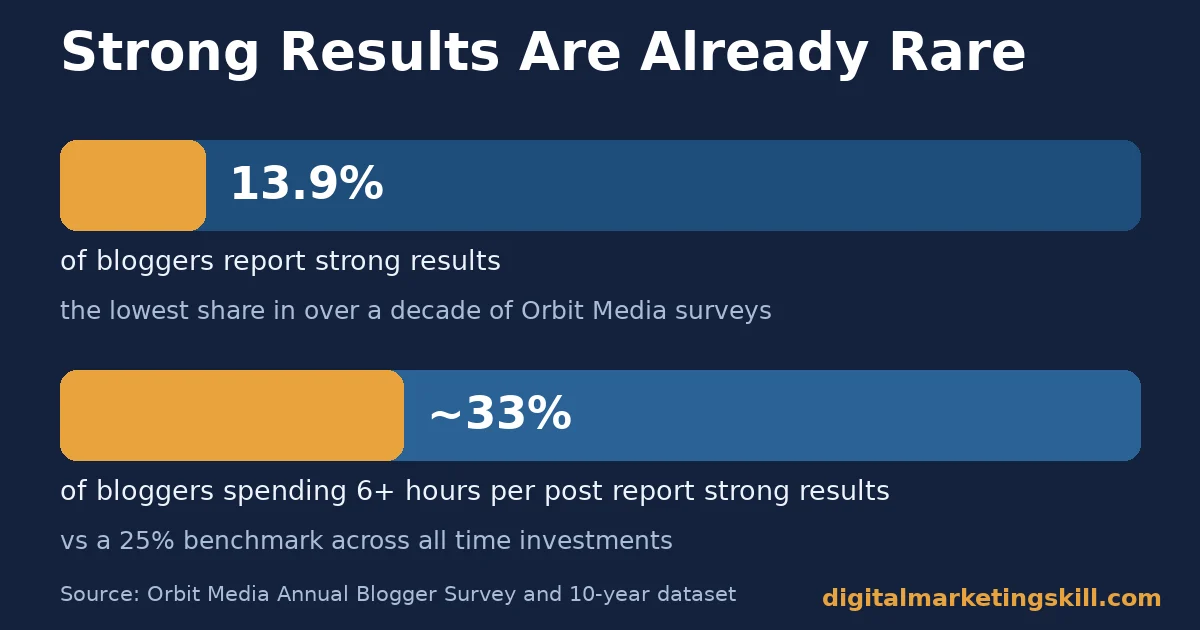
- Vague goals do not move the needle. Orbit Media’s most recent Annual Blogger Survey of 1,042 content marketers found only 13.9% report strong results. That is the lowest share in over a decade.
- Time invested predicts results more than talent. Across Orbit Media’s 10-year dataset of 11,051 bloggers, writers spending 6 or more hours per post are roughly one-third likely to report strong results, versus a 25% overall benchmark.
- Consistency beats sporadic bursts. The same research found that bloggers who publish most consistently are the most likely to report strong results, not the ones who write the longest single posts.
- Updating old posts is an underused goal. Bloggers who update old content are twice as likely to report strong results, per Orbit Media’s findings. Yet it rarely appears on a goals list next to “publish more.”
- Traffic goals ignore a harsh baseline. Ahrefs’ study of about 14 billion pages found that 96.55% get zero traffic from Google. So a goal built only around total traffic ignores how most content performs by default.
In this guide
- What Most Blogging Goals Advice Gets Backwards
- Why Vague Blogging Goals Fail to Predict Results
- Three Blogging Goals the Data Actually Supports
- How to Lead With Each Goal, Not Just Set It
- How to Measure Whether a Blogging Goal Is Actually Working
- The One Rule: Pick One Goal Before Adding a Second
- What a Decade of Blogger Data Shows
- Frequently Asked Questions About Blogging Goals
- Turning Blogging Goals Into a Repeatable Content Practice
What Most Blogging Goals Advice Gets Backwards
Most blogging goals lists read the same way every year. Post twice a week. Grow your email list. Increase traffic. They sound reasonable, but they rarely survive contact with a real editorial calendar, because they describe outcomes, not the specific actions that produce them.
The fix is not more motivation. It is picking goals that match what the data actually shows predicts results. Then make each one specific enough to measure weekly, not just at year’s end.
This reading comes from Orbit Media’s own published survey data and Ahrefs’ own study of indexed pages. It is not a universal formula that fits every blog. A blog in a narrow technical niche will see different absolute numbers than a lifestyle blog. But the relative pattern, specific and consistent goals outperforming vague ones, holds across both.
Most bloggers already sense this. Few people genuinely believe “post more” is a complete strategy. But without a specific alternative backed by real data, it is the easiest goal to default to at the start of a new year, because it requires no decision about what to actually measure. This guide replaces that default with three blogging goals, each backed by a documented, named source. None of the three require you to abandon a strategy you already trust. They simply give it a measurable floor.
Why Vague Blogging Goals Fail to Predict Results
A goal like “grow traffic” has no built-in way to tell you whether this month’s effort worked. A goal like “publish one updated version of an old post every two weeks” does. The difference is not motivation. It is measurability. A measurable goal tells you, within a week, whether you are on track. A vague one only tells you at the end of the year, after the chance to adjust has already passed.
Strong Results Are Already Rare, So Vague Goals Make It Worse
Orbit Media’s most recent Annual Blogger Survey asked 1,042 content marketers 24 questions about their practices. It found that only 13.9% report their blog delivers strong marketing results. That is the lowest share the survey has recorded in more than a decade. A vague goal does not fix this. It just hides which specific practice, time investment, consistency, or updates, is the one actually missing.
The Traffic Baseline Most Goals Ignore
Before setting a traffic goal, know the baseline it is competing against. Ahrefs’ search traffic study of roughly 14 billion pages found that 96.55% get zero traffic from Google. A goal like “increase traffic” does not account for this. A goal built around a specific number of indexed, ranking pages does, because it targets the mechanism, getting a page to rank at all, instead of the outcome everyone wants but few pages achieve. Google’s own guidance on creating helpful, reliable, people-first content ties ranking directly to depth of knowledge and first-hand expertise. That is exactly what a rushed, deadline-only post skips. A handful of free SEO tools can show you how many of your own posts rank for anything at all right now.
Three Blogging Goals the Data Actually Supports
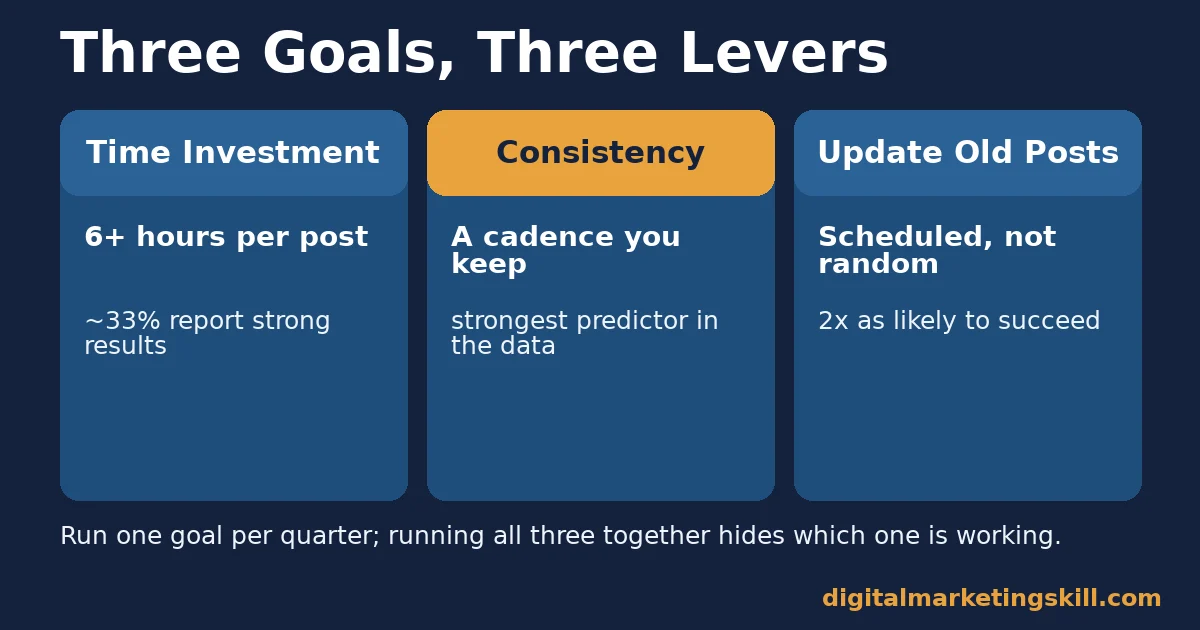
Not every popular blogging goal predicts results equally. These three blogging goals have the clearest evidence behind them, each built on a different lever. None of them requires a bigger team, a bigger budget, or a new content format. They require choosing which existing habit to change first, and tracking it honestly. A solo blog and a five-person content team can both run the same three goals. Only the scale changes.
A Time-Investment Goal: Built on the Strongest Correlation in the Data
Across Orbit Media’s 10-year dataset of 11,051 bloggers, time spent per post correlates directly with reported results. Bloggers spending 6 or more hours on a single post are roughly one-third likely to report strong results, compared to a 25% overall benchmark across all respondents. This goal is built on effort per piece, not total output.
A Consistency Goal: Built on Publishing Cadence, Not Post Length
The same research found that the bloggers who publish most consistently are the most likely to report strong results. This goal is built on cadence. It rewards a blogger who reliably ships one solid post every two weeks over one who publishes six posts in a burst, then nothing for two months.
An Update Goal: Built on Content You Already Have
Bloggers who update old content are twice as likely to report strong results than those who do not, per the same Orbit Media research. This goal is built on existing assets. It does not require a new topic, new research, or a new angle. It only needs a scheduled return to posts that already rank or already get some traffic. HubSpot’s own published historical optimization experiment tested this directly. Updating and republishing old posts raised their average monthly organic search views by 106%, and tripled monthly leads from the posts they updated, without writing a single new article.
How to Lead With Each Goal, Not Just Set It
Setting a goal is the easy part. Each of these three needs a different first move to actually stick.
Time-Investment Goal: Lead With a Minimum, Not a Deadline
Set a minimum hours figure per post, not a word count or a publish date. A post rushed to hit a deadline skips the research, editing, or sourcing that the data ties to strong results. Those are the same inputs a solid blog content strategy depends on. Track hours for four posts before judging whether the goal is realistic for your schedule. If your real average sits closer to two hours, do not set a 6-hour minimum on day one. Raise the floor gradually, half an hour at a time, so the extra time goes toward research and editing, not toward staring at a blank page longer.
Consistency Goal: Lead With the Cadence You Can Actually Keep
Pick a publishing interval you can sustain for three months without a single missed post, even if that means fewer posts than you would like. A cadence of one post every two weeks, kept without exception, beats a weekly schedule that collapses after a month. Write the interval into a shared calendar, not just a personal note. That way a missed post is visible to whoever else relies on the blog, not just to you. If you miss one, resist the urge to publish two the following week to compensate; that burst-then-silence pattern is exactly what the consistency data penalizes.
Update Goal: Lead With Your Highest-Traffic Old Posts, Not Your Favorites
Pull your analytics and sort old posts by traffic. Schedule updates for the top five first, not the posts you personally like best. Updating a post nobody finds wastes the same hour that updating a post Google already ranks could spend much better. It also does nothing for blog readership if the post was never getting read in the first place. Keep a running list of your top ten posts by traffic, refreshed quarterly, so the update goal always points at posts worth the hour.
How to Measure Whether a Blogging Goal Is Actually Working
Each metric below checks a different one of the three goals. Track the one tied to your current goal, not all of them at once. Checking a metric unrelated to your current goal adds noise, without adding a decision you can actually act on this week.
- Average hours per post: logged time against your minimum. If it drifts below the minimum for more than two posts in a row, the time-investment goal is slipping, not the writing itself.
- Publishing interval variance: the gap between consecutive posts. A consistency goal is working if this gap stays flat. It is failing if gaps keep widening, even while total post count looks fine over a quarter.
- Updated-post traffic change: organic sessions on an updated post, compared to its own traffic in the month before the update. This isolates whether the update goal is paying off, post by post.
- Ranking pages as a share of published pages: how many of your posts earn any organic traffic at all, against Ahrefs’ 96.55% baseline that gets none. A rising share means your topic or structure choices are improving, not just your volume.
- Email list growth rate: new subscribers as a percentage of existing list size. This one is useful for a list-building goal specifically, but it should not substitute for the three goals above if you have not set time, cadence, or update goals yet.
Review these monthly, not daily. Reading Google Analytics reports alongside your publishing log shows whether a traffic change tracks back to a specific post, update, or cadence change, instead of a platform-wide fluctuation. A daily check on any of these five metrics mostly measures noise, since a single post can swing a day’s numbers without meaning the underlying goal has changed.
The One Rule: Pick One Goal Before Adding a Second
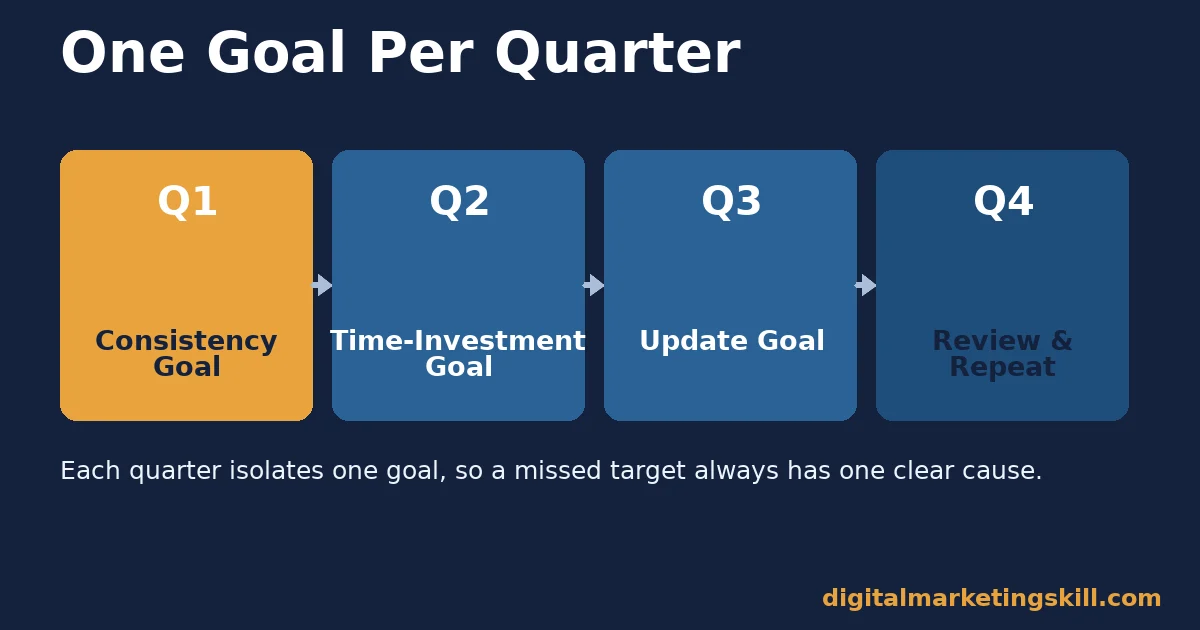
If you take one decision rule from this guide, make it this: commit to one of these three goals for a full quarter before adding another. Running a time-investment goal, a consistency goal, and an update goal all at once usually means none of them gets measured properly, because a missed post could be a cadence failure, a time-budget failure, or neither.
Illustrative, invented numbers to show why: say a blogger sets all three goals on day one. By week six, output has dropped. Was it the 6-hour minimum eating into available time? An unrealistic publishing interval? Unrelated update work crowding the schedule? With three goals running together, there is no way to isolate the cause. With one goal running at a time, the answer is immediate. That clarity is worth more than the extra ambition of chasing three goals at once, because a goal you cannot diagnose when it fails is not really a goal. It is just a hope.
What a Decade of Blogger Data Shows
Andy Crestodina, co-founder of Orbit Media, has published the firm’s blogger survey findings every year for over a decade, now covering 11,051 bloggers in total. Three patterns hold across that entire span. Bloggers who spend more hours per post report stronger results. Bloggers who publish most consistently outperform those who publish in bursts. And bloggers who update old content are twice as likely to report strong results as those who never do.
This is aggregate, self-reported survey data, not an audited case study of one blog. “Strong results” is each respondent’s own judgment, not a standardized metric like revenue or verified traffic. Treat the direction of each finding as reliable, since it repeats year over year. Treat the exact percentages as a snapshot of self-reported sentiment, not a guarantee for any single blog. None of these blogging goals claim to work identically for every niche, audience size, or publishing team. They claim only that the direction of the pattern repeats. The HubSpot historical optimization experiment adds a second, independently documented data point pointing the same direction. Existing content, updated deliberately, outperformed the assumption that only new content drives growth.
Frequently Asked Questions About Blogging Goals
What is the most important blogging goal to set first?
A consistency goal, because Orbit Media’s research found that bloggers who publish most consistently are the most likely to report strong results, ahead of post length or any single piece of content. Set a cadence you can keep for three months before adding a time-investment or update goal.
Is a traffic goal a bad blogging goal?
Not bad, but incomplete on its own. Ahrefs’ search traffic study of about 14 billion pages found that 96.55% get zero traffic from Google. So a traffic goal needs a mechanism behind it, like a ranking-pages goal, rather than standing alone as a wish for more visitors.
How many hours should a blog post take to write?
There is no universal number, but Orbit Media’s 10-year dataset found bloggers spending 6 or more hours per post are roughly one-third likely to report strong results, against a 25% baseline across all time investments. Use that as a floor to test against your own results, not a rule to copy exactly.
Should updating old posts be its own blogging goal?
Yes. Per Orbit Media’s findings, bloggers who update old content are twice as likely to report strong results, yet it is rarely treated as a standalone goal next to publishing new posts. Scheduling updates for your highest-traffic old posts is a specific, measurable goal on its own.
How many blogging goals should I set at once?
One at a time, for at least a full quarter. Running a time-investment, consistency, and update goal simultaneously makes it hard to tell which one is responsible when results change, because any missed target could trace back to any of the three.
Does email list growth belong on a blogging goals list?
It can, but only after a consistency or time-investment goal is already working, since list growth depends on posts people want to read regularly. Setting a list-growth goal before fixing publishing consistency usually just measures the same underlying problem from a different angle.
How long before a blogging goal shows whether it is working?
Give a consistency or time-investment goal a full quarter before judging it, since a handful of posts is not enough data to separate goal performance from normal week-to-week variation. An update goal can show a signal faster, often within weeks of republishing a high-traffic post.
Can a solo blogger realistically use the same blogging goals as a team?
Yes, with a lower bar on cadence, not a different kind of goal. A solo blogger can still run a time-investment, consistency, or update goal one at a time. The interval between posts may simply need to be longer than a team could sustain, since Orbit Media’s research measures the pattern, not a specific publishing frequency every blogger must hit. A solo blogger publishing monthly, on a schedule they never break, is applying the consistency goal correctly, even though the raw post count looks small next to a team’s output.
What should replace “grow traffic” as a blogging goal?
Replace it with a goal tied to the mechanism behind traffic, such as the share of your posts that rank for any keyword at all, measured against Ahrefs’ 96.55% baseline of pages that get none. That goal tells you whether your content and structure choices are improving, which “grow traffic” alone never isolates.
Turning Blogging Goals Into a Repeatable Content Practice
Blogging goals work when they are specific enough to check weekly and grounded in what the data shows actually predicts results, not in what sounds ambitious on day one of a new plan. A time-investment goal, a consistency goal, and an update goal, run one at a time, cover the three levers the research ties most directly to strong results. Revisit which blogging goal is active every quarter, rather than letting the same one run unchecked for a full year.
The Digital Marketing Skill Institute’s Master Diploma in Digital & AI Marketing covers content strategy and measurement inside its WordPress and SEO Specialist track, one of four AI-powered tracks in a ten-course, dual US and UK accredited program recognised in more than 100 countries. Every student gets unlimited 1-on-1 coaching and mentoring, plus real project work inside a US partner company, 100% online, so a goal-setting framework like this one gets tested against a real editorial calendar, not just read about at digitalmarketingskill.com. See the full curriculum at Digital Marketing Skill Institute, or go straight to the Master Diploma in Digital & AI Marketing program page for every track in detail.
If you blog for a business anywhere in your country, these patterns hold regardless of language or market, since Orbit Media’s dataset and Ahrefs’ index both span blogs worldwide. Pick one goal from this guide. Set a weekly check-in for it. Give it a full quarter before adding another. Apply to the Master Diploma program, or browse more guides on the Digital Marketing Skill Institute blog, to build the rest of a content practice around it.
Every figure in this guide was checked against its original source before publication. Figures marked as illustrative are invented examples, not real results.
![9 Amazing Digital Marketing Skills to Make Money Online [With Proof]](https://digitalmarketingskill.com/wp-content/uploads/2019/07/9-Amazing-Digital-Marketing-Skills-to-Make-Money-Online-With-Proof-17.png)