A dropshipping business sells products online without holding any inventory. The store takes the order. A supplier ships it directly to the customer. The store keeps the margin between the two prices. The model is easy to start. It is much harder to run at a real profit.
Key Takeaways
- The global dropshipping market is worth hundreds of billions of dollars. It is projected to keep growing at over 20% a year, per Grand View Research. Growth does not mean every store is profitable.
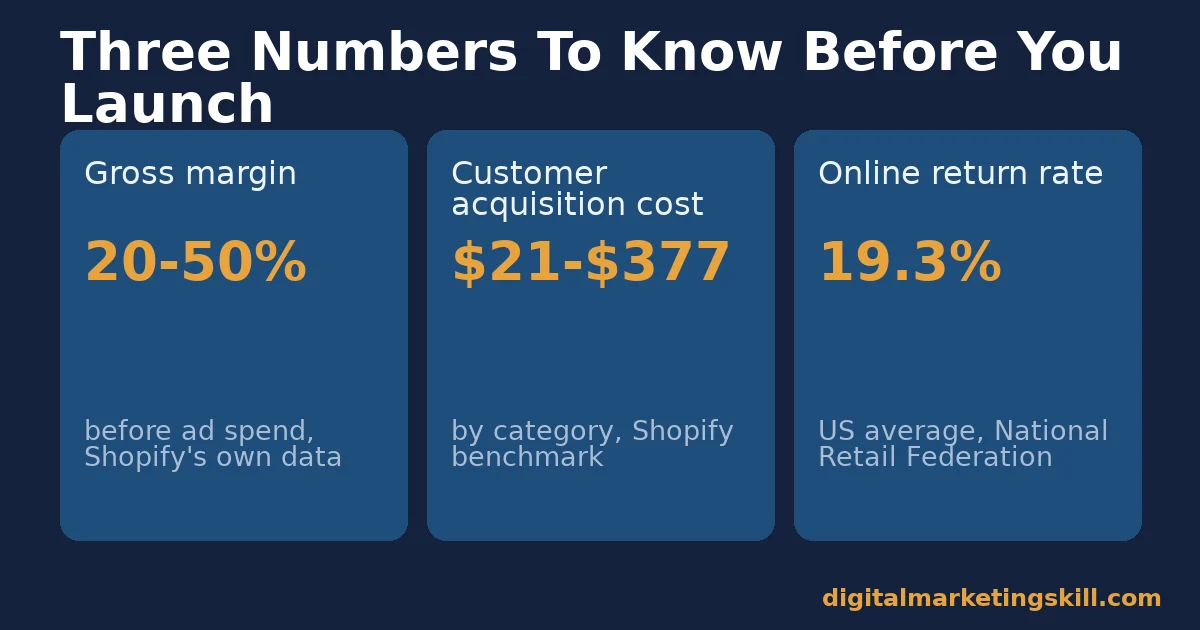
- Typical dropshipping margins run 20% to 50% before ad spend, per Shopify’s own data. After advertising and returns, net margins are usually much thinner.
- The US Federal Trade Commission has banned multiple e-commerce “business opportunity” sellers. They promised “$100K+ per month” results that, in the FTC’s words, “rarely, if ever, materialized.”
- Customer acquisition costs vary sharply by category. Shopify’s own benchmark puts this from about $21 in arts and entertainment to $377 in electronics.
- No course or supplier can guarantee income. A real dropshipping business depends on product choice, supplier reliability and paid traffic costs that change constantly.
In this guide
- The Real Gap: Easy to Start, Rarely Explained Honestly
- How a Dropshipping Business Actually Works
- What Differs Among Dropshipping Business Models
- How To Run Each Dropshipping Business Model
- How To Measure Whether a Dropshipping Business Is Working
- The One Decision Rule for a New Dropshipping Business
- Policy and Marketplace Rules That Affect a Dropshipping Business
- A Real Case: When “Guaranteed” Income Claims Become a Legal Case
- Frequently Asked Questions About Starting a Dropshipping Business
- Building a Real Dropshipping Business: Where To Go From Here
The Real Gap: Easy to Start, Rarely Explained Honestly
Most dropshipping business guides sell the easy part. They show you how to pick a product and open a store in an afternoon. Few explain margins, refunds or supplier risk in plain numbers.
Three ground rules keep this guide honest. First, market-size and margin figures are named by source. Different research firms disagree on exact numbers. Second, nobody can promise you income. This guide states what the evidence shows, not what you will personally earn. Third, “dropshipping” covers several different models. They do not all work the same way.
This guide treats a dropshipping business as a real business, not a shortcut. That means covering the mechanism first, then the real costs, then how to measure whether yours is actually working.
For the wider picture of running an online store beyond dropshipping, see this guide to what ecommerce actually involves.
How a Dropshipping Business Actually Works
The order flow has four steps. A customer buys from your online store. Your store forwards the order and payment to a supplier. The supplier ships the product directly to the customer, usually under your store’s branding on the packing slip. You keep the difference between what the customer paid and what the supplier charged.
That structure creates the model’s two core trade-offs:
- Low starting cost, thin margins. You never buy inventory upfront, which is why a dropshipping business is cheap to start. But you also pay a supplier’s price, not a wholesale price. That is why margins average 20% to 50% before advertising, per Shopify’s own figures.
- No inventory risk, no fulfillment control. You are not stuck with unsold stock. But you also cannot control packaging quality, shipping speed or stock accuracy, since the supplier handles all three.
Put together, a dropshipping business trades capital risk for margin and control. That trade only works if you price for it and choose suppliers carefully. If you plan to hold any stock instead of pure dropshipping, our guide to running an import and resell business covers the landed-cost math for wholesale and retail-arbitrage models.
Supplier vetting is where most of that control gets won back. Order a sample yourself before you list a product. Time the actual delivery, rather than trusting a supplier’s stated shipping window. Check how the supplier handles damaged or missing items, since you answer to the customer either way, not the supplier.
A dropshipping business is only as reliable as its weakest supplier. Treat vetting as part of the product decision, not a separate task to handle later.
What Differs Among Dropshipping Business Models
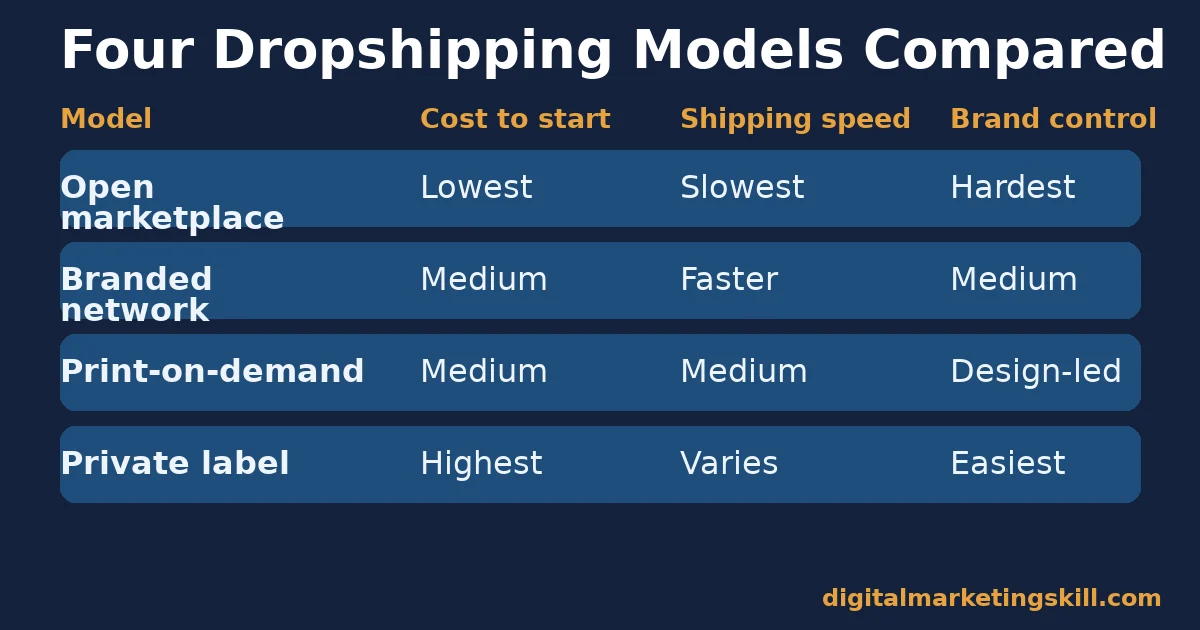
“Dropshipping” is not one model. The four common versions below differ in cost, speed and who actually trusts the brand.
Open-Marketplace Dropshipping: Built For Low Cost
This is the model most people picture. A store lists products sourced from large open marketplaces at low unit cost. Margins are thin, because the same products are often listed by many competing stores. It fits sellers testing many products quickly on a small budget.
Shipping time is the usual weak point here. Many open-marketplace suppliers ship from overseas, so delivery can take one to three weeks depending on the destination. Set that expectation clearly on your product page, since an unexpected delay is one of the most common reasons for a refund request.
Branded Supplier Networks: Built For Speed and Quality
Some platforms connect stores to vetted regional suppliers with faster shipping and tighter quality control, such as Shopify Collective. Margins run higher, 20% to 50% per Shopify’s own data, because the products are harder for competitors to copy exactly. It fits sellers who want fewer refunds and faster delivery, in exchange for a smaller supplier pool.
Print-on-Demand: Built For Custom Designs
Nothing is made until a customer orders it. A supplier prints your design onto a blank product, such as apparel or home goods, then ships it. It fits sellers with a real design or niche community, not a generic product, since the design is the entire differentiator. For a fashion-specific look at this choice, see our guide to starting an online boutique.
Private-Label Dropshipping: Built For Brand Building
A supplier manufactures a product to your specification, then ships it under your own brand and packaging. It takes longer to set up and usually needs a minimum order size. It fits sellers planning to build a lasting brand, not just test a product fast.
Because it ties up cash in a minimum order, this model carries the most financial risk of the four. Treat the first order as a test of the supplier’s quality and reliability, not just the product’s demand, since you cannot easily switch suppliers mid-run once goods are manufactured.
How To Run Each Dropshipping Business Model
Picking a model only matters once it changes how you operate. Here is the practical lead for each one, mirrored to the sections above.
Open-Marketplace: Lead With Fast Testing
Treat each product as a cheap experiment. Run a small ad budget. Check real conversion and refund data within two weeks, then kill or scale based on the numbers, not your opinion of the product. This guide to Google Ads for small business covers the search and shopping campaigns most stores test with first.
Branded Network: Lead With Delivery Speed in Your Marketing
Advertise the shipping speed and quality directly, since that is the trade-off customers are paying more for. Track refund rate closely. If it is not meaningfully lower than open-marketplace sourcing, the higher cost is not paying off.
Print-on-Demand: Lead With the Design, Not the Product
Market the design and the community behind it, not the blank product underneath. Price for a thinner margin than branded dropshipping, since print-on-demand suppliers typically charge more per unit for small runs.
Private Label: Lead With Proof Before You Order in Bulk
Validate demand with a smaller product line first, ideally sourced through another model, before you commit to a minimum order size. A private-label run that does not sell ties up real cash, unlike the other three models.
How To Measure Whether a Dropshipping Business Is Working
Track these five numbers before you judge any product or supplier.
- Gross margin: what the customer paid minus the supplier’s price, as a percentage. It tells you whether the product has room to absorb ad costs and refunds at all.
- Customer acquisition cost (CAC): total ad spend divided by the number of paying customers it produced. Shopify’s own benchmarks put this anywhere from about $21 to $377, depending on category. Compare your CAC to your own margin, not to a generic number.
- Refund and return rate: the share of orders refunded or returned. A high rate quietly erases a margin that looked healthy on paper. For scale, the National Retail Federation puts the US online return rate at 19.3%, well above the 15.8% rate across retail overall.
- Fulfillment time: days from order to delivery. Slow fulfillment drives both refund requests and bad reviews, especially on branded or marketplace stores competing with fast shipping.
- Net profit after ads: gross margin minus CAC minus refunds minus platform fees. This is the only number that tells you if the business is actually working.
Review these weekly for a new product, not monthly. A dropshipping business can burn through a test budget fast if a bad signal goes unnoticed for a month. If checkout drop-off is the issue rather than the product, this breakdown of the ecommerce sales funnel shows where sales are usually lost.
The One Decision Rule for a New Dropshipping Business
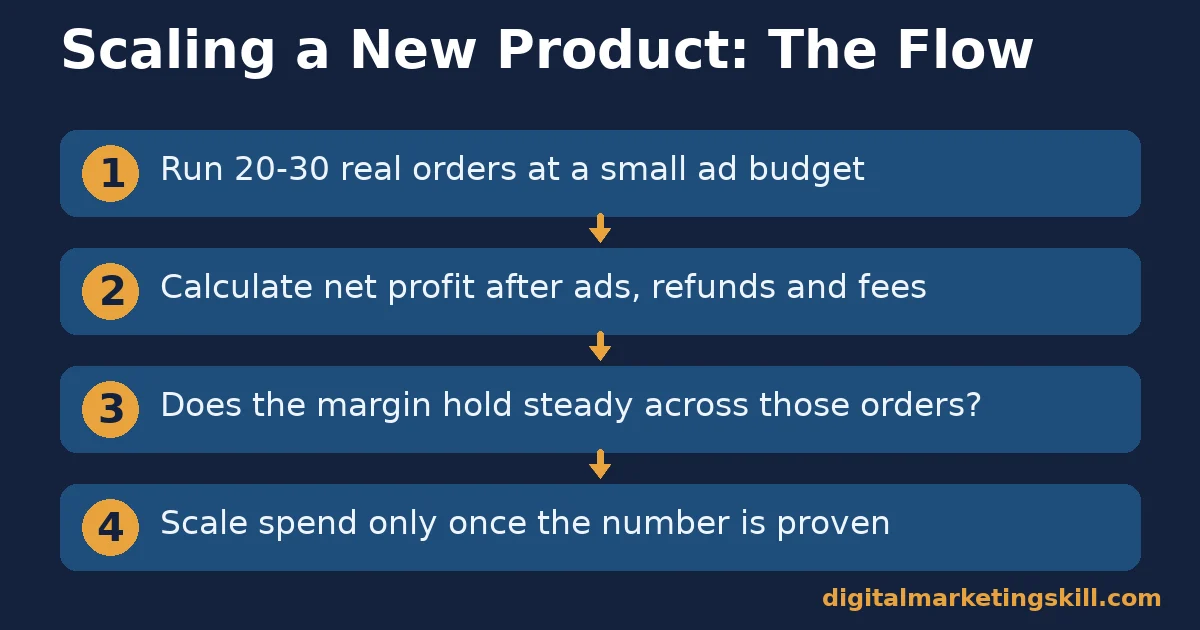
Decision rule: do not scale ad spend on any product until you know its net profit after ads, refunds and fees across at least 20 to 30 real orders. A good-looking margin on paper means nothing until real orders confirm it.
Illustrative, invented numbers: a store tests a product with a 40% gross margin and a $15 cost. After a $12 average CAC and a 9% refund rate, the real net margin drops to roughly 14%. Under this rule, the store would only increase ad spend once that 14% held steady across enough orders to trust the number.
The same rule protects against a different trap: stopping too early. A product can look weak after five orders, purely from small-sample noise. It can then turn profitable by order thirty, once the refund rate settles down.
Twenty to thirty orders is a floor, not a guarantee. Higher-priced products need more orders before the number is trustworthy, since a single refund swings the average further.
Policy and Marketplace Rules That Affect a Dropshipping Business
Two sets of rules sit outside your store and still shape whether a dropshipping business works: marketplace policy and customs duty.
Marketplace Policy: Dropshipping Is Allowed, Retail Arbitrage Is Not
Major marketplaces generally allow dropshipping from a wholesale supplier or manufacturer. But eBay’s own seller policy explicitly bans “retail arbitrage”: buying a listed item from another retailer and having that retailer ship it straight to your buyer. You must also appear as the seller on every packing slip and handle your own customer service, not the supplier.
Breaking these rules risks a removed listing or a suspended account. That erases a dropshipping business overnight, regardless of how good its margins were. Read your platform’s current seller policy directly before you list your first product.
Customs Duty: Low-Value Shipments Are No Longer Automatically Exempt
Cross-border dropshipping used to lean on an exemption that let low-value shipments enter the US without duties. That exemption has been suspended, per US Customs and Border Protection’s own announcement. Shipments once exempt under $800 are now subject to duties and formal customs entry, the same as larger shipments.
This is a US-specific rule, and equivalent thresholds differ by country. Check your own country’s customs rules rather than assuming an old exemption still applies. For a dropshipping business sourcing internationally, build duty cost into your margin calculation, not just supplier price and shipping.
A Real Case: When “Guaranteed” Income Claims Become a Legal Case
The US Federal Trade Commission permanently banned the operator of “Ecom Genie” from selling business opportunities. The agency alleged the company promised consumers “$100K+ per month” in sales and “million-dollar” stores selling through major marketplaces.
The FTC said those promises “rarely, if ever, materialized,” and most consumers lost tens of thousands of dollars. The settlement included a nearly $14 million judgment and asset surrender.
Limits on this evidence: this is one enforcement case, not proof that every paid dropshipping program is a scam. But it shows why specific, guaranteed income numbers attached to a dropshipping business are a warning sign, not a selling point.
See the Institute’s own earnings disclaimer for how to read any income claim, including this guide’s.
Frequently Asked Questions About Starting a Dropshipping Business
Is a dropshipping business still worth starting?
It can be, but treat it like any other business with real costs and risks, not a shortcut. The margin and acquisition-cost numbers above should hold up for your specific product before you commit real ad budget.
How much money do you need to start a dropshipping business?
Dropshipping needs far less upfront capital than holding inventory, since you are not buying stock in advance. You still need a testing budget for ads, a store platform fee and time to find a reliable supplier.
Is dropshipping the same as being an Amazon or eBay seller?
Not exactly. Some dropshipping businesses sell through marketplaces like Amazon or eBay, but many run their own branded store instead. The order-forwarding mechanism described above is the same either way, though marketplace-specific policies, like eBay’s ban on retail arbitrage, still apply if you sell there.
What causes most dropshipping businesses to fail?
Thin, uncontrolled margins are the most common cause. A store spends more acquiring a customer than the product actually earns after refunds and fees. Poor supplier reliability and copied, oversaturated products are the next most common causes.
Can you build a real brand with dropshipping?
Yes, most reliably through the branded-network or private-label models described above, where product quality and consistency are controllable. Open-marketplace dropshipping is harder to brand, since many stores sell the identical product.
This guide on how to start and grow an ecommerce business covers brand-building steps that apply once you move past a single dropshipped product.
Do you need a business license for a dropshipping business?
Requirements vary by country and region, so check your local rules before you start selling. This guide covers the dropshipping mechanism itself, not legal or tax setup, which a local professional should confirm for your situation.
Does dropshipping avoid customs duties on cheap products?
Not reliably anymore, at least into the US. The exemption that once let many low-value shipments skip duties has been suspended. Build duty cost into your pricing, rather than assuming small orders stay duty-free.
Can you get banned from a marketplace for dropshipping?
Yes, if you break the platform’s specific rules, such as retail arbitrage on eBay, rather than sourcing from an approved wholesale supplier or manufacturer. Read your marketplace’s current seller policy before listing, since the rules differ by platform and change over time.
Building a Real Dropshipping Business: Where To Go From Here
Running a profitable dropshipping business depends on the same core skills as any other online store: paid traffic, conversion, analytics and honest measurement. Trial and error is the slow way to learn all four at once.
Digital Marketing Skill Institute’s Master Diploma in Digital & AI Marketing includes AI-Powered Lead Generation, AI-Powered Google Advertising and AI-Powered Google Analytics courses that apply directly to running any online store, dropshipping or otherwise.
It comes with unlimited 1-on-1 coaching and mentoring, plus real project work inside a U.S. partner company. The program is dual US and UK accredited, recognised in more than 100 countries, and runs 100% online, so you can study anywhere in your country on your own schedule.
Learn more on the Master Diploma in Digital & AI Marketing page. Browse more guides like this one on the digital marketing blog, or read student outcomes on the reviews page.
When you are ready, apply here — wherever you live, the coaching and project work are built to run the same way online. Learn more at Digital Marketing Skill Institute, or start your application at digitalmarketingskill.com.
Every figure in this guide was checked against its original source before publication. Figures marked as illustrative are invented examples, not real results.