
Benefits of social media marketing go well beyond likes and followers. Done well, it builds reach, strengthens customer relationships, drives measurable sales and surfaces insight no survey can match. More than two thirds of the world’s population now uses these platforms, often at a lower cost than traditional channels.
Key Takeaways
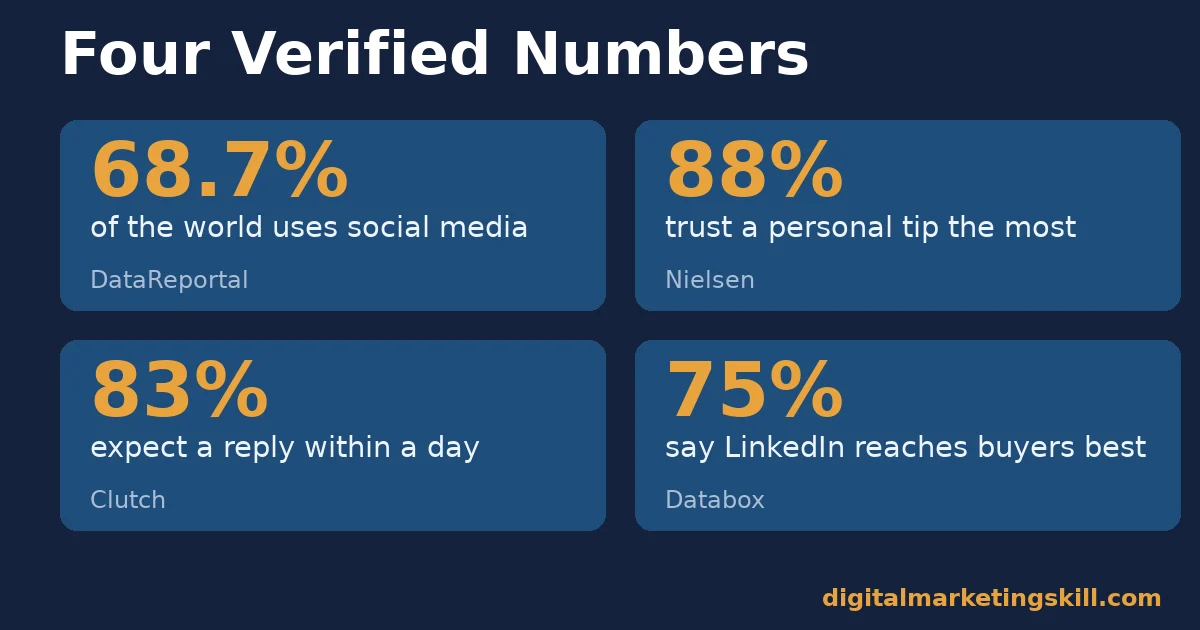
- Reach is close to universal. DataReportal counted 5.66 billion active social media identities worldwide, 68.7% of the global population.
- Trust still travels person to person. Nielsen’s global survey found 88% trust recommendations from people they know more than any other channel.
- Response speed shapes loyalty. Clutch’s survey of US social media users found 83% expect a brand reply within a day. 45% think more positively of a brand that replies to a negative comment.
- Channel choice depends on audience. Databox found more than half of B2B marketers primarily use LinkedIn versus about 20% for Facebook, and nearly 75% say LinkedIn reaches decision-makers better.
- Real revenue is possible, but rarely from one channel alone. In a published agency case study, paid social accounted for about a quarter of a 785% revenue jump; the rest came from the organic and referral traffic it also lifted.
In this guide
- What Most “Benefits” Lists Skip
- Benefits of Social Media Marketing Fall Into Four Groups
- How to Capture Each Benefit
- How to Measure the Benefits of Social Media Marketing
- The Most Useful Rule: Measure the Benefit You Are Actually Chasing
- A Four-Week Plan to Capture the Benefits of Social Media Marketing
- A Real Case: A 785% Revenue Jump, With the Honest Breakdown
- Frequently Asked Questions About the Benefits of Social Media Marketing
- Start With the One Benefit You Need Most
What Most “Benefits” Lists Skip
Most lists of social media marketing benefits repeat the same four words: awareness, engagement, traffic, sales. None of that is wrong, but it treats every business the same. A solo consultant and a 200-person company rarely need the same channel for the same reason.
A generic list also skips the honest limits behind each benefit. Reach figures are vanity unless they reach the right audience. Revenue figures from one case rarely transfer cleanly to a different product or budget. This guide keeps both the number and the limit attached to it, so you can judge each figure on its own terms rather than borrowing someone else’s result as a promise.
This guide groups the real benefits of social media marketing into four kinds. It names a verified figure for each one, and shows the one habit that captures it.
The figures below come from DataReportal, Nielsen, Clutch and Databox, each named by its own survey method. A single published case closes the guide, with its limits stated plainly.
Benefits of Social Media Marketing Fall Into Four Groups
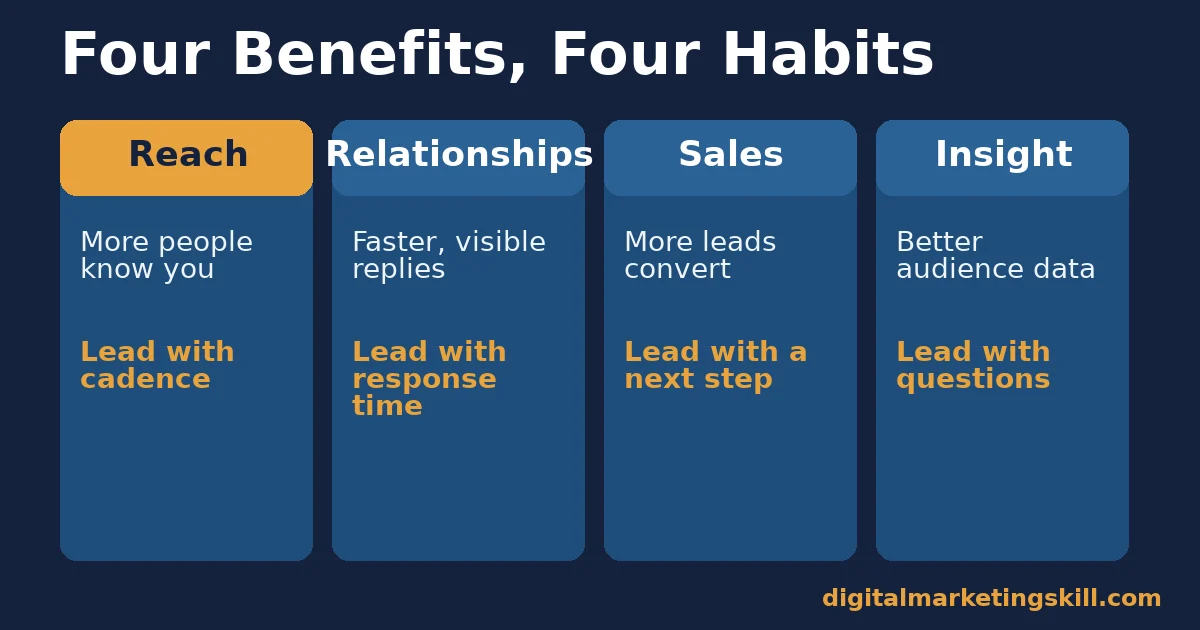
Nearly every real benefit of social media marketing lands in one of four buckets. More people knowing you exist, stronger relationships with the people who already do, more of those relationships turning into sales, and better information about what your audience actually wants.
Most businesses chase all four at once with one undifferentiated content calendar. Naming which benefit a post is actually meant to deliver, before writing it, makes each of the four far easier to measure. A post aimed at reach should be judged on reach, not blamed for failing to also close a sale the same week.
Reach and Brand Awareness
Social platforms put a business in front of people who have never heard of it, at a scale traditional advertising rarely matches for the price. DataReportal’s Digital Global Overview report counted 5.66 billion active social media user identities. That is 68.7% of the world’s population.
That reach is not evenly split. Pew Research Center found 84% of US adults use YouTube and 71% use Facebook. Niche platforms reach far smaller but more specific slices of an audience instead.
Reach only becomes one of the real benefits of social media marketing when it lands on the right slice of people, not the largest slice available.
Customer Relationships and Service
Social media turned customer service into a public, real-time channel. A Clutch survey of US social media users found 83% expect a brand to respond to a comment within a day or less. 45% said they think more positively of a brand that replies to a negative comment rather than ignoring it.
That expectation cuts both ways. A business that answers quickly builds visible goodwill. One that goes quiet in public does the opposite, in front of the same audience that was watching.
This relationship benefit also echoes a wider pattern. Nielsen’s global trust survey of more than 40,000 consumers found 88% trust recommendations from people they know more than any other channel, including ads. A business that behaves well in public, visible replies included, feeds exactly that kind of trusted word of mouth.
That word of mouth compounds quietly. A customer who screenshots a helpful public reply and sends it to a friend is doing free advertising. No paid campaign can quite replicate it, because it carries the trust of a personal recommendation rather than a sponsored post.
Lead Generation and Sales
Social platforms shorten the distance between discovering a product and buying it. Shoppable posts, direct messages and links let a buyer skip a search entirely. The published Seltzer Goods case study, run by the agency Inflow, reported a 785% revenue increase over a 30-day paid Facebook and Instagram campaign, alongside a 9.68x return on ad spend.
The same write-up is honest about where that growth came from. Paid social accounted for roughly a quarter of the increase. The rest came from organic, direct and referral traffic that the campaign also lifted.
Sales rarely come from one channel in isolation, which is one of the real benefits of social media marketing that a single attribution number tends to hide.
Customer Insight and Research
Comments, shares and direct replies hand a business live feedback no formal survey offers. A sudden spike of comments on one product is market research that arrives unprompted. So is the same question asked by several different customers in the same week.
Databox’s analysis found more than half of B2B marketers primarily use LinkedIn for B2B marketing, versus about 20% for Facebook. Nearly 75% said LinkedIn reaches decision-makers better than Facebook does.
That is a channel preference revealed by where B2B marketers actually put their effort, not a stated opinion alone. It is one of the more durable benefits of social media marketing data: watching real behaviour rather than asking people what they say they prefer.
The same logic applies on a smaller scale inside a single account. Which posts get saved rather than just liked, which product photo draws the most questions, which caption gets the most replies: all of it is free insight your competitors have to pay a research firm for.
How to Capture Each Benefit
Knowing the benefit exists is not the same as capturing it. Each one below needs a different first habit, not a bigger budget. Our guide on growing an Instagram following covers the reach habit in more detail, if that is the benefit your business needs first.
Reach Benefits of Social Media Marketing: Lead With Consistency
Chasing a single viral post is a poor strategy, because virality is mostly unpredictable. A steady publishing rhythm on the one or two platforms your audience actually uses builds reach far more reliably than waiting for a lucky post. Most of the accounts that look like overnight successes were posting consistently, without much reach, for months before anything broke through.
Match the platform to the audience first. HubSpot’s State of Marketing survey of more than 1,500 global marketers found Instagram and Facebook tied as the top-ROI platforms for B2C marketers, at 47.4% each. Short-form video was the top-performing format overall, at 48.6%, so format matters as much as platform.
Relationships: Lead With Response Time
Set a target reply window and staff it, even if the target is one business day rather than one hour. Clutch’s 83% figure is a floor, not a stretch goal, for how fast most people expect an answer.
Reply to criticism in public before moving the detail to a private message. A visible, calm reply does more for trust than a fast delete. Clutch found nearly half of consumers view a brand more positively just for replying to a negative comment at all.
Sales: Lead With a Clear Next Step
Every post that could lead to a sale needs one obvious next step: a link, a shoppable tag or a clear call to message. Posts that only inform, with no path forward, waste the moment a reader is actually paying attention.
Track sales by channel honestly, the way the Seltzer Goods case study did. Crediting paid social alone for a revenue jump it only partly caused leads to the wrong budget decision next quarter. This is where the real benefits of social media marketing get confused with ad performance alone.
Insight: Lead With Questions, Not Assumptions
Ask your audience a direct question in a post or story at least once a month, rather than only broadcasting. Direct answers are faster and cheaper than a formal survey. The sample is smaller and less rigorous, but it costs nothing to run.
Read comments for patterns, not single complaints. One comment is an anecdote; the same objection from several different customers in a week is a signal worth acting on. Keep a simple running note of repeated themes so the pattern is visible, rather than relying on memory alone.
How to Measure the Benefits of Social Media Marketing
Each benefit above has its own honest metric. Track the one that matches the benefit you are actually chasing, rather than one combined vanity number.
Five Metrics That Show These Benefits Are Real
- Reach. Unique accounts that saw a post, tracked over weeks, not single-post spikes. Rising reach on a steady cadence is a durable signal; a one-off spike is not.
- Response time. The average time between a customer comment or message and your first reply. Compare it against the one-day expectation most people hold.
- Click-through rate on sales posts. The share of viewers who follow a post’s link or tag through to a product. This isolates whether the “next step” is actually working.
- Revenue by channel, attributed honestly. Sales traced to social, separated from the organic and referral traffic a campaign also lifts, as the Seltzer Goods case study did.
- Repeated feedback themes. The number of times the same question or complaint appears across comments in a month. Rising repeats point to a real, fixable pattern.
How to Read These Together
Read reach and response time first, since they are the cheapest and fastest to move. Revenue and feedback themes usually take longer to shift. Check those two monthly rather than weekly.
Do not expect every metric to move at once. A business fixing response time this month may not see a revenue change until the relationship habit has had time to compound into real trust. Give each habit at least one full cycle of the four-week plan below before deciding it is not working.
The Most Useful Rule: Measure the Benefit You Are Actually Chasing
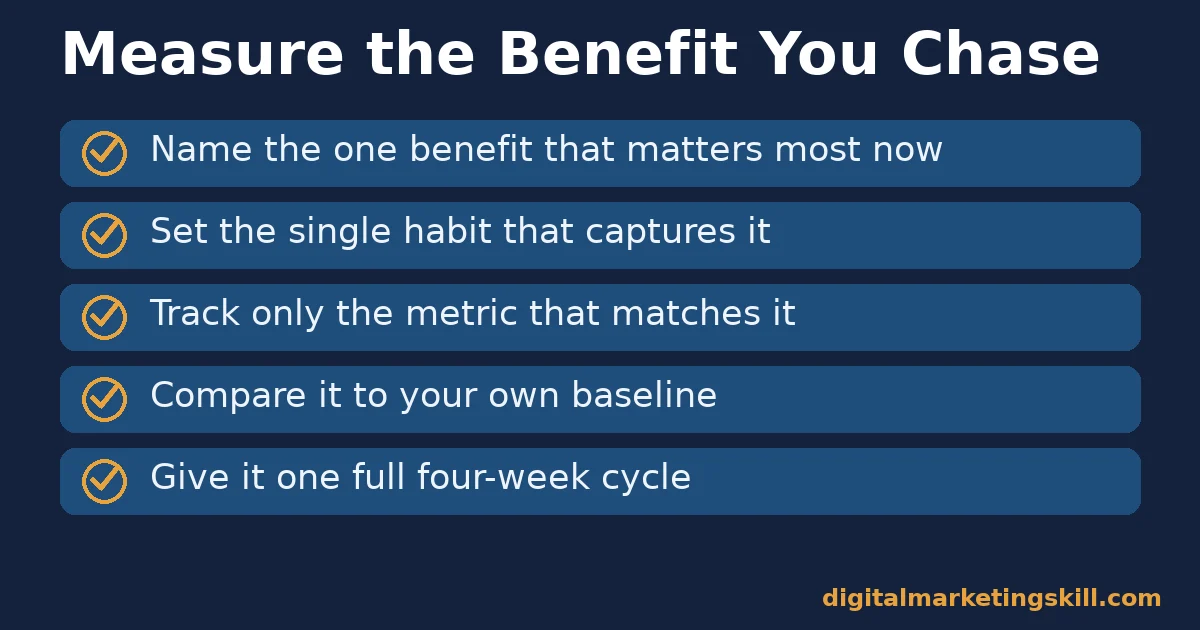
If you remember one decision rule from this guide, make it this one. Pick the single benefit your business needs most right now, and measure only that one for a month. Resist judging the channel by a benefit you were never actually pursuing.
Here is an illustrative example, with invented numbers. A small furniture maker wants more repeat buyers, not more followers. If the business judges social media only by follower growth, a quiet month of flat followers would look like failure.
But if repeat orders are rising at the same time, the actual goal, relationships, is working exactly as planned. The follower count was simply the wrong benefit to track.
The lesson is to measure on purpose. Choosing the wrong metric for the benefit you actually need is the most common reason social media marketing gets written off as “not working,” when the channel was simply never asked to deliver that particular result.
A Four-Week Plan to Capture the Benefits of Social Media Marketing
This plan focuses on one benefit at a time, since trying to fix reach, service, sales and insight together usually fixes none of them. It works whether the business is brand new to social media or has been posting inconsistently for years.
- Week one: pick the one benefit that matters most. Name it out loud: more reach, better service, more sales or better insight.
- Week two: set the matching habit. A posting cadence for reach, a reply-time target for service, a clear next step for sales, or a monthly question for insight.
- Week three: track the matching metric. Use the relevant metric from the list above, checked against your own baseline from before week one.
- Week four: decide and repeat. Keep the habit if the metric moved, adjust it if it did not, then pick the next benefit to focus on.
Running this cycle once a month, one benefit at a time, builds a social media programme that earns its keep instead of one that is busy for its own sake. Most businesses see their first clear result inside two cycles, once the habit itself becomes routine rather than a new task.
A Real Case: A 785% Revenue Jump, With the Honest Breakdown
The home goods and puzzle brand Seltzer Goods ran a paid campaign on Facebook and Instagram with the agency Inflow over 30 days. The published case study reported a 785% increase in monthly revenue. It also reported a 9.68x return on ad spend and a cost per customer acquisition of $4.87.
According to Inflow’s published case study, paid social accounted for roughly a quarter of the total revenue increase. The rest came from a lift in organic, direct and referral traffic that the paid campaign also helped drive.
This is a single agency-published case, not an independent audit. Results for a different product, price point or audience will differ, sometimes by a wide margin.
The honesty in the breakdown is the real lesson here. A business that credited the whole 785% to paid ads alone would overspend on the wrong channel next time. The case study’s own numbers point the other way, toward the full mix of benefits of social media marketing working together.
Frequently Asked Questions About the Benefits of Social Media Marketing
What are the main benefits of social media marketing?
The main benefits fall into four groups: reach and brand awareness, stronger customer relationships and service, lead generation and sales, and customer insight gathered directly from comments and messages. Most businesses get the most value from focusing on one group at a time rather than all four at once.
Does social media marketing actually increase sales?
It can, but rarely alone. The published Seltzer Goods case study found paid social drove about a quarter of a 785% revenue increase, with the rest coming from organic and referral traffic the campaign also lifted. Treat any single number like that as a best case worth learning from, not a guarantee.
Is social media marketing cheaper than traditional advertising?
It is often lower-cost to start, since organic posting has no media spend, and paid options let a business set its own budget. Actual cost per result still depends heavily on platform, audience and competition.
How fast should a business respond to comments on social media?
Clutch’s survey found 83% of consumers expect a reply within a day or less. Treat that as a floor: a faster, consistent reply window builds more goodwill than an occasional fast reply.
Which social media platform gives the best return for a small business?
It depends on the audience. Databox found B2B marketers lean toward LinkedIn, while HubSpot’s survey found Instagram and Facebook tying for the strongest reported ROI among B2C marketers. Match the platform to where your buyers already are, since that single decision shapes most of the other benefits of social media marketing you will see.
Can social media marketing replace market research?
Not fully, but it adds a fast, free layer to it. Repeated questions or complaints in comments are a real signal, though a smaller and less structured one than a formal survey. Use it to spot patterns worth investigating further, not as a replacement for structured research on a major decision.
Do small businesses get the same benefits of social media marketing as large brands?
Yes, often more directly. A small business can reply personally and build visible relationships that a large brand’s support queue rarely allows, which is exactly the relationship benefit this guide describes.
How long does it take to see benefits from social media marketing?
Reach and response time can shift within weeks. Revenue and insight benefits usually take longer, since they depend on a relationship habit compounding over months, not days.
Start With the One Benefit You Need Most
The benefits of social media marketing do not all show up at once. Name the single benefit your business needs most, set the one habit that captures it, and measure only that for a month.
For the platform-by-platform detail, see our guide to the best social media platforms for business. For a full strategy, our guide on building a social media marketing strategy walks through the next steps, and our guide on growing a Facebook page for free covers the reach side in more depth.
If you want guided practice turning these benefits into results, Digital Marketing Skill Institute teaches it hands-on inside the Master Diploma in Digital & AI Marketing. The programme is built around four AI-powered tracks totalling ten courses, including AI-Powered Social Media Management and Advertising and AI-Powered Lead Generation and Email Automation, with a Full Stack option for learners who want all four tracks.
It comes with unlimited 1-on-1 coaching and mentoring and a U.S. Project Internship with a verified U.S. Work Reference Letter. The diploma is dual US and UK accredited and recognised in more than 100 countries, fully online, so you can study from anywhere in your country.
Browse more guides on the Digital Marketing Skill Institute blog, and when you are ready, apply for the Master Diploma or start from the Digital Marketing Skill Institute homepage.
Every figure in this guide was checked against its original source before publication. Figures marked as illustrative are invented examples, not real results.
![9 Amazing Digital Marketing Skills to Make Money Online [With Proof]](https://digitalmarketingskill.com/wp-content/uploads/2019/07/9-Amazing-Digital-Marketing-Skills-to-Make-Money-Online-With-Proof-17.png)






