
Most teams try to avoid digital marketing mistakes for a week, then slide back. They fall into five habits: generic content, one-channel distribution, silent social accounts, ignored analytics and a single imaginary customer. Each habit is fixable in days, once you can see it, measure it and know which one to fix first.
Key Takeaways
- Strategy rarely gets finished. Only 29% of B2B marketers rate their content strategy as extremely or very effective, according to the Content Marketing Institute’s benchmark research.
- Effort and results do not match. Orbit Media’s survey of 1,042 content marketers found the average post now takes about 3 hours 20 minutes to write. Yet only 13.9% of marketers report strong results, an all-time low in the 13-year survey.
- Google Analytics dominates measurement, but many never open it. W3Techs finds Google Analytics is used on 82.8% of sites whose analytics tool is known. Many teams install it, then stop checking it within weeks.
- Segmentation pays. Bain’s research found companies with strong customer segmentation earned about 10% higher profit over five years than weak-segmentation peers. Most executives still rate their own segmentation poorly.
- Consistency beats cleverness on social. HubSpot’s social media survey found more than half of marketers now name producing consistent, good content their top challenge. That is a sharp rise from the year before.
In this guide
- How to Avoid Digital Marketing Mistakes From Day One
- Why Teams Struggle to Avoid Digital Marketing Mistakes
- Five Digital Marketing Mistakes That Repeat
- How to Fix Each Mistake and Avoid Digital Marketing Mistakes Next Time
- Measure to Avoid Digital Marketing Mistakes Repeating
- The One Decision Rule: Fix Measurement First
- A Real Case: One Fixed Channel, Recurring Income
- Frequently Asked Questions About How to Avoid Digital Marketing Mistakes
- Start Today to Avoid Digital Marketing Mistakes for Good
How to Avoid Digital Marketing Mistakes From Day One
Most lists of digital marketing mistakes read like a scolding. Post more. Try harder. Care more about your customers. None of that advice is wrong. But it skips the one thing that actually changes behaviour: knowing which mistake costs you the most right now.
This guide names five mistakes. They show up across content, distribution, social media, analytics and audience understanding. It explains why smart teams repeat them anyway. Then it gives one fix per mistake, plus a way to check whether the fix worked.
Each section follows the same shape, so you can skim to the mistake that matters most to you right now. First comes the mistake itself, named plainly. Then comes the one fix that addresses it, without extra steps. Finally comes the single number that tells you whether the fix actually worked, rather than just felt productive.
A few ground rules first. Each figure below comes from one named study, with its own sample and limits. Content Marketing Institute surveyed B2B marketers, mostly in North America. Orbit Media’s numbers are self-reported by bloggers. Bain drew on client work and a separate executive survey. W3Techs scans live websites automatically.
Treat each number as a snapshot from that group, not a universal law. Treat the fixes as an informed method to avoid digital marketing mistakes, not a guarantee. The goal is a shorter list of better habits, not a longer list of rules to memorise.
Why Teams Struggle to Avoid Digital Marketing Mistakes
These five mistakes are not random. They share one root cause. Teams skip the step that would tell them the mistake is happening, so nobody ever corrects it.
The No-Strategy, No-Measurement Loop
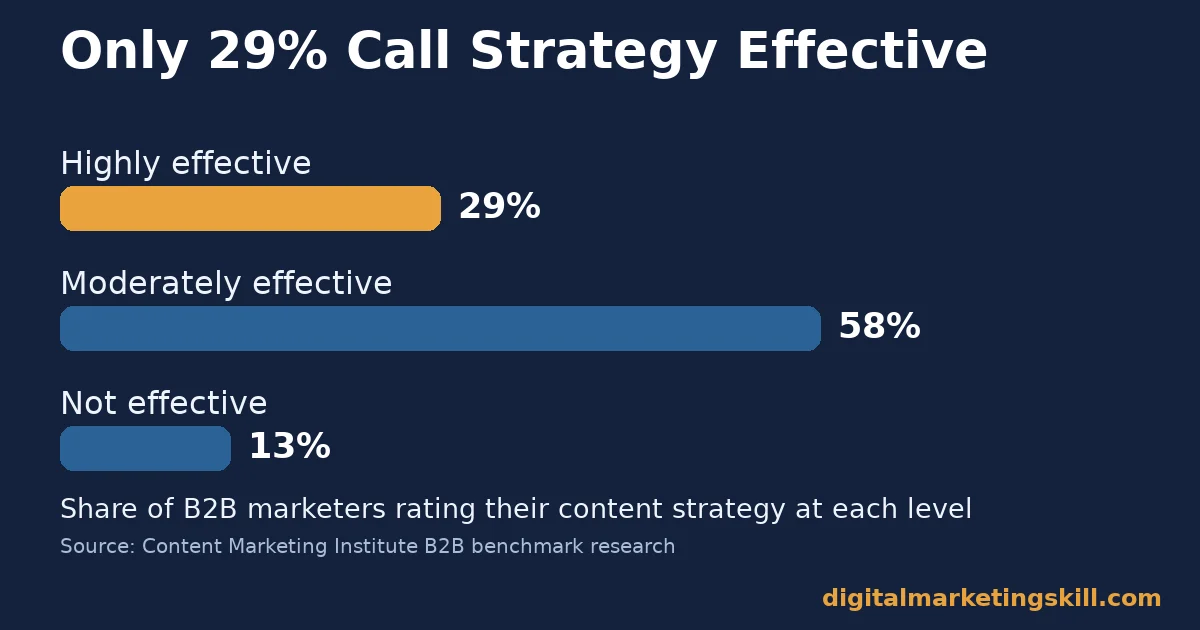
A team without a written strategy cannot tell generic content from targeted content. So it keeps publishing whatever is easiest. The Content Marketing Institute found that only 29% of B2B marketers rate their content strategy as extremely or very effective. Another 58% call it only moderately effective, and 13% call it ineffective outright. Most teams are guessing at a strategy they never wrote down.
Without a strategy, there is nothing specific to measure. So analytics gets installed, then ignored. Without measurement, nobody can prove that a persona, a channel or a content type is underperforming. The same weak version keeps running.
Break the loop at either end, strategy or measurement, and the other mistakes become easy to see. Most teams only need to break it once, because a working weekly habit tends to keep running on its own after the first month. That is the fastest route to avoid digital marketing mistakes without hiring anyone new or buying another tool.
Five Digital Marketing Mistakes That Repeat
Here are the five mistakes that show up most often: in content, distribution, social media, analytics and audience understanding. Check your last three pieces of work against each one. Patterns appear fast.
None of the five mistakes needs a bigger budget to fix. Each one is a habit, not a resourcing problem, which is why a small team can avoid digital marketing mistakes just as well as a large one once it sees the pattern clearly.
Content: Built Around the Brand, Not the Reader
The first mistake is writing about what the business wants to say, not what the reader needs. Google’s guidance on helpful, people-first content asks creators one key question: will a reader “leave feeling they’ve learned enough” about their topic? Brand-first content usually fails that test. The brand’s priorities and the reader’s question rarely match.
Orbit Media’s survey of 1,042 content marketers found the average post now takes about 3 hours 20 minutes to write. Yet only 13.9% of respondents reported strong results, the lowest figure in the survey’s 13-year run. Effort is not the problem here. Direction is.
Distribution: One Post, One Channel, Done
The second mistake is publishing once, then moving on, as if visibility is automatic. It is not. Ahrefs studied roughly 14 billion pages in its search traffic study and found that 96.55% get no traffic from Google at all. A post with no plan for search, social and email distribution is competing for attention it has not earned.
HubSpot’s own analysis of its historical content found something useful here. Updating and re-promoting older posts lifted their average organic search views by 106%. Posts published some time ago still generate 38% of its total blog traffic today. Distribution is not a one-time task tied to publishing. It is an ongoing job that keeps paying off for months.
Social Media: Broadcasting Instead of Replying
The third mistake is treating social accounts like a megaphone, not a conversation. Too many brands post on a fixed schedule but never reply to comments or questions. That silence teaches an audience to stop engaging back.
HubSpot’s social media survey found that more than half of marketers now name producing consistent, good content their single biggest challenge. That is a sharp rise from roughly one in six marketers the year before. Consistency without conversation still reads as broadcasting. Audiences notice the difference quickly.
Analytics: Installed, Then Ignored
The fourth mistake is installing an analytics tool once, during setup, then never opening it again. W3Techs reports that Google Analytics is used on 82.8% of websites whose analytics tool is known. Most teams already have the data sitting there. Few check it on any regular schedule.
Our guide to choosing the right web analytics stack and our walkthrough of reading Google Analytics reports with intent cover the setup side well. This guide focuses on the habit side instead. A tool nobody opens cannot catch a mistake before it costs another month of budget.
Audience: One Persona for Everyone
The fifth mistake is marketing to a single, vague idea of “the customer” instead of the real people who buy. Bain & Company’s client work found that strong customer segmentation can lift sales performance by double digits in percentage terms.
A separate executive survey found 81% call segmentation critical to profit growth. Fewer than 25% believe their own company executes it well. That gap between belief and execution is itself one of the clearest digital marketing mistakes to avoid, because the fix is well known but rarely scheduled on anyone’s calendar.
Our beginner’s guide to building buyer personas walks through that process step by step. The mistake addressed here is simpler: skipping the process entirely and marketing to one imaginary person instead.
How to Fix Each Mistake and Avoid Digital Marketing Mistakes Next Time
Each fix below mirrors the mistake above, in the same order. Work straight down the list, or start with whichever mistake your own numbers point to first. None of these fixes requires new software or a bigger team, only a different weekly habit.
Content: Lead With the Reader’s Question
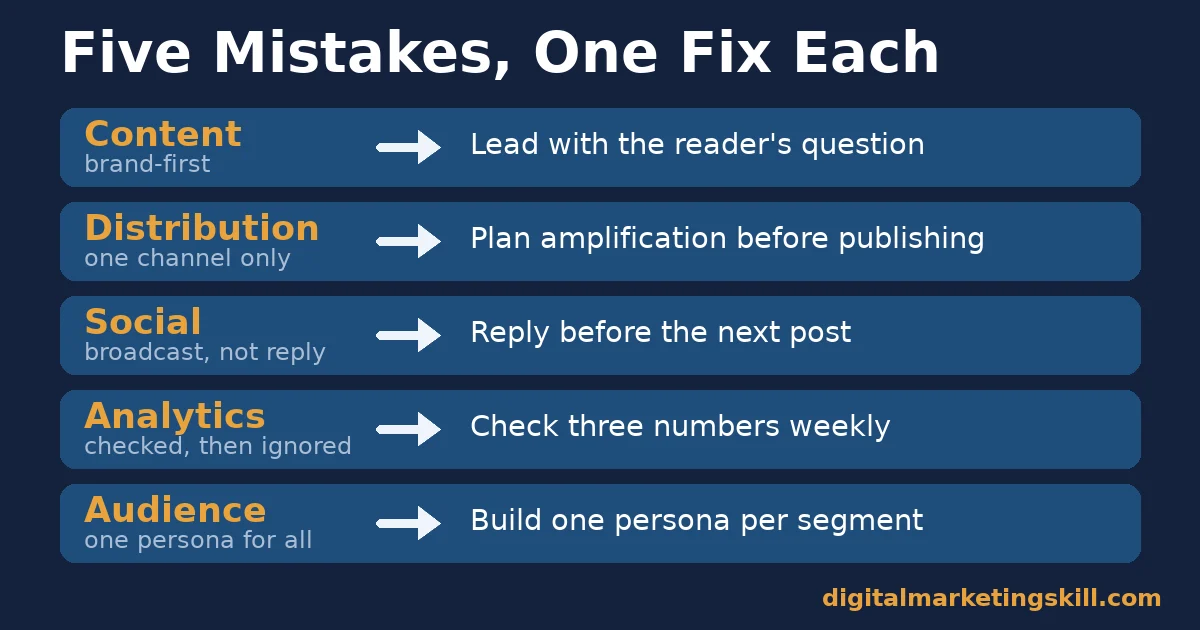
Before writing, name the one question the piece answers. Name the one action the reader should take next. Put the direct answer in the first two or three sentences. Use the rest of the piece to support it with steps, data or examples. This single change fixes most of the brand-first problem, with no extra production time.
Keep a short list of the questions your audience actually asks, pulled from search terms, support tickets or sales calls. Writing straight from that list is one of the fastest ways to avoid digital marketing mistakes in content, because every piece starts from a real question instead of a guess.
Distribution: Plan the Amplification First
Write the distribution plan at the same time as the content, not after it is finished. Decide which search terms the piece targets. Decide which existing posts it should link to and from. Check whether an older post on the same topic should absorb it instead. Our guide to fixing content marketing’s weakest links covers this diagnose-first approach in more depth, from topic choice through to promotion.
Put a date on your calendar, 90 days out, to revisit each post’s distribution plan. Re-share it, update a stale statistic, and add one new internal link. That single habit does more to avoid digital marketing mistakes in distribution than publishing another post from scratch.
Social Media: Reply Before You Broadcast Again
Set a daily window, even ten minutes, to reply to every comment and message. Do this before you schedule the next post. Treat unanswered comments as a queue, not background noise.
A smaller account that replies consistently usually earns more trust than a larger one that only broadcasts. Assign the reply window to one named person, even in a small team, so the habit does not quietly disappear in a busy week.
Analytics: Pick Three Numbers and Check Them Weekly
Do not try to watch every metric at once. Pick three that match your current goal, such as organic sessions, engagement rate and conversion rate. Check them on the same day every week.
A short, repeatable habit catches a falling number while there is still time to act. The measurement section below defines each one in full. Write the three numbers somewhere visible, such as a shared spreadsheet, so the whole team can see the trend, not just whoever runs the check.
Audience: Build One Persona Per Segment
List the two or three genuinely different groups who buy from you. Give each one a short, specific persona: their goal, their objection, and the offer that answers both. Match each campaign to one persona at a time, instead of writing copy meant to suit everyone at once.
Measure to Avoid Digital Marketing Mistakes Repeating
Each fix above needs its own number. Without one, you cannot tell a real improvement from a lucky week. The five metrics below are defined in one sentence each, with a note on how to read them. They sit alongside the traffic and conversion numbers you likely already track, so none of this requires new tools.
Five Metrics That Catch These Mistakes Early
- Engagement rate. Google Analytics counts a session as engaged when it lasts over 10 seconds, includes a key event, or has two or more page views. A falling engagement rate usually means the content mistake is back.
- Organic sessions on updated posts. Track this for four weeks after you republish or re-promote an older post. A lift suggests the distribution fix is working, in line with the pattern HubSpot reported for its own blog.
- Reply rate on social posts. This is the share of comments and messages answered within 24 hours. Track it alongside follower growth, so a broadcasting habit cannot hide behind a rising follower count.
- Weekly check completion. This is a simple yes or no: did you open your three chosen numbers this week? It sounds trivial. It is still the best predictor of whether the analytics fix survives past its first month.
- Conversion rate by persona. Where your tools allow it, compare conversion rate across your two or three personas, rather than as one blended average. A wide gap shows which persona needs its own message.
The One Decision Rule: Fix Measurement First
If you take only one decision rule from this guide, make it this one. Fix the measurement habit before you fix the content itself. Without a number you check weekly, you cannot tell whether a content, distribution, social or audience fix actually worked. You risk repeating the same mistake with more effort than before.
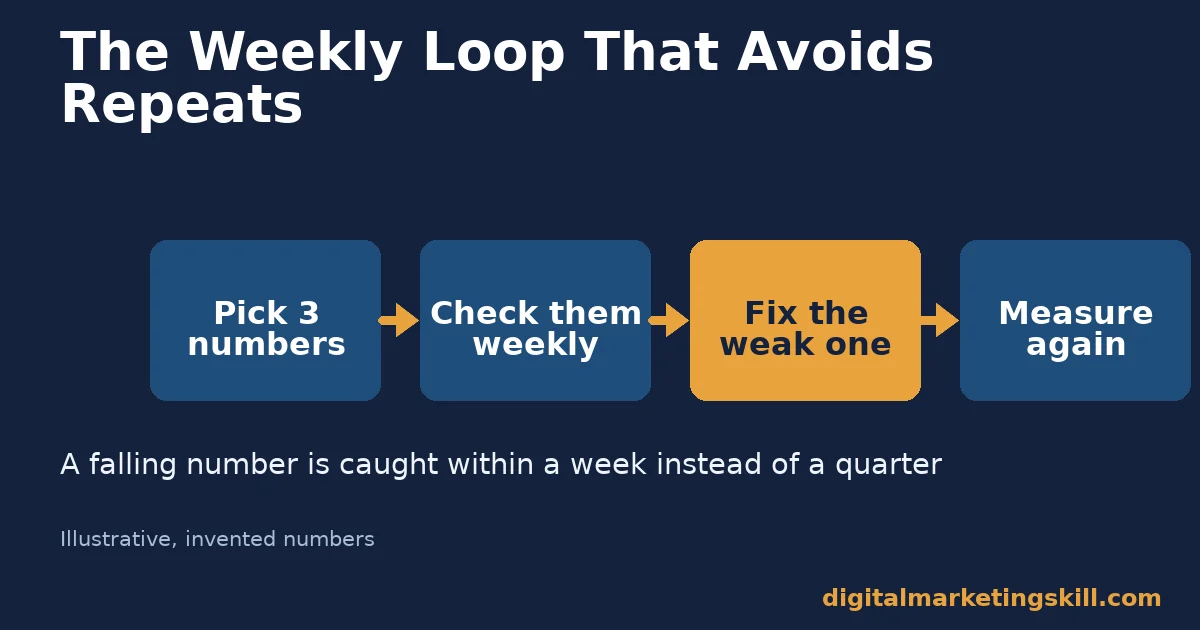
Here is an illustrative example, with invented numbers. A small services business publishes two posts a month. It has never opened its analytics dashboard, so it has no evidence to avoid digital marketing mistakes on its own site. It starts checking three numbers every Monday: organic sessions, engagement rate and leads from the contact form.
In week two, it notices one post drives most of the organic sessions but has a weak call to action. It rewrites that one page’s ending. Leads from that page roughly double over the following month, without a single new post being written.
The lesson is about order, not effort. Measurement found the highest-leverage fix within days. Guessing at new content would have taken weeks to reach the same page by chance. Any team that wants to avoid digital marketing mistakes on a tight budget should start with this same order: measure first, then fix the one thing the numbers point to.
A Real Case: One Fixed Channel, Recurring Income
A real student case from Digital Marketing Skill Institute’s published reviews shows how fixing one channel can compound. Olajire Jacob started with a single, specific offer: setting up email marketing flows for clients, beginning around $500 per project. That one offer scaled into roughly $5,000 a month in recurring work.
The pattern matches the fixes above. One audience: clients who needed email automation. One channel, built properly before being expanded. A result tracked well enough to describe in specific numbers, not vague improvement.
As with any individual result, treat this as one documented case, not a guaranteed outcome. See the Institute’s earnings disclaimer for the limits on income claims like this one. The case is useful here for one reason. It shows that fixing and scaling a single channel, rather than spreading effort across many, is how a documented result actually happened.
Frequently Asked Questions About How to Avoid Digital Marketing Mistakes
What is the most common digital marketing mistake?
Skipping a written strategy is the root mistake behind most others. Only 29% of B2B marketers rate their content strategy as highly effective, per Content Marketing Institute. Most teams improvise content, distribution and audience decisions with no shared plan.
How do I know which mistake to fix first?
Check whichever stage has no number attached to it. If you cannot say how many sessions, replies or conversions a recent effort produced, start with the analytics fix. Every other fix depends on being able to measure its own result.
Does posting more often fix weak content results?
Not on its own. Orbit Media’s survey found the average post takes over three hours to write, yet only 13.9% of marketers report strong results. More volume, with no clearer reader question, tends to multiply the mistake rather than fix it.
Why do social accounts lose engagement even when posting stays consistent?
Consistent posting is not the same as consistent replying. HubSpot’s survey found producing consistent, good content is now marketers’ top social challenge. But a schedule of posts with no replies still reads as a broadcast, not a conversation.
Is one buyer persona enough for a small business?
Usually not, if you sell to more than one kind of customer. Bain’s research links stronger segmentation to meaningfully better sales performance over time. Most businesses with more than one product or use case have at least two real segments worth separating.
How often should I check analytics to avoid this mistake?
Weekly, on a fixed day, is enough for most small teams. The specific day matters less than the habit itself. A short weekly check of three chosen numbers catches a falling trend long before a monthly or quarterly review would.
Can fixing one mistake improve the others on its own?
Often, yes. Fixing measurement usually exposes which content, channel or persona is underperforming. That makes the content, distribution and audience fixes faster to apply, because you are no longer guessing at the cause.
Start Today to Avoid Digital Marketing Mistakes for Good
You do not need to fix all five mistakes this month. Pick the one your own numbers point to. Apply the matching fix. Give it four weeks before you move to the next one. That order, rather than effort alone, is what lets you avoid digital marketing mistakes for good, not just for this quarter.
If you want structured practice fixing these exact mistakes, Digital Marketing Skill Institute teaches them hands-on inside the Master Diploma in Digital & AI Marketing. The AI-Powered Social Media Management and Advertising track covers the content and social fixes above. The AI-Powered Lead Generation and Email Automation track covers distribution, analytics and persona-based conversion.
Both tracks include unlimited 1-on-1 coaching and mentoring, plus a U.S. Project Internship with a verified U.S. Work Reference Letter. You can combine all four tracks through the Full Stack option if you want to cover every mistake in this guide in one program. The diploma is dual US and UK accredited and recognised in more than 100 countries.
The programme is fully online, so you can study and apply these fixes from anywhere in your country. Browse more guides on the Digital Marketing Skill Institute blog, read more real results on the reviews page, and when you are ready, apply for the Master Diploma or start from the Digital Marketing Skill Institute homepage.
Every figure in this guide was checked against its original source before publication. Figures marked as illustrative are invented examples, not real results.
![9 Amazing Digital Marketing Skills to Make Money Online [With Proof]](https://digitalmarketingskill.com/wp-content/uploads/2019/07/9-Amazing-Digital-Marketing-Skills-to-Make-Money-Online-With-Proof-17.png)






