Small business digital marketing works best when you rank channels by how fast they return revenue. You should not rank them by how many you can run at once. Most owners spread a small budget across five channels and master none. This guide ranks email, social media and local search by return, so you know where small business digital marketing should start.
Key Takeaways
- Social media leads for new businesses. Constant Contact’s Small Business Now research found 63% of newer small businesses rely on social media as their primary marketing channel. 73% say it drives the most revenue.
- Email pays back well, but ranges vary. Litmus found that among marketers who measure email ROI, 35% report $10 to $36 back per $1 spent. 30% report $36 to $50, and 5% report over $50.
- Local search is often neglected. BrightLocal found only 35% of small businesses have claimed their Google Business Profile, in a US survey of over 1,000 consumers on local search habits.
- Most small businesses are already building digital habits. Meta’s Global State of Small Business report found 77% had increased their use of digital tools. Around two in five consumers discovered a small business through a social post or ad.
- This is the majority of all businesses. The World Bank estimates small and medium enterprises make up around 90% of businesses worldwide and over half of global employment.
In this guide
- The Gap Most Small Business Digital Marketing Advice Skips
- What Small Business Digital Marketing Actually Requires
- What Changes by Channel
- How to Lead With Each Channel
- How to Measure Small Business Digital Marketing
- The One Rule: Prove One Channel Before You Add a Second
- A Real Case: What Changed for Newer Small Businesses
- Frequently Asked Questions About Small Business Digital Marketing
- Pick One Channel and Prove It This Quarter
The Gap Most Small Business Digital Marketing Advice Skips
Most guides list every channel available. Run social media. Send emails. Optimise for local search. Try paid ads too. None of that is wrong. But it ignores the real constraint small businesses have: time and budget, not ideas.
The real gap is sequencing, not coverage. A small team that tries four channels at once usually does all four poorly. A few ground rules apply here too. The figures below come from named surveys, each with its own scope. Read them as evidence to weigh, not settled fact. The ranking later in this guide is an informed inference built from that evidence, not a guarantee for every business. And every number is a snapshot from its own survey, not a permanent ranking of channel performance.
Three Budget Mistakes That Waste a Small Marketing Budget
Before the channel-by-channel detail, these three mistakes show up most often in small business digital marketing budgets.
- Splitting the budget evenly across channels. An even split sounds fair, but it usually means every channel gets too little to work. Concentrate spend on the one channel that is proven first.
- Chasing followers instead of leads. Follower counts look good in a report, but they rarely pay the bills on their own. Track cost per lead instead, from the first week.
- Copying a competitor’s channel mix. A competitor’s customers, budget and team are rarely identical to yours. Their channel mix is a clue, not a template to copy directly.
What Small Business Digital Marketing Actually Requires
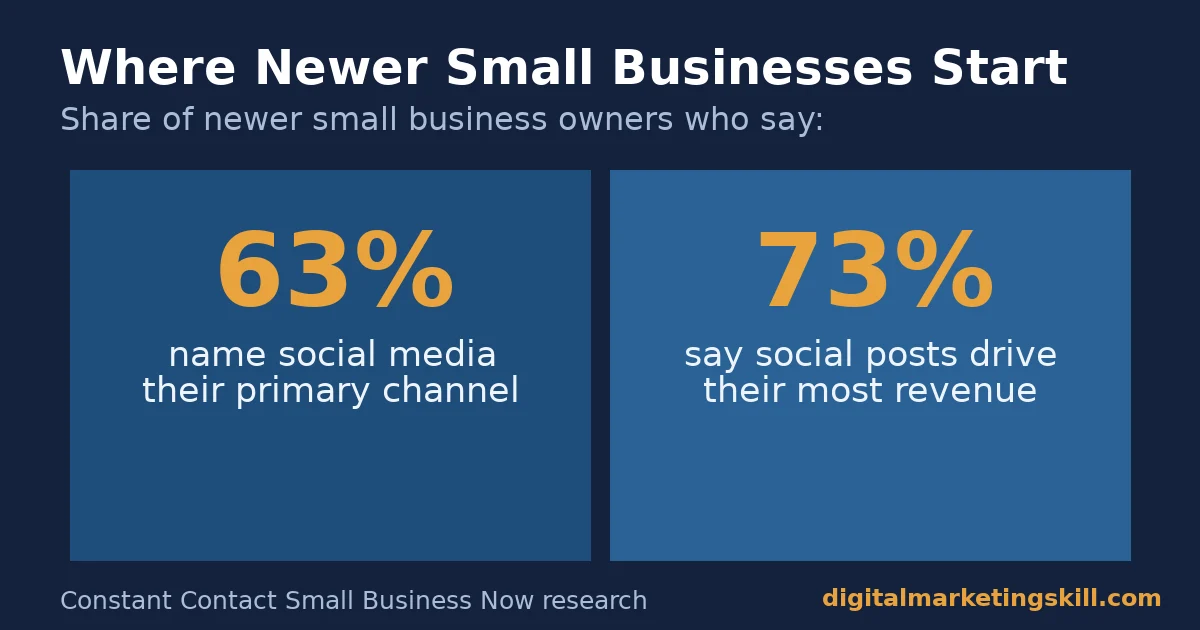
Small business digital marketing is not about running every channel. It is about choosing the one or two that return revenue fastest for your specific customers. Add more only once those are proven. Three things decide which channel should come first, inside the wider digital strategy for your business.
The Three Things That Decide Your First Channel
First, where do your customers already look for businesses like yours. A plumber’s customers search differently from a boutique clothing brand’s followers. Second, how much time can you give it each week. A channel you cannot maintain will not compound. Third, how fast do you need revenue. Some channels build slowly while others can convert within days.
Answer those three questions before you touch a single platform. A business that needs revenue this month should rarely start with a channel that takes six months to build an audience, even if that channel is cheaper in the long run.
The same three questions lead different businesses to different answers. A repeat-customer service business, like a cleaning company, often does better starting with email, since its customers are already known. A retail shop chasing new local foot traffic often does better starting with local search instead. Neither is wrong to differ from the other; the point is matching the channel to the customer.
Matching the Channel to the Customer, Not the Trend
Resist copying whichever channel is trending in your industry this quarter. A trend that works for a competitor with a different customer base, budget or team size may simply waste your time. Use the three factors above on your own business, every time, before you follow anyone else’s channel choice. This is the core discipline behind small business digital marketing that actually returns revenue.
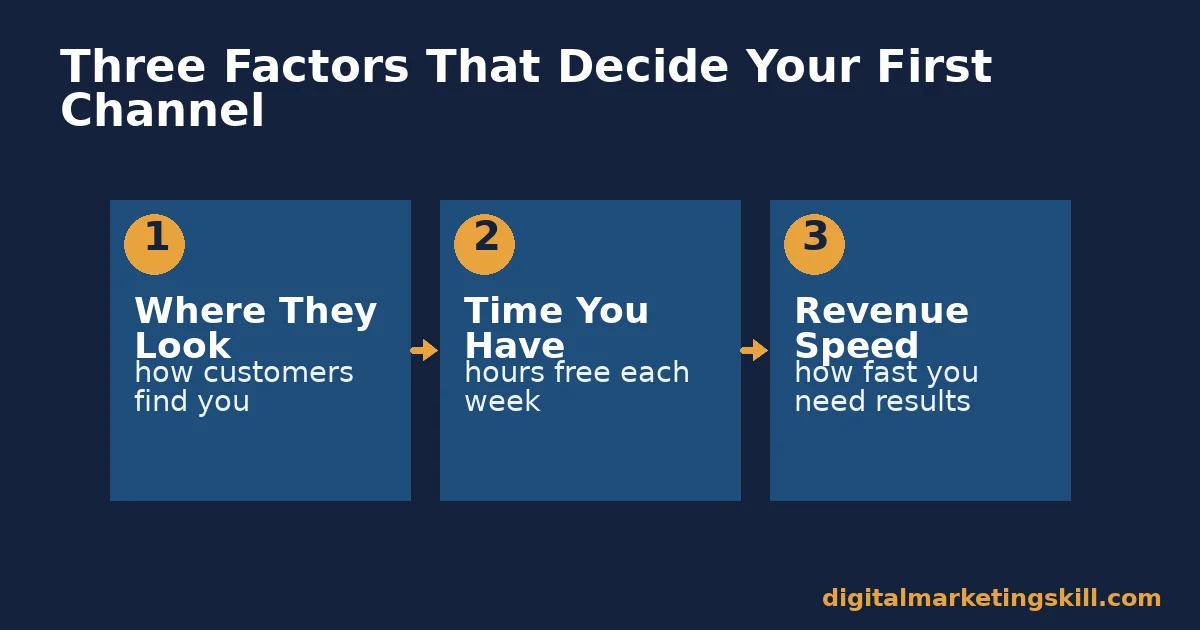
Constant Contact’s research found that newer small businesses are more than twice as likely to use social media as their primary channel, compared with email or text messaging. That is not proof social media is always right. It shows where many small businesses are putting their first effort, often because it fits the three factors above for a business with no existing list to email.
What Changes by Channel
Email, social media and local search solve different problems. Each one fits a different stage of the three factors above. The sections below cover what each channel in small business digital marketing is actually built for.
Email: Built for Owned, Repeatable Reach
Email is the only channel on this list that you fully own. A social platform can change its algorithm overnight. Your email list stays yours no matter what any platform changes. Litmus’s research found that among marketers who track email ROI, a third report returns between $10 and $36 for every $1 spent. Another 35% report even higher. That spread is wide, because return depends heavily on list quality and how targeted each send is.
The catch is that email needs a list first. A brand-new business often has no subscribers. That is why many newer small businesses start with social media instead, then build an email list from that audience over time.
Social Media: Built for Discovery and Trust
Social media solves a different problem: getting found by people who do not know you yet. Constant Contact’s survey found 73% of newer small business owners say social posts, paid or unpaid, drive their most revenue. It works because people can see real engagement, reviews and content before they ever visit your website.
The limit is reach decay. Organic posts reach a shrinking share of followers over time on most platforms. So social media usually needs some paid support to keep working once a following gets large. Our guide to marketing channel mix covers how to budget for that shift.
Local Search: Built for Buyers Already Looking
Local search catches people who are already looking for a business like yours, right now, nearby. That makes it the highest-intent channel on this list. Yet BrightLocal found that only 35% of small businesses in its US survey have claimed their Google Business Profile. That is a free listing that shows in local search results and maps.
That gap matters because local search requires almost no ad spend to start. Claiming and completing a profile takes under an hour. It is often the fastest return on time of the three channels in small business digital marketing, even if the US-only data above should not be read as a worldwide figure.
How to Lead With Each Channel
Once you know which channel fits your business, build it properly rather than starting all three badly. These sections mirror the channels above.
Email: Lead With Automation Before Volume
Set up one welcome automation before you worry about sending more newsletters. A welcome series reaches every new subscriber at the exact moment they are most interested. That is why it usually earns a higher return than a one-off broadcast. Add a single offer or useful resource to that series, then measure clicks before adding more emails.
Keep your list small and real rather than large and cold. A list built from actual customers and genuine sign-ups converts far better than a purchased or scraped list. It also protects your sender reputation with email providers.
Social Media: Lead With One Platform, Not Five
Pick the single platform where your specific customers already spend time. Post there consistently for a full quarter before judging results. Spreading thin content across five platforms usually performs worse than strong content on one. Our guide to small business marketing strategy covers how to pick that one platform using a three-pillar framework.
Reply to every comment and message for the first few months. Early engagement signals to both the algorithm and real customers that the account is active. It is often what turns a follower into a paying customer.
Local Search: Lead With a Complete, Accurate Profile
Claim your Google Business Profile first, then fill in every field: hours, categories, photos and a short description that names what you actually sell. An incomplete profile ranks worse and converts worse than a complete one, even with identical reviews.
Ask every satisfied customer for a review in the same week you serve them. Reviews left close to the purchase tend to be more detailed and more frequent than requests sent weeks later. A steady stream of recent reviews matters more to local ranking than a handful of old ones.
When to Add Paid Ads as a Fourth Channel
Paid ads are not one of the three starting channels in this guide, because they cost money from day one, unlike organic social posts, email or a free Google Business Profile. That makes them a poor place to start small business digital marketing with a tight budget.
Add paid ads only once your first organic channel has a known, profitable cost per lead. At that point, paid spend on the same channel usually scales the result you already proved, rather than being a guess about what might work. Boosting a post that already converts organically is a safer first paid step than launching a brand-new campaign from zero data.
How to Measure Small Business Digital Marketing
Each channel needs its own metric, defined simply enough to check in a few minutes a week. Track these alongside whatever revenue number you already watch.
Four KPIs That Fit a Small Team
- Email click rate. The share of recipients who click a link in your email. It shows whether the content and offer are relevant, separate from how many people merely opened it.
- Cost per lead, by channel. Total spend on a channel, divided by the leads it produced. This is what lets you compare email, social and local search on equal terms, using the same reports covered in our guide to Google Analytics reports.
- Profile views and actions. Google Business Profile reports views, calls and direction requests. Rising actions show your local listing is converting lookers into contacts.
- Review count and recency. The number of reviews earned in the last month, not the lifetime total. A business with recent reviews signals current activity, which both customers and search engines weigh heavily.
Reading the Numbers Together
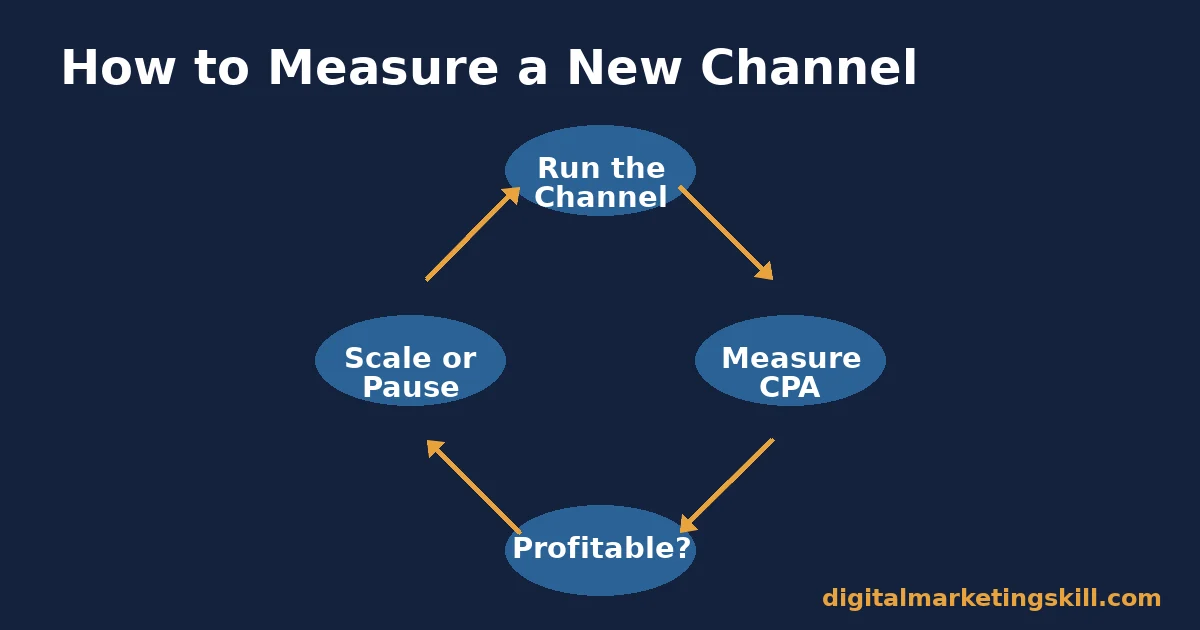
Check cost per lead across channels side by side once a month. The channel with the lowest cost per lead deserves more of next month’s time and budget. Do not simply favour the channel you personally enjoy running. If a channel’s cost per lead keeps climbing for two months straight, pause new spend there and investigate before continuing. Write the number down every month in a simple spreadsheet, even a basic one, because memory alone makes it easy to misremember which month was actually strong.
Three Signs You Picked the Wrong First Channel
A few early signals usually show up before a full quarter is wasted. Watch for these three.
- You cannot keep up the posting pace. A channel that needs more hours than you have will stall regardless of how well it could perform in theory.
- Engagement comes from people who will never buy. Likes and comments from outside your service area or target customer are not a sign of progress.
- Cost per lead rises every single week. A short dip is normal. A steady climb across a full month is a sign the channel or the content needs to change.
The One Rule: Prove One Channel Before You Add a Second
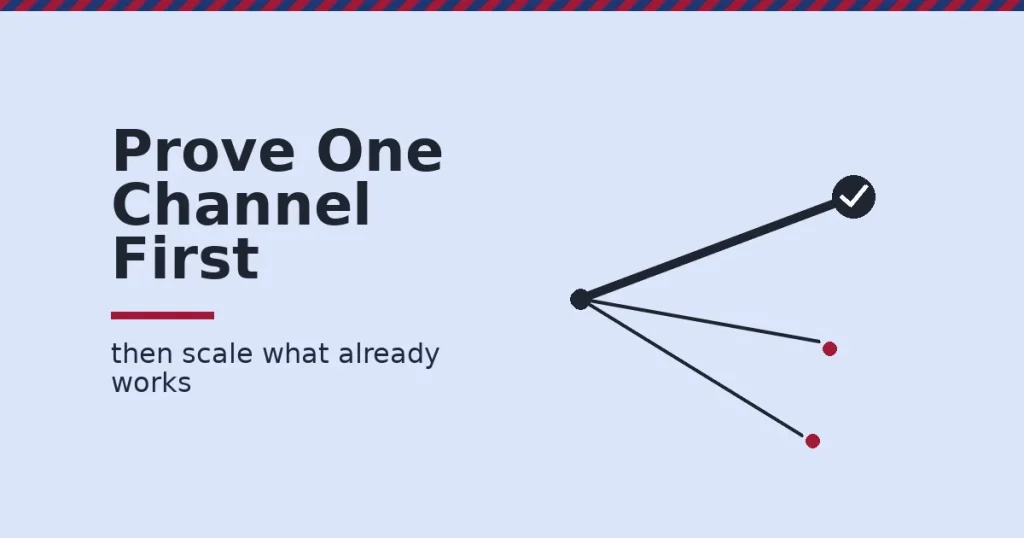
If you remember one rule from this guide, make it this one. Run a single channel for a full quarter. Measure its cost per lead, and only add a second channel once the first is profitable. Running three channels badly costs more in time than running one channel well.
Here is an illustrative example, with invented numbers. A small bakery picks social media first, because its customers discover new bakeries by scrolling, not searching. After one quarter it has a cost per lead of $12 and a steady stream of orders. Only then does the owner claim a Google Business Profile, because by that point there is a following to ask for reviews. Starting both at once would have split a small amount of weekly time in half, and likely delayed both results.
The lesson is sequencing, not channel choice. Whichever channel fits your three factors first, prove it before you add the next one.
A Real Case: What Changed for Newer Small Businesses
Constant Contact’s Small Business Now research, carried out with Ascend2, surveyed more than 1,600 small business owners across several countries. It found that businesses eight years old or younger lean heavily on social media. 63% name it their primary channel, and 73% credit it as their biggest revenue driver.
Keep the limits in mind. The survey covers owners in the United States, United Kingdom, Australia and Canada. The results are self-reported, not pulled from verified sales data. Treat it as a strong signal of where newer small businesses are investing their time, not as proof that social media outperforms every other channel for every business. A mature business with an established email list, or one serving customers who search rather than scroll, may rank these channels in a different order entirely.
The same report found these newer businesses are more than twice as likely to prioritise social media over email or text messaging. That fits the pattern in this guide: a channel that needs no existing list, like social media, is often where a brand-new business can move fastest in its digital marketing.
Frequently Asked Questions About Small Business Digital Marketing
Where should a small business start with digital marketing?
Start with the one channel your specific customers already use to find businesses like yours. Run it for a full quarter, and measure cost per lead before adding a second channel.
Is social media or email better for small business digital marketing?
Neither is universally better. Constant Contact found newer small businesses lean on social media because it needs no existing list. Litmus found email can return $10 or more per $1 spent once a list exists. Many businesses start with social media and build an email list from it.
How much should a small business spend on digital marketing?
There is no universal figure, since this varies widely by industry and goal. Instead of a fixed percentage, track cost per lead by channel and increase spend only where that number is improving.
Is local search worth the effort for a small business?
Yes, especially because it needs almost no budget to start. BrightLocal found only 35% of small businesses in its US survey had claimed their free Google Business Profile, so completing one is often a fast, low-cost win.
How many digital marketing channels should a small business run at once?
Usually just one, until it is proven. Running several channels at a mediocre level typically performs worse than running one channel well, especially with a small team.
How do I know if my digital marketing channel is working?
Track its cost per lead for a full quarter. A stable or falling cost per lead means the channel is working. A rising one for two months straight is a signal to pause and investigate.
Do small businesses really need a Google Business Profile?
Yes. It is free, it captures people already searching for a business like yours nearby, and a complete, accurate profile with recent reviews tends to convert better than an incomplete one.
Can a small business do digital marketing without paid ads?
Yes, especially at the start. A complete Google Business Profile, consistent organic social posts and a simple welcome email series all cost time rather than ad spend, and each can produce real leads before any paid budget is needed.
What is the biggest mistake in small business digital marketing?
Running too many channels at once with no way to compare them. Without a shared metric like cost per lead, it is nearly impossible to tell which channel is actually worth the time it takes.
Pick One Channel and Prove It This Quarter
Small business digital marketing works best narrow, not wide. Choose the one channel that fits where your customers already look, how much time you have, and how fast you need revenue. Run it for a full quarter, track its cost per lead, and only then add the next channel. Revisit the three factors every few months, because as a business grows, its best first channel can change too.
If you want guided practice building and running real digital marketing channels, Digital Marketing Skill Institute teaches these skills hands-on. The Master Diploma in Digital & AI Marketing includes nine practical courses, among them AI-powered social media marketing and AI-powered SEO and content marketing. It comes with unlimited 1-on-1 coaching and mentoring and real project work inside a U.S. company. The diploma is dual US and UK accredited and recognised in more than 100 countries.
The programme is fully online, so you can study and apply these skills from anywhere in your country. Explore more guides on the Digital Marketing Skill Institute blog, and when you are ready, apply for the Master Diploma or start from the Digital Marketing Skill Institute homepage.
Every figure in this guide was checked against its original source before publication. Figures marked as illustrative are invented examples, not real results.
![9 Amazing Digital Marketing Skills to Make Money Online [With Proof]](https://digitalmarketingskill.com/wp-content/uploads/2019/07/9-Amazing-Digital-Marketing-Skills-to-Make-Money-Online-With-Proof-17.png)