
A digital strategy is the written plan that sets your business goal, names your audience, and ranks which digital channels and budget will reach them. You write it before you spend a dollar on ads or content. Without one, nearly half of businesses run digital marketing with no defined direction at all. This guide shows how to build a digital strategy that actually drives sales.
Key Takeaways
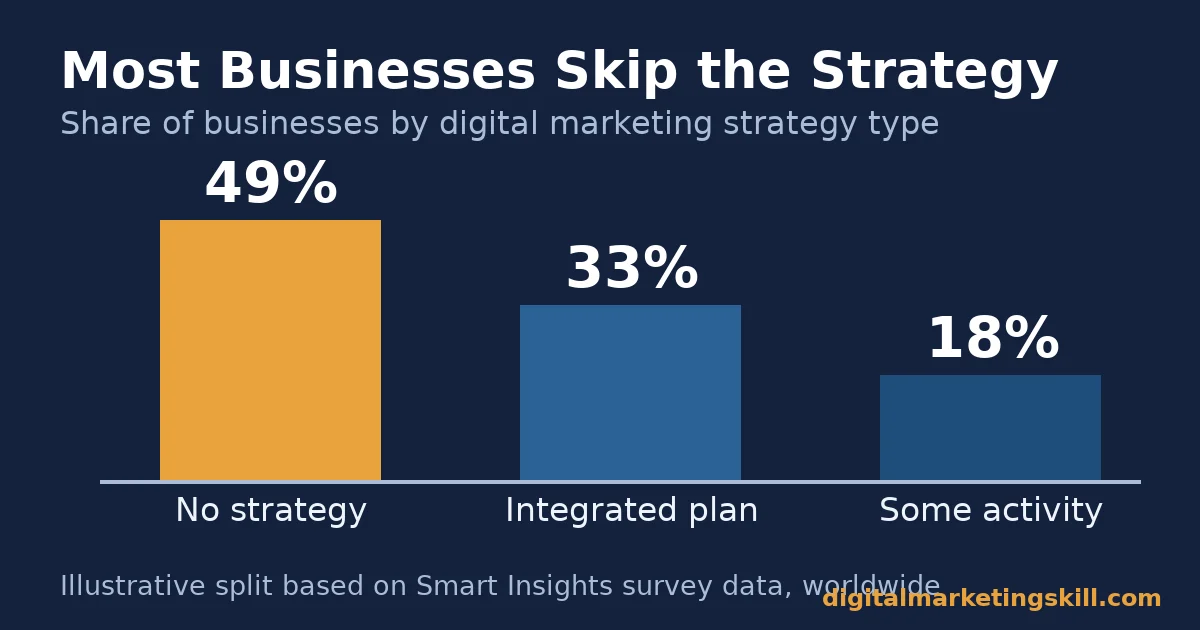
- Most businesses still skip it. Smart Insights surveyed more than 600 marketing and digital managers worldwide. It found 49% run digital marketing with no clearly defined strategy.
- Strategy shows up in the numbers. McKinsey studied outperforming companies. They grew revenue about 5 percentage points faster and profitability about 7 points more each year than their peers, tied to a clear, resourced growth strategy.
- Budgets are tightening. Gartner’s CMO Spend Survey put marketing budgets at 7.7% of overall company revenue, down from 9.1% in the prior survey. A documented strategy matters more when spend gets questioned.
- Channels keep multiplying. Salesforce’s State of Marketing research found companies now use an average of 10 marketing channels. That is unmanageable without a plan that ranks them.
- A documented plan is a stated success factor. Content Marketing Institute’s B2B research found 47% of the strongest-performing content marketers cite having a documented strategy as a reason for their results.
In this guide
- The Gap Most Digital Strategy Advice Skips
- What a Digital Strategy Actually Is, and Why It Changes Results
- What a Digital Strategy Looks Like by Business Size
- How to Build the Strategy for Your Size
- How to Measure Whether Your Digital Strategy Is Working
- The One Rule: Write the Goal Before You Choose the Channel
- A Real Case: What Separates Outperforming Companies
- Frequently Asked Questions About Digital Strategy
- Write Your One-Page Strategy This Week
The Gap Most Digital Strategy Advice Skips
Most articles on digital strategy list channels. Start a blog. Run ads. Post daily on social media. Almost none explain why so many businesses do all of that and still see little return. The real gap is sequencing. Channels get chosen before goals get set. So the plan has no way to judge whether anything worked.
A few ground rules before the detail. The figures below come from named surveys and studies. Each has its own scope and sample, so read them as evidence to weigh, not settled fact. The decision rule later in this guide is an informed inference built from that evidence, not a guarantee. And every number is a snapshot from the survey that produced it, not a permanent ranking of what digital marketing costs or returns.
There is a second, quieter reason strategy matters: discoverability. Ahrefs studied about 14 billion pages and found that 96.55% get no traffic from Google at all. In other words, a channel plan built on hope rather than demand often fails before a single ad runs. A written strategy forces you to check demand for a topic or audience first, instead of publishing and hoping.
What a Digital Strategy Actually Is, and Why It Changes Results
A digital strategy is a written, high-level plan. It states the business goal. It names the audience. It ranks which digital channels will be used. And it sets the budget and the metric that will judge success. So a strategy sits above tactics. A tactic is “post three times a week on Instagram.” A strategy decides whether Instagram belongs in the plan at all.
The gap between businesses with and without one is not small. Smart Insights has tracked this for years. It surveyed over 600 marketing and digital managers worldwide for its “Managing Digital Marketing” research. The study found that 49% of businesses carry out digital marketing with no clearly defined strategy. A further share run some digital activity but have never put a strategy on paper. Only around a third reported having an integrated strategy that connects their channels to a goal.
The Four Things Every Digital Strategy Must Define
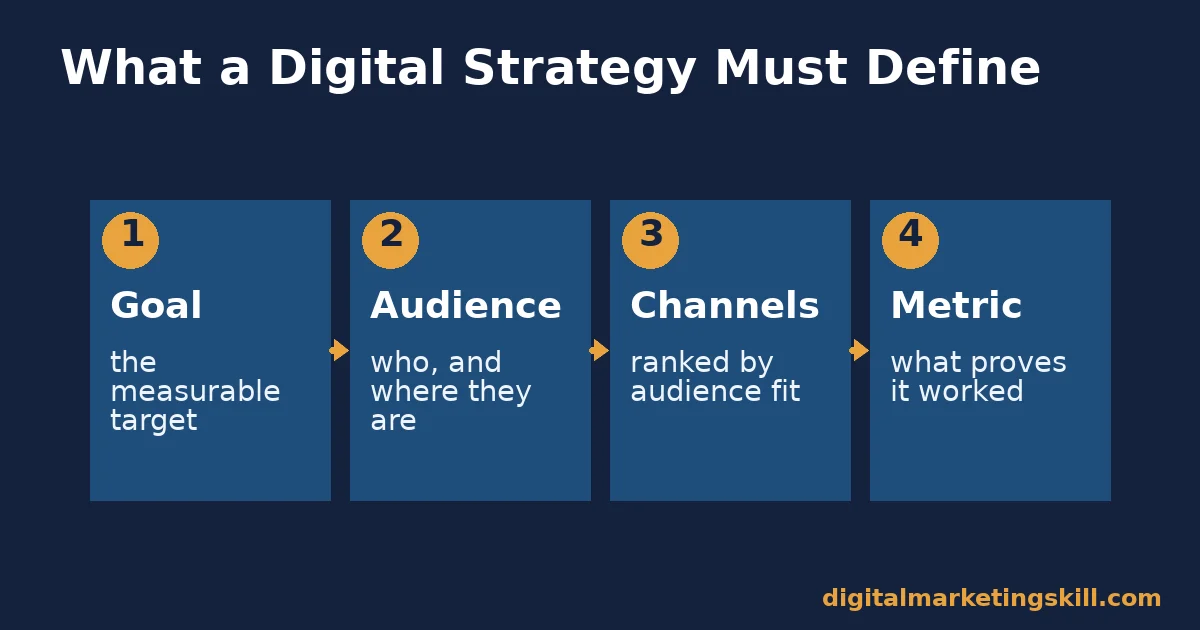
Strip away the jargon. A working digital strategy answers four questions, in this order. First, what is the measurable business goal: a lead volume, a sales number, or a cost-per-acquisition ceiling. Second, who is the audience, described by what they search for and where they spend time online, not by broad demographics alone. Third, which channels earn a place in the plan, ranked by where that audience already is. Fourth, what single metric will tell you, within a set period, whether the plan is working.
Skip any one of the four and the strategy stops being a strategy. A goal without a metric cannot be judged. Channels chosen without an audience in mind waste budget on the wrong platform. This is also why a documented strategy correlates with performance. Content Marketing Institute’s B2B research found that among weaker performers, 42% named “lack of clear goals” as a reason their strategy underperformed. Another 39% named “content not aligned to the buyer journey.” Both are exactly the first two questions above, left unanswered.
Five Signs Your Business Is Missing One
You can usually tell within a few minutes whether a business has a real digital strategy or just digital activity. Check your own business against these five signs.
- Nobody can state the goal in one sentence. If the marketing goal takes a paragraph to explain, there probably is not one written down yet.
- Channels were added by copying competitors. A channel chosen because “everyone else is on it” rarely gets judged against your own numbers later.
- No one can say the cost per customer. Without this number, you cannot tell a good month from a lucky one.
- Content and ads are planned week to week. Short-term planning is a symptom of a missing strategy, not a strategy on its own.
- Budget moves channel to channel without a reason. Spend should shift because a KPI changed, not because of a hunch.
If two or more of these sound familiar, the sections below will help you fix the gap in a few focused steps.
What a Digital Strategy Looks Like by Business Size
A documented strategy is not one template. What it needs to define, and how much of it needs writing down, changes with the size and complexity of the business behind it. The two patterns below cover most businesses.
Small Teams: Built for Focus, Not Coverage
A small business or solo operator rarely has the budget or hours to run every channel well. The World Bank estimates that small and medium enterprises make up around 90% of all businesses worldwide. They account for more than half of global employment. So this is the majority case, not the exception. Our guide to small business marketing strategy covers a three-pillar framework that fits this group well. For this group, a digital strategy is mostly a decision about what to ignore.
Meta’s Global State of Small Business report was produced with the OECD and World Bank. It surveyed small businesses and found 77% had increased their use of digital tools. About two in five consumers discovered a small business through a social media ad, page or post. The same research found close to 40% of small businesses named a lack of digital marketing knowledge as a top challenge. That is the strategy gap showing up directly in the data.
Larger Organisations: Built for Coordination Across Teams
Once a business has more than one marketing hire, the problem shifts. It is no longer “which channel.” It becomes “who decides, and how do we stay consistent.” Salesforce’s State of Marketing research found that companies now run an average of 10 marketing channels. At that scale, channels drift out of alignment without a shared document that says what each one is for. Our guide to marketing channel mix covers how to choose and fund each channel on that list.
Larger organisations also feel budget pressure differently. Gartner’s CMO Spend Survey covered 395 CMOs and senior marketing leaders, mostly in North America and Western Europe. It found that marketing budgets fell to 7.7% of overall company revenue, down from 9.1% in the prior survey. A written strategy is what lets a marketing leader defend or reallocate that shrinking budget with evidence instead of opinion.
How to Build the Strategy for Your Size
The sections below mirror the two patterns above. Start with the one that matches your business today. You can add the other pattern’s practices as you grow.
Small Teams: Lead With One Goal and One Channel
Pick a single measurable goal for the next quarter. It could be a target number of qualified leads, or a cost-per-sale ceiling. Then choose the one channel where your specific audience already searches or scrolls. Do not try to maintain five channels at a mediocre level. So a strategy document for a small team can fit on one page: the goal, the audience in one sentence, the one priority channel, the budget, and the metric you will check weekly.
Review that one page monthly. If the metric is not moving after a full quarter, change the channel or the offer before you add a second one. Coverage without a working first channel only spreads a small budget thinner.
Larger Organisations: Lead With Governance and Shared KPIs
At scale, write the strategy as a shared reference, not a private plan. Name the business goal. Then rank the channels by priority. Assign one accountable owner and one KPI to each channel, so every team can see how their work ladders up to the same number. Review the ranking each quarter against the channel-fragmentation finding above. If a channel on your list is not earning its place against the goal, retire it rather than running it out of habit.
Build the budget case the same way those CMOs are learning to. With less revenue to work with than before, every channel has to justify its share with its own number: cost per lead, cost per sale, or share of revenue it can be credited with. A documented strategy is what makes that conversation evidence-based, rather than a fight over who shouts loudest in a budget meeting.
How to Measure Whether Your Digital Strategy Is Working
A strategy without measurement is just a document. Each metric below is defined in one sentence, with a note on how to read it. You can check progress without a dedicated analytics team.
Five KPIs That Show a Strategy Is Working
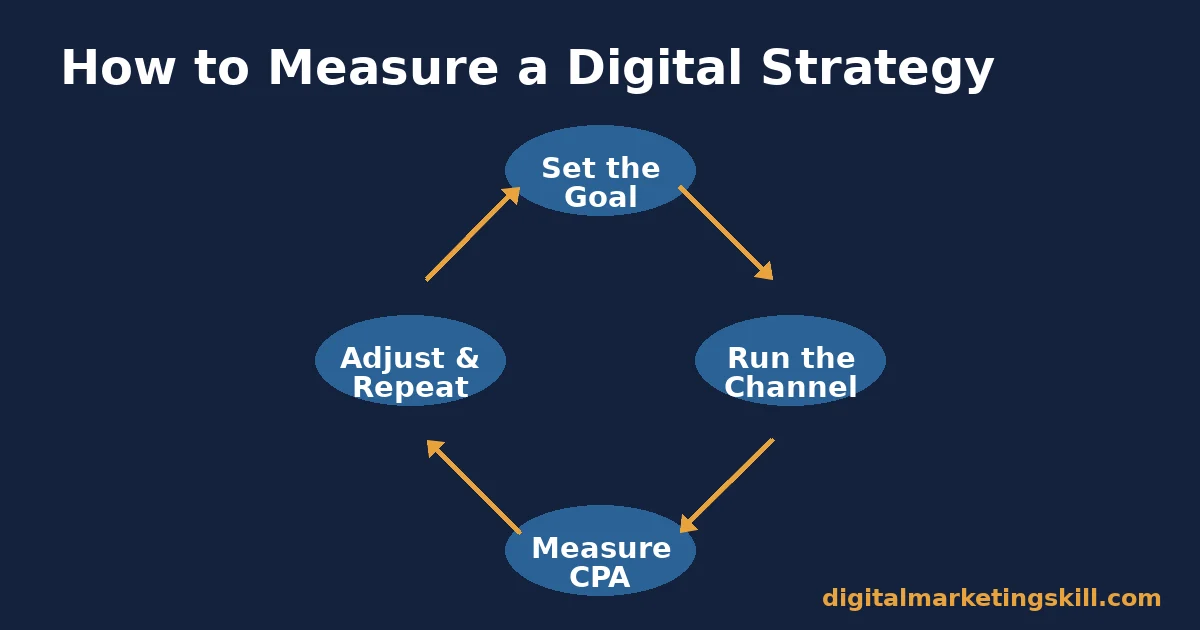
- Cost per acquisition (CPA). Total spend on a channel, divided by the number of customers it produced. A falling CPA over several months is the clearest sign a channel is maturing well.
- Channel contribution to revenue. The share of total sales you can trace to each channel through a shared tracking method, such as the model compared in Google Analytics attribution settings. This tells you which of your average 10 channels are worth keeping.
- Lead-to-customer rate. The percentage of leads from a channel that become paying customers. A channel with cheap leads but a low rate here is often not as cheap as it looks.
- Marketing spend as a share of revenue. Your own version of the Gartner benchmark above. Track it quarterly. Use the industry figure only as a rough comparison point, not a target.
- Audience growth in your named segment. Growth specifically within the audience your strategy defined, not total followers or total traffic. Those can rise while the right people stay flat.
Reading the Numbers Together
Read CPA and lead-to-customer rate together first. A channel can look cheap on CPA and still be expensive once you see how few leads convert. Then check channel contribution to revenue against where your budget is actually going. A mismatch there is usually the fastest fix available. Marketing spend as a share of revenue is the slowest-moving number, so review it quarterly rather than monthly. Our guide to Google Analytics reports shows where to pull channel contribution and conversion numbers from directly.
A Short Quarterly Review Checklist
Before each quarter closes, run through four quick checks. Together they take less than an hour and catch most drift early.
- Did the goal stay the same? If the business goal changed mid-quarter, your channel ranking probably needs to change too.
- Which channel had the lowest CPA? So protect its budget first, then test whether it can take more spend.
- Which channel had the highest CPA with no improvement? Pause it or redesign the offer before the next quarter starts.
- Did any number move without an explanation? Investigate before you act, because a tracking error looks identical to a real change.
The One Rule: Write the Goal Before You Choose the Channel
If you take one decision rule from this guide, make it this one. Write the measurable goal and the audience description before you pick a single channel, platform or tactic. Every channel decision should answer back to that goal, never the reverse.
Here is an illustrative example, with invented numbers. A small services business sets a goal: 40 new qualified leads a month, at a cost per lead under $50. Working backwards from that goal, the owner tests search ads first, because that is where its audience searches with buying intent. A competitor is active on social media, but that is not the reason to start there. After two months the CPA settles at $38. Only then does the plan add a second channel, instead of splitting a small budget across three untested channels from day one.
The lesson is about order, not channel choice. Starting from the goal means every later decision has a number to be judged against, including which of your average 10 possible channels to use next.
A Real Case: What Separates Outperforming Companies
McKinsey analysed a set of 61 companies that outperformed their peers on both growth and profitability over a sustained multi-year period. The firms that pulled ahead grew revenue roughly 5 percentage points faster each year. They also improved profitability by roughly 7 points more than the companies they were compared against. McKinsey ties that gap to having a clear, resourced growth strategy, rather than running activity without one.
Keep the limits of this case in mind. McKinsey’s sample is a curated set of outperforming companies, drawn from its own broader dataset. The comparison is about overall growth strategy, not a narrow digital marketing plan on its own. So treat it as directional evidence for the value of a documented plan, rather than a guaranteed return for any single business.
The same principle shows up at smaller scale. Clutch’s survey of 500 small-business decision-makers found 45% already plan to outsource part of their marketing. Often that is precisely because building and running a strategy in-house takes more structure than a small team can spare. That is the same gap a written digital strategy is meant to close.
Both cases point the same direction. A clear, resourced strategy is not a guarantee of results, but its absence is a reliable predictor of wasted spend. Treat the research above as a reason to write the plan down this month, not as a formula that promises a specific number for your own business.
Frequently Asked Questions About Digital Strategy
What is a digital strategy in simple terms?
It is a written plan that states your business goal, names your audience, ranks the digital channels you will use to reach them, sets a budget, and defines the one metric that will show whether it worked.
Why do businesses need a digital strategy instead of just running ads?
Smart Insights found 49% of businesses run digital marketing with no clearly defined strategy. Running ads or posting content without a goal behind them makes it impossible to judge whether the spend is working.
How is a digital strategy different from a digital marketing plan?
The strategy is the high-level decision about goals, audience and channel priority. The plan is the operational detail underneath it, such as a content calendar or an ad schedule. A strategy without a plan stays theoretical. A plan without a strategy has no direction. See our guide to content marketing challenges and how to fix each one for the operational side.
How much of my budget should I spend on digital marketing?
There is no universal figure. Gartner’s CMO Spend Survey put overall marketing budgets at 7.7% of company revenue, mostly among larger North American and European companies. Use it as a rough reference point, then build your own number from your cost per acquisition and revenue goals.
How many marketing channels should a digital strategy cover?
Fewer than you think. Salesforce found companies use an average of 10 channels. A strategy should rank them and prove the top one or two work before adding more, rather than starting wide.
How do I know if my digital strategy is working?
Track cost per acquisition, lead-to-customer rate and channel contribution to revenue together. If those three numbers are stable or improving over a full quarter, the strategy is working. If not, revisit the goal and audience before you change the channel.
Can a small business build a digital strategy without a marketing team?
Yes. A one-page document covering one goal, one audience description, one priority channel, a budget and a weekly metric is enough to start. That beats running several channels with no plan at all.
Write Your One-Page Strategy This Week
A digital strategy does not need to be long to work. State your measurable goal. Describe your audience in one sentence. Name the one channel you will prove first. Set a budget, and pick the single metric you will check weekly. Review it monthly, and let the numbers, not habit, decide what gets added next.
If you want guided practice building and running a real digital strategy, Digital Marketing Skill Institute teaches these skills hands-on. The Master Diploma in Digital & AI Marketing includes nine practical courses, among them AI-powered SEO and content marketing and AI-powered Google Analytics. It comes with unlimited 1-on-1 coaching and mentoring and real project work inside a U.S. company. The diploma is dual US and UK accredited and recognised in more than 100 countries.
The programme is fully online, so you can study and apply these skills from anywhere in your country. Explore more guides on the Digital Marketing Skill Institute blog, and when you are ready, apply for the Master Diploma or start from the Digital Marketing Skill Institute homepage.
Every figure in this guide was checked against its original source before publication. Figures marked as illustrative are invented examples, not real results.
![9 Amazing Digital Marketing Skills to Make Money Online [With Proof]](https://digitalmarketingskill.com/wp-content/uploads/2019/07/9-Amazing-Digital-Marketing-Skills-to-Make-Money-Online-With-Proof-17.png)