
Copywriting skills are the specific, learnable abilities that turn plain writing into writing that gets a reader to act. They include knowing your audience, writing a headline that earns a read, crafting one clear call to action, and editing with intent. Beginners build these skills fastest by practising one at a time on a real piece of copy, not by waiting for talent to arrive.
Key Takeaways
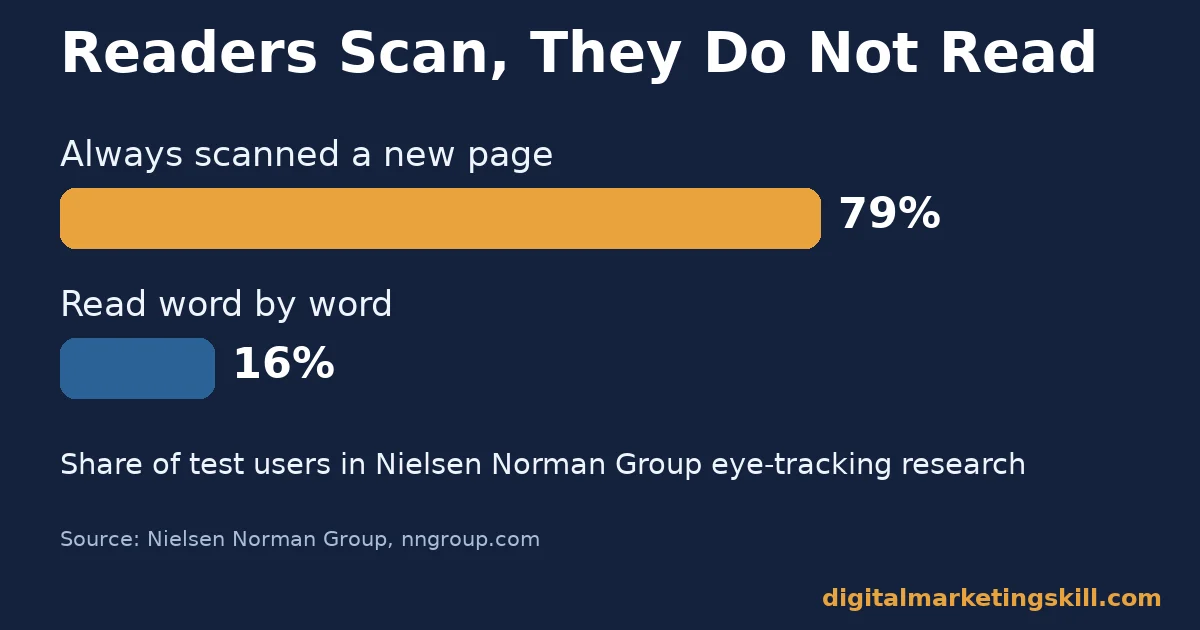
- Readers scan before they read. Nielsen Norman Group’s eye-tracking research found that 79% of users always scanned a new page, while only 16% read word by word.
- Plain, scannable writing wins. The same research found that concise, scannable, objective writing improved measured usability by 124% over promotional writing.
- Most writing never gets found. Ahrefs studied about 14 billion pages and found that 96.55% get zero traffic from Google, so a copywriter’s research and structure skills decide whether anyone sees the page at all.
- A clear CTA beats a vague one. Unbounce’s Conversion Benchmark Report, built from 41,000 landing pages and 57 million conversions, puts the median landing page conversion rate at 6.6%, with the top 25% of pages well above that.
- Effort does not guarantee results. Orbit Media’s annual survey of 1,042 content marketers found the average blog post takes 3 hours 20 minutes to write, yet only 13.9% of respondents call their results strong.
In this guide
- What Most Copywriting Skills Advice Gets Wrong
- How Copywriting Skills Turn Words Into Action
- The Eight Copywriting Skills This Guide Covers
- Copywriting Skills Differ by the Job the Copy Has to Do
- How to Build the Right Copywriting Skill for Each Job
- How to Measure Whether Your Copywriting Skills Are Working
- The One Decision Rule: Fix the First Two Sentences Before Anything Else
- A Real Case: Three Words on a Button
- A Four-Week Plan to Practise Copywriting Skills
- Frequently Asked Questions About Copywriting Skills
- Start With One Skill on One Page
What Most Copywriting Skills Advice Gets Wrong
Most lists of copywriting skills read like a job description: “understand your audience,” “write good headlines,” “know SEO.” None of that is wrong. But it treats every piece of copy the same way, and copy is not one job. A product page, a cold email and a blog post each ask a reader to do a different thing, in a different amount of time.
This guide names eight specific copywriting skills. It then shows which ones matter most for three common jobs copy has to do: getting found in search, converting a sales page, and earning the next email open. Treat the research figures below as checkable snapshots from named sources, not universal laws. The three-job framework is an informed way to apply them, not a settled rule, and nothing here is country-specific.
How Copywriting Skills Turn Words Into Action
Copywriting is writing built to get a reader to take one action: buy, subscribe, click or reply. The skill is not clever phrasing. Good copywriting skill means understanding what the reader is doing in the few seconds they give the page, and meeting them there.
That matters because readers do not read the way writers imagine. Nielsen Norman Group fitted 232 participants with eye-tracking cameras. It found they moved across the top of the page, then a shorter line lower down, then down the left side, forming an F-shaped pattern. In the same body of research, 79% of test users always scanned a new page. Only 16% read word by word.
That single fact explains most of the eight copywriting skills below. A headline, a subheading or a call to action is not decoration. It is often the only part of the page a scanning reader actually absorbs.
The same research found that rewriting a page in concise, scannable, objective language, instead of promotional language, lifted measured usability by 124% over the original. Good copy, in other words, is a usability feature before it is a sales pitch.
The Eight Copywriting Skills This Guide Covers
Before splitting these skills by job, here is the full list in plain terms. Each one reappears in the sections below, attached to the job it matters for most.
- Audience understanding. Knowing the reader’s specific problem, words and doubts well enough to write to one person, not a general crowd.
- Headline writing. Writing the one line most readers will see, since scanning research shows it decides whether anything else gets read.
- Call-to-action crafting. Describing one next step in plain, specific language, instead of a vague label or several competing buttons.
- Storytelling. Using a short, concrete example to make a benefit real, rather than listing features a reader has to interpret.
- SEO awareness. Structuring and researching a piece so it can be found by the people searching for it, without forcing keywords.
- Editing and proofreading. Cutting anything that does not earn its place, and catching errors that undermine trust before a reader even reaches the offer.
- Adaptability. Adjusting tone, length and format for the platform and the reader, instead of reusing one voice everywhere.
- Research proficiency. Checking facts, competitors and the reader’s own situation before writing, so the copy says something a template could not.
Copywriting Skills Differ by the Job the Copy Has to Do
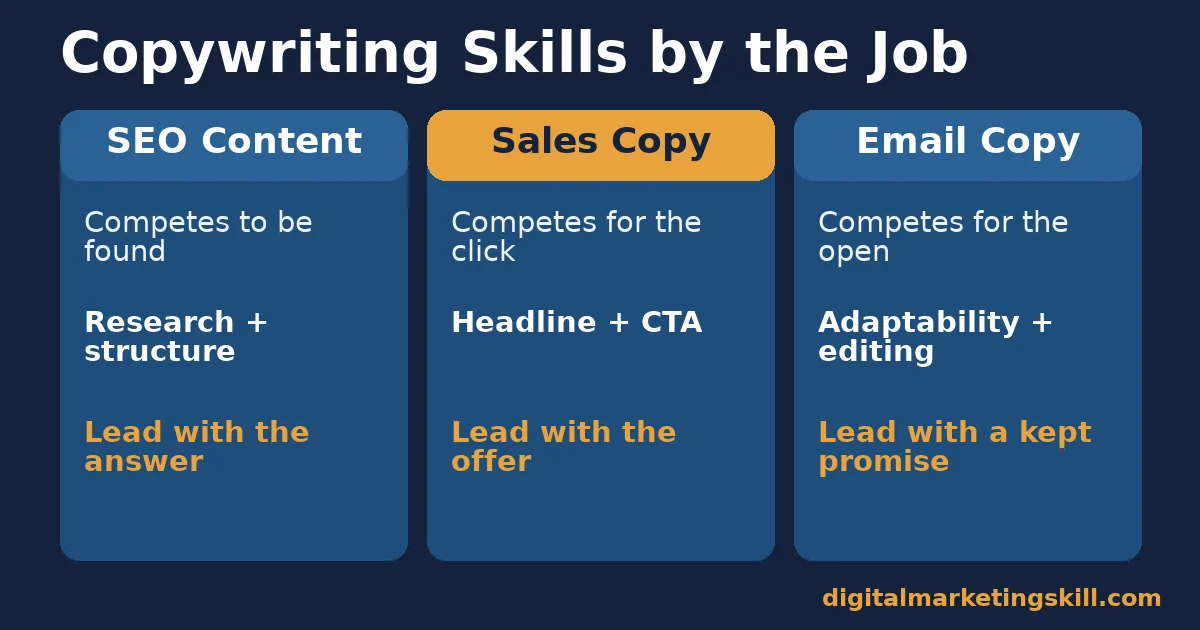
Not all copy competes for the same thing. SEO content competes with other search results before a reader ever sees it. Sales copy competes with a reader’s hesitation to spend money. Email copy competes with every other unread message in an inbox. Each job rewards a different mix of copywriting skills.
SEO Content: Built to Be Found First
SEO content has to win a search before it can win a reader. Ahrefs analysed roughly 14 billion pages in its search traffic study. It found that 96.55% get zero traffic from Google, a figure the study itself notes may skew toward higher-quality content since it excludes much of the wider web. For this kind of copy, research and structure outrank clever phrasing.
Google’s own guidance on helpful content asks a blunt question. Will someone, “after reading your content,” leave “feeling they’ve learned enough about a topic to help achieve their goal”? SEO copywriting skill is largely the skill of answering that question plainly, in a structure search engines and readers can both follow.
Sales Copy: Built to Convert Fast
Sales and landing page copy has already won the click. Its job is to turn attention into one action within the same visit.
Unbounce’s Conversion Benchmark Report is drawn from more than 41,000 landing pages, 464 million visitors and 57 million conversions. It found a median conversion rate of 6.6% across industries, with SaaS and technology pages lower at a 3.8% median and entertainment pages higher at 12.3%.
The report itself notes it measures conversion events, not the value of each conversion. A high conversion rate is not automatically a high-revenue page.
For this job, headline writing and call-to-action crafting carry more weight than they do for the other two jobs. The reader is deciding in seconds whether the page is worth their trust.
Email Copy: Built to Earn the Next Open
Email copy is read by people who already chose to hear from a sender. Its real test is not this message but the next one. Mailchimp’s own email marketing benchmarks put the all-industry average open rate at 35.63% and the average click rate at 2.62%. Mailchimp cautions that Apple’s Mail Privacy Protection can inflate open-rate accuracy by auto-loading images.
Because open rate is distorted, click rate is the more honest signal of whether the copy itself worked. Adaptability and editing are the two copywriting skills that matter most here. A subject line and preview text that overpromise will raise opens the data cannot fully trust. Under-delivering on the body text trains readers to stop opening at all.
How to Build the Right Copywriting Skill for Each Job
The sections below mirror the three jobs above. Start with whichever one matches the copy you write most often, since practising the matching skill improves your results fastest.
SEO Content: Lead With Research and Structure
Research proficiency is the foundation here. Before writing a sentence, find out what a reader searching that question actually wants to know. Check what the current top results leave out. Then build the piece around clear subheadings that use the words a scanning reader is looking for. Nielsen Norman Group’s scanning research shows readers fixate on the first words of a heading more than the paragraph beneath it.
SEO awareness is a supporting copywriting skill, not the main one. Our guide to effective SEO keywords covers how to pick topics without forcing keywords into sentences that no longer read naturally. For the full structure of a search-first piece, see our step-by-step guide to SEO copywriting.
Sales Copy: Lead With the Headline and One Clear CTA
Headline writing is the highest-leverage skill for sales copy. A reader who does not finish the headline never reaches the offer. Write the headline last, after you know the single strongest reason to buy. Then state that reason plainly instead of teasing it.
Call-to-action crafting is the second lever. Give the page one primary action, described in specific, first-person language rather than a generic label. Remove competing buttons that split attention.
Storytelling is the third skill that helps here. A short, concrete example of the product solving the exact problem the headline named builds the case the CTA is asking the reader to act on. Our guide on five tips for writing copy that converts goes deeper on this pairing.
Email Copy: Lead With a Promise You Keep
Adaptability is the core skill for email. The same core message has to work as a subject line, a preview line and a body. Write the subject line to describe the single idea inside, not to manufacture curiosity the email cannot pay off. A broken promise costs you the next open.
Editing and proofreading matter disproportionately in email. There is no second chance to fix a typo or a broken link once a message is sent. Read it once as the busy reader who only skims the first line, and cut anything that does not earn its place before that reader decides whether to keep reading.
How to Measure Whether Your Copywriting Skills Are Working
You cannot tell whether a skill is improving from how the writing feels. Measure what the reader actually did. Each metric below is defined in one sentence, with a note on how to read it.
Five Metrics That Show Whether Copy Is Working
- Click-through rate. The share of people who saw a headline, subject line or link and clicked it. It tests the headline and CTA skills in isolation from everything that follows.
- Conversion rate. The share of visitors who completed the action the page asked for. Unbounce’s benchmark report puts the cross-industry median at 6.6%, a useful reference point rather than a target for every page.
- Email click rate. The share of recipients who clicked a link inside an email, Mailchimp’s benchmark average being 2.62%. Judge email copy on this rather than open rate, since Apple’s privacy features distort opens.
- Scroll depth or read-through. How far down the page a typical reader gets. A sharp drop-off early in the copy usually points to the opening, not the close.
- Time to strong results. Orbit Media’s annual survey found only 13.9% of content marketers call their results strong, even though the average post now takes over three hours to write. Tracking your own rate of “strong” outcomes over time matters more than copying someone else’s process.
How to Read These Numbers Together
Read click-through rate first. If it is low, the headline or subject line is the problem, regardless of what the rest of the copy says. If click-through is healthy but conversion is weak, the gap sits between the promise and the payoff on the page itself.
Track one change at a time. Note the date you changed a headline or CTA. Compare the four weeks after against the four weeks before. That turns an opinion about copywriting skill into a number you can defend.
The One Decision Rule: Fix the First Two Sentences Before Anything Else
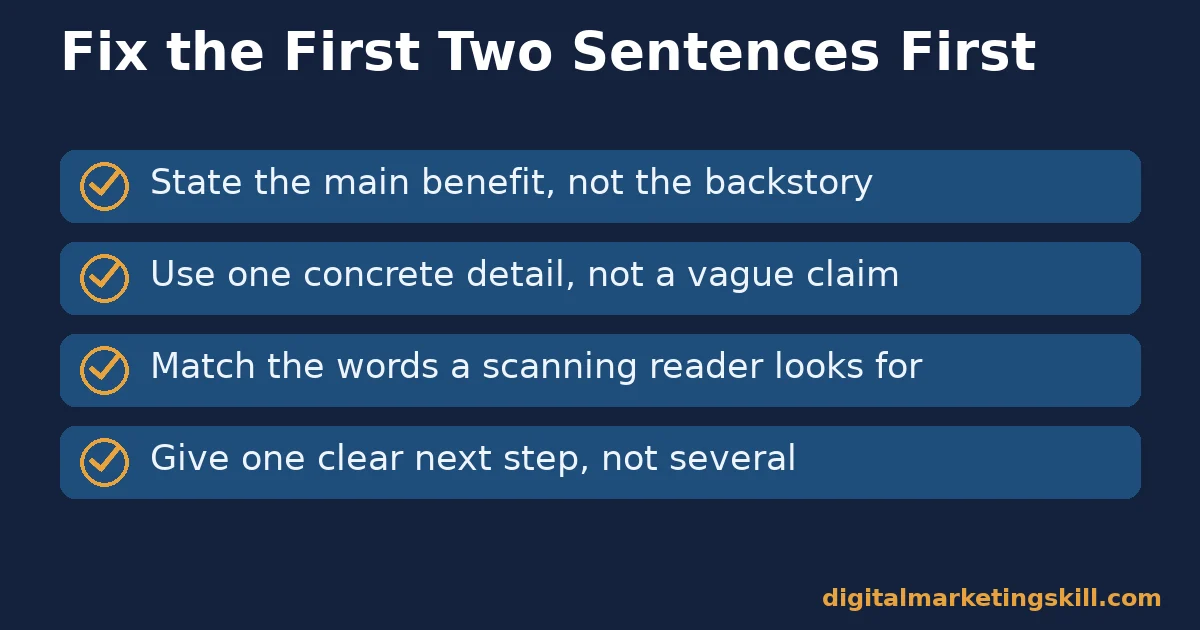
If you only have time to apply one of the eight copywriting skills, apply this rule. Rewrite the first two sentences of any piece of copy before you touch anything else. Scanning research shows readers decide whether to keep going almost immediately. A weak opening caps the return on every other skill you practise.
Here is an illustrative example, with invented numbers. A freelance copywriter’s product description converts visitors to the cart at 1.8%, well under Unbounce’s 6.6% cross-industry median. The description opens with two sentences of brand history.
She rewrites the opening to state the main benefit and a concrete detail, leaving the history further down the page. Over the following month, with no other change, the conversion rate rises to 3.1%.
The lesson here is about leverage, not magic. The rest of the page already had the reader’s attention. Moving the strongest point to where most readers actually look changed what they saw.
A Real Case: Three Words on a Button
Fab, the e-commerce site, ran a controlled test on its own “add to cart” button. One version showed only a shopping cart icon, with no text. A second version replaced the icon with the words “Add to Cart,” a change documented in HubSpot’s write-up of word-choice conversion tests.
That single change produced a 49% increase in cart adds. Nothing else on the page moved. The icon was not unclear to every visitor, but plain, explicit language removed the guessing that a symbol-only button leaves for some readers.
Keep the limit in mind. This is one company’s test on one button, reported second-hand by a marketing blog rather than by Fab itself. Treat it as a demonstration that word choice on a small, high-traffic element can matter, not as a guaranteed percentage for your own page.
A Four-Week Plan to Practise Copywriting Skills
Skill comes from repetition against real copy, not from reading about copy. This plan uses an hour a week and no paid tools. Each week builds on one of the copywriting skills above, in roughly the order a new piece of copy gets written.
- Week one: build a swipe file. Save ten pieces of copy you think work well, across headlines, CTAs and subject lines. Write one sentence on why each one works, naming the specific skill it demonstrates.
- Week two: rewrite one real page. Pick a page on a site you run or follow. Rewrite its opening two sentences and its call to action using the lead-with rules above.
- Week three: get feedback. Share the rewrite with a peer, a mentor or an online writing community. Ask specifically what was unclear, not just whether they liked it.
- Week four: measure one change. If you can publish the rewrite, track click-through rate or conversion rate for four weeks against the four weeks before. Keep only the version that performs better.
Repeat the cycle on a new page each month. Rotate which of the eight skills you focus on, so weak spots get practice too, not just the skills that come easily. A portfolio of real, measured rewrites demonstrates copywriting skill to a client or employer far better than a list of skills on a resume.
Frequently Asked Questions About Copywriting Skills
Which copywriting skill matters most for beginners?
Understanding your audience, because every other skill depends on it. A well-written headline aimed at the wrong reader still fails, while a plainly written one aimed at the right reader often works.
How can beginners develop copywriting skills quickly?
Practise on real copy, not exercises. Rewrite one existing headline, email or product description a week, get feedback from a peer or mentor, and track whether click-through or conversion rate moves.
Where can you apply copywriting skills?
Almost anywhere a business communicates: product pages, email campaigns, landing pages, social captions, press releases and ads. The specific skill that matters most shifts with the job the copy has to do, as the three examples in this guide show.
Do copywriters need to understand SEO?
It helps for content built to be found through search, where research and structure decide whether anyone reads the piece at all. It matters much less for sales copy or email, where the reader has already arrived.
What makes a call to action effective?
Specific, first-person language describing exactly what happens next, attached to one clear action rather than several competing ones. Removing a second, competing button is often a bigger lift than rewording the first one.
How do you know if your copywriting is actually working?
Track click-through rate for headlines and subject lines, and conversion rate or email click rate for the action you want. Compare each change against your own past numbers rather than a generic target.
How long does it take to get good at copywriting?
There is no fixed timeline. It depends on how often you practise against real copy and measure the result. Consistent weekly practice with feedback, like the plan in this guide, builds copywriting skill faster than occasional long sessions.
Do copywriting tools replace these skills?
No. Grammar checkers and AI drafting tools can speed up editing and give you a starting draft, but they cannot know your audience, your product’s real advantage or what a specific reader needs to hear next. Use tools to save time on the mechanical parts, and spend the time you save on research, structure and testing.
Start With One Skill on One Page
Copywriting skills compound: a clearer headline makes a stronger CTA more effective, and a better-structured piece of SEO content gives a good headline a chance to be seen in the first place. Pick the one skill from this guide that matches the copy you write most, apply it to a single page this week, and measure the result before moving to the next skill.
If you want guided practice, Digital Marketing Skill Institute teaches these copywriting skills hands-on inside the Master Diploma in Digital & AI Marketing. The program is built from four AI-powered tracks, totalling ten courses, including AI-Powered WordPress and SEO Specialist and AI-Powered Lead Generation and Email Automation. A Full Stack option covers all four tracks.
Every track includes unlimited 1-on-1 coaching and mentoring, plus a U.S. Project Internship with a verified U.S. Work Reference Letter. The diploma is dual US and UK accredited, and recognised in more than 100 countries.
The program is 100% online, so you can study and practise these copywriting skills from anywhere in your country. Read more on the Digital Marketing Skill Institute blog, see real outcomes on the reviews page, and when you are ready, apply for the Master Diploma or start from the Digital Marketing Skill Institute homepage.
Every figure in this guide was checked against its original source before publication. Figures marked as illustrative are invented examples, not real results.
![9 Amazing Digital Marketing Skills to Make Money Online [With Proof]](https://digitalmarketingskill.com/wp-content/uploads/2019/07/9-Amazing-Digital-Marketing-Skills-to-Make-Money-Online-With-Proof-17.png)






