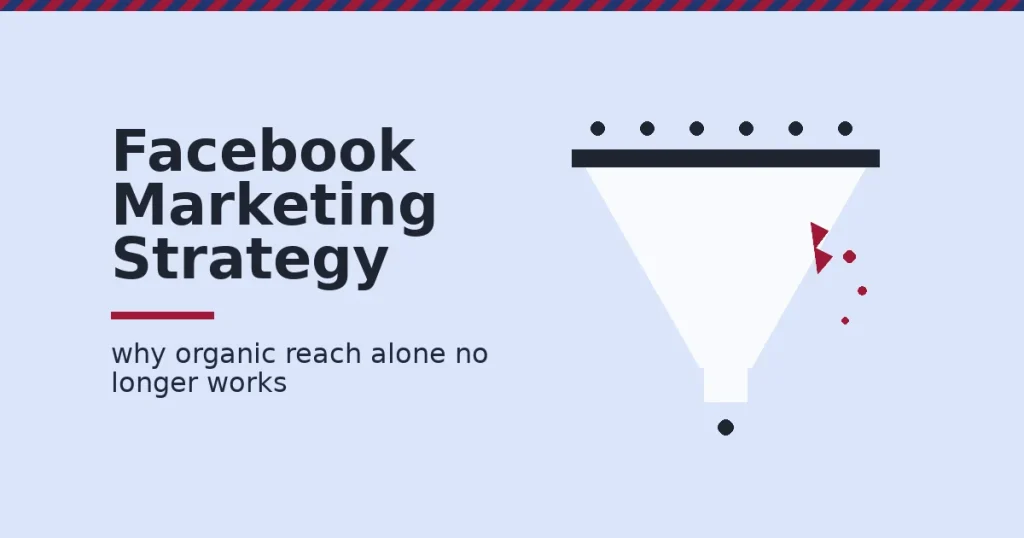
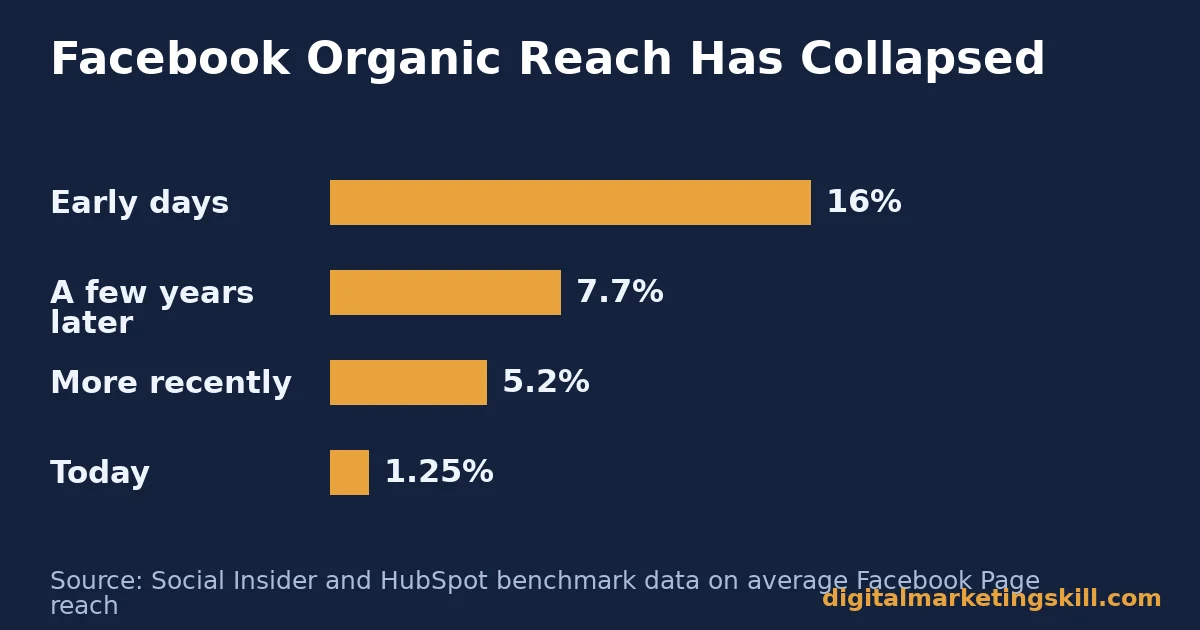
A Facebook marketing strategy today has to work around one hard fact: organic reach has collapsed to about 1.25% of followers. Paid ads, community engagement and retargeting now carry most of the weight. This guide shows how each piece actually works, and how to combine them without wasting budget.
Key Takeaways
- Facebook’s audience is still enormous. Meta’s own quarterly results reported more than 2 billion daily active users on Facebook.
- But organic reach is now small. Social Insider’s benchmark data put Facebook’s average organic reach at 1.25% of followers in its most recent reading.
- That reach has been falling for years. HubSpot’s own analysis traces average reach down from about 16% of fans in the platform’s early years to a small fraction of that today.
- The wider audience keeps growing. DataReportal’s Digital overview counted 5.79 billion social media user identities worldwide.
- Smaller pages still reach more of their audience. Social Insider’s data found small pages reach several times more of their followers per post than large pages do.
In this guide
- What Most Facebook Marketing Strategy Guides Get Wrong
- How A Facebook Marketing Strategy Actually Works
- What Differs Among Facebook Marketing Strategy Components
- Pairing Components Of A Facebook Marketing Strategy
- Cost And Time To Results, By Component
- How To Execute Each Part Of Your Facebook Marketing Strategy
- How To Measure Whether Your Facebook Marketing Strategy Is Working
- The One Rule: Let Paid Reach Carry New Customers, Organic Carry Trust
- A Real Case: Running Campaigns As A Paid Service
- Frequently Asked Questions About Facebook Marketing Strategy
- Your Next Step With Digital Marketing Skill Institute
What Most Facebook Marketing Strategy Guides Get Wrong
Search “Facebook marketing strategy” and most guides list 10 or 15 tactics. Post consistently. Use video. Run ads. Join groups. None of that is wrong, but it skips the one shift that changed everything: organic reach collapsed, and no tactic list fixes that on its own.
A working Facebook marketing strategy accepts that fact instead of fighting it. Organic content still matters, but mostly for proving your page is active and building a retargeting audience. Paid reach now does most of the actual work of finding new customers.
This guide narrows the long tactic lists down to four underlying components: organic content, paid ads, community engagement, and retargeting. Every specific tactic you have read about, a trending audio post, a flash-sale ad, a group comment, fits inside one of these four. Knowing which component a tactic belongs to tells you what result to actually expect from it.
A ground rule before we go further. Figures below are checked against the organization that published them, and labeled where they come from one company’s own report or a single benchmark study. Nothing here is a guaranteed result. Any example marked “illustrative” is invented, used only to show the math.
How A Facebook Marketing Strategy Actually Works
Facebook’s algorithm ranks posts by predicted engagement, not by follower count or post time. A post that gets early comments and shares earns more reach. A post that gets scrolled past earns almost none, regardless of how many people follow your page.
This is why a Facebook marketing strategy built only on organic posting struggles. Most followers never see most posts. Social Insider’s benchmark puts average organic reach at about 1.25% of followers, so a page with 10,000 followers might reach roughly 125 people per post without paid support.
Paid ads work differently. You choose exactly who sees the ad, by interest, behavior or by retargeting people who already visited your site. That targeting is what makes paid Facebook marketing strategy effective even as organic reach keeps shrinking.
The two are not separate strategies. Organic content builds the page people land on after clicking an ad, and gives you a pool of engaged visitors to retarget. Paid reach does the work of finding people in the first place.
Most businesses that struggle with Facebook marketing strategy only build one half of this. They either post organically and wonder why nothing grows, or they run ads to a page with no content behind it, which wastes the trust-building work organic content is supposed to do. A working strategy treats both halves as one system, not two separate efforts.
What Differs Among Facebook Marketing Strategy Components
Four components make up most Facebook marketing strategy work: organic content, paid ads, community engagement, and retargeting. Each does a different job.
Organic Content: Prove The Page Is Worth Following
Organic content earns little reach on its own now. But it still does one job well: proving to a new visitor that your page is active and real. A page with recent, relevant posts converts better than an empty one, even if few people saw those posts organically.
Think of organic content as a storefront window, not a megaphone. Its job is to look open and worth entering. It is not meant to shout loudly enough to be heard across the street.
Paid Ads: Find People Who Do Not Know You Yet
Paid ads reach people outside your existing followers, using Meta’s targeting by interest, behavior, location or lookalike audiences built from your existing customers. This is the main growth engine of a modern Facebook marketing strategy. Our guide to Facebook ad setup covers the choices that most affect results.
Community Engagement: Turn Followers Into Advocates
Community engagement, replying to comments, responding in Messenger, participating in relevant groups, turns a passive follower into someone who recommends you. It rarely shows up in reach numbers, but it drives the word of mouth that reach cannot measure. A business that replies quickly and helpfully in public comments builds trust with everyone who reads that thread, not just the person who asked the question.
Retargeting: Bring Back People Who Almost Bought
Retargeting shows ads only to people who already visited your site or engaged with your page. These are the warmest prospects you have, since they have already shown interest once. See our beginner’s guide to Facebook retargeting for the setup steps.
Pairing Components Of A Facebook Marketing Strategy
These four components are not separate plans. They feed each other in a specific order. Organic content and community engagement build the page a cold visitor lands on after clicking a paid ad. If that page looks empty or inactive, the ad spend is wasted on a bad first impression.
Paid ads and retargeting pair even more directly. A cold ad brings a stranger to your site. The pixel then remembers that visit. Retargeting brings that same person back with a more specific offer, once they already know who you are. Skipping retargeting means paying full price to reach the same person twice, instead of a lower retargeting rate the second time.
Cost And Time To Results, By Component
Before you commit budget, see the four components side by side. Cost and speed both vary more than most guides admit.
Organic content costs mostly time, not cash. It rarely produces new customers on its own now, but it still needs a steady publishing schedule to do its one job well: looking active.
Paid ads cost real money from day one, but they can produce a first result within days. Cost per result usually drops over the first few weeks as the algorithm learns who converts.
Community engagement costs time, not money. It rarely shows an immediate sales result, but it compounds slowly into word of mouth and repeat customers over months.
Retargeting costs very little extra once ads are already running, since it reuses traffic you already paid to acquire. It usually becomes available only after a few weeks of traffic, once the pixel has enough data to build an audience.
How To Execute Each Part Of Your Facebook Marketing Strategy
Picking the components is step one. Executing each one well is a separate, specific set of moves.
Organic Content: Post Consistently, Not Constantly
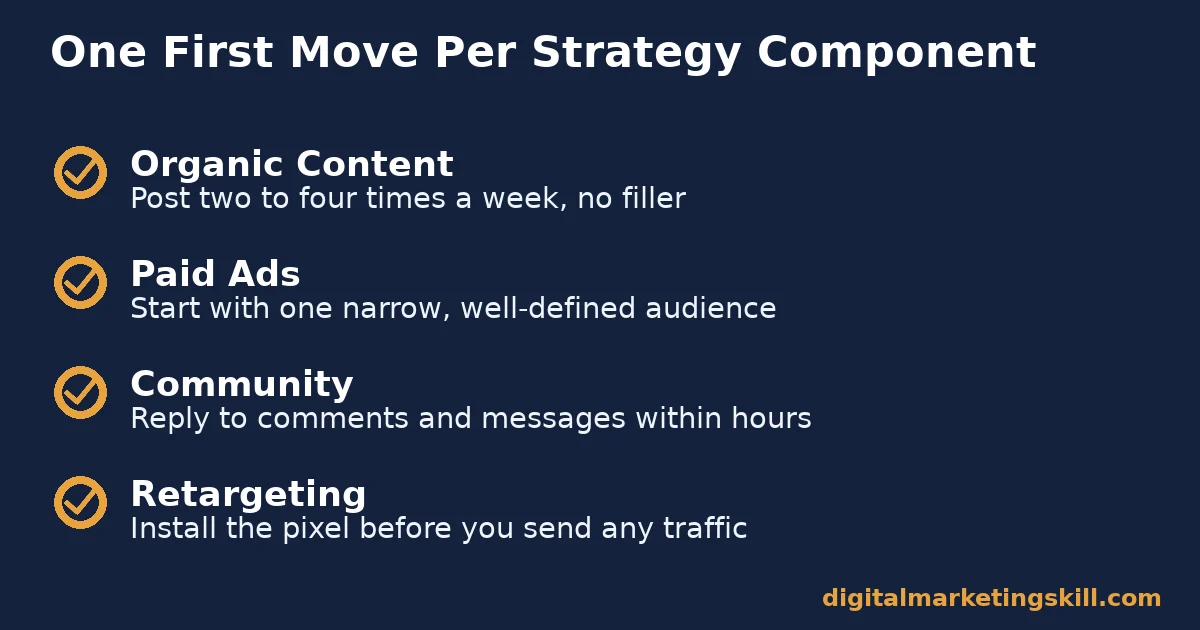
Post two to four times a week with content that reflects what you actually sell, rather than posting daily with generic filler. Mix formats: Buffer’s analysis of over 50 million posts found Facebook is unusually format-agnostic. Images, video and text posts all land within a percentage point of each other here, so format matters less than on most platforms.
Treat organic posts as proof of activity, not as your main source of new reach. Mix product posts with genuinely useful content, so your page does not read as one long advertisement.
Paid Ads: Start Narrow, Then Expand What Works
Start with a specific, well-defined audience rather than a broad one. A narrow test tells you faster what is working. Run at least two ad variations at once, so you are comparing results instead of guessing.
Expand budget on the version that performs, and cut the other. Do not split spend evenly out of caution. Our step-by-step guide to setting up and scaling Facebook ad campaigns covers this in more depth.
Community Engagement: Reply Within Hours, Not Days
Reply to comments and messages within a few hours when possible, since slow replies lose the moment of interest. Answer questions publicly in the comments when useful, so future visitors see the answer too. Join two or three relevant groups and contribute genuinely before ever mentioning your own page. Our broader guide to building a social media marketing strategy covers community building across platforms.
Retargeting: Install The Pixel Before You Need It
Install Meta’s own tracking pixel on your site before you run any traffic to it. This builds a retargeting audience from day one, instead of losing those early visitors.
Segment retargeting by what someone actually did: viewed a product, started checkout, or visited the pricing page. This way the ad they see matches their specific interest. Exclude people who already bought, so you are not paying to show an ad to an existing customer for something they already purchased.
How To Measure Whether Your Facebook Marketing Strategy Is Working
Each component has one number that shows whether it is working, before sales are large enough to judge alone. Checking these weekly catches a problem long before it shows up in monthly revenue.
Organic content: engagement rate per follower. Likes, comments and shares as a share of total followers, not raw counts. A small, engaged page often beats a large, silent one.
Paid ads: cost per result against your actual margin. What you pay for a click, lead or sale, measured against what that result is worth to your business, not against a generic industry average.
Community engagement: response time and resolution. How quickly you reply, and whether the reply actually solves the question. Slow or unhelpful replies show up in reviews before they show up in any report.
Retargeting: return on ad spend compared to cold audiences. Retargeting campaigns should consistently outperform cold audience campaigns on return, since the audience already knows you. If they do not, the pixel setup or audience segments usually need fixing. A retargeting campaign that performs worse than cold traffic almost always points to a tracking problem, not a bad audience.
The One Rule: Let Paid Reach Carry New Customers, Organic Carry Trust
If your goal is new customers, put your budget into paid ads and retargeting, not more organic posts. If your goal is keeping existing customers engaged, organic content and community engagement matter more than any amount of ad spend. Most businesses need both, in different proportions depending on the goal.
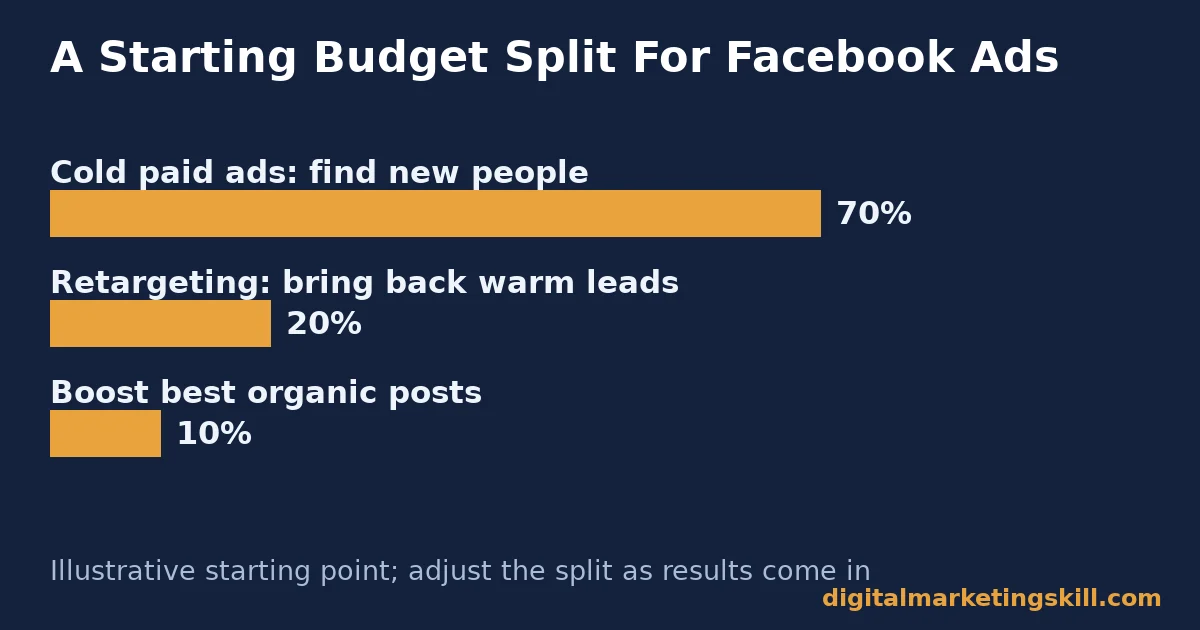
A simple starting split for a new budget: roughly 70% toward cold paid ads finding new people, 20% toward retargeting the warmest of those people, and the rest toward boosting the organic posts that already show signs of working. Adjust the split as data comes in, rather than treating it as fixed.
Illustrative, invented numbers: a page with 5,000 followers and 1.25% organic reach reaches about 62 people per post for free. The same budget spent on a narrow paid audience of 5,000 similar people could reach most of them directly. The math is not close, which is why paid reach now carries most new-customer growth.
A Real Case: Running Campaigns As A Paid Service
Damola Akanbi, a Digital Marketing Skill Institute graduate, reported quitting his job and now averaging $1,500 per client to run digital marketing campaigns, including Facebook marketing strategy work, for businesses. This was published on the Institute’s own reviews page.
The result shows that Facebook marketing strategy skills can be sold as a service, not only used to grow your own page. It does not show that every freelancer reaches this rate immediately; the figure comes from one person’s reported experience, not an audited average. Read the Institute’s earnings disclaimer before using any student result to set expectations for your own work.
The underlying pattern is worth noting on its own. A Facebook marketing strategy built around paid ads and retargeting is a skill clients will pay for directly, not just a way to grow your own page. That makes it one of the more transferable skills in this guide, useful whether you are marketing your own business or running campaigns for someone else’s.
Frequently Asked Questions About Facebook Marketing Strategy
Is organic Facebook marketing strategy still worth doing?
Yes, but for a different reason than it used to be. Organic posts no longer reach most of your audience, but they prove your page is active to people who land there from an ad or a search, which affects whether they trust you enough to buy.
How much budget does a Facebook marketing strategy need to start?
Less than many businesses assume. A small, narrow test campaign can run on a modest daily budget for a week or two before you decide whether to expand it. Start small, measure cost per result, then scale what works.
What is the biggest mistake in Facebook marketing strategy?
Expecting organic posts alone to reach a meaningful share of followers. With average organic reach near 1.25%, a page relying only on organic posting is effectively invisible to most of its own audience.
How is retargeting different from a normal Facebook ad?
A normal ad reaches people who may have never heard of you. Retargeting only reaches people who already visited your site or engaged with your page, which is why it usually costs less per result and converts better.
Do small businesses need all four components of a Facebook marketing strategy?
Not immediately. A small business can start with organic content and a modest paid budget, then add structured retargeting once there is enough site traffic to build an audience from. Community engagement should start from day one regardless, since it costs time rather than money.
How often should a business post as part of its Facebook marketing strategy?
Two to four times a week is enough for most businesses. Posting daily with low-effort content tends to perform worse than posting less often with content people actually want to see.
Can a Facebook marketing strategy work without video?
Yes. Unlike most platforms, Facebook does not show a strong built-in advantage for video over images or text, based on large cross-platform analyses. A strategy built entirely on static images can still work if the targeting and offer are strong; video is an option, not a requirement.
Should a Facebook marketing strategy focus on Facebook alone or include Instagram?
Most businesses run both, since Meta’s ad platform lets one campaign serve both apps from the same setup. Facebook and Instagram often reach different parts of the same audience.
Running both usually costs little extra for meaningfully more reach. A younger audience tends to skew more toward Instagram, while Facebook often still reaches a broader age range, so the right mix depends on who you are actually trying to reach.
How do you know when to increase ad budget?
Increase budget once a campaign shows a stable, profitable cost per result over at least a week of consistent spending. Scaling a campaign too early, before it has stabilized, often raises cost per result instead of lowering it.
Your Next Step With Digital Marketing Skill Institute
Whatever stage your Facebook marketing strategy is at, the skill behind it is the same. Reaching the right audience and converting that attention into customers. Digital Marketing Skill Institute’s Master Diploma in Digital & AI Marketing teaches this through four AI-powered tracks. AI-Powered Social Media Management and Advertising, AI-Powered Lead Generation and Email Automation, AI-Powered Google Specialist, and AI-Powered WordPress and SEO Specialist.
A Full Stack option covers all four tracks and earns the combined certificate. Every track includes unlimited 1-on-1 coaching and mentoring, plus a U.S. Project Internship with a verified U.S. Work Reference Letter.
The program carries dual US and UK accreditation, recognized in more than 100 countries. It runs 100% online, so you can build your Facebook marketing strategy from anywhere in your country.
Start with the Digital Marketing Skill Institute blog. See the full program on the Master Diploma page. Browse real outcomes on the reviews page. When you are ready, apply here. Digital Marketing Skill Institute built this program for people starting from anywhere, wherever you live. digitalmarketingskill.com is the best place to start exploring which track fits your Facebook marketing strategy.
Every figure in this guide was checked against its original source before publication. Figures marked as illustrative are invented examples, not real results.