Social listening is the practice of collecting and analyzing online conversations to understand what people think, feel and need, not just when they mention your brand by name. It turns scattered comments into a data-driven input for real decisions. Most teams collect the data but stall before acting on it, and this guide shows how to close that gap.
Key Takeaways
- 76% of marketing professionals worldwide now use social listening software. 55% plan to increase that investment, according to Statista’s survey of global marketers. The real edge today is speed of use, not adoption.
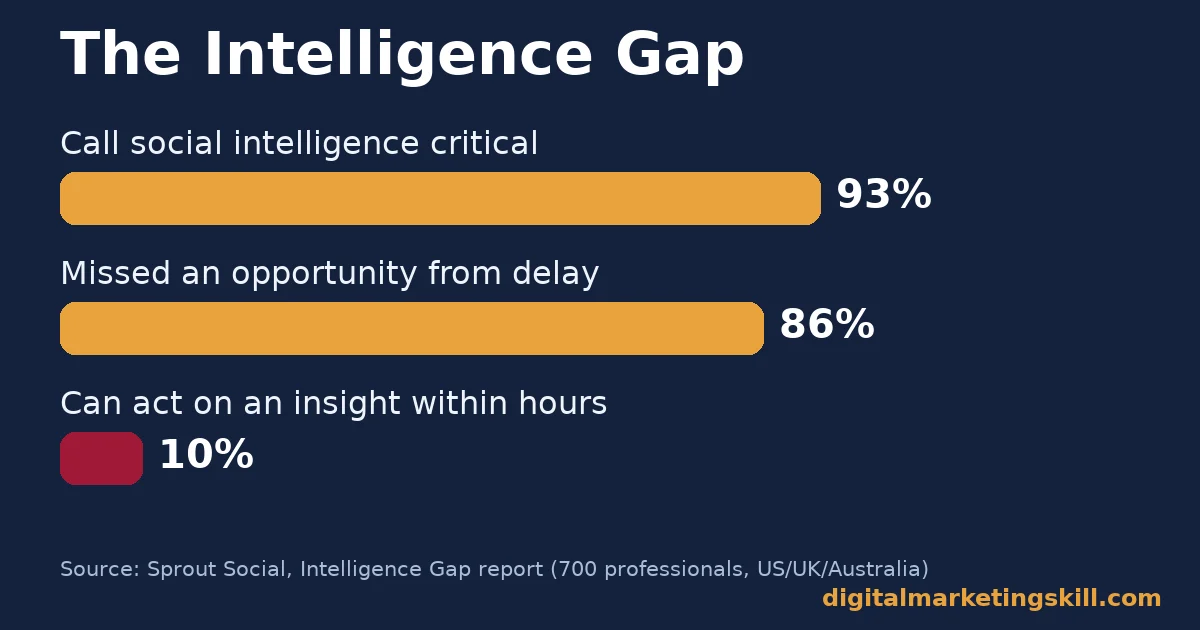
- In Sprout Social’s Intelligence Gap study of 700 social and marketing professionals, 93% called social intelligence critical to growth. Yet only 10% could turn an insight into action within hours, which is why most listening programs stall.
- 86% of the same professionals said they had missed a real business opportunity. The cause: insights that sat delayed, siloed or unused. The cost of slow listening is lost revenue, not just a missed metric.
- 64.6% of social listening teams name API restrictions and platform changes as their top challenge, according to The Social Intelligence Lab’s State of Social Listening report. So 78.5% of listening teams now run more than one platform instead of just one.
- The global social media listening software market reached roughly 12.15 billion dollars, according to The Business Research Company. It should climb past 22.6 billion dollars within the next several years, so this function keeps growing as a share of marketing budgets.
In this guide
- The Gap Between Collecting Data And Using It
- How Social Listening Actually Works
- Social Listening vs. Social Monitoring: What Differs
- How To Lead With Each Approach
- Building A Listening Strategy That Produces Action
- Measuring What Your Listening Program Produces
- The One Decision Rule For Prioritizing What You Hear
- A Real Case: How Netflix Uses Listening To Shape Decisions
- Common Challenges And How To Handle Them
- Frequently Asked Questions About Social Listening
- Build The Skills To Run This, Not Just Read About It
The Gap Between Collecting Data And Using It
Most guides to social listening stop at the definition. Watch conversations, spot sentiment, report a dashboard. What they skip is the harder problem.
Sprout Social’s Intelligence Gap report surveyed 700 professionals across the US, UK and Australia. Most agree social intelligence matters: 93% call it critical to growth. But agreement is not action. Only 10% of those organizations can turn a fresh insight into a decision within hours. And 86% admit they let a real opportunity slip past because the data sat unused.
That is an informed read of current research, not a permanent ranking of any tool or team. The gap narrows as workflows mature. So the ground rule for this guide is simple: treat social listening as an input to a decision, not just a report to file. If a section does not end in an action you can take this week, it has not done its job.
That standard applies to this guide too. Every section below names a specific step, a metric to track, or a rule to apply, not just background on what social listening is.
How Social Listening Actually Works
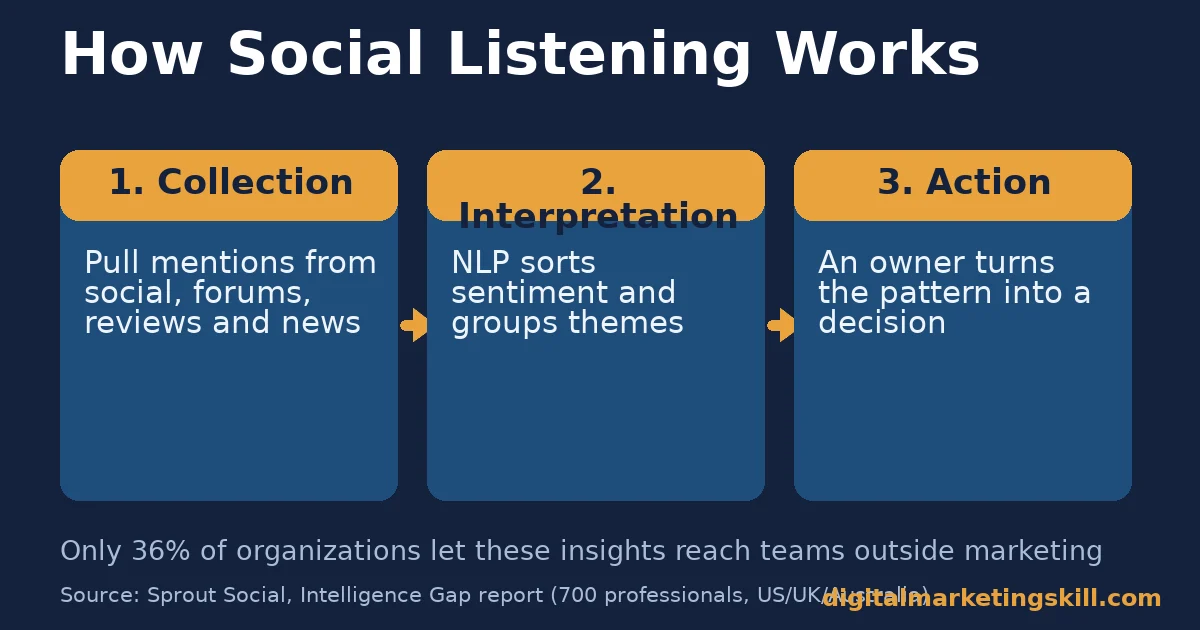
Social listening runs in three stages: collection, interpretation and action. Collection pulls mentions of your brand, competitors and industry terms from social platforms, forums, review sites and news coverage. Most tools do this through API connections, so you rarely need manual search.
What Gets Collected, And From Where
The channels worth covering go beyond the big social networks. Forums such as Reddit, question sites such as Quora, app store reviews, and comment sections on relevant news coverage all carry real signal. A short complaint on a social feed might just say a product “feels slow.”
But a forum thread about the same product usually explains exactly which feature is slow, under what conditions, and what the person tried before giving up. In other words, that extra context is why a mature listening setup pulls from several source types, not just one.
How Interpretation And Action Follow Collection
Interpretation is where natural language processing, or NLP, comes in. NLP is software trained to read and classify human text rather than just match keywords. It sorts mentions by sentiment (positive, negative, neutral) and groups related comments into themes. A thousand scattered comments become a handful of readable patterns.
Action is the stage most teams underbuild. A pattern only earns a response when someone with real authority sees it and decides. But Sprout Social found that only 36% of organizations let social intelligence inform decisions outside marketing, such as product development or customer experience. So good insights often go nowhere, because they never reach the team that could use them.
Social listening differs from keyword search because it tracks sentiment and context, not just a word’s presence. A spike in mentions only tells you volume. But sentiment analysis tells you whether that spike is good news or a problem forming in real time.
Scale is part of why this matters. DataReportal’s latest global digital overview counts 5.79 billion social media user identities worldwide, close to 70% of the global population. In short, that is the size of the conversation a listening program tries to make sense of.
Social Listening vs. Social Monitoring: What Differs
These two terms get used interchangeably. But they answer different questions and reward different tactics.
Social Monitoring: Built For Real-Time Response
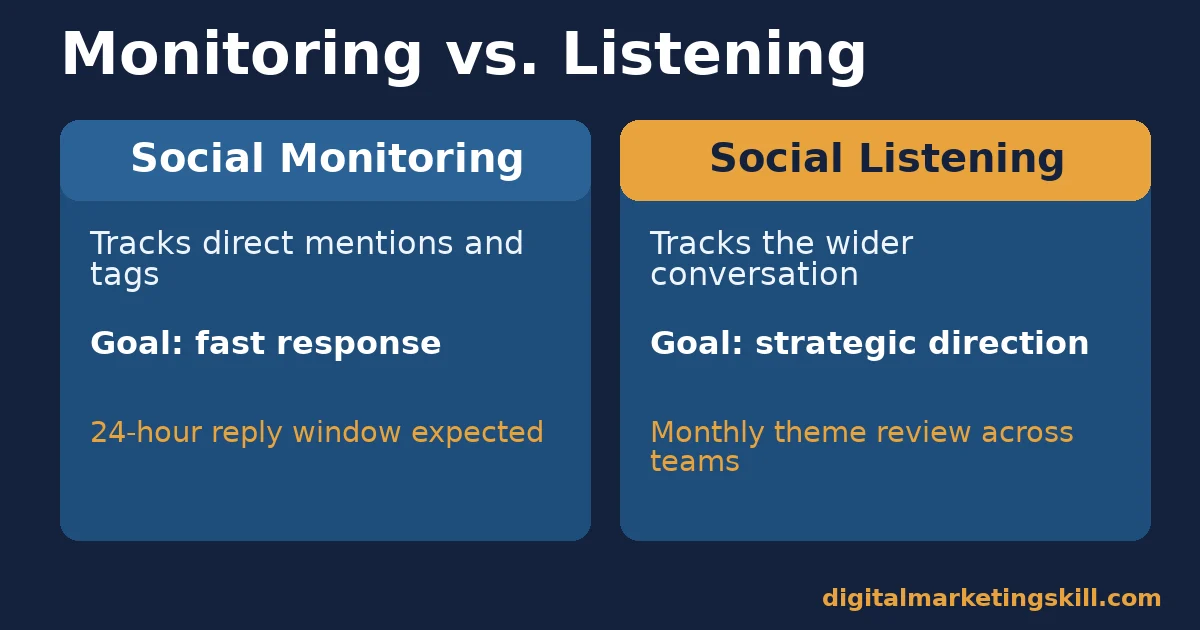
Social monitoring tracks direct mentions, comments and tags aimed at your brand, so you can respond quickly. Its job is operational, because it catches a complaint, answers a question, or flags a service issue before it spreads. Sprout Social’s research on social customer service found that most social media users expect a brand reply within 24 hours. That makes monitoring a speed game first.
Social Listening: Built For Strategic Direction
Social listening looks past direct mentions to the wider conversation about your industry and audience, tagged or not. Its job is strategic: spot a trend forming, understand why customers churn, or find a content gap competitors missed.
Those same themes feed directly into personalized marketing, because knowing what a segment of your audience actually talks about is what makes a message feel relevant instead of generic. In short, listening trades speed for depth.
How To Lead With Each Approach
Knowing the difference only helps if it changes what your team does.
Social Monitoring: Lead With Speed And Service
Set a response-time target tied to the 24-hour expectation above. Route tagged mentions to whoever owns customer service that day. Keep a short list of pre-approved response templates for common issues, so speed does not sacrifice tone. Review response-time data weekly, not quarterly. Fast, consistent responses are one of the clearest ways to strengthen customer relations over time.
Social Listening: Lead With Pattern And Strategy
Set a recurring review, for example monthly, where marketing, product and customer experience look at listening themes together, because the 36% figure above shows this cross-team step is where most programs fail. Track the same three or four themes across each review so you can see whether they grow, shrink or change shape. Bring one listening-driven recommendation to each cycle, not just a slide of raw mentions.
Building A Listening Strategy That Produces Action
A strategy that never changes a decision is not worth the subscription. Build yours in this order.
1. Set One Primary Goal Before You Pick A Tool
Decide whether this quarter’s priority is customer satisfaction, competitive intelligence, content ideas or crisis prevention. Line it up with whatever marketing strategy you already run. Trying to track all four with equal weight is how teams end up with the 86% missed-opportunity problem: everything is monitored, nothing is prioritized.
2. Choose A Tool That Matches That Goal
Platforms such as Brand24, Hootsuite and Sprout Social cover sentiment tracking and keyword alerts at different price points. A free option such as Google Alerts can cover basic brand and competitor mentions while you test the value of a paid tool. Match the tool to your goal, not to the longest feature list.
3. Pick Three To Five Keywords Worth Tracking Closely
Track your brand and product names, your top two or three competitors, and one or two industry terms your audience actually uses. But skip generic category words, because they return mostly noise. Fewer, sharper keywords beat a long list nobody reads.
If you sell a B2B service, prioritize mentions of pain points and challenges in your buyer’s language over generic industry chatter. That is closer to the moment a prospect is deciding whether to look for a solution.
If you sell a consumer product, prioritize mentions of your product name, your closest competitor’s name, and any recurring complaint words. Those tell you fastest where to fix something or where to lean into what is already working.
4. Assign A Named Owner For Turning Alerts Into Action
Only 10% of organizations can act within hours, per Sprout Social’s research. Name one person whose job includes deciding what an alert means and who needs to know. Do not leave alerts sitting in a shared inbox.
5. Set A Fixed Review Cadence And Keep It
Review monitoring-style alerts weekly. Review strategic listening themes monthly. Revisit your keyword list and goal every quarter. The Social Intelligence Lab’s research shows 73.7% of teams that switch listening tools do so over data access limits, not strategy failure. A regular cadence check catches most other problems first.
Measuring What Your Listening Program Produces
Each KPI below answers a different question. None of them means much without the others. Track all four together in one recurring report, rather than letting any single number carry the whole story, since a healthy sentiment ratio with a slow insight-to-action time still means your team is leaving value on the table.
Share of voice is the percentage of relevant conversation that mentions your brand versus competitors. A rising share of voice means you are more central to the conversation, not necessarily more liked.
Sentiment ratio is the split between positive, negative and neutral mentions. Read it alongside volume. A small spike in negative mentions during a big volume week matters less than the same spike during a quiet one.
The Two Metrics That Measure Speed
Response time is how long it takes your team to reply to a direct mention. Measure it against the roughly 24-hour expectation most social users hold, not an internal target that ignores the customer’s clock.
Insight-to-action time is how long it takes from spotting a pattern to someone actually changing a decision because of it. Sprout Social’s research shows most organizations ignore this KPI. It is the one most tied to real business outcomes.
Illustrative, invented numbers: a retail brand notices a recurring complaint about a confusing checkout step. Its listening dashboard logs the pattern on day one. But the product team does not see it until day eleven, when a support manager finally forwards the summary.
In practice, that ten-day gap is the insight-to-action time. It is the number worth tracking down to zero, because every day in that gap is a day of customers hitting the same confusing step.
The One Decision Rule For Prioritizing What You Hear
If volume on a theme rises sharply, sentiment turns negative, and your team can fix the issue, escalate it the same day. If volume is high but sentiment is neutral, or the issue sits outside your control, log it for your next scheduled review instead.
This single rule stops teams from ignoring a real problem or burning attention on noise. Write the rule down and share it with everyone who touches the listening dashboard, so escalation does not depend on one person noticing at the right moment.
A Worked Example Of The Rule In Practice
Illustrative, invented numbers: a software company sees mentions of a login bug jump from 20 to 180 in two days, with 70% negative sentiment and a clear fix available. Under the rule, that escalates immediately.
The same company also sees a slow rise in people comparing its price to a competitor over a month, with mixed sentiment and no single fixable cause. That goes into the monthly strategic review instead, because it is a trend to plan around, not a fire to put out.
A Real Case: How Netflix Uses Listening To Shape Decisions
Netflix’s own Consumer Insights research team describes social listening and audience analysis as one of several research methods it runs, alongside interviews, surveys and experimental design. The team’s stated role is to translate online conversation into recommendations for content strategy and marketing. Findings go to data science, product and studio teams, not just marketing.
The limit worth naming: Netflix has research resources most companies will never have. The lesson to copy is not the scale; it is the structure. Listening findings reach teams beyond marketing, which is exactly the cross-team step the 36% figure above shows most organizations skip.
A smaller business cannot run a dedicated Consumer Insights department, but it can copy the habit on a smaller scale. Share one listening theme with someone outside marketing every month, whether that is a product lead, a founder or a customer support lead.
Ask them directly what they would change because of it. In the end, that single habit is what turns a listening dashboard from a marketing report into a company-wide input.
Common Challenges And How To Handle Them
Data Overload
More channels and more mentions do not automatically mean more insight. Narrow your keyword list first, before you widen your tool’s feature set. A focused search returns clearer patterns than a broad one buried in noise. If a weekly report regularly runs past a page of raw mentions nobody reads end to end, that report has already failed, no matter how complete the data behind it is.
API Restrictions And Platform Changes
This is the top-ranked challenge in SILab’s research, named by 64.6% of practitioners. Most of it traces back to restricted access to platforms such as LinkedIn and TikTok. Running more than one listening tool, as 78.5% of teams now do, is the practical workaround.
Turning Data Into Action
This is the core problem this guide addresses. An insight without an owner and a deadline stays an insight. Apply the named-owner step and the decision rule above so every alert has somewhere to go. If a theme keeps resurfacing in your weekly review without ever reaching a decision maker, that is a sign your process, not your tool, needs fixing.
Privacy And Ethical Use
Analyze public conversation patterns and aggregate sentiment, not identifiable personal details about individual users. So be transparent internally about what your tool collects and why. Treat this as a non-negotiable guideline, not a growth lever.
Frequently Asked Questions About Social Listening
What is the difference between social listening and social monitoring?
Social monitoring tracks direct mentions of your brand so you can respond quickly. Social listening tracks the wider conversation about your industry and audience, tagged or not, to inform strategy. Most teams need both, run as separate workflows with separate owners.
What tools are used for social listening?
Brand24, Hootsuite and Sprout Social are common paid platforms with sentiment tracking and keyword alerts. Google Alerts offers a free way to track basic brand and competitor mentions while you test whether a paid tool is worth the cost. Price and channel coverage vary widely between tools, so match your choice to the goal you set in step one, not to whichever platform has the longest feature list.
How is sentiment analysis done in social listening?
Natural language processing models read the text of each mention and classify it as positive, negative or neutral based on language patterns. Spot-check a sample of classifications by hand. Automated sentiment is not perfectly accurate on sarcasm or industry slang.
Is social listening the same as a KPI?
Social listening is a practice, not a single KPI. The KPIs it produces, such as share of voice, sentiment ratio and insight-to-action time, are what you report against business goals. Treat the practice and the metrics as two separate things on your dashboard.
How often should a business review its social listening data?
Review direct-mention monitoring weekly since it is response-time sensitive. Review strategic listening themes monthly. Adjust your keyword list and goals every quarter.
Can small businesses do social listening without an expensive tool?
Yes. Free tools such as Google Alerts cover basic brand and competitor mentions. Manually checking relevant hashtags and forum threads on a set schedule can substitute for paid sentiment analysis until volume justifies the cost.
Why do so many companies struggle to act on listening data?
Sprout Social’s research points to structure, not data volume. Social intelligence stays siloed inside marketing at most organizations. Insights that matter to product or customer experience teams never reach them in time.
Does social listening work for a brand new business with few mentions?
Yes, though the focus shifts. With low mention volume, spend more time listening to competitor and industry conversation rather than your own brand, since that is where you will find the gaps and ideas worth acting on early.
Build The Skills To Run This, Not Just Read About It
Reading about social listening is a start. But running a program that turns mentions into decisions is a skill, and you build it with practice, feedback and real campaigns.
Digital Marketing Skill Institute‘s Master Diploma in Digital & AI Marketing teaches this inside four AI-powered tracks built from ten practical courses: AI-Powered Social Media Management and Advertising, AI-Powered Lead Generation and Email Automation, AI-Powered Google Specialist, and AI-Powered WordPress and SEO Specialist. Choose a Full Stack option if you want all four.
Every track includes unlimited one-on-one coaching and mentoring, plus a U.S. Project Internship with a verified U.S. Work Reference Letter you can use anywhere in your country.
The program is dual US and UK accredited, so it is recognized in more than 100 countries and runs 100% online. That means you can study wherever you live.
Explore the full curriculum on the Master Diploma program page, or read real outcomes on the student reviews page. Browse more guides like this one on the digital marketing blog.
When you are ready, apply here. Visit digitalmarketingskill.com to see the full range of programs, and come back any time you want another evidence-based guide like this one.
Every figure in this guide was checked against its original source before publication. Figures marked as illustrative are invented examples, not real results.