
AI summarisation is the use of artificial intelligence to turn a long piece of text, audio or video into a shorter version that keeps the main points. Tools can either pick out the most important original sentences or write a new, shorter summary in their own words. It matters because marketers deal with long reports, calls, reviews and articles every day, and a good summary saves hours, as long as someone checks it for accuracy.
Key Takeaways
- There are two main approaches: extractive, which picks key sentences, and abstractive, which writes new ones.
- Large language models such as Claude and ChatGPT mostly produce abstractive summaries.
- Research has found that summarisation models are prone to “hallucinate” details that are not in the source.
- Asking the model to quote the relevant parts first can help it stay focused on the source.
- A human should always check names, numbers and claims before a summary is shared.
What Is AI Summarisation?
A summary gives you the core of something long in a few lines. AI summarisation does this with software. You paste in a report, a transcript or a set of reviews, and the tool returns the key points.
Microsoft’s documentation describes two approaches. Extractive summarisation produces a summary “by extracting salient sentences within the source text”. Abstractive summarisation, by contrast, generates “concise, coherent sentences or words that aren’t verbatim extract sentences from the original source”.
For example, a marketing manager might have 200 customer reviews. An AI tool can sum them up in five bullet points, such as “delivery is fast” and “sizes run small”. As a result, the team sees the main themes in minutes rather than hours.
How AI Summarisation Works
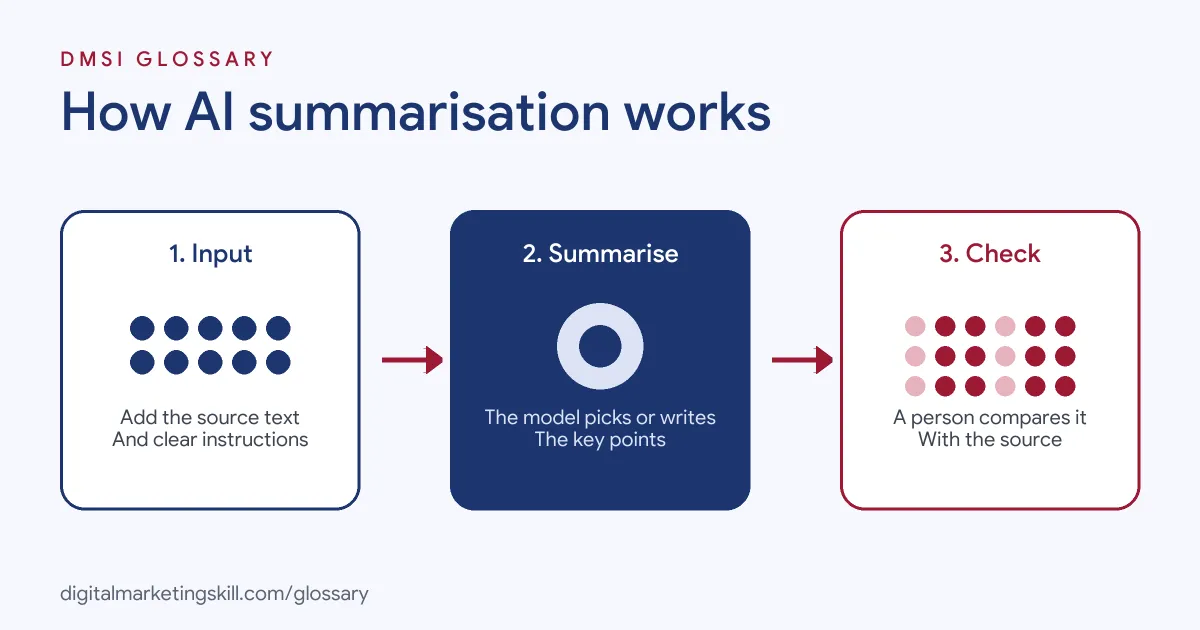
The process has three steps. First, you give the tool the source text and clear instructions. Next, the model either selects key sentences or writes a new summary. Finally, a person checks the result against the source before using it.
Extractive Summaries
Extractive tools score each sentence for importance. Microsoft explains that a rank score “indicates how relevant a sentence is to the main topic”. So if you ask for a three-sentence summary, the tool returns the three highest-scoring sentences. Because the sentences come straight from the source, the wording stays accurate, although the result can feel choppy.
Abstractive Summaries
Abstractive tools write fresh sentences, much as a person would. This reads more naturally. However, it also brings risk. A well-known study by Maynez and colleagues found that summarisation models “are highly prone to hallucinate content that is unfaithful to the input document”. In other words, the summary may include facts that the source never said.
Prompting for Better Summaries
The way you ask matters. Anthropic’s documentation suggests that, for long document tasks, you “ask Claude to quote relevant parts of the documents first” before it carries out the task. It says this “helps Claude focus on the relevant content and ignore the rest of the document”. Anthropic also shows wrapping each document in tags with its source, so the model can keep several documents apart.
What Summaries Leave Out
Every summary is a choice about what to drop. So a short version may lose an exception, a condition or a warning that mattered in the original. This is true for people as well as for AI. However, AI tools make it very easy to produce summaries quickly, which can tempt teams to skip reading the source altogether. The safest habit is simple: use the summary to decide what to read closely, not as a reason to stop reading.
AI Summarisation Examples
Here are three made-up examples of how marketers use AI summaries:
- Customer reviews: An online shop summarises a month of reviews into top likes and complaints. Then it uses the themes in its product pages and ads.
- Sales calls: A B2B team transcribes discovery calls and asks for a summary of each prospect’s goals, budget and next step. The notes go straight into the CRM.
- Content research: A content writer summarises five long industry reports. She then checks each key point against the original before quoting it in a blog post.
In each case, the summary speeds up the work. The final check keeps it trustworthy.
Extractive vs Abstractive AI Summarisation
Here is how the two approaches compare:
| Feature | Extractive | Abstractive |
|---|---|---|
| How it works | Picks the most important original sentences | Writes new sentences that capture the meaning |
| Wording | Exactly as in the source | New wording, often smoother |
| Main risk | Can feel disjointed or miss context | Can add details that are not in the source |
| Best for | Legal, technical or quoted material | Briefings, notes and readable overviews |
In practice, many teams use abstractive tools for speed, then check key facts against the source, which brings back some of the safety of extractive methods.
How to Use AI Summarisation Well
Follow these steps for reliable summaries:
- Say who the summary is for. A summary for a client differs from one for your own notes.
- Set the format and length. For example, ask for five bullet points of no more than 15 words each.
- Label each source. If you add several documents, mark where each one starts and ends.
- Ask for quotes first. Get the model to pull the relevant passages before it summarises.
- Request what matters. Ask for key numbers, decisions, risks or next steps.
- Check against the source. Verify every name, figure and claim.
- Keep the original. Link or store the full source, so others can check it.
After that, save the prompts that work well. Over time, you build a set of reliable templates for each type of summary.
Best Practices for AI Summarisation
- Treat summaries as drafts. They save time, but they are not final until checked.
- Protect private data. Do not paste confidential client or customer details into tools your company has not approved.
- Prefer quotes for claims. When a summary supports a public claim, quote the source directly.
- Watch for missing points. A summary can drop an important exception or warning.
- Be open with clients. Tell them when a report summary was produced with AI.
Common Mistakes to Avoid
A common mistake is sharing a summary without reading the source. As a result, an invented number or quote can reach a client or a published post. Another mistake is giving vague instructions, which leads to generic summaries. Some people also paste in far too much at once without labelling it, so the model mixes up sources. Finally, many forget that a summary reflects only what it was given. If the source is wrong, the summary will be wrong too.
How to Check an AI Summary Quickly
You do not need to reread everything. Instead, follow a short routine. First, check every number and name against the source. Next, pick the two most important claims and find them in the original. Then ask, “Is anything important missing?” Finally, compare the length and tone with what the reader needs. If any check fails, fix the summary or ask the tool to try again with clearer instructions.
Where You’ll Use AI Summarisation at Work
Summarising appears in many remote job ads, often alongside AI tools. For example, listings mention:
- Using “approved AI tools to support meeting notes, follow-up drafting, customer resource preparation, summarization, and routine account administration” (Customer Success Specialist).
- Writing “clear, standalone summaries that capture the absolute essence of a media item” (Broadcast Monitor).
So whether you aim to be a Digital Marketing Manager, Growth Marketer or Freelance Digital Marketer, you will summarise research, calls and reports, and you will be trusted only if your summaries are accurate.
Learn It in the Full Stack Programme
AI fundamentals, including strategy and planning, are part of every track. The Full Stack (all four tracks) programme covers all ten courses, with one portfolio project from each track. In addition, you get unlimited 1-on-1 mentoring and a U.S. Project Internship from day one.
For practical tips, read our guides to AI writing tools and ChatGPT prompts for marketers. You can also learn why an AI hallucination happens.
Frequently Asked Questions
What is AI summarisation in simple terms?
It is using AI to shorten long text, audio or video into the key points, either by picking key sentences or by writing a new summary.
What is the difference between extractive and abstractive summaries?
Extractive summaries reuse the most important original sentences. Abstractive summaries write new sentences that capture the meaning.
Can AI summaries be wrong?
Yes. Research has found that summarisation models can add details that are not in the source, so always check key facts.
How do I get better summaries from an AI tool?
Give clear instructions, set the length and format, label each source and ask the model to quote relevant parts first.
Is it safe to summarise client documents with AI?
Only with tools your company has approved for that data. Remove sensitive details if you are unsure.
Sources: Microsoft Learn: Summarization overview; Maynez et al.: On faithfulness and factuality in abstractive summarization; Anthropic Docs: Prompting best practices; remote job listings on Himalayas.