
International SEO is the work of setting up a website so search engines can show the right language or country version of each page to the right people. If you sell in more than one country, or write in more than one language, this decides which page a searcher actually sees. As a result, it can make the difference between a page that ranks abroad and one that never shows up. It also stops your own versions from competing with each other.
Key Takeaways
- International SEO helps search engines match each page to the right language and country.
- You choose a URL structure: a country domain, a subdomain or a subdirectory.
- Hreflang tags tell Google which versions of a page belong together.
- Google advises against redirecting users by IP address or browser language.
- Real translation and local content matter as much as the technical set-up.
What Is International SEO?
Most search engine optimisation work assumes one site, one language and one market. International SEO adds a new question. Which version of a page should a searcher in France, Germany or Brazil see?
So you need to answer two things. First, which language is each page written in? Second, which country is it meant for? Some sites only change language. For example, a blog might have English and Spanish versions for anyone. Other sites change country too. For instance, a shop might have one English page for the UK in pounds and another for Australia in dollars.
Think of a hotel lobby with signs in several languages. A guest looks for their own language and follows that sign. In the same way, international SEO puts clear signs on your site, so search engines can send each visitor to the right door.
Google gives clear guidance here. It says you should “use hreflang annotations to help Google Search results link to the correct language version of a page.” In short, you tell Google how your versions fit together, and it uses that to choose the best one for each searcher.
Why It Matters
Without this work, Google may show your UK page to people in the USA. Then they see the wrong prices, spelling and delivery terms. Also, similar pages in the same language can look like copies of each other. However, a clear set-up shows they serve different markets. That means better clicks, fewer bounces and more sales in each country.
How International SEO Works
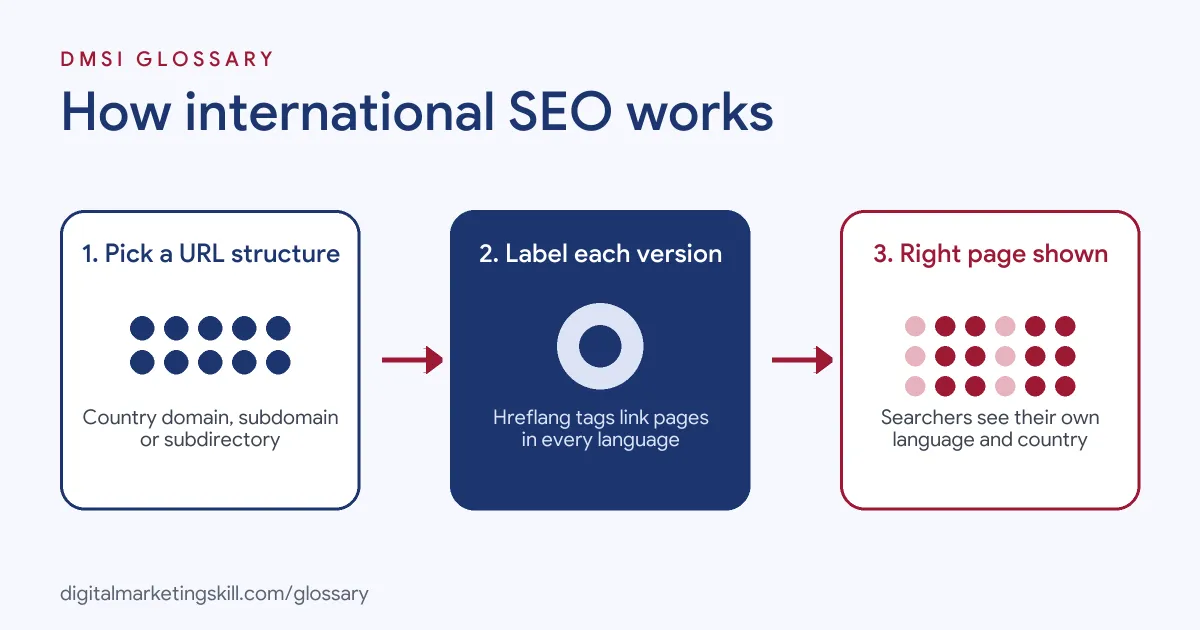
International SEO works through a few signals that point search engines to the right version. First, you pick a URL structure. Then you label each version, and finally you make the content truly local.
Step 1: Choose a URL Structure
Google lists several options. A country-code domain, such as example.de, gives “Clear geotargeting.” However, Google notes it is “Expensive” and “Can only target a single country.” A subdomain, such as de.example.com, is another choice. Still, Google warns that “Users might not recognize geotargeting from the URL alone.” A subdirectory, such as example.com/de/, is “Low maintenance” because it sits on the same host. Finally, URL parameters such as ?loc=de are “Not recommended.”
Step 2: Label Your Versions
Next, you add hreflang annotations. These tell Google which pages are versions of each other. You can add them in the HTML head, in HTTP headers or in an XML sitemap. Google says “The three methods are equivalent from Google’s perspective.” Each tag uses a language code, and you can add an optional region code. For example, “en-gb” means English for the UK.
The links must go both ways. In Google’s words, “If two pages don’t both point to each other, the tags will be ignored.” Also, the reserved x-default value names the page to show when no other version matches.
Step 3: Send Local Signals
Google also looks at other clues. These include “local addresses and phone numbers on the pages,” local language and currency, and links from local sites. By contrast, Google says it ignores location meta tags such as “geo.position.” So local content does more than any hidden tag.
Step 4: Let Users Choose
Finally, Google says “Avoid automatically redirecting users from one language version of a site to a different language version of a site.” It also notes that “Most, but not all, Google crawls originate from the US.” So if you force visitors to a page by their IP address, Google may never see your other versions. Instead, show a simple banner or menu that lets people switch.
Examples of International SEO
- An online clothing shop. The shop sells in the UK, Ireland and Australia. So it builds subdirectories such as /en-gb/ and /en-au/, each with local prices and sizes. Then it adds hreflang tags so each country sees its own page.
- A software company with a help centre. The help articles exist in English, French and German. Because the content is the same everywhere, the team uses language-only codes such as “fr” and “de.” In addition, an x-default page shows a language picker.
- A travel firm entering a new market. The firm buys a country domain for Spain. Next, it hires native writers rather than using raw machine translation. It also does fresh keyword research, because Spanish searchers use different words for the same trips.
International SEO vs Local SEO
| Point | International SEO | Local SEO |
|---|---|---|
| Main goal | Reach searchers in other countries or languages | Reach searchers near a physical place |
| Key tools | Hreflang, URL structure, translation | Business Profile, reviews, local listings |
| Typical scale | Whole site in many versions | One or a few locations |
| Main risk | Wrong version shown in the wrong market | Not showing in map results |
| Who uses it | Global brands, online shops, software firms | Shops, clinics, trades, restaurants |
The two can work together. For example, a chain with stores in several countries needs both. You can read more in our guide to local SEO.
How to Do International SEO
- Pick your markets. Use your analytics and sales data to see where demand already comes from. Then decide which countries and languages to target first.
- Decide language or country. If content is the same everywhere, target by language. If prices, laws or products change, target by country as well.
- Choose a URL structure. Compare country domains, subdomains and subdirectories. For many teams, subdirectories are the simplest to run.
- Translate and localise. Use native speakers, local currency and local examples. Also, research local keywords for each market.
- Add hreflang tags. List every version on every page, including the page itself. Then add an x-default for users who match no version.
- Check canonicals. Each version should point its canonical tag to itself, not to another language.
- Add a language switcher. Use real links, so both users and bots can reach every version.
- Monitor results. Use Google Search Console to filter performance by country. After that, fix any market where the wrong page appears.
Best Practices for International SEO
- Keep one version per URL. Each language or country version should have its own clear address.
- Use the right codes. Language codes follow ISO 639-1, and region codes follow ISO 3166-1 Alpha 2, so “en-gb” works but “en-uk” does not.
- Make links go both ways. Every page in a set should list all the others, and itself.
- Localise, don’t just translate. Change prices, units, spelling and examples to fit each market.
- Link between versions. Simple menus and internal linking help bots find every version.
- Audit often. New pages and site changes can break tags, so check them after each release.
Common Mistakes to Avoid
- Forced redirects. Sending people to a version by IP can hide your other pages from Google.
- One-way hreflang. If page A points to page B but not back, Google ignores the tags.
- Wrong country codes. A typo like “en-uk” makes the tag useless.
- Canonicals to one language. Pointing all versions to the English page tells Google to drop the others.
- Raw machine translation. Clumsy text can put off readers and weaken trust.
- Copying keywords across markets. People in each country may search with very different words.
Where You’ll Use International SEO at Work
International SEO shows up in senior SEO and technical SEO roles, often next to hreflang and localisation skills. For example, real remote job listings ask for:
- “background in international SEO across multiple markets and languages” (Senior SEO Strategy Lead (SEO, AEO, GEO)).
- “Own international SEO architecture, GEO strategy, hreflang, and localization to support launches in new markets.” (Head of SEO).
- “Experience working with multi-language or international SEO (or confidence in learning quickly).” (SEO Specialist).
Learn It in the WordPress and SEO Track
You can learn international SEO, along with wider technical SEO, in the AI-Powered WordPress and SEO Specialist track. Every track includes a U.S. Project Internship from day one, with unlimited 1-on-1 mentoring.
Frequently Asked Questions
What is the best URL structure for international SEO?
There is no single best choice. Country domains give the clearest signal, but subdirectories are often the easiest to manage on one site.
Do I need hreflang for international SEO?
It is strongly advised when you have several language or country versions. Hreflang helps Google show the right version, but it does not replace good local content.
Can I use the same English page for the UK and the USA?
Yes, if the content is the same. However, if prices, spelling or delivery terms differ, separate pages with hreflang give a better experience.
Should I redirect visitors by their location?
Google advises against automatic redirects. Instead, suggest a version with a banner and let visitors choose.
Is machine translation good enough?
It can be a starting point. Still, a native speaker should review the text, so it reads naturally and uses local search terms.
Sources: Google Search Central: Managing multi-regional and multilingual sites; Google Search Central: Tell Google about localized versions of your page; Google Search Central: International and multilingual sites; remote job listings on Himalayas, Himalayas and Himalayas.