
Programmatic SEO is a way of building many search-focused pages at once from a template and a structured set of data. Instead of writing each page by hand, you design one strong layout and fill it with rows from a database or spreadsheet. As a result, a small team can target thousands of specific searches. However, it only works when each page gives real value, so quality control matters as much as scale.
Key Takeaways
- Programmatic SEO uses one page template plus a dataset to create many pages.
- It suits searches that follow a pattern, such as “[service] in [city]” or “[tool] vs [tool]”.
- Each page needs unique, useful data, or it can count as scaled content abuse under Google’s spam policies.
- Crawling, indexing and internal links need careful planning on large page sets.
- Start small, measure results, and only then expand to more pages.
What Is Programmatic SEO?
Most SEO pages are written one at a time. Programmatic SEO flips that. First, you find a search pattern with many versions. Then you build one template and a table of data. Finally, you publish one page for each row.
For example, a travel site might want to rank for “weather in Lisbon in spring” and hundreds of similar phrases. Writing each one by hand would take months. So the team builds one weather template and fills it from a climate dataset. Each city and season then gets its own page.
Think of a cookie cutter. You shape the cutter once, and then you press out many cookies. However, the dough still has to taste good. In the same way, your data is what makes each page worth reading.
This approach is closely tied to long-tail keywords. Each phrase may get few searches on its own. Together, though, they can add up to a large share of traffic.
Why It Matters
Programmatic SEO lets you cover a whole topic grid that would be too big to write by hand. Also, it keeps every page consistent in layout, speed and structure. On the other hand, scale cuts both ways. Google’s spam policies say that “Scaled content abuse is when many pages are generated for the primary purpose of manipulating search rankings and not helping users.” So the goal is never page count alone. Instead, the goal is many genuinely useful pages.
When It Is a Bad Fit
Programmatic SEO is not right for every site. For example, if your topic needs deep expert opinion, a template can’t replace a skilled writer. Also, if you have no unique data, your pages will look like everyone else’s. In that case, a few strong hand-written guides will often do better. Likewise, a small local business with five services rarely needs thousands of pages. So before you start, ask two questions. First, is there a real search pattern with many versions? Second, do you have data that makes each version useful? If either answer is no, focus on classic content work instead.
How Programmatic SEO Works
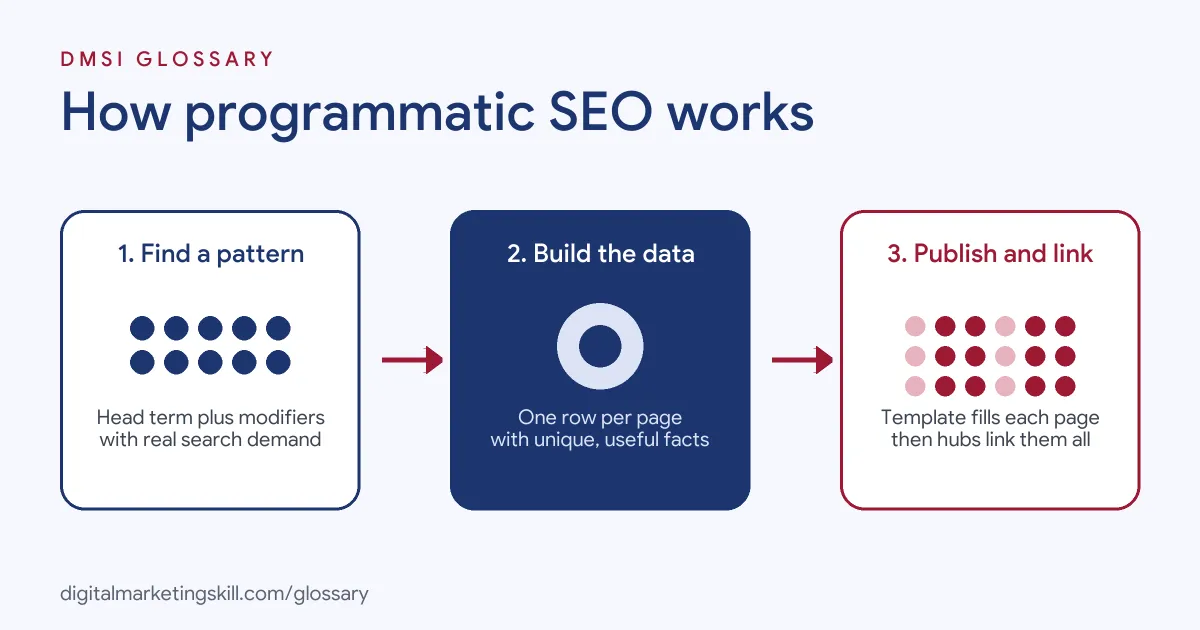
Programmatic SEO follows a simple flow. First you find a pattern, then you gather data, and finally you publish pages from a template. Each step has its own risks, so it helps to look at them one by one.
Step 1: Find a Search Pattern
Start with keyword research. Look for a “head” term plus a changing part, called a modifier. For instance, “accountant in Leeds” and “accountant in Bristol” share a head term. The city is the modifier. Also, check the search intent behind the pattern. If people want a list, a comparison or a price, your template must give them that.
Step 2: Build the Dataset
Next, gather the data that fills each page. It might come from your own product catalogue, a public dataset or your own research. Each row should hold facts that change from page to page. For example, a row could include a city name, local prices, opening hours and nearby options. Thin data leads to thin pages, so this step decides your quality.
Step 3: Design the Template
Then you design one page layout. It sets where the title, headings, tables and text go. Good templates mix fixed parts with data-driven parts. In addition, they leave room for unique notes, images or reviews. Many teams build this in a content management system such as WordPress, using custom fields.
Step 4: Publish, Link and Monitor
Finally, you publish the pages and connect them. Hub pages and category pages link down to each one, so search engines can find them. You also add them to your XML sitemap. After that, you track which pages get indexed and which get traffic. Google’s crawl guidance advises site owners to “Eliminate duplicate content to focus crawling on unique content rather than unique URLs.”
Examples of Programmatic SEO
- A local services directory. The site builds one page per trade and town, such as “plumbers in Cardiff”. Each page lists real local businesses, service areas and average call-out details. As a result, it can rank for many local searches at once.
- A software comparison site. The team creates “Tool A vs Tool B” pages from a table of features and plans. Then an editor adds a short, hand-written verdict to the most popular pairs.
- An online shop. The store builds landing pages for each product type and colour, such as “black leather office chairs”. Each page pulls live stock, prices and filters from the catalogue, so the content stays fresh.
Programmatic SEO vs Traditional Content SEO
| Point | Programmatic SEO | Traditional content SEO |
|---|---|---|
| How pages are made | One template plus a dataset | Each page written by hand |
| Number of pages | Hundreds or thousands | Usually dozens |
| Best for | Pattern searches with many versions | Deep guides and opinion pieces |
| Main risk | Thin or duplicate pages at scale | Slow output and high cost per page |
| Key skill | Data, templates and technical SEO | Writing, research and editing |
How to Do Programmatic SEO
- Pick one pattern. Choose a head term with many clear modifiers. Then check that real people search for those versions.
- Check the results page. Search a few versions yourself. If the top results are thin directories, you may have room to do better.
- Source unique data. Find facts that differ for each page. Ideally, use data you own or have collected yourself.
- Write the template. Plan the title, headings, intro, data blocks and calls to action. Also, add a slot for unique text.
- Build a small test batch. Publish twenty to fifty pages first. That way, you can spot problems early.
- Link the pages. Add hub pages, breadcrumbs and related links, so every page is reachable.
- Submit and watch. Add the pages to your sitemap. Next, use Google Search Console to check indexing and clicks.
- Improve, then scale. Fix weak pages, prune empty ones and only then add more rows.
Best Practices for Programmatic SEO
- Lead with value. Ask what a user learns on each page that they can’t get elsewhere.
- Use real data. Never fill pages with guessed or made-up numbers.
- Set clear rules for empty rows. If a row has too little data, don’t publish that page, or mark it noindex.
- Plan your internal links. Strong internal linking helps search engines find deep pages.
- Handle near-duplicates. Where two pages are almost the same, merge them or use a canonical tag.
- Keep data fresh. Schedule updates, so prices, hours and stock stay correct.
- Be open about automation. Google’s AI content guidance suggests explaining how automated content was made.
Common Mistakes to Avoid
- Swapping one word only. Pages that change just the city name look like doorway pages to search engines.
- Publishing everything at once. Thousands of new pages can waste crawl time if many are weak.
- Ignoring search intent. A template that gives a list when people want a price will not rank well.
- Using AI text with no checks. Google warns against using generative AI “to generate many pages without adding value for users”.
- Forgetting maintenance. Old data makes pages wrong, and wrong pages lose trust fast.
- Orphan pages. Pages with no links pointing to them are hard to find and slow to index.
Where You’ll Use Programmatic SEO at Work
Programmatic SEO appears in growth and senior SEO roles, often at software, marketplace and media firms. For example, real remote job listings ask for:
- “Develop scalable programmatic SEO solutions and ensure fast indexing of dynamic Sportsbook landing pages.” (Head of SEO).
- “Experience with programmatic SEO or large-scale content systems.” (Lead – SEO).
- “Hands-on experience building and scaling programmatic SEO using data-driven, templated pages across large page inventories.” (Organic Growth Specialist).
Learn It in the WordPress and SEO Track
You can learn programmatic SEO, templates and wider technical SEO in the AI-Powered WordPress and SEO Specialist track. Every track includes a U.S. Project Internship from day one, with unlimited 1-on-1 mentoring.
Frequently Asked Questions
Is programmatic SEO against Google’s rules?
No, not by itself. However, Google treats mass pages made mainly to manipulate rankings as scaled content abuse. So each page must help users.
Do I need to code to do programmatic SEO?
Not always. Many teams use spreadsheets, WordPress custom fields and page builders. Still, basic data skills help a lot.
How many pages should I start with?
Start with a small test batch, such as twenty to fifty pages. Then check indexing and clicks before you add more.
Can I use AI to write programmatic pages?
Yes, but with care. Google’s guidance says AI content is fine when it adds value. So check facts and add real data to every page.
What kinds of sites use programmatic SEO?
Directories, travel sites, marketplaces, software firms and online shops often use it. Basically, any site with a big, structured dataset can benefit.
Sources: Google Search Central: Spam policies for Google web search; Google Search Central: Guidance on using generative AI content on your website; Google Search Central: Large site owner’s guide to managing your crawl budget; remote job listings on Himalayas, Himalayas and Himalayas.