
A Neural Network is a type of machine learning model made of layers of connected nodes that learns patterns from data and uses them to make predictions. It is the core technology behind most modern AI, from chatbots to image tools. So when you use AI to write ad copy, sort leads or tag photos, a neural network is usually doing the work. Knowing the basics helps you use these tools well and explain their limits.
Key Takeaways
- A neural network is a machine learning model built from layers of connected nodes.
- It has an input layer, one or more hidden layers and an output layer.
- It learns by adjusting weights to reduce its errors during training.
- Different types suit different data, such as images, text or sequences.
- Large language models and AI image tools are built on neural networks.
What Is a Neural Network?
A neural network is a way for a computer to learn from examples. Instead of following fixed rules written by a person, it finds patterns in data by itself. Then it uses those patterns to make a guess about new data.
In fact, the idea is loosely based on the human brain. Your brain has cells that pass signals to each other. In a similar way, a neural network has simple units, called nodes or “neurons”, that pass numbers to each other. However, it is a maths model, not a real brain.
Google’s machine learning course gives a simple definition. It says, “Neural networks are a family of model architectures designed to find nonlinear patterns in data.” In plain words, they can spot patterns that are too complex for a straight-line rule.
For example, imagine teaching a child to spot a cat. You don’t list rules about whiskers and ears. Instead, you show many pictures and say “cat” or “not cat”. After a while, the child learns. A neural network learns in much the same way, only with far more examples.
Neural networks are a part of machine learning, which is itself a part of artificial intelligence. When a network has many hidden layers, people call it deep learning.
Why It Matters for Marketers
Why should a marketer care? Because many tools you use every day rely on neural networks. For example, ad platforms use them to predict who is likely to click or buy. Also, writing assistants and image tools are built on them. So a basic understanding helps you judge outputs, spot errors and explain results to clients. You don’t need to build one. Still, you should know what they can and can’t do.
How a Neural Network Works
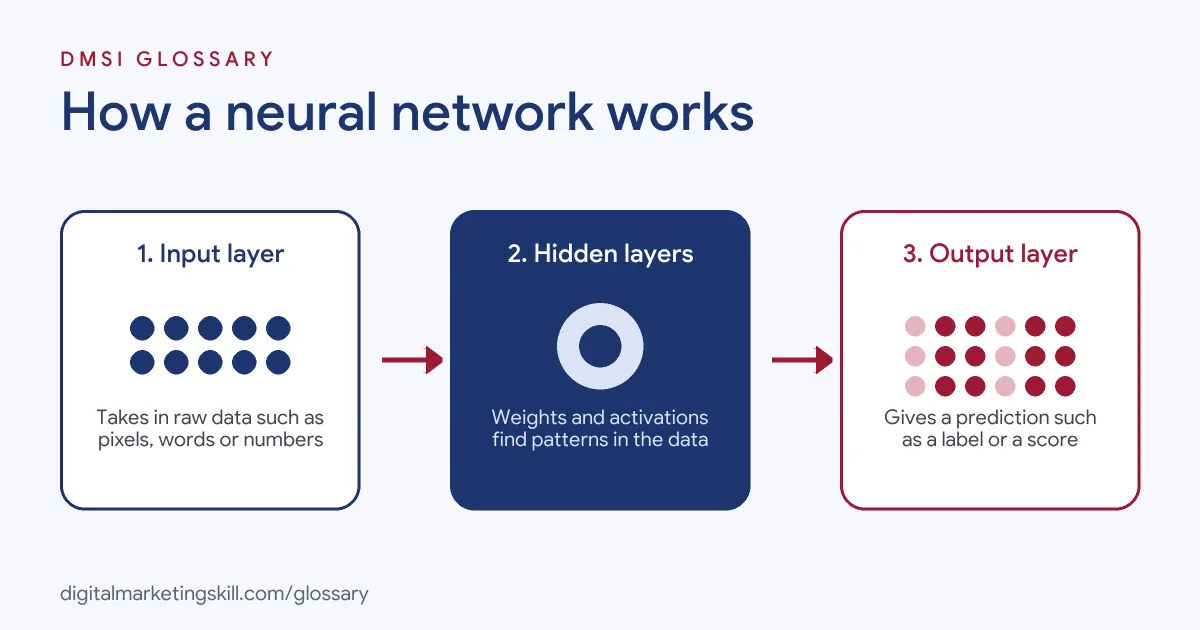
A neural network works by passing data through layers. First, the input layer takes in the data. Next, hidden layers combine and transform it. Finally, the output layer gives a prediction.
Layers and Nodes
In short, each layer holds a set of nodes. The input layer receives raw features, such as the pixels of an image or the words in a sentence. Then each hidden layer mixes those inputs using numbers called weights. In addition, an activation function decides how strongly each node passes its signal on. As a result, the network can learn complex, non-straight patterns. Finally, the output layer turns everything into an answer, such as “cat” or a score from 0 to 1.
Training
At first, the weights are random, so the guesses are poor. So the network trains on many labelled examples. For each one, it makes a guess and measures how wrong it was. Then it adjusts its weights to do a little better next time. Google calls backpropagation “the most common training algorithm for neural networks.” In simple terms, it works out which weights caused the error and nudges them in the right direction. After many rounds, the network gets much more accurate.
Types of Neural Networks
However, different tasks need different designs. For instance, convolutional neural networks are good with images. Recurrent neural networks handle sequences, such as speech or time series. Also, transformers use a method called attention to handle text. They power most large language models today. Many networks also turn words or images into number lists called embeddings, so they can compare meaning.
Limits to Know
Even so, neural networks have limits. For example, they can only learn from the data they see. So biased or poor data leads to biased or poor results. In addition, a network can “overfit”, which means it learns the training data too closely and then fails on new data. Also, it is often hard to explain exactly why a network made a decision. That is why human review still matters.
Examples of Neural Networks in Marketing
- An online shop with product photos. The shop uses an image model to tag photos by colour and style. As a result, shoppers can filter products more easily, and the team saves hours of manual work.
- A subscription business. The team uses a model that scores customers by how likely they are to cancel. Then it sends a special offer to the people at highest risk. This is a form of predictive analytics.
- A content agency. Writers use an AI assistant built on a large language model to draft outlines. However, an editor checks every fact and rewrites the copy in the brand’s voice.
Neural Network vs Machine Learning vs Deep Learning
| Point | Machine learning | Neural network | Deep learning |
|---|---|---|---|
| What it is | The broad field of learning from data | One type of machine learning model | Neural networks with many hidden layers |
| Typical data | Tables, numbers, labels | Many kinds of data | Images, text, audio, video |
| Data needed | Can work with smaller sets | Usually more examples | Often very large data sets |
| Marketing example | Simple lead scoring | Churn prediction | Chatbots and image generation |
How to Use Neural Networks in Your Marketing Work
- Start with a clear problem. Pick one task, such as tagging images or predicting churn. Then decide what a good result looks like.
- Check the tools you already have. Many ad platforms, email tools and CRMs already include AI features built on neural networks.
- Gather good data. Make sure your data is accurate, recent and allowed to be used for this purpose.
- Test on a small scale. Run a short trial and compare the results with your current method.
- Review the outputs. Check a sample by hand for errors and bias.
- Measure the impact. Track time saved, accuracy and business results, such as sales or retention.
- Keep a human in the loop. Let people approve key decisions and customer-facing content.
Best Practices for Neural Networks
- Focus on the use case. Choose the tool for the problem, not the other way round.
- Use clean data. Better data usually beats a bigger model.
- Protect privacy. Only use personal data where you have a lawful reason and clear consent.
- Check for bias. Review results across different customer groups.
- Explain the limits. Tell clients and colleagues what the model can and can’t do.
- Keep learning. Pair this topic with generative AI basics, so you understand the tools you use.
Common Mistakes to Avoid
- Treating it like a brain. A neural network finds patterns in numbers. It doesn’t think or understand like a person.
- Trusting every output. Models can be confidently wrong, so check important results.
- Using poor data. Messy or biased data leads to messy or biased predictions.
- Ignoring overfitting. A model that looks perfect in testing may still fail on new data.
- Skipping measurement. Without a clear goal, you can’t tell if the model helps.
- Forgetting privacy rules. Feeding customer data into a tool without checking the terms can create risk.
Where You’ll Use Neural Networks at Work
In practice, most job listings that name neural networks are technical AI roles. For example, real remote job listings ask for:
- “deep expertise in large-scale neural network inference” (Senior Solutions Architect).
- “Demonstrable expertise with at least 3 of the following: convolutional neural networks, foundation models, vector databases, AI evaluation methods, RAG approaches, agentic frameworks, robotics.” (Sr. AI Engineer).
- “Experience training neural network policies on GPU clusters.” (Applied RL Engineer).
As a marketer, you are more likely to work with these teams than to build models yourself. So knowing the basics helps you brief engineers, choose tools and explain AI results to clients.
Learn It in the Full Stack Programme
You can learn how to apply AI tools across marketing in the Full Stack programme, which covers all four tracks. Every track includes a U.S. Project Internship from day one, with unlimited 1-on-1 mentoring.
Frequently Asked Questions
Is a neural network the same as AI?
No. A neural network is one type of machine learning model. Machine learning, in turn, is one part of the wider field of AI.
Do I need to code to use neural networks?
Not for most marketing work. Many tools already use them behind the scenes, so you can use the features without writing code.
What is deep learning?
Deep learning means using neural networks with many hidden layers. It powers tools such as chatbots, image generators and speech recognition.
How does a neural network learn?
It makes a guess, measures the error and then adjusts its weights. This process, called backpropagation, repeats until the guesses get better.
Can neural networks make mistakes?
Yes. They can be wrong, biased or overconfident. That is why you should always review important outputs.
Sources: Google for Developers: Neural networks; Google for Developers: Neural Networks: Training using backpropagation; IBM: What Is a Neural Network?; remote job listings on Himalayas, Himalayas and Himalayas.