
A North Star Metric is the single number a business picks to show the core value customers get from its product, and so its best guide to long-term growth. Teams use it to agree on what success looks like. As a result, product, marketing and sales all pull in the same direction. It also helps you say no to work that won’t move the needle.
Key Takeaways
- A North Star Metric is one main number that tracks the value customers get.
- It should predict future revenue, not just report past results.
- Smaller input metrics sit under it and show teams what to work on.
- Vanity numbers, such as page views or downloads, make poor North Stars.
- A good North Star is easy to explain and something your teams can influence.
What Is a North Star Metric?
Sailors once used the North Star to find their way at night. In the same way, a North Star Metric gives a business one fixed point to steer by. Instead of chasing dozens of numbers, the whole company watches one that matters most.
Mixpanel defines it as “the one measurement that’s most predictive of a company’s long-term success.” Similarly, Amplitude says the metric “represents the value your product provides its customers.” So the best North Star sits where customer value and business growth meet.
Think of a home cooking app. It could track downloads. However, many people download an app and never open it again. A better North Star might be the number of recipes cooked each week. That number rises only when users get real value. And when users get value, they are more likely to stay and pay.
Amplitude also points to examples that are widely cited. For instance, its article lists “nights booked” for Airbnb and “rides per week” for Uber. Each one counts the moment a customer gets what they came for.
Signs of a Good North Star
So how do you know you have picked well? First, the metric should reflect value. In Amplitude’s words, it “represents what customers value about your product.” Second, it should look ahead. In other words, when it rises, revenue should tend to rise later. Third, your teams must be able to change it through their work. Finally, it should be easy to explain. If people need a long talk to understand the number, they won’t use it to make choices.
Also, note that sources don’t always agree on examples. For instance, Mixpanel lists daily active users as a consumer tech example, while Amplitude treats it as a weak choice. So test any metric against your own data before you commit.
Why It Matters
Without a shared goal, teams often chase their own numbers. For example, marketing pushes sign-ups while product focuses on new features. As a result, effort spreads thin. On the other hand, a clear North Star links everyone’s work to one outcome. Also, it makes trade-offs easier. If a project won’t move the North Star, it can probably wait.
How a North Star Metric Works
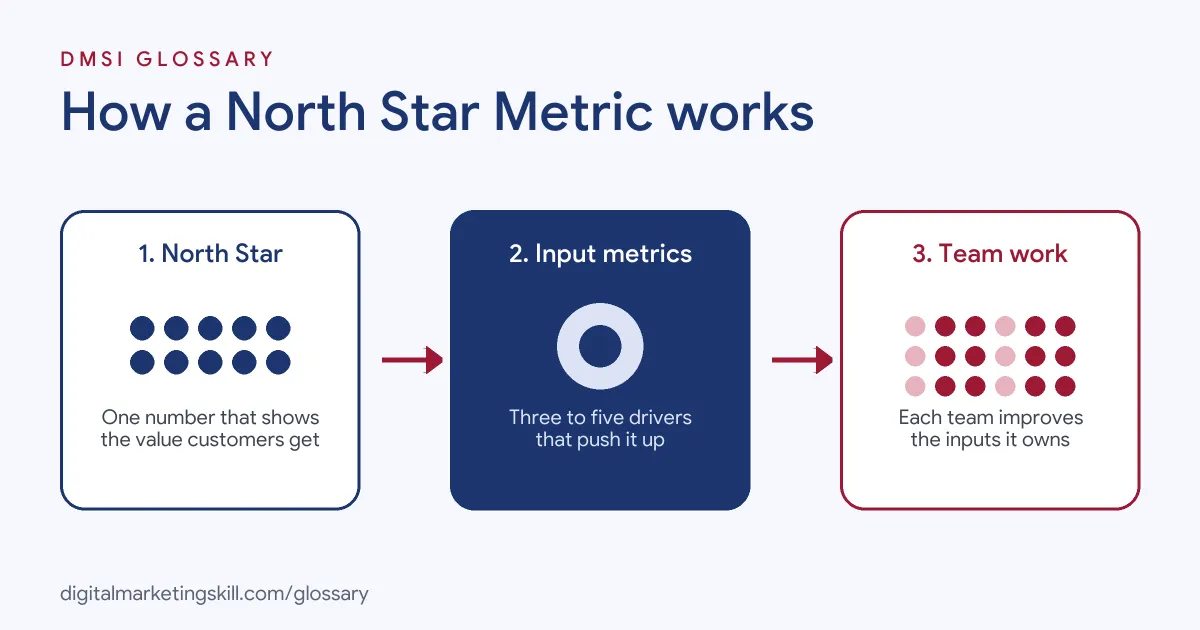
A North Star Metric works as the top of a simple tree. Under it sit a few input metrics that drive it. Then each team owns one or more inputs and runs work to improve them.
The North Star at the Top
First, you choose one metric that reflects customer value. According to Amplitude, a good one is “a leading indicator of revenue.” It is also “within product and marketing’s sphere of influence.” So you can move it with your own work, and it tells you early whether revenue will follow.
Input Metrics Below It
Next, you break the North Star into drivers. Mixpanel explains that “To enable action, you need input metrics.” These are the levers “that teams can directly influence.” For example, a recipe app’s inputs might be new users who cook their first recipe, recipes cooked per active user and users who return each week.
Team Work on the Inputs
Then each team picks the inputs it can affect. For instance, the onboarding team works on first recipes cooked. Meanwhile, the content team adds more recipes people want. In addition, the email team sends reminders to bring users back. As a result, every project links to a clear number.
Regular Reviews
Finally, you track the North Star and its inputs on a marketing dashboard or product report. Review it weekly or monthly. If an input rises but the North Star does not, your tree may be wrong. So you adjust the inputs and test again.
Examples of a North Star Metric
- An online shop. Instead of site visits, it tracks weekly customers who complete a first order. Mixpanel lists a similar ecommerce example. Then its inputs include product page views, add-to-basket rate and checkout completion.
- A team chat tool. It tracks teams that send a set number of messages in their first week. After that, the inputs cover invites sent, first messages and daily use.
- A language learning app. It tracks lessons completed each week. Also, the inputs include new learners finishing lesson one and learners keeping a daily streak.
North Star Metric vs KPI vs Vanity Metric
| Point | North Star Metric | KPI | Vanity Metric |
|---|---|---|---|
| How many | One for the whole business | Several, often per team | Any number |
| What it shows | Core value customers get | Progress on a set goal | Activity that looks good |
| Time view | Leading, predicts growth | Leading or lagging | Often lagging or empty |
| Example | Recipes cooked per week | Email open rate | Total app downloads |
| Use | Aligns the whole company | Tracks team performance | Best avoided for decisions |
In short, a key performance indicator can be one of your inputs. However, the North Star sits above all of them. Meanwhile, vanity metrics can still be useful for spotting trends, as long as no one mistakes them for success. In product-led growth companies, the North Star is often a product action, because the product drives sales.
How to Choose a North Star Metric
- Define your core value. Write one sentence on what customers get from your product.
- Find the value moment. Pick the action that shows a customer got that value.
- Turn it into a number. Count that action over a set period, such as per week.
- Test it against revenue. Check whether the number tends to rise before revenue does.
- Check you can move it. Make sure your teams can influence it with their work.
- Map the inputs. List three to five drivers that push the North Star up.
- Share it widely. Explain the metric and why it matters to every team.
- Review and refine. Revisit the choice when your product or market changes.
Best Practices for a North Star Metric
- Keep it simple. Anyone in the company should be able to explain it in one sentence.
- Measure value, not activity. Count what customers achieve, not just clicks or visits.
- Pair it with health checks. Watch churn rate and costs, so growth doesn’t hide problems.
- Link it to revenue. Track how changes in the North Star relate to customer lifetime value.
- Make inputs owned. Give each input metric a clear team owner.
- Use clean data. Set up tracking in a tool such as Google Analytics 4 or a product analytics platform.
Common Mistakes to Avoid
- Picking a vanity metric. Amplitude warns: “Be wary of choosing vanity metrics for your North Star Metric.”
- Using revenue alone. Revenue lags behind. As Amplitude puts it, “With revenue, what’s done is done.”
- Choosing too many. Several North Stars split focus, which defeats the point.
- Skipping input metrics. Without inputs, teams don’t know what to work on.
- Never changing it. As the business grows, the best North Star can shift.
- Gaming the number. If a push lifts the metric but not customer value, the gain won’t last.
Where You’ll Use a North Star Metric at Work
North Star Metrics come up in growth, product and analytics roles, especially at software and app firms. Remote listings that name the term are still fairly rare. When they do, it usually sits next to growth frameworks such as AARRR and A/B testing, as one growth strategist listing shows.
\n
So expect to know the AARRR model, growth trees, North Star Metrics and A/B testing for these roles. Also, growth marketers, product managers and data analysts often set or report on a North Star.
Learn It in the Google Ads and Analytics Track
You can learn to set up tracking, build dashboards and choose the metrics that matter in the AI-Powered Google Specialist track. Every track includes a U.S. Project Internship from day one, with unlimited 1-on-1 mentoring.
Frequently Asked Questions
Can a business have more than one North Star Metric?
Usually, no. The point is to give everyone one shared goal. However, a large firm with very different products may set one per product.
Is revenue a good North Star Metric?
Not on its own. Revenue shows past results, so a value-based metric that predicts revenue is usually better.
What is the difference between a North Star and a KPI?
A KPI tracks progress on one goal. By contrast, the North Star is the one metric that sits above all KPIs.
How often should I review my North Star?
Track it weekly or monthly. Then revisit the choice itself when your product, customers or business model change.
Do small businesses need a North Star Metric?
It helps. Even a small team saves time when everyone knows which number matters most.
Sources: Mixpanel: What is a North Star metric?; Amplitude: What Makes a Good vs Bad North Star Metric; Amplitude: Introducing The North Star Playbook; remote job listings on Himalayas.