Yes, TikTok works as a search engine for millions of people, but it has not replaced Google. Adobe Express’s 2026 survey found that 49% of U.S. consumers have used TikTok as a search engine, up from 41% in 2024. Yet the same survey found that 89% of Gen Z still prefer Google over every other platform, and only 4% of Gen Z prefer TikTok to Google. The real picture is that TikTok has become a second search engine: people use it to find tutorials, product reviews, recipes, places and real-life experiences, then often check details on Google. This guide explains how TikTok search works, what the latest data really says, why people search there, how it differs from Google, and what marketers and small businesses should do about it.
If you market to anyone under 45, ignoring TikTok search means ignoring a place where your customers are actively looking for answers. But treating it as “the new Google” leads to bad decisions too. The opportunity is in understanding exactly which searches happen where.
Key Takeaways
- Adobe Express’s survey of 807 U.S. consumers, collected in January 2026, found 49% have used TikTok as a search engine, up from 41% in 2024.
- The same survey found 89% of Gen Z prefer Google over all other platforms, and Gen Z’s preference for TikTok over Google fell from 8% in 2024 to 4% in 2026.
- Research by TikTok and WARC, reported by Tubefilter in 2025, found 90% of Gen Z use Google Search weekly and 86% search on TikTok weekly.
- Adobe found the content people most want from TikTok search is video tutorials (61%), product reviews (45%) and personal stories (41%).
- Small business owners surveyed by Adobe put an average of 15% of their SEO budget into TikTok search optimisation.
In this guide
- Is TikTok a Search Engine?
- What the Data Says About TikTok Search
- Why People Search on TikTok
- What People Search for on TikTok
- TikTok Search vs Google Search
- How TikTok Search Works
- What Most Guides Miss
- What TikTok Search Means for Marketers
- How to Show Up in TikTok Search: 9 Steps
- Which Businesses Benefit Most
- Limits and Risks of TikTok Search
- How to Measure TikTok Search Performance
- An Illustrative Example
- Frequently Asked Questions
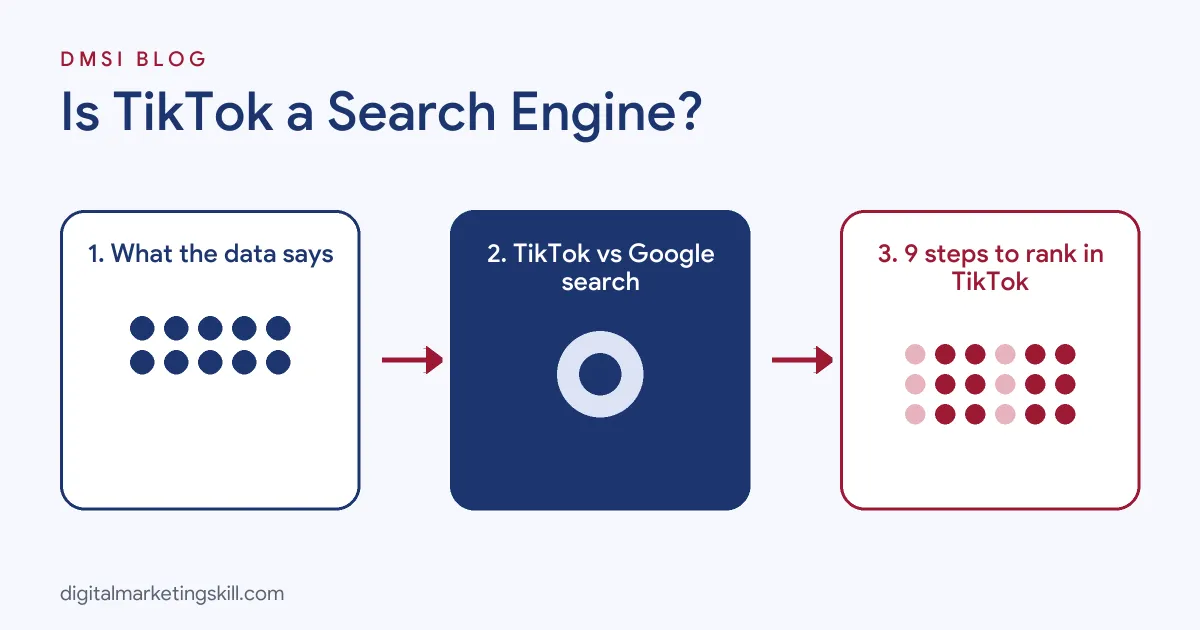
Is TikTok a Search Engine?
A search engine is any system that lets people type a query and returns relevant results. By that definition, TikTok is a search engine: it has a search bar at the top of the app, autocomplete suggestions, results tabs for videos, users, sounds, shops, places and hashtags, and a ranking system that decides which videos appear first. TikTok also adds search prompts inside comments and captions (“Others searched for”) that send viewers into new searches.
The difference is scope. Google indexes the open web: billions of pages, maps, products, news and videos from many sites. TikTok searches only its own content, mainly short videos made by creators and brands. So TikTok is best described as a platform search engine, like YouTube, Amazon or Pinterest, rather than a general web search engine.
That distinction matters. People do not go to TikTok to find a tax form or a company’s opening hours. They go there to see something: how to do a hairstyle, what a hotel room really looks like, whether a product is worth buying, which street food stall is best in a city.
What the Data Says About TikTok Search
Headlines often claim that Gen Z has abandoned Google. The research tells a more balanced story.
| Source | Finding |
|---|---|
| Adobe Express survey (data collected January 2026, 807 U.S. consumers) | 49% of consumers used TikTok as a search engine, up from 41% in 2024 |
| Adobe Express survey, 2026 | 89% of Gen Z prefer Google over all other platforms; only 4% of Gen Z prefer TikTok over Google, down from 8% in 2024 |
| Adobe Express survey, 2026 | 25% of Gen Z found TikTok effective for finding information, versus 17% of millennials, 12% of Gen X and 5% of baby boomers |
| Adobe Express survey, 2026 | 14% of consumers are more likely to rely on ChatGPT than Google as a search engine |
| TikTok and WARC research, reported 2025 | 90% of Gen Z use Google Search weekly; 86% search on TikTok weekly |
| Google internal data shared by Prabhakar Raghavan, 2022 | Almost 40% of young people looking for a place to eat use TikTok or Instagram rather than Google Maps or Search |
| Forbes Advisor and Talker Research survey, April 2024 | 45% of Gen Z were more likely to use social search than Google |
Put together, the data shows two things at once. TikTok search is mainstream and growing, especially for discovery and inspiration. And Google remains the default for most people, including Gen Z. Searchers move between platforms depending on what they need, and AI assistants are now a third option competing for the same questions.
Why People Search on TikTok
Adobe’s survey asked consumers why they use TikTok over traditional search. The top reasons were the short video format (26%), storytelling (21%) and interactive experiences (17%). Among Gen Z, 21% also cited personalised content. In practice, these reasons break down into five motivations:
- Seeing beats reading. A 30-second video showing how to tie a tie, fix a tap or style an outfit is faster than a 2,000-word article.
- Real people feel more trustworthy. Many users trust a creator who shows a product in real life more than a polished brand page or an ad-filled results page.
- Discovery, not just answers. TikTok search results invite browsing. You go looking for one recipe and find five ideas you had not considered.
- Personalisation. TikTok tailors results to your interests and location, so results feel relevant.
- Habit. People who spend an hour a day on the app naturally search there first, without switching apps.
What People Search for on TikTok
Adobe found the most-wanted content types in TikTok search were video tutorials (61%), product reviews (45%), personal stories (41%) and influencer recommendations (33%). The most common search categories include:
| Category | Example searches | Why TikTok wins here |
|---|---|---|
| Food and recipes | “easy chicken dinner”, “jollof rice recipe” | Step-by-step visuals |
| Beauty and fashion | “curly hair routine”, “outfit ideas for work” | See results on real people |
| Travel and local places | “things to do in Lisbon”, “best brunch near me” | Authentic look at places |
| Product reviews | “best budget headphones”, “is this worth it” | Unboxings and honest opinions |
| DIY and home | “how to clean grout”, “small room ideas” | Quick demonstrations |
| Learning and careers | “how to learn Excel fast”, “remote job tips” | Bite-sized explanations |
| Fitness and wellness | “10 minute workout”, “morning routine” | Follow-along content |
Notice what is missing: complex research, official information, detailed comparisons, local business details and anything that needs a reliable written source. Those searches still go mostly to Google and, increasingly, to AI assistants.
TikTok Search vs Google Search
| Factor | TikTok search | Google search |
|---|---|---|
| What it searches | TikTok videos, creators, sounds, hashtags, shops and places | The open web, plus maps, shopping, news, images and video |
| Main format | Short vertical video | Web pages, AI answers and mixed media |
| Best for | Inspiration, tutorials, reviews, real experiences | Facts, research, comparisons, local details, official information |
| Ranking signals | Relevance, engagement, user interests, recency, account activity | Relevance, quality, links, expertise, page experience |
| Personalisation | Very high | Moderate |
| Speed to visibility | Can be days for a new video | Often months for a new page |
| Lifespan of content | Shorter, though search can extend it | Longer for evergreen pages |
| Path to purchase | TikTok Shop, links in bio, profile links | Direct website visits, shopping ads, maps |
| Misinformation risk | Higher, as anyone can post claims | Lower, though not zero |
The two platforms are increasingly connected. TikTok videos now appear in Google results, especially in video carousels and short-video sections, so a well-optimised TikTok video can be found on both. And Google’s own AI features, such as Google AI Mode, sometimes cite short videos in their answers.
How TikTok Search Works
TikTok has not published a full ranking formula, but its own guidance and creator testing point to these main factors:
- Text relevance. TikTok reads your caption, hashtags, on-screen text, auto-generated captions (from what you say) and sometimes the text in comments. Words that match the query help the video rank.
- Engagement. Watch time, completion rate, rewatches, likes, comments, shares and saves signal that a video satisfies viewers.
- User interests. Results are personalised based on what each person watches, follows and searches.
- Freshness. Newer videos often get a chance to rank, especially for trending topics.
- Location and language. Local searches and language settings shape results.
- Account signals. Accounts that post consistently on a topic tend to be associated with it.
For a deep dive into keyword research, profile optimisation and where to place keywords, read our complete guide to TikTok SEO.
What Most Guides Miss
Most articles stop at “Gen Z uses TikTok instead of Google”. Three points are more useful for marketers.
1. TikTok search is a mid-funnel channel. People rarely search TikTok for a brand name to buy right now. They search for ideas, comparisons and proof. That is the moment when a customer forms a shortlist. If your brand is absent from TikTok results for “best X for Y”, you can lose the sale before the customer ever types your name into Google.
2. The journey is multi-platform. A typical path today might start with a TikTok search for inspiration, move to Google or an AI assistant to check details and prices, and finish on a website or shop. Measuring TikTok on last-click sales alone undervalues it. Measuring Google alone misses where the decision began.
3. The trend is not a one-way shift. Adobe’s data shows overall TikTok search use rising, while Gen Z’s outright preference for TikTok over Google fell between 2024 and 2026. The winners are brands that show up on several platforms with content suited to each, not those that bet everything on one.
What TikTok Search Means for Marketers
- Keyword research now includes social platforms. The phrases people type into TikTok are often more conversational and visual than Google keywords.
- Video is part of SEO. Search strategy should cover short-form video as well as web pages.
- Creators matter. Adobe found 38% of small business owners used TikTok influencers for product sales or promotions in 2026, up from 25% in 2024.
- Social proof drives decisions. Reviews and real-life demonstrations are what searchers want.
- Conversion is the hard part. Adobe found the top challenge for business owners was converting TikTok engagement into sales (38%).
For the bigger picture of building a TikTok presence, see our guide to TikTok marketing strategy.
How to Show Up in TikTok Search: 9 Steps
1. Find what your audience searches
Type your topic into the TikTok search bar and note the autocomplete suggestions. Check the “Others searched for” prompts under related videos. If you run ads, TikTok’s Creative Center and Keyword Insights tools show trending phrases.
2. Choose one search phrase per video
Build each video around a single clear query, such as “how to make cold brew at home” or “best laptop for students”. Trying to cover several topics weakens relevance.
3. Say the keyword out loud
TikTok creates captions from speech, so saying the phrase in the first few seconds helps the video match searches and tells viewers they are in the right place.
4. Put the keyword on screen
Add a short text overlay with the main phrase at the start of the video. It helps both viewers and TikTok understand the topic.
5. Write a searchable caption
Use the phrase naturally in a caption that explains what the video shows. Add a few relevant hashtags, not dozens of generic ones.
6. Answer the question fast
Searchers want answers. Show the result or the key point in the first three seconds, then explain. Strong retention is a major ranking signal.
7. Optimise your profile
Include your main topic in your display name and bio, and keep your posting focused. A profile clearly about “budget travel in West Africa” is easier to rank than a mixed account.
8. Encourage comments and saves
Ask a simple question or invite viewers to save the video for later. Saves are a strong sign that a video is useful.
9. Build series around related searches
Create a series of videos that answer connected questions. This builds topical association and keeps viewers watching more of your content. Our guide on how to go viral on TikTok covers hooks and retention in detail.
Which Businesses Benefit Most From TikTok Search
TikTok search can help almost any business that sells to consumers, but some benefit far more than others.
| Business type | Why TikTok search works | Content that ranks |
|---|---|---|
| Restaurants, cafes and bars | People search for places to eat by area | Dish close-ups, “best X in [area]” videos |
| Beauty, skincare and fashion | Visual results matter most | Tutorials, before-and-after, try-ons |
| Travel and hospitality | Searchers want to see the real place | Room tours, itineraries, hidden gems |
| Ecommerce brands | Reviews and demos drive purchases | Unboxings, comparisons, how-to-use videos |
| Education and courses | People search for skills and career tips | Quick lessons, myth-busting, student journeys |
| Home services and DIY | People want to see how problems are fixed | Quick fixes, before-and-after, tips |
| Fitness and wellness | Follow-along formats suit video | Short routines, form tips, day-in-the-life |
B2B companies can benefit too, especially when selling to younger professionals, but usually find LinkedIn, YouTube and Google more important for complex purchases.
Limits and Risks of TikTok Search
- Misinformation. Anyone can post claims, and engaging videos can rank even when they are wrong. This is a risk for searchers and a reputational risk for brands discussed inaccurately.
- Platform dependence. Algorithms, features and regulations change. Building only on TikTok leaves you exposed.
- Short content lifespan. Many videos fade quickly, although search can give evergreen videos a longer life.
- Limited outbound traffic. TikTok is designed to keep people in the app, so sending traffic to your website is harder than with Google.
- Measurement gaps. It is hard to track how a TikTok search influenced a later Google search or sale.
The safest approach is to treat TikTok as one part of a wider search strategy that also includes your website, Google, YouTube, email and AI search visibility. Read more about how AI is changing discovery in our AI search glossary entry.
How to Measure TikTok Search Performance
TikTok analytics show where your video views come from. Look for the traffic source breakdown on each video, which includes Search alongside For You, Following and Personal profile.
| Metric | Where to find it | What it tells you |
|---|---|---|
| Search traffic share | Video analytics, traffic sources | How much of a video’s views came from search |
| Search queries | Video analytics, search queries (where shown) | Which terms led people to the video |
| Average watch time | Video analytics | Whether the video satisfies searchers |
| Saves and shares | Video analytics | How useful viewers found it |
| Profile visits and link clicks | Account analytics | Whether search viewers take the next step |
| Branded search on Google | Google Search Console | Whether TikTok exposure drives people to look you up |
| “How did you hear about us?” | Forms and checkout | Self-reported TikTok influence |
Compare videos built around search phrases with your other content. If search-optimised videos earn steadier views over weeks and months, your TikTok search strategy is working.
Common Mistakes to Avoid
- Believing TikTok has replaced Google. It complements Google for most audiences. Keep your website and Google presence strong.
- Stuffing captions with hashtags. A few relevant tags and a clear caption work better.
- Slow intros. Searchers leave if the answer does not arrive quickly.
- Chasing trends that do not match search intent. Trending sounds can help reach, but searchable videos answer real questions.
- Making ads that look like ads. Native, helpful content usually performs better in search than polished commercials.
- Ignoring comments. Comments add searchable text and reveal follow-up questions to answer in new videos.
- No path to conversion. Make it easy to find your website, shop or booking page from your profile.
One rule to remember
Make the video that best answers what someone typed, show the answer fast, and give them an easy next step. That works on TikTok, on Google and in AI answers alike.
An Illustrative Example
This is an illustrative scenario, not a real business. A small bakery in Manchester posted fun behind-the-scenes TikToks that got likes but few customers. The owner searched TikTok for phrases like “best cakes in Manchester”, “birthday cake Manchester” and “vegan bakery Manchester” and saw that few local bakeries appeared. She started making one short video per week targeting a single phrase, saying it in the first two seconds, adding it as on-screen text and in the caption, and showing the finished cake immediately. She also added “Manchester bakery” to her profile name and linked her order page in her bio. Within three months, around a third of her views came from search, and her order form asked customers where they found her. TikTok became her second biggest source of new orders, while Google remained the first.
Frequently Asked Questions
Is TikTok really a search engine?
Yes, in the sense that it has a search bar, autocomplete and ranked results. But it searches only TikTok’s own content, so it is a platform search engine like YouTube or Pinterest rather than a replacement for Google.
How many people use TikTok as a search engine?
Adobe Express’s 2026 survey found 49% of U.S. consumers have used TikTok as a search engine, up from 41% in 2024.
Is TikTok replacing Google for Gen Z?
Not overall. Adobe found 89% of Gen Z still prefer Google over all other platforms, and TikTok and WARC research found 90% of Gen Z use Google weekly compared with 86% who search on TikTok weekly. Gen Z uses both, for different kinds of searches.
Why do people search on TikTok instead of Google?
Mainly because they prefer short videos, storytelling and real people showing real results. TikTok is especially popular for tutorials, product reviews, recipes, travel and local recommendations.
What do people search for most on TikTok?
Adobe found the most-wanted content types were video tutorials (61%), product reviews (45%), personal stories (41%) and influencer recommendations (33%).
How do I get my videos to show up in TikTok search?
Build each video around one search phrase, say it out loud early, add it as on-screen text and in the caption, answer quickly, use a few relevant hashtags and keep your profile focused on your topic.
Do TikTok videos appear on Google?
Yes. Google often shows TikTok videos in video and short-video results, so a well-optimised TikTok video can be found on both platforms.
Is TikTok search good for small businesses?
Yes, especially for local, visual and consumer businesses such as restaurants, beauty, fashion, travel and ecommerce. Adobe found 58% of small business owners surveyed had used TikTok for business promotion.
Can I advertise in TikTok search results?
Yes. TikTok offers search ads that appear in search results for relevant queries. See our glossary entry on TikTok ads for the main formats.
Is TikTok search reliable?
It can be useful for ideas and real-world experiences, but it is less reliable for facts. Check important information, such as health, money or legal advice, against trusted sources.
Should I focus on TikTok SEO or Google SEO?
Most businesses need both. Google SEO captures research and buying searches; TikTok SEO captures discovery and inspiration searches. Start with whichever platform your audience uses most for your type of product.
Your Next Step
Knowing how to reach customers wherever they search, on Google, TikTok and AI assistants, is a skill employers and clients increasingly look for. The Master Diploma in Digital & AI Marketing at Digital Marketing Skill Institute covers AI-powered Social Media Management and Advertising, Lead Generation and Email Automation, Google, and a WordPress and SEO track where you build and rank a real website.
From day one, you work on a real U.S. company’s project through the U.S. Project Internship, so you finish with real results and a verified U.S. work reference letter. You also get unlimited one-on-one coaching. The program carries dual US and UK accreditation, is recognised in more than 100 countries, and runs 100% online over three months.
You can build those skills wherever you live, anywhere in your country. Read student reviews, then apply for the 65% partial scholarship to see if you qualify.
Sources checked November 2026: Adobe Express survey on using TikTok as a search engine (807 U.S. consumers and 200 small business owners, data collected January 2026), TikTok and WARC research as reported by Tubefilter (2025), Google comments reported by Fortune and other outlets, Forbes Advisor and Talker Research survey (April 2024) as cited by Fortune, and the Found and Forbes articles on social search.