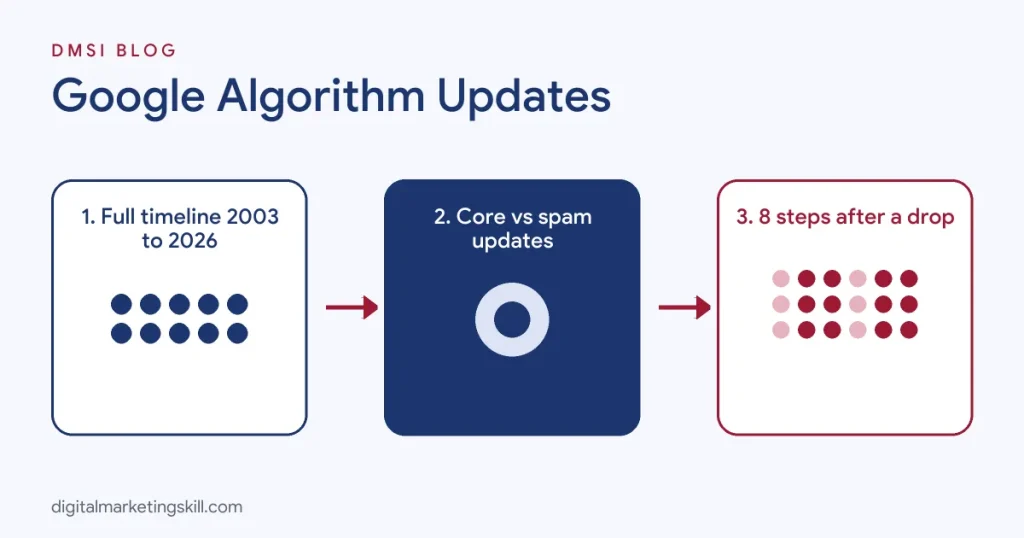
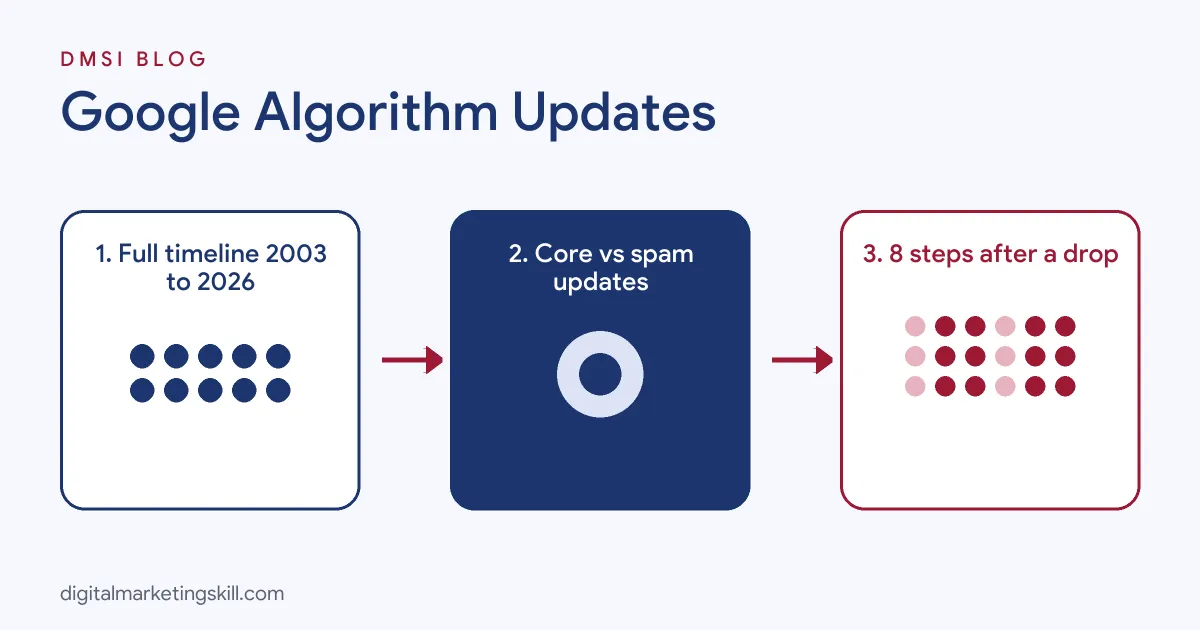
Google algorithm updates are changes Google makes to the systems that decide which pages appear in search results and in what order. Google changes Search thousands of times a year, but only a handful of updates each year are big enough to confirm publicly. These are mainly broad core updates, which reassess content quality across the web, and spam updates, which target manipulative tactics. The most recent confirmed update is the November 2026 core update, which began rolling out on 10 November 2026. This guide gives you the full timeline of confirmed Google algorithm updates from the official Google Search Status Dashboard, explains the landmark updates that shaped modern SEO, and shows you exactly what to do if an update affects your site.
If you work in SEO or content, updates are not something to fear. They are Google’s way of rewarding pages that serve people well. Understanding the pattern behind them is one of the most valuable skills you can build.
Key Takeaways
- Google’s Search Status Dashboard lists the November 2026 core update as starting on 10 November 2026, following core updates in March and May 2026 and spam updates in March, June, August and September 2026.
- Google says it makes broad core updates several times a year, and each one typically takes around two weeks to roll out, though some have taken much longer.
- The March 2024 core update took 45 days to roll out, the longest on the dashboard, and folded the helpful content system into Google’s core ranking systems.
- Google launched 4,725 changes to Search in 2022 alone, about 13 a day, according to figures reported by Search Engine Land.
- Google advises waiting at least one full week after an update finishes rolling out before comparing your Search Console data with the period before it.
In this guide
- What Are Google Algorithm Updates?
- Types of Google Algorithm Updates
- The Latest Update: November 2026 Core Update
- 2026 Google Algorithm Updates
- 2025 Google Algorithm Updates
- 2024 Google Algorithm Updates
- 2023 Google Algorithm Updates
- Landmark Updates That Shaped SEO (2003 to 2022)
- What Most Update Histories Miss
- How to Tell If an Update Affected Your Site
- What to Do After a Google Update: 8 Steps
- How to Make Your Site Update-Proof
- Common Mistakes to Avoid
- An Illustrative Example
- Frequently Asked Questions
What Are Google Algorithm Updates?
Google Search relies on many automated ranking systems that look at hundreds of signals, such as the words on a page, how useful and trustworthy the content is, links from other sites, page experience and the searcher’s location and language. An algorithm update is a change to one or more of these systems. For a short definition, see our glossary entry on the Google algorithm update.
Most changes are tiny and go unnoticed. A few are significant enough that Google announces them, usually on the Google Search Status Dashboard and the Google Search Central blog or social channels. When people talk about “Google algorithm updates”, they usually mean these confirmed, named updates.
How often does Google update its algorithm?
Constantly. Search Engine Land reported that Google made 4,725 launches to Search in 2022, an average of about 13 changes a day, including ranking changes and interface changes. Confirmed updates are far fewer. In recent years Google has typically confirmed two to four core updates a year, plus several spam updates. Since 2024 the pattern has been steady: core updates roughly every two to four months, with spam updates in between.
Why does Google update its algorithm?
Google’s stated goal is to keep showing the most helpful, reliable results as the web, user behaviour and spam tactics change. New content appears every day, people search in new ways (including with AI features like AI Overviews and AI Mode), and some site owners try to game the system. Updates let Google improve how it understands queries, judges quality and filters out manipulation.
Types of Google Algorithm Updates
| Type | What it does | Typical frequency | Example |
|---|---|---|---|
| Core update | Broad changes to how Google assesses content overall; not aimed at specific sites | Several times a year | November 2026 core update |
| Spam update | Improves automated detection of spam and policy violations | Several times a year | September 2026 spam update |
| Discover update | Changes how articles are chosen for the Google Discover feed | Occasional | February 2026 Discover update |
| Helpful content update | Rewarded people-first content; now part of core systems | 2022 to 2023, then merged | September 2023 helpful content update |
| Reviews update | Rewarded in-depth, first-hand reviews; now continuous | 2021 to 2023, then ongoing | November 2023 reviews update |
| Page experience | Added signals like Core Web Vitals and mobile usability | Rolled out 2021 to 2022 | Page experience update |
| Link spam update | Neutralises unnatural links, including with SpamBrain | Occasional | December 2022 link spam update |
| Policy change | New or updated spam policies enforced manually or algorithmically | Occasional | Site reputation abuse policy, 2024 |
The key distinction is between core updates and spam updates. A core update does not mean anything is wrong with your site. Google compares it to updating a list of the best films: some good films drop down not because they got worse, but because newer or better ones appeared. A spam update, by contrast, specifically targets sites that break Google’s spam policies, such as using black hat SEO tactics.
The Latest Update: November 2026 Core Update
Google began rolling out the November 2026 core update on 10 November 2026, according to the Google Search Status Dashboard. It is the third core update of 2026, after the March and May core updates. At the time of writing in late November, the rollout is still in progress, and SEO commentators are reporting notable gains and losses across many sectors as Google reassesses content quality.
If your traffic has moved since 10 November, the most important advice is to wait. Core updates often cause rankings to shift back and forth during the rollout. Google recommends waiting until the update is complete, then at least another week, before analysing the impact. Use that time to collect data rather than make changes.
2026 Google Algorithm Updates
All dates and rollout times below come from the Google Search Status Dashboard.
| Update | Start date | Rollout time | What it meant |
|---|---|---|---|
| November 2026 core update | 10 Nov 2026 | In progress at time of writing | Third broad core update of the year |
| September 2026 spam update | 24 Sep 2026 | 13 days, 16 hours | Global spam update, one of the longer spam rollouts |
| August 2026 spam update | 18 Aug 2026 | 2 days, 16 hours | Short spam update |
| June 2026 spam update | 24 Jun 2026 | 2 days, 1 hour | Short spam update |
| May 2026 core update | 21 May 2026 | 11 days, 21 hours | Second core update of 2026, launched around Google I/O |
| March 2026 core update | 27 Mar 2026 | 12 days, 4 hours | First core update of 2026 |
| March 2026 spam update | 24 Mar 2026 | 19 hours, 30 minutes | One of the fastest spam rollouts on record |
| February 2026 Discover update | 5 Feb 2026 | 21 days, 17 hours | Changed how articles surface in Google Discover |
The 2026 pattern shows Google settling into a rhythm: a core update in spring, early summer and autumn, with frequent short spam updates. The Discover update was notable for publishers, since Discover traffic is separate from regular search traffic and can make up a large share of visits for news and lifestyle sites.
2025 Google Algorithm Updates
| Update | Start date | Rollout time |
|---|---|---|
| December 2025 core update | 11 Dec 2025 | 18 days, 2 hours |
| August 2025 spam update | 26 Aug 2025 | 26 days, 15 hours |
| June 2025 core update | 30 Jun 2025 | 16 days, 18 hours |
| March 2025 core update | 13 Mar 2025 | 13 days, 21 hours |
2025 had fewer confirmed updates than 2024, but the year was dominated by changes to the search results page itself, especially the expansion of AI Overviews and the launch of AI Mode. Many sites saw traffic changes that came from AI features taking clicks, not from ranking changes. Separating these two causes became an important skill.
2024 Google Algorithm Updates
| Update | Start date | Rollout time | Notes |
|---|---|---|---|
| December 2024 spam update | 19 Dec 2024 | 7 days, 2 hours | Came days after the December core update |
| December 2024 core update | 12 Dec 2024 | 6 days, 4 hours | Second core update in a row; Google said it improved different core systems |
| November 2024 core update | 11 Nov 2024 | 23 days, 13 hours | Broad core update |
| August 2024 core update | 15 Aug 2024 | 19 days, 4 hours | Aimed to promote useful content from smaller sites as well as large ones |
| June 2024 spam update | 20 Jun 2024 | 7 days, 1 hour | Spam update |
| March 2024 spam update | 5 Mar 2024 | 14 days, 21 hours | Launched with new spam policies |
| March 2024 core update | 5 Mar 2024 | 45 days | Merged helpful content into core systems; Google said it would reduce unhelpful content by about 40% |
2024 was one of the most disruptive years in SEO history. The March 2024 core update was more complex than usual, updating multiple core systems at once, and it ended the separate helpful content system. At the same time, Google introduced three new spam policies: scaled content abuse (mass-produced pages made mainly to rank, whether by people or AI), site reputation abuse (third-party content published on a strong site to exploit its reputation, sometimes called parasite SEO) and expired domain abuse (buying old domains to boost low-quality content). In May 2024, AI Overviews also launched to all U.S. users.
2023 Google Algorithm Updates
| Update | Start date | Rollout time |
|---|---|---|
| November 2023 reviews update | 8 Nov 2023 | 29 days |
| November 2023 core update | 2 Nov 2023 | 25 days, 21 hours |
| October 2023 core update | 5 Oct 2023 | 13 days, 23 hours |
| October 2023 spam update | 4 Oct 2023 | 15 days, 12 hours |
| September 2023 helpful content update | 14 Sep 2023 | 13 days, 11 hours |
| August 2023 core update | 22 Aug 2023 | 16 days, 3 hours |
| April 2023 reviews update | 12 Apr 2023 | 13 days, 2 hours |
| March 2023 core update | 15 Mar 2023 | 13 days, 7 hours |
| February 2023 product reviews update | 21 Feb 2023 | Around two weeks |
The September 2023 helpful content update hit many independent publishers and affiliate sites hard, and it became the most discussed update of the year. Google also announced that the reviews system would update continuously, so separate reviews updates stopped after November 2023.
Landmark Updates That Shaped SEO (2003 to 2022)
Many older updates are still referenced today because they changed SEO permanently. Here are the ones every marketer should know.
| Year | Update | What it changed | Lasting lesson |
|---|---|---|---|
| 2003 | Florida | Hit keyword-stuffed pages just before the holiday season | Stuffing keywords stopped working |
| 2010 | Caffeine | Rebuilt Google’s indexing system for fresher results | Fresh content could be found faster |
| 2011 | Panda | Targeted thin, low-quality and duplicate content and content farms | Quality content matters more than volume |
| 2012 | Penguin | Targeted manipulative link schemes and over-optimised anchor text | Earn links; do not buy them |
| 2012 | Venice | Mixed more local results into general searches | Local SEO became essential |
| 2013 | Hummingbird | Improved understanding of the meaning of whole queries | Write for topics and intent, not exact keywords |
| 2014 | Pigeon | Tied local results more closely to traditional ranking signals | Local businesses need strong websites too |
| 2015 | Mobile-friendly update | Boosted mobile-friendly pages in mobile results | Mobile experience affects rankings |
| 2015 | RankBrain | Added machine learning to interpret unfamiliar queries | AI became part of ranking |
| 2016 | Possum | Filtered local results by location and duplicate listings | Address and proximity matter in local |
| 2018 | Medic (August core update) | Hit health, finance and other high-stakes sites | Expertise and trust matter most for YMYL topics |
| 2018 | Mobile-first indexing | Google started using the mobile version of pages for indexing | Your mobile site is your main site |
| 2019 | BERT | Improved understanding of language and context in queries | Write naturally for people |
| 2021 | Page experience | Added Core Web Vitals as ranking signals | Speed and stability are part of quality |
| 2021 | Product reviews | Rewarded in-depth reviews with first-hand evidence | Show real experience |
| 2022 | Helpful content | Demoted content made mainly for search engines | Write for people first |
| 2022 | E-E-A-T | Google added Experience to E-A-T in its quality rater guidelines | First-hand experience is a quality signal |
Panda and Penguin later became part of Google’s core algorithm and now work in real time. That is why you no longer hear about “Panda updates”: the principles are built in.
What Most Update Histories Miss
Long lists of dates are useful for diagnosis, but they can hide the real lesson. Three points matter more than any single update.
1. The direction has never changed. From Florida in 2003 to the November 2026 core update, every major update has pushed in the same direction: away from tactics that manipulate rankings and towards content that genuinely helps people. If you study the history, you will notice that the sites that suffer repeatedly are usually chasing shortcuts. The sites that grow through update after update are usually focused on their audience.
2. Not every traffic drop is an algorithm update. Since 2024, AI Overviews and AI Mode have changed click-through rates even when rankings stay the same. Seasonality, tracking errors, site migrations, lost backlinks and competitor improvements also cause drops. Before you blame an update, check whether your rankings fell or only your clicks.
3. Recovery is slow by design. Google has said that core updates assess sites over time, and improvements may not be fully reflected until a later core update. Some sites recover in the next update; others take several. Making quick, cosmetic changes rarely helps. Real recovery comes from meaningful improvements to content, expertise and user experience.
How to Tell If an Update Affected Your Site
Follow this quick diagnosis before you change anything.
- Check the dates. Open the Google Search Status Dashboard and note when the update started and finished. Compare these dates with when your traffic changed.
- Look at Search Console, not just analytics. In the Performance report, compare clicks, impressions and average position for the period after the update with the same length of time before it. A drop in impressions and position suggests a ranking change. A drop in clicks with steady impressions suggests a change to the results page, such as more AI answers or ads.
- Find which pages and queries moved. Use the Pages and Queries tabs to see whether the drop is site-wide or limited to certain sections, topics or page types.
- Check organic behaviour in analytics. Use our guide to Google Analytics for SEO to confirm whether organic sessions and key events fell for the same pages.
- Rule out other causes. Check for tracking errors, site changes, migrations, server downtime, robots.txt mistakes, manual actions in Search Console and normal seasonal patterns.
- Look at who replaced you. Search your main queries and see which pages now rank above you. What do they do better?
| What you see | Likely cause | First step |
|---|---|---|
| Site-wide drop starting on a core update date | Core update reassessment | Review overall content quality and helpfulness |
| Sudden, sharp drop on a spam update date | Spam policy issue | Check for spammy links, scaled content or policy violations |
| Drop in clicks, stable impressions and position | Results page changes, such as AI Overviews | Improve titles and earn citations in AI answers |
| Drop on specific pages only | Competitors improved or intent changed | Compare with the pages now ranking |
| Drop with a message in Search Console | Manual action | Fix the issue and request reconsideration |
| Drop with no update and no message | Technical issue or tracking error | Run a technical SEO audit |
What to Do After a Google Update: 8 Steps
1. Wait for the rollout to finish
Rankings often move up and down during a rollout. Changes you make mid-rollout make it harder to know what helped. Google recommends waiting until the update completes, plus at least a week, before analysing results.
2. Compare like with like
In Search Console, compare the week after the rollout ended with the week before it started, then widen to longer periods. Focus on your most important pages and queries.
3. Review content against Google’s helpful content questions
Google publishes a list of self-assessment questions about content quality. Ask honestly: does this page provide original information or analysis? Does it fully answer the question? Would someone trust it? Was it written mainly to help people or mainly to rank? Would you bookmark it or share it?
4. Strengthen experience and expertise
Add clear author information, first-hand experience, examples, original data and expert review where relevant. For topics that affect money, health or careers, trust signals are especially important.
5. Improve, merge or remove weak pages
Thin, outdated or overlapping pages can drag down how Google sees your site. Improve the ones with potential, merge near-duplicates into stronger single pages and redirect or remove pages that serve no one. Our glossary entry on the SEO audit explains how to find them.
6. Fix technical and page experience issues
Check crawlability, indexing, Core Web Vitals, mobile usability, intrusive pop-ups and broken links. These rarely cause core update drops on their own, but they hold good content back.
7. Clean up spam risks after a spam update
If you were hit by a spam update, look for paid or unnatural links, mass-produced pages, hidden text, cloaking or third-party content that breaks the site reputation abuse policy. Remove the problem rather than trying to hide it.
8. Keep improving and be patient
Track progress monthly. Recovery from a core update often shows up in the next core update, which may be months away. Keep publishing genuinely useful content in the meantime.
How to Make Your Site Update-Proof
No site is completely immune to updates, but some are far more resilient. The common traits are:
- A clear audience and purpose. Every page should serve a specific reader with a specific need.
- Original value. Unique data, experience, examples or opinions that are hard to copy.
- Real expertise. Content written or reviewed by people who know the subject, with their credentials visible.
- Natural links and mentions. A reputation earned through useful content and genuine relationships, not link schemes.
- Diverse traffic sources. Email, social media, partnerships and direct traffic reduce your dependence on Google.
- Regular content maintenance. Updating, merging and pruning pages so the whole site stays strong.
- A good page experience. Fast, stable, mobile-friendly pages without aggressive ads or pop-ups.
Follow the Google Search Status Dashboard, the Google Search Central blog and trusted industry news sources so you hear about updates quickly.
Common Mistakes to Avoid
- Panicking during the rollout. Early movements often reverse.
- Blaming every drop on an update. Check AI features, seasonality, tracking and technical issues first.
- Making cosmetic changes. Changing dates or rewording a few lines will not fix a quality problem.
- Deleting large amounts of content without analysis. Pruning helps only when you remove or merge pages that are genuinely weak.
- Buying links to recover. This risks a spam action on top of the drop.
- Mass-producing AI content to win traffic back. Scaled content abuse is a spam policy. AI-assisted content is fine if it is genuinely helpful and checked by people.
- Ignoring winners. Study the pages that gained, both yours and competitors’, to see what Google now rewards.
One rule to remember
Build for the searcher, not for the update. Sites that consistently help people well tend to gain over time, whatever Google changes next.
An Illustrative Example
This is an illustrative scenario, not a real business. A personal finance blog lost about 35% of its organic traffic during a core update. The owner first checked Search Console and saw that impressions and average position had fallen for many money-saving articles, while a handful of in-depth guides held steady. The pages now ranking above it had named authors with finance qualifications, worked examples and recently updated figures. The blog’s weaker posts were short, anonymous and largely repeated each other. Over the next four months, the owner merged 60 thin posts into 15 comprehensive guides, added author bios and sources, updated every figure and added calculators and real budget examples. Rankings improved slowly, and most of the lost traffic returned after the next core update. The owner also started an email newsletter, so a future update would hurt less.
Frequently Asked Questions
What is the latest Google algorithm update?
The latest confirmed update is the November 2026 core update, which began rolling out on 10 November 2026, according to the Google Search Status Dashboard.
How many Google algorithm updates are there each year?
Google makes thousands of small changes every year, but typically confirms only a handful: usually two to four core updates and several spam updates.
How long does a Google core update take to roll out?
Usually around two weeks, but it varies. Recent core updates took between about 6 and 24 days, and the March 2024 core update took 45 days.
Where can I check for Google algorithm updates?
The official source is the Google Search Status Dashboard, which lists confirmed ranking updates with start dates and rollout times. Google also posts on the Search Central blog and its social channels.
What is the difference between a core update and a spam update?
A core update is a broad change to how Google assesses content overall and does not target specific sites. A spam update improves Google’s detection of spam and sites that break its spam policies.
Was my site penalised by a core update?
Not in the usual sense. Core updates are not penalties. A drop means Google now judges other pages as more helpful for those searches. A penalty, or manual action, is shown in Search Console under Manual actions.
How long does it take to recover from a Google update?
It varies. Some sites recover within weeks, but many see recovery only after the next core update, once Google has reassessed the improvements. Meaningful content improvements matter more than speed.
Should I change my site during an update rollout?
It is best to wait. Rankings can fluctuate during the rollout, and changes make it harder to understand what happened. Fix urgent technical problems, but save strategic changes for after analysis.
Do Google updates affect AI Overviews and AI Mode?
Yes. AI Overviews and AI Mode draw on Google’s ranking systems, so core and spam updates can change which sources are cited as well as where pages rank.
Does Google penalise AI-generated content?
Not for being AI-generated. Google’s guidance focuses on quality, not production method. However, mass-producing low-value pages mainly to rank, with or without AI, breaks the scaled content abuse policy.
What were the biggest Google algorithm updates in history?
Florida (2003), Panda (2011), Penguin (2012), Hummingbird (2013), the mobile-friendly update and RankBrain (2015), Medic (2018), BERT (2019), the helpful content update (2022) and the March 2024 core update are among the most influential.
Your Next Step
Understanding how Google ranks content, and how to respond when it changes, is a core skill for any SEO or content marketer. The Master Diploma in Digital & AI Marketing at Digital Marketing Skill Institute covers AI-powered Social Media Management and Advertising, Lead Generation and Email Automation, Google, and a WordPress and SEO track where you build and rank a real website.
From day one, you work on a real U.S. company’s project through the U.S. Project Internship, so you finish with real results and a verified U.S. work reference letter. You also get unlimited one-on-one coaching. The program carries dual US and UK accreditation, is recognised in more than 100 countries, and runs 100% online over three months.
You can build those skills wherever you live, anywhere in your country. Read student reviews, then apply for the 65% partial scholarship to see if you qualify.
Sources checked November 2026: Google Search Status Dashboard ranking history (all update dates and rollout times), Google Search Central documentation on core updates and spam policies, Search Engine Journal and Search Engine Land update histories, and The HOTH Google update history. Dates for landmark updates before 2020 are as widely reported in industry histories.