
Most YouTubers make little or nothing from YouTube itself, while a small share earn a full-time income or more. Once a channel joins the YouTube Partner Program, it typically earns somewhere around $1 to $30 per 1,000 views from ads, depending on niche, audience location and format, which is roughly $1,000 to $5,000 or more per million long-form views. Successful creators usually earn more from sponsorships, affiliate links, memberships and their own products than from ads.
This guide explains how YouTube pays, the eligibility rules (including the changes YouTube has announced for February 2027), what affects earnings, realistic income ranges by channel size, every way creators make money and how to estimate your own potential.
Key Takeaways
- To join the YouTube Partner Program for ad revenue, channels currently need 1,000 subscribers plus 4,000 qualified watch hours in 12 months or 10 million qualified Shorts views in 90 days (YouTube Help).
- Creators receive 55% of revenue share for long-form videos and 45% for Shorts (YouTube Official Blog).
- From 1 February 2027, new applicants will need 8,000 qualified watch hours in 365 days or 20 million qualified Shorts views in 90 days, and Shorts revenue sharing will require 10 million qualified Shorts views in 90 days (YouTube Official Blog).
- Neal Schaffer’s guide estimates roughly $500 per 100,000 views and about $5,000 per million views from ads (Neal Schaffer).
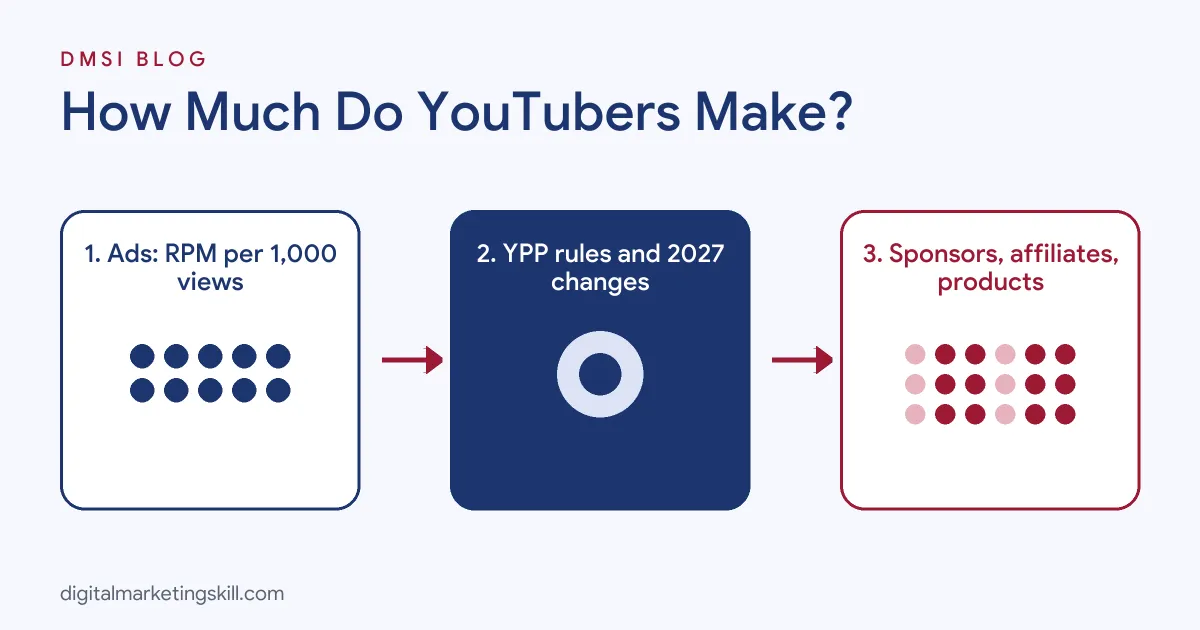
- What Most Earnings Guides Miss
- How YouTube Pays Creators
- Who Can Earn: YPP Rules
- How Much YouTube Pays Per View
- What Affects Earnings
- Earnings by Channel Size
- Other Income Streams
- Estimate Your Own Earnings
- Common Mistakes
- FAQ
What Most YouTube Earnings Guides Miss
Most earnings articles focus on headline numbers: per-view rates, subscriber tiers and the incomes of the most famous creators. Those figures are interesting but can be misleading, because averages are pulled up by a tiny number of huge channels. Circle’s guide makes this point directly, noting that averages are misleading and that RPM is not the same as income.
Two other things are often missing. First, YouTube’s rules are changing: in August 2026, YouTube announced the first significant change to its Partner Program since 2018, including higher entry requirements from February 2027. Second, the creators who earn steadily usually treat YouTube as a marketing channel for a wider business, not as an ad-revenue job. This guide covers both, so you can set realistic expectations.
How YouTube Pays Creators
YouTube shares revenue with creators who are accepted into the YouTube Partner Program (YPP). The main sources are:
- Watch page ads: ads shown before, during and after long-form videos. YouTube’s official blog states creators receive 55% of revenue share for long-form videos.
- Shorts Feed ads: ads shown between Shorts. Revenue is pooled and allocated based on views, and creators keep 45% of their allocated share.
- YouTube Premium: part of subscription revenue from Premium and Premium Lite members is shared based on how much they watch your content. YouTube says 30% of net Premium subscription revenue and 60% of Premium Lite revenue go into creator pools.
- Fan funding: channel memberships, Super Chat, Super Stickers and Super Thanks, where viewers pay directly.
- Shopping: earning from products featured through YouTube Shopping.
YouTube pays through AdSense, usually monthly once your balance passes the payment threshold for your country.
CPM vs RPM
Two terms come up constantly:
- CPM (cost per mille): what advertisers pay per 1,000 ad impressions. This is before YouTube’s share.
- RPM (revenue per mille): what you actually earn per 1,000 views, after YouTube’s share and across all revenue sources. RPM is lower than CPM because not every view shows an ad and YouTube keeps its share.
RPM is the number that matters for estimating income, and you can see it in YouTube Studio analytics once you are monetised.
Who Can Earn: YouTube Partner Program Rules
Current requirements
According to YouTube Help, to share ad revenue a channel needs 1,000 subscribers plus either:
- 4,000 qualified watch hours from public long-form videos in the last 12 months; or
- 10 million qualified Shorts views in the last 90 days.
Meeting a threshold does not guarantee acceptance. YouTube reviews each channel against its policies, and YouTube Help says the review typically takes about a month.
There is also a lower tier for features such as Shopping and fan funding: 500 subscribers, 3 valid public uploads in the last 90 days, and either 3,000 qualified watch hours in 12 months or 3 million qualified Shorts views in 90 days.
Changes announced for February 2027
On 10 August 2026, YouTube announced updates that take effect on 1 February 2027:
- Higher entry requirements for new applicants: 8,000 qualified watch hours in the last 365 days or 20 million qualified Shorts views in the last 90 days. Creators already in YPP are not affected, and fan funding and Shopping thresholds are unchanged.
- Shorts revenue threshold: only channels with 10 million qualified Shorts views in the last 90 days will share in ads and subscription revenue on Shorts. Channels below that stay in YPP and keep earning from long-form content.
- New incentives for smaller channels: milestone-based programmes, such as bonuses linked to YouTube Shopping, brand deal incentives and boosts for trends, with more details to come.
YouTube also said YPP has over 3 million creators and that it expects to pay creators more in 2027 than in 2026. If you are building a channel now, plan for the higher entry bar.
How Much Does YouTube Pay Per View?
YouTube does not pay a fixed amount per view. Earnings depend on how many views show ads, how much advertisers are paying and how much of the revenue is shared. Published estimates vary:
- Neal Schaffer’s guide works out to roughly $500 per 100,000 views and about $5,000 per million views.
- Backstage reports AdSense paying around $4 to $25 per 1,000 views.
- NextClip suggests most creators earn about $1 to $10 per 1,000 long-form views.
Treat these as broad ranges, not promises. Shorts typically earn far less per view than long-form videos, because Shorts revenue is pooled across many creators and the share is lower.
| Views | At $1 RPM | At $5 RPM | At $15 RPM |
|---|---|---|---|
| 10,000 | $10 | $50 | $150 |
| 100,000 | $100 | $500 | $1,500 |
| 1,000,000 | $1,000 | $5,000 | $15,000 |
The table simply multiplies views by different RPMs to show how much the rate matters. Your own RPM in YouTube Studio is the only reliable figure.
What Affects How Much YouTubers Make
Niche and advertiser demand
Advertisers pay more to reach audiences who are likely to spend money. Channels about personal finance, business, software, technology and marketing often earn higher RPMs than broad entertainment, because advertisers in those sectors bid more. A finance channel with fewer views can out-earn a comedy channel with more.
Audience location
Viewers in countries with high advertising spend, such as the United States, Canada, the UK, Australia and parts of Western Europe, usually bring higher ad rates. A channel with mostly viewers in lower-spend markets may earn a lower RPM even with the same view count.
Video length and ad placement
Long-form videos of 8 minutes or more can include mid-roll ads, which can increase earnings. That does not mean every video should be stretched; padding usually hurts watch time and audience trust.
Format: long-form vs Shorts
Shorts can grow a channel quickly, but they generally earn much less per view. Many creators use Shorts for discovery and long-form videos, products or sponsorships for income.
Engagement and watch time
Videos that people watch for longer are recommended more, gain more views and show more ads. Engagement also makes a channel more attractive to sponsors.
Season
Ad rates often rise in the last quarter of the year as advertisers spend more around holiday shopping, and often dip in January.
Content suitability
Videos that do not meet YouTube’s advertiser-friendly guidelines may receive limited or no ads. Strong language, violence or sensitive topics can reduce earnings on those videos.
How Much YouTubers Make by Channel Size
Subscriber counts are only a rough guide, because views and niche matter more. Riverside’s guide offers these broad ranges for ad income:
| Channel stage | Riverside’s estimated monthly range |
|---|---|
| Beginners (1,000+ subscribers) | $30 to $300 |
| Mid-range (100,000+ subscribers) | $500 to $5,000 |
| Famous (1 million+ subscribers) | $10,000 to $100,000 |
Two channels with the same subscriber count can earn very different amounts. A channel with 100,000 subscribers that gets 20,000 views per video in a finance niche may earn more than one with 500,000 subscribers whose videos now get few views. Sponsorships and products can also multiply income well beyond ad revenue.
How much does a 100K subscriber YouTuber make?
It depends on monthly views, not subscribers. A 100,000-subscriber channel getting 300,000 long-form views a month at a $5 RPM would earn about $1,500 from ads, plus whatever it earns from sponsorships and other income. The same channel at a $1 RPM would earn about $300.
How much do 30,000 views pay?
At an RPM between $1 and $10, 30,000 long-form views would pay roughly $30 to $300 from ads.
How much do 2 million views pay?
At the same range, 2 million long-form views might bring roughly $2,000 to $20,000, though 2 million Shorts views would usually earn much less.
Other Ways YouTubers Make Money
For most full-time creators, ad revenue is only one part of income. Riverside and Neal Schaffer both list sponsorships, merchandise, memberships, affiliate links and digital products as major income streams.
Brand sponsorships
Brands pay creators to feature products in videos, either as a dedicated video or a short segment. Sponsorships can pay far more than ads for the same video, especially in niches with valuable audiences. Rates depend on views, niche, engagement and how well the audience matches the brand. Sponsored content must be disclosed, and YouTube has a paid promotion setting for this.
Affiliate marketing
Creators earn commission when viewers buy products through their links. This works well for reviews, tutorials and comparison videos. Affiliate income can continue for years from older videos that keep getting views.
Channel memberships and fan funding
Memberships let viewers pay a monthly fee for perks such as badges, emojis and exclusive videos. Super Chat and Super Stickers let viewers pay to highlight messages during live streams, and Super Thanks lets them tip on videos. Some creators also use external membership platforms.
Merchandise
Clothing, accessories and other branded products can earn money for creators with loyal audiences. YouTube Shopping lets eligible creators show products under their videos.
Digital products and courses
Templates, presets, guides, courses and coaching can bring high margins because they are made once and sold many times. Educational channels often earn most of their income this way.
Services and business leads
Many professionals use YouTube to attract clients rather than to earn from ads. A marketing consultant, designer, accountant or coach might earn more from one client found through a video than from a year of ad revenue on that channel.
Licensing
Viral clips can be licensed to media companies and other channels for a fee.
What Kind of Videos Make the Most Money?
Videos that combine high advertiser demand with buying intent tend to earn most. Examples include software tutorials, product reviews and comparisons, personal finance explainers, business and marketing advice, and technology guides. Neal Schaffer lists gaming, lifehacks, news, food reviews and tutorials among popular niches, but popularity does not always mean high RPM; a niche with fewer but more valuable viewers can pay better.
How to Estimate Your Own YouTube Earnings
- Estimate monthly long-form views. Look at your average views per video and how often you publish.
- Choose a cautious RPM. If you are not yet monetised, use a low estimate, such as $1 to $3, and adjust once you see real data in YouTube Studio.
- Multiply. Monthly views divided by 1,000, multiplied by RPM, gives an estimate of ad income.
- Add other income. Estimate sponsorships, affiliate commissions and product sales separately.
- Subtract costs. Include equipment, software, editing, music licensing and tax.
For example, 50,000 monthly views at a $3 RPM is about $150 a month from ads. One affiliate sale a day at $5 commission would add about $150, doubling income. This shows why diversified income matters.
How to Increase YouTube Income
- Pick a clear niche with an audience that advertisers and sponsors value.
- Improve titles, thumbnails and the first 30 seconds to raise click-through and watch time.
- Use YouTube SEO so videos are found through search for months or years.
- Publish consistently to build a returning audience.
- Use Shorts for discovery and point viewers to long-form videos.
- Add affiliate links and products early, rather than waiting for monetisation.
- Build an email list so you can reach fans without relying on the algorithm.
- Pitch sponsors with a short media kit showing views, audience and results.
If you are starting from scratch, our guides on creating a YouTube channel, YouTube SEO for beginners and how to make money on YouTube go deeper, and you can compare platforms with how much TikTokers make.
Why YouTube Earnings Often Beat Other Platforms Over Time
Compared with many short-form platforms, YouTube has two advantages for long-term income. First, long-form videos earn a clear share of ad revenue, while creator funds on some other apps have historically paid little per view. Second, YouTube is also a search engine, so a helpful tutorial or review can keep getting views, ad revenue and affiliate clicks for years after it is published. A post on a feed-based platform often gets most of its views within a few days.
That longevity changes how successful creators plan. Instead of chasing daily trends, they build a library of evergreen videos that answer common questions in their niche, then refresh titles and thumbnails on older videos that still get traffic. Over time, the back catalogue earns more than new uploads. Many creators also repurpose long-form videos into Shorts and clips for other platforms, using those for discovery while the long-form videos and products do most of the earning.
The trade-off is effort. Long-form videos take far more time to plan, film and edit than short clips, and growth is often slow at first. Creators who stay consistent for months, track their analytics and improve each video usually see the compounding effect that makes YouTube income more stable.
Common Mistakes
- Judging income by subscribers. Views, niche and audience location matter more.
- Relying only on ad revenue. Most creators need several income streams.
- Buying views or subscribers. Fake engagement breaks YouTube policies and can cost you monetisation.
- Using copyrighted music or clips. Claims can redirect revenue or remove videos.
- Stretching videos for mid-rolls. Padding lowers watch time and trust.
- Ignoring the 2027 changes. New channels will face a higher entry bar from February 2027.
- Forgetting tax. YouTube income is usually taxable, so keep records and set money aside.
One Rule to Remember
Treat ad revenue as a bonus, not the business plan: build a focused channel for a valuable audience, then earn from sponsorships, affiliate links and your own products alongside ads.
Example: a creator in Accra starts a channel teaching small businesses how to run Facebook and Instagram ads. After a year, the channel has 12,000 subscribers and about 40,000 long-form views a month. Ad revenue is modest, but affiliate commissions from recommended tools and a low-cost video course bring in several times more, and two viewers become consulting clients. This example is illustrative and not a real person.
YouTube Skills and Marketing Careers
The skills behind successful channels, including video SEO, thumbnail testing, audience research, analytics and sponsorship pitching, are valuable digital marketing skills in their own right. Brands hire people to run YouTube channels, manage creator partnerships and plan video ads. If you are in your country, building these skills and a portfolio of channel growth or video campaigns can open doors to marketing roles and freelance work with brands worldwide, whether or not your own channel becomes a big earner.
Frequently Asked Questions
How much do YouTubers make per 1,000 views?
Published estimates mostly fall between about $1 and $30 per 1,000 long-form views, depending on niche, audience location and format. Many channels sit at the lower end, and Shorts usually pay much less.
How many subscribers do you need to get paid on YouTube?
To share ad revenue, you currently need 1,000 subscribers plus 4,000 qualified watch hours in 12 months or 10 million qualified Shorts views in 90 days. From 1 February 2027, new applicants will need 8,000 watch hours in 365 days or 20 million Shorts views in 90 days.
What is the 30-second rule on YouTube?
It usually refers to skippable in-stream ads: advertisers typically pay when a viewer watches 30 seconds of the ad, or the whole ad if it is shorter, or interacts with it. Creators also use the phrase for hooking viewers in the first 30 seconds of a video, which strongly affects watch time.
Does YouTube pay every month?
Yes. Earnings are paid through AdSense, usually monthly, once your balance reaches your country’s payment threshold.
Do Shorts make money?
Yes, through the Shorts Feed revenue pool, where creators keep 45% of their allocated revenue. From February 2027, Shorts revenue sharing will require 10 million qualified Shorts views in the last 90 days.
How much do YouTubers with 1 million subscribers make?
It varies widely. Riverside estimates $10,000 to $100,000 a month for channels at this size, but views, niche and sponsorships make a huge difference.
Is being a YouTuber a good job?
It can be for some, but income is unpredictable and most channels never earn a living wage from YouTube alone. Many creators combine YouTube with other work or a business.
Which YouTube niches pay the most?
Niches with high advertiser demand, such as personal finance, business, software, technology and marketing, often earn higher RPMs than broad entertainment.
Do YouTubers pay tax?
YouTube income is usually taxable. Rules depend on where you live, so keep records and check local tax guidance or speak to an accountant.
Can you make money on YouTube without monetisation?
Yes. Affiliate links, sponsorships, your own products and client work can all earn money before or without joining the Partner Program.
Your Next Step
YouTube growth uses core digital marketing skills like video SEO, analytics and paid video ads, which brands hire for too. The Master Diploma in Digital & AI Marketing at Digital Marketing Skill Institute covers AI-powered Social Media Management and Advertising, Lead Generation and Email Automation, Google, and a WordPress and SEO track where you build and rank a real website.
From day one, you work on a real U.S. company’s project through the U.S. Project Internship, so you finish with real results and a verified U.S. work reference letter. You also get unlimited one-on-one coaching. The program carries dual US and UK accreditation, is recognised in more than 100 countries, and runs 100% online over three months.
You can build those skills wherever you live, anywhere in your country. Read student reviews, then apply for the 65% partial scholarship to see if you qualify.
Sources checked November 2026: YouTube Help (YPP eligibility), YouTube Help (monetisation features), YouTube Official Blog, Neal Schaffer, Riverside, Backstage, Circle and NextClip. Earnings figures are estimates, not guarantees. We have no connection with these companies.