
Most facebook advertising tips lists stop at ad formats. The tips that actually move conversion rate are about who you show ads to again. They are not about what the ad looks like. Three retargeting audiences do most of the work. They are people who ignored your email, people who abandoned a cart, and people who visited but left.
Key Takeaways
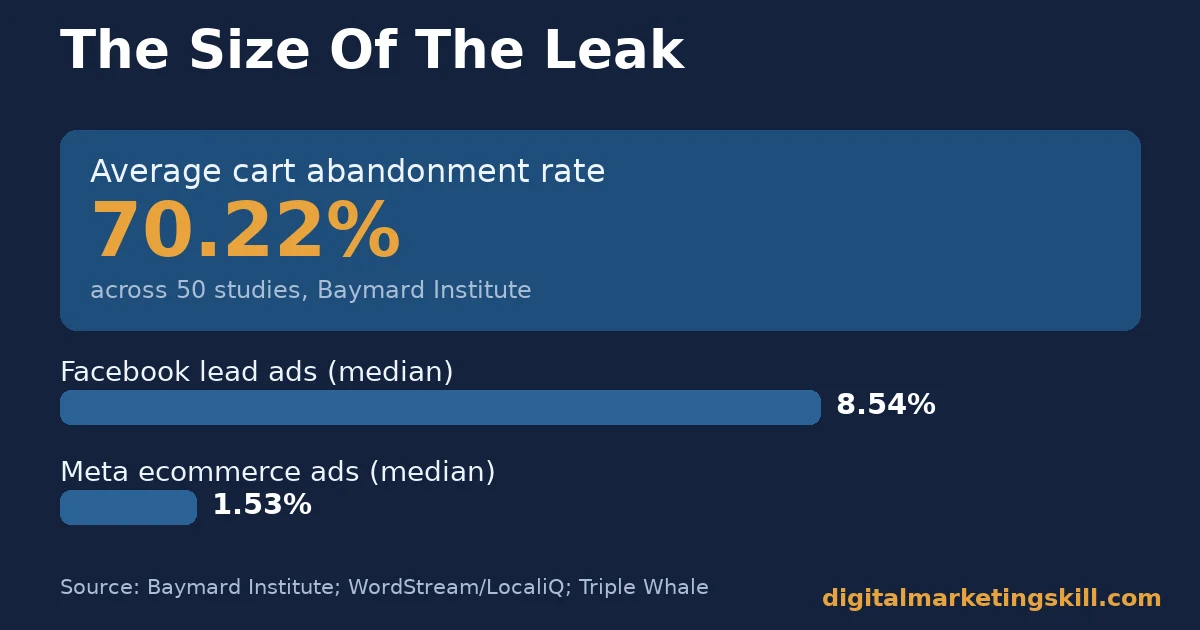
- Cart abandonment is the single biggest conversion leak. The Baymard Institute averaged 50 separate studies and found a 70.22% average online cart abandonment rate.
- Facebook lead ads convert at a specific, named rate. WordStream/LocaliQ platform data put the median conversion rate for US Facebook lead campaigns at 8.54% across all industries. Education and Instruction topped the list at 15.87%. Automotive-For Sale was lowest, at 4.15%.
- Ecommerce converts differently from lead generation. Triple Whale’s ecommerce brand analysis found a 1.53% median conversion rate on Meta ads, with a 2.39% median click-through rate.
- Retargeting needs a frequency cap. Without one, the same audience sees an ad too often. Cost per result rises, and people start ignoring the brand rather than converting.
- Small, targeted retargeting budgets can work. A Digital Marketing Skill Institute student, Ayooluwa Osemi, reported spending $14 on Facebook and Instagram ads and generating $878 in sales. Treat this as one illustrative result, not a typical outcome.
In this guide
- What Most Facebook Advertising Tips Lists Get Wrong, And Why
- How Facebook Retargeting Actually Works
- Choosing an Ad Format For Retargeting
- Facebook Advertising Tips By Audience: Three Jobs, Not One
- How To Retarget Each Audience
- Facebook Advertising Tips: Mistakes That Waste Budget
- Facebook Advertising Tips For Your First Retargeting Campaign
- How To Measure Facebook Retargeting
- The One Rule: Exclude Converters From Every Retargeting Audience
- A Real Case: Turning a Small Ad Budget Into Sales
- Frequently Asked Questions About Facebook Advertising Tips
- Start With Your Biggest Leak, Then Expand
What Most Facebook Advertising Tips Lists Get Wrong, And Why
Search for facebook advertising tips and most lists read the same way. They name ad formats: photo ads, video ads, lead ads, carousel ads. That information is not wrong, but it answers the wrong question. Format rarely decides whether an ad converts.
The bigger lever is audience. An identical ad shown to a stranger and to someone who already added your product to a cart converts at wildly different rates. This guide focuses on the three retargeting audiences that recover the most lost conversions. It also covers the one rule that keeps retargeting from wasting money.
A quick note on the evidence. Conversion and engagement figures below come from named platforms and studies, each with its own scope. Treat them as a snapshot of how campaigns performed in the period measured. They are not a permanent ranking you can expect to match exactly.
How Facebook Retargeting Actually Works
Retargeting starts with a small piece of tracking code, commonly called a pixel, placed on your website. Someone visits a page, opens an email, or takes an action your pixel tracks. Facebook then adds them to a Custom Audience, and you build an ad specifically for that audience.
This differs from ordinary advertising in one key way. A cold audience has never heard of you. So the ad has to do two jobs: introduce the brand and prompt action, which our guide to Facebook ad setup covers in more detail. A retargeted audience already knows the brand. The ad only has one job: remove whatever stopped them converting the first time.
Why Cart Abandonment Is the Biggest Opportunity
Baymard Institute’s analysis of 50 separate studies, cited above, found a 70.22% average cart abandonment rate. For every ten people who add a product to their cart, roughly seven leave without buying. Most of them are not rejecting the product. They are getting distracted, comparing prices, or waiting for payday.
That is what makes cart abandonment retargeting so effective compared with cold advertising. You are not trying to create interest from nothing. You are reminding someone of a decision they almost made.
Why Frequency Caps Keep Retargeting Working
Retargeting pools are small compared with the total audience on Facebook. The same group of people can see your ad many times in a short period. Past a certain point, more impressions stop adding conversions and start adding irritation.
A frequency cap limits how many times one person sees an ad in a set period. It keeps cost per result from climbing as the novelty wears off. Without a cap, the same shrinking pool absorbs budget with less and less return each week.
Choosing an Ad Format For Retargeting
Format matters less than audience, but it still matters. Facebook’s own ad format options group most retargeting-friendly formats into a few types worth knowing before you build a campaign.
- Single image or photo ads. The simplest format. Works well when the message is simple and the product photographs clearly on its own.
- Video ads. Better suited to explaining a product or building trust before a purchase. They can show the product in use rather than just describe it.
- Dynamic product ads. Built from your product catalogue. These automatically show the exact item a visitor viewed or abandoned, without manual ad creation for every product.
- Carousel ads. Useful for showing a small range of related products. A crowded carousel, though, can dilute a retargeting message that should stay focused on one item.
- Lead ads. Keep the person inside Facebook to submit a form, removing the extra step of loading a separate landing page. This suits non-opener retargeting aimed at re-capturing an email address.
Pick the format that matches the audience’s stage, not the format that looks most impressive. A dynamic product ad showing the exact item someone abandoned usually beats a polished brand video for that specific audience. This is one of the simplest facebook advertising tips to apply, and one of the most overlooked.
Facebook Advertising Tips By Audience: Three Jobs, Not One
Not every visitor who leaves without converting left for the same reason. Treating them as one audience wastes the targeting precision retargeting offers. These three groups cover most of what a typical business can recover.
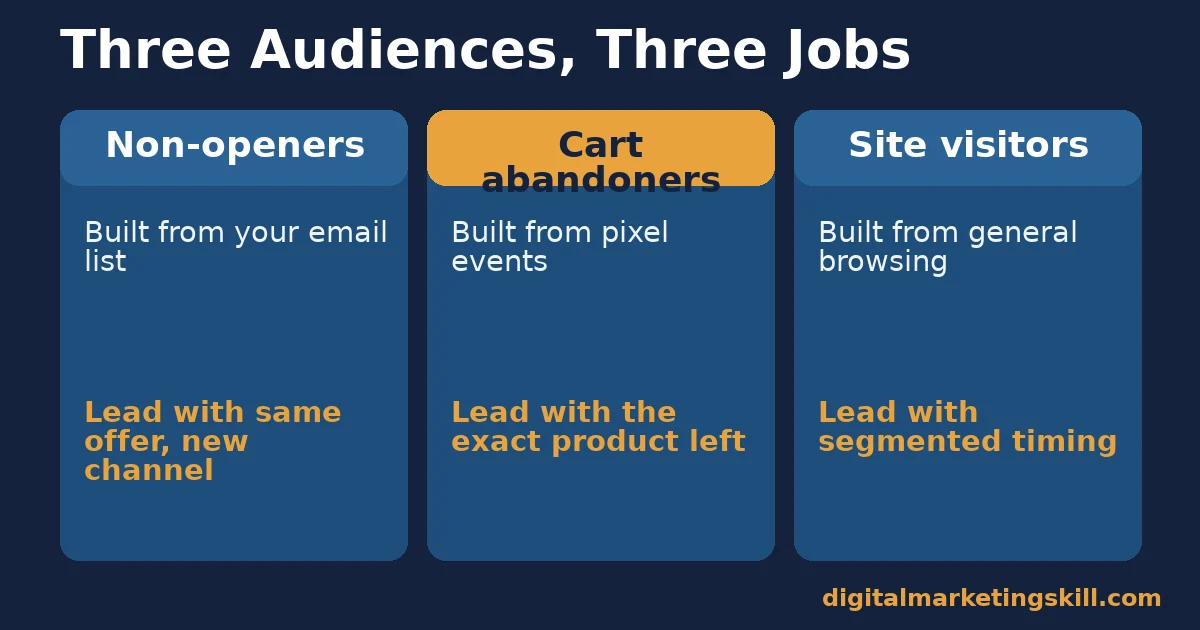
Non-Openers: Built From Your Own Email List
Every email list has a segment that never opens. They subscribed once, then went quiet. Email alone cannot reach them if they are not opening messages. A Custom Audience built from their email addresses fixes that. It puts your offer back in front of them, on a channel they do still use.
Cart Abandoners: Built From Pixel Events
This audience is built automatically from your website pixel. It comes specifically from people who triggered an “Add to Cart” event without a matching “Purchase” event. It needs no list upload and updates itself continuously as people shop.
Site Visitors: Built From General Browsing
This is the widest of the three audiences. It includes anyone who visited your site in a set window, regardless of what they did there. It is less precise than the other two. But it catches people who read content, compared options, and left before taking any trackable action at all.
How To Retarget Each Audience
Each audience needs a different message, because each left for a different reason. Match the ad to the audience below, rather than running one retargeting ad for everyone.
Non-Openers: Lead With the Same Offer, A New Channel
Export the list of subscribers who have not opened recent emails from your email platform’s analytics. Upload it to Facebook as a Custom Audience. Build an ad that repeats the message from the emails they skipped. You are not starting a new conversation. You are continuing one on a channel they will actually see.
Cart Abandoners: Lead With the Product They Left
Upload your product catalogue to Facebook and connect it to dynamic ads. The ad then automatically shows the exact product someone abandoned, rather than a generic promotion. A small, time-limited incentive can also help. A discount code or free shipping often moves an undecided shopper who only needed a nudge.
Site Visitors: Lead With Segmented Timing
Split this audience by recency. Use three groups: people who visited in the last day, the last three days, and the last five days, excluding anyone who already converted. Show the most recent visitors your strongest offer first. Interest fades the longer someone has been away from your site. Our guide to Facebook ad targeting covers how to build and exclude these overlapping audiences correctly.
Facebook Advertising Tips: Mistakes That Waste Budget
A few habits quietly drain retargeting budgets even when the audiences are built correctly. Checking for these before you scale spend is faster than fixing a damaged account reputation afterward. In practice, these facebook advertising tips matter more once spend grows, because small inefficiencies compound at scale.
Forgetting to Exclude Recent Converters
If a buyer keeps seeing ads for the item they already bought, that reads as careless at best and annoying at worst. Every retargeting audience should exclude anyone with a matching conversion event within a reasonable window.
Running the Same Ad for Too Long
Retargeting pools are small, so the same people see the same ad repeatedly. Creative that would feel fresh to a cold audience feels stale fast to a retargeting pool. Rotate the image, headline or offer every few weeks to keep the ad from becoming background noise. Our guide to Facebook ad campaigns has more detail on structuring creative tests without disrupting a working campaign.
Setting a Retargeting Window That Does Not Match the Buying Cycle
A seven-day window is too short for a considered purchase and too long for an impulse buy. Match the window to how long people genuinely take to decide, not to a default setting.
Using One Message For Every Audience
A single generic retargeting ad, shown to non-openers, cart abandoners and site visitors alike, wastes the precision these facebook advertising tips are built around. Each audience left for a different reason, so each needs its own message, as the sections above explain in detail.
Facebook Advertising Tips For Your First Retargeting Campaign
These facebook advertising tips only work once the underlying setup is correct. Before building any ad, walk through these five steps in order. Skipping one usually shows up later as a broken audience or an ad that never leaves review.
Step 1: Install and Verify the Pixel
Add the Facebook pixel to every page of your site, not just the homepage. Use Facebook’s own Events Manager tool to confirm it is firing correctly on key pages. Check the cart and checkout pages especially, before building any audience from it.
Step 2: Build the Three Core Audiences
Create your non-opener, cart-abandoner and site-visitor audiences as described above. Name them clearly, such as “Cart Abandoners 7 Day” or “Non-Openers Last 90 Days”. Future campaigns are then easy to find and reuse.
Step 3: Add Exclusions Before You Launch
Build a Purchase-event audience and attach it as an exclusion to every retargeting campaign before the first ad goes live. Adding exclusions after launch means some budget has already been wasted on people who converted.
Step 4: Start With a Small, Fixed Budget
Retargeting pools are small, so a large daily budget gets spent on a limited group quickly, pushing frequency up fast. Start with a modest daily budget, watch frequency and cost per result for a week, then adjust.
Step 5: Review Weekly, Not Daily
Retargeting audiences change slowly, since they depend on ongoing site activity and email behaviour. Checking performance daily invites overreacting to normal day-to-day noise. A weekly review is usually enough to catch a real problem early.
How To Measure Facebook Retargeting
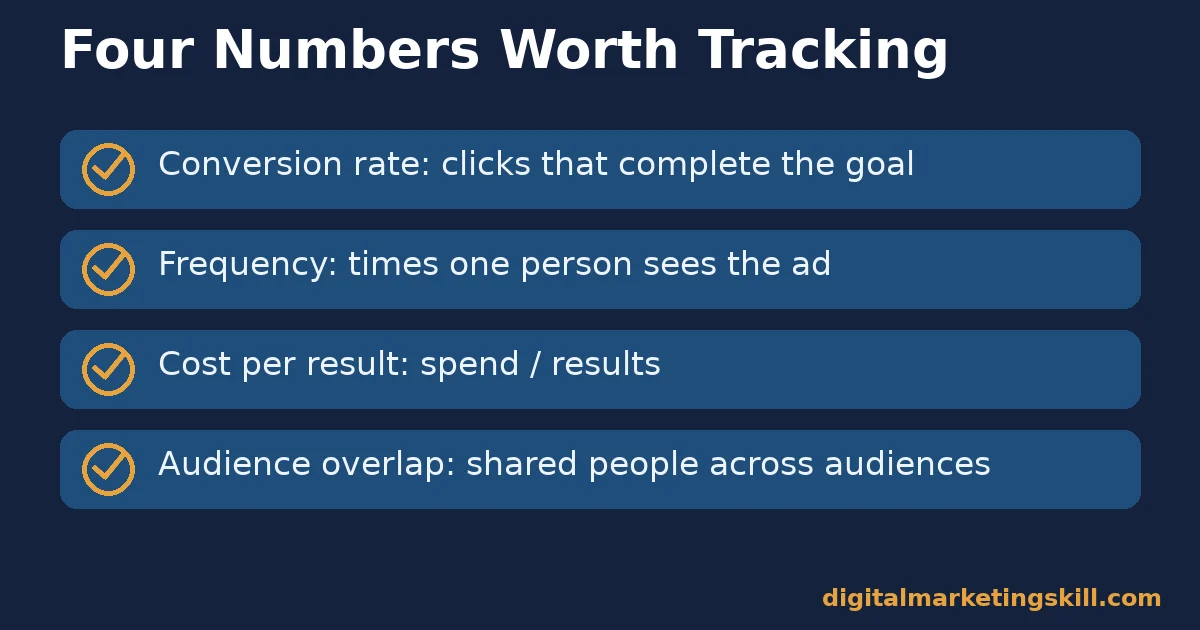
Retargeting produces the same metrics as any Facebook campaign. But they mean something different for a warm audience than for a cold one. These four matter most.
Four Numbers Worth Tracking
- Conversion rate. The share of people who clicked who then completed the goal action. For US Facebook lead campaigns, WordStream/LocaliQ data put the median at 8.54%; for Meta ecommerce ads, Triple Whale found 1.53%. Retargeting should beat your account’s own cold-audience average, since the audience already knows you.
- Frequency. The average number of times one person has seen your ad. Rising frequency with flat or falling conversion rate is the clearest sign a frequency cap is overdue.
- Cost per result. Ad spend divided by the number of results (purchases, leads, sign-ups). Compare this across your three audiences separately, since cart abandoners usually cost less per result than general site visitors.
- Audience overlap. How much your three retargeting audiences overlap each other. High overlap without exclusions means you are showing multiple ads to the same person and inflating frequency without meaning to.
Reading These Numbers Together
A low cost per result with climbing frequency is a warning, not a win. It usually means the same small group is converting repeatedly while the rest of the pool has gone cold. Check frequency and conversion rate side by side, not cost per result alone.
The One Rule: Exclude Converters From Every Retargeting Audience
If you only change one thing about your facebook advertising tips, make it exclusions. Every retargeting audience should exclude anyone who already completed the goal action. Without this, you keep paying to show ads to people who already bought. That wastes budget, and it can make a happy customer feel pestered.
Here is an illustrative, invented example to show the logic, not a real account’s numbers. An account retargets 10,000 cart abandoners without excluding recent buyers. If 15% of that pool already purchased through another channel, roughly 1,500 people are seeing ads for a product they own.
Adding one exclusion rule, for anyone with a matching Purchase event in the last 30 days, removes that waste immediately. The budget then concentrates on people who genuinely have not converted yet.
A Real Case: Turning a Small Ad Budget Into Sales
Numbers mean more with a real example attached, even a small one. Ayooluwa Osemi, a Digital Marketing Skill Institute student, reported spending $14 on Facebook and Instagram ads. That spend generated $878 in sales, as published on the Institute’s reviews page.
That result is one student’s outcome, not a guarantee. Income results vary by product, audience and offer; see the Institute’s earnings disclaimer for the full context. What the case does show is the mechanism this guide describes. A small, well-targeted budget aimed at a specific audience can produce a return before you need a large budget.
Frequently Asked Questions About Facebook Advertising Tips
Do I need a website to use Facebook retargeting?
For pixel-based retargeting, such as cart abandonment or site-visitor audiences, yes, because the pixel needs somewhere to track. For an email-based Custom Audience, no. You only need a list of email addresses collected with consent.
How small can a retargeting audience be and still work?
Facebook can technically run ads to very small audiences, but results get unreliable below roughly a few hundred people. If a segment is smaller than that, consider combining it with a related audience rather than running it alone.
How long should a retargeting window stay open?
It depends on the buying cycle. A low-cost, fast-decision product might only need a 3 to 5 day window. A considered purchase can justify a window of several weeks.
What frequency cap should I set?
There is no single correct number, because it depends on the offer and the audience size. Start conservatively and watch cost per result as frequency climbs. Cap it at the point where cost per result starts rising instead of holding steady.
Which ad format works best for retargeting?
Dynamic product ads work best for cart abandoners, because they show the exact item someone left behind. For non-openers and site visitors, the format changes. A single clear image or short video, repeating your core offer, tends to outperform a crowded carousel.
Can retargeting replace cold audience advertising entirely?
No. Retargeting only reaches people who already interacted with your brand, so it cannot grow your audience on its own. It works best alongside cold-audience campaigns that keep feeding new visitors into the retargeting pools.
How exactly do I exclude recent converters from an audience?
Inside Facebook’s audience builder, add a second Custom Audience built from your Purchase event. Then set it as an exclusion on the retargeting audience you are building. This stops the two audiences from overlapping.
How should I split budget across the three audiences?
Weight spend toward whichever audience converts best for your account, usually cart abandoners for ecommerce. Start with roughly even budgets across all three. After a couple of weeks of data, shift spend toward the audience with the lowest cost per result.
When should I not bother with retargeting?
If your site gets very little traffic, your retargeting audiences will stay too small to spend meaningfully against. In that case, put the budget into cold-audience campaigns first. Revisit retargeting once traffic and pixel data have built up.
Start With Your Biggest Leak, Then Expand
Facebook advertising tips are only useful once you know which audience to apply them to. Start with cart abandonment if you sell online, since it is the largest documented leak. Add non-opener and site-visitor retargeting once that first audience is set up and excluding converters correctly.
None of these facebook advertising tips require a large budget to test. A single small campaign, aimed at one audience with one exclusion rule in place, is enough to see whether retargeting earns its place in your marketing mix before you commit more spend to it.
These facebook advertising tips work whether you are running your first campaign or managing an established ad account.
If you want structured help running a Facebook ad account properly, the Digital Marketing Skill Institute’s Master Diploma in Digital & AI Marketing includes an AI-Powered Social Media Management and Advertising track. It is one of four AI-powered tracks making up ten courses in total, with a Full Stack option for completing all four.
It comes with unlimited 1-on-1 coaching and mentoring, a U.S. Project Internship with a verified U.S. Work Reference Letter, and dual US and UK accreditation recognised in more than 100 countries. It is delivered 100% online, so you can study from anywhere in your country.
Explore the programme at Digital Marketing Skill Institute, or browse more practical guides like this one on the Digital Marketing Skill Institute blog. When you are ready, apply here. Wherever you run ads from, these fundamentals work the same way, and the training travels with you anywhere in your country. Learn more at digitalmarketingskill.com.
Every figure in this guide was checked against its original source before publication. Figures marked as illustrative are invented examples, not real results.
![9 Amazing Digital Marketing Skills to Make Money Online [With Proof]](https://digitalmarketingskill.com/wp-content/uploads/2019/07/9-Amazing-Digital-Marketing-Skills-to-Make-Money-Online-With-Proof-17.png)






