
Architecture firm marketing works when a website, search visibility and content point toward the same kind of client. 72% of small businesses now have a website, and 52% run social media (LocaliQ). This guide shows the channels inside architecture firm marketing, how to lead with each one, and how to measure progress.
Key Takeaways
- A website is the baseline, not a bonus. 72% of small businesses now have a website, and the share keeps rising (LocaliQ).
- Most pages are never found. 96.55% of web pages get zero organic traffic from Google, based on a study of roughly 14 billion pages (Ahrefs).
- Content marketing drives real demand. 74% of B2B marketers say content marketing helped generate demand or leads in the past year, in a survey of 980 B2B marketers (Content Marketing Institute).
- Email still pays back fast. Every $1 spent on email marketing returns about $36 on average (Litmus).
- The client base is worldwide. More than 6 billion people are online globally, so architecture firm marketing is not limited to local referrals alone (DataReportal).
In this guide
- Why Most Architecture Firm Marketing Advice Falls Short
- How Architecture Firm Marketing Actually Works
- The Channels Inside Architecture Firm Marketing
- Common Mistakes in Architecture Firm Marketing
- How to Lead With Each Channel
- Website: Lead With One Clear Enquiry Path
- SEO: Lead With One Search-Intent Page at a Time
- Content Marketing: Lead With One Documented Process
- Email Marketing: Lead With a Simple Project Update List
- Social Media: Lead With Process, Not Just Finished Photos
- Past Clients: Lead With a Simple, Direct Ask
- How to Measure Whether Architecture Firm Marketing Is Working
- The One Rule: Fix the Website Before Buying More Traffic
- A Real Case: Content Changed the Growth Pattern
- Your Next Step
- Frequently Asked Questions About Architecture Firm Marketing
Why Most Architecture Firm Marketing Advice Falls Short
Most advice tells architecture firms to “be active online.” It rarely says which channel matters at which stage of a client relationship. That advice is not wrong. It skips the part that actually wins projects: matching each channel to how a client really chooses a firm.
This guide fills that gap directly. The figures below come from named studies. Each one has its own scope. Some are small-business surveys. Some are large-scale web studies. One is a single firm’s self-reported case. Treat every number as a snapshot, not a guarantee. Read the source notes before you act on any single figure.
How Architecture Firm Marketing Actually Works
Architecture firm marketing works through three linked steps. First, a prospective client discovers the firm, often through search, a referral, or social media. Next, the firm’s website and portfolio build enough trust for a conversation to start. Finally, email and follow-up content keep the firm visible until the client is ready to commit.
That last step matters more in architecture than in many industries. Design and build decisions often take months. So firms that stay visible during that gap, without being pushy, tend to win the project when the client finally moves.
Scale matters too. More than 6 billion people are online worldwide, according to DataReportal’s global digital research. A firm’s next client could come from a referral two streets away, or from a search in another country entirely. Architecture firm marketing should not rely on local word of mouth alone.
The Channels Inside Architecture Firm Marketing
Each channel below plays a different role in winning a project. Running all of them the same way is the most common reason firms feel busy without seeing more enquiries.
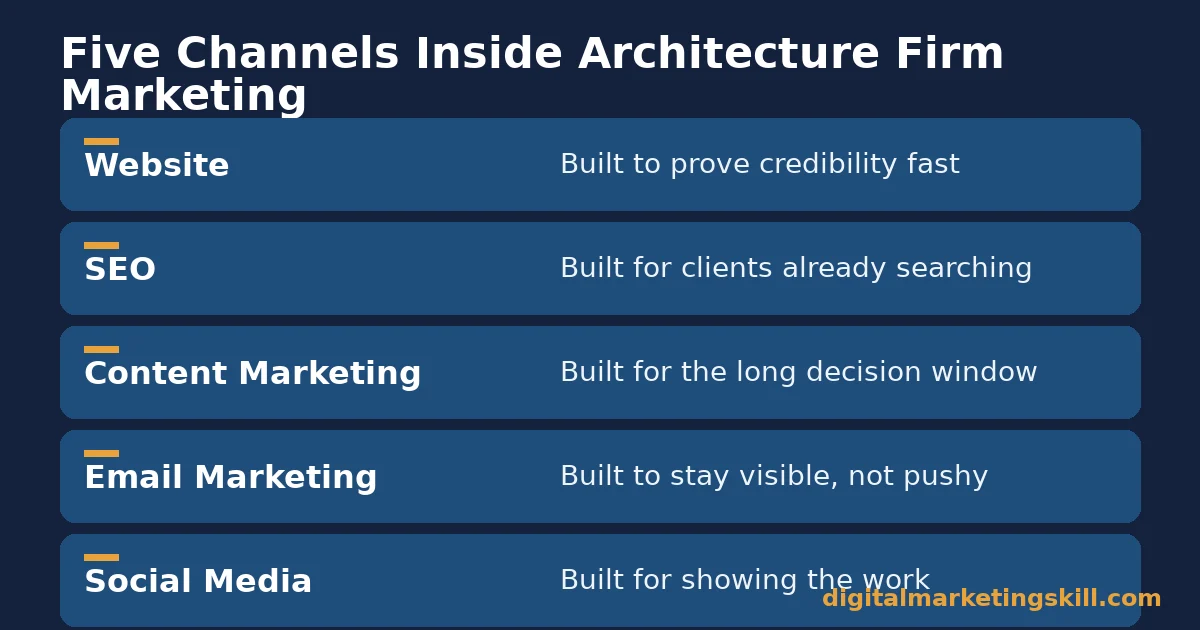
A Website: Built to Prove Credibility Fast
A website answers one question quickly: can this firm do what I need. It is the one channel a firm fully controls. That is why 72% of small businesses now have a website, according to LocaliQ’s Small Business Marketing Trends Report.
For an architecture firm, the portfolio and project pages carry most of that proof. Our guide on measuring brand awareness covers how to check whether that proof is actually landing with visitors, not just looking good to the firm itself.
SEO: Built for Clients Who Are Already Searching
SEO reaches people who are already looking for a firm like yours. A well-optimised page keeps attracting enquiries long after it is published. Most pages never get that chance: Ahrefs studied roughly 14 billion pages in its search traffic study and found that 96.55% get zero organic traffic from Google.
Reach through search compounds, but only for pages built around a real search question. Our roundup of free SEO tools can help a small firm check this without extra software spend.
Content Marketing: Built for the Long Decision Window
Content marketing stays useful during the months a client spends deciding. Project write-ups, process explainers and design guides all show expertise without asking for anything in return. 74% of B2B marketers say content marketing helped generate demand or leads over the past year, in a survey of 980 B2B marketers by Content Marketing Institute.
Our guide on content creation covers how to plan this kind of content without it taking over a firm’s week. Even one new piece a month, done consistently, beats an ambitious schedule that stalls after two posts.
Email Marketing: Built to Stay Visible Without Being Pushy
Email stays in front of people who already know the firm, including past clients, referral partners and warm leads who are not ready yet. Every message reaches someone who chose to hear from the firm. That direct line is part of why email marketing returns about $36 for every $1 spent on average, according to Litmus’s email marketing ROI research.
Social Media: Built for Showing the Work
Social media shows finished and in-progress work to people who have never heard of the firm. Visual platforms suit architecture especially well, because the work itself is the pitch. 52% of small businesses now run social media marketing, per the same LocaliQ research cited above. Our guide on social media management covers how to plan and run that presence consistently.
Common Mistakes in Architecture Firm Marketing
Before changing anything, check whether one of these mistakes already explains a quiet pipeline. Each one is common among small and mid-size firms. Each one is fixable.
Treating the Website as a Portfolio Only
A gallery of finished projects looks impressive. It rarely converts a visitor into an enquiry on its own. The site also needs a clear next step, such as a contact form or a consultation link, placed where a convinced visitor will actually see it.
Publishing Project Pages With No Search Intent Behind Them
Many firms publish project pages that describe the work beautifully. They never target a phrase a prospective client would actually search. Pairing each project page with one genuine search question, like a service type plus a location or building type, fixes this without changing the writing style.
Letting Warm Leads Go Cold
Architecture sales cycles are long. A prospect who is not ready today is often ready in six months. Firms that never follow up, beyond the first enquiry reply, lose projects to whichever competitor happened to still be visible when the client finally moved.
Publishing Generic Content Instead of Process Detail
Short, generic posts about design trends rarely differentiate one firm from another. Content that walks through a firm’s actual process, including the planning, budgeting and decision points, shows expertise that generic posts cannot.
Not Knowing Which Channel Actually Brought the Client
Many firms credit the last thing a client remembers, usually a referral, even when a website or a piece of content did the real work of building trust beforehand. A simple question on the enquiry form, asking how the person found the firm, fixes most of this without any analytics software.
How to Lead With Each Channel
Knowing what each channel is built for only helps once a firm changes what it does first. These moves mirror the five channels above.
Website: Lead With One Clear Enquiry Path
Add one obvious next step to every project page and the homepage: a short enquiry form or a consultation link. Keep it short enough that a visitor can complete it from a phone in under a minute.
SEO: Lead With One Search-Intent Page at a Time
Pick one real question a prospective client searches for, such as a project type paired with a location. Build one page that answers it fully. Google’s own guidance on helpful, people-first content rewards pages that satisfy a single search intent completely, rather than pages that skim many topics.
Content Marketing: Lead With One Documented Process
Write one piece that walks a reader through the full process behind a single project. Include the decisions and trade-offs, not just the finished photos. This single piece usually outperforms ten short, generic posts for building trust.
Email Marketing: Lead With a Simple Project Update List
Offer past clients, referral partners and warm leads one clear reason to join a list, such as updates on new projects or design insights. Send updates on a schedule you can actually keep, even if that means less often than you’d like. Our email marketing checklist covers the basics of setting that schedule up correctly.
Social Media: Lead With Process, Not Just Finished Photos
Share the in-progress work, not only the final reveal. Process photos and short clips of decisions being made build more trust over time than a feed of only polished final shots.
Past Clients: Lead With a Simple, Direct Ask
Referrals still matter in architecture firm marketing, and the simplest fix is also the most skipped: ask satisfied past clients directly for an introduction or a short written reference. A direct ask at the end of a successful project converts far more often than hoping a happy client remembers to mention the firm later.
How to Measure Whether Architecture Firm Marketing Is Working
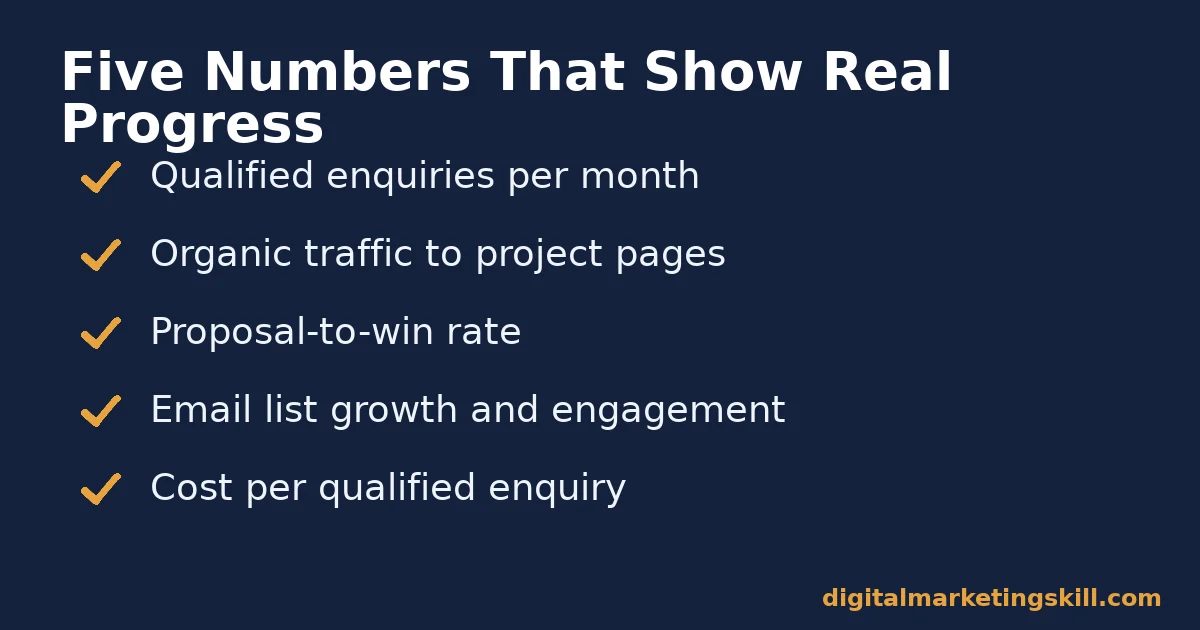
Busy activity is not the same as a fuller pipeline. These five numbers show whether architecture firm marketing is actually working.
- Qualified enquiries per month. The number of enquiries that match the type of project the firm actually wants, not just any contact form submission.
- Organic traffic to project and service pages. Visits arriving from unpaid search results, tracked separately from social and direct traffic.
- Proposal-to-win rate. The share of proposals that convert into signed projects. This shows whether marketing is bringing in the right kind of lead.
- Email list growth and engagement. New subscribers minus unsubscribes, plus how many actually open and click, not just the raw list size.
- Cost per qualified enquiry. Total marketing spend divided by qualified enquiries, compared across channels before deciding where to spend more.
Track these monthly, not weekly. Architecture sales cycles are long enough that week-to-week swings rarely mean anything, while a three-month trend usually does.
Reading the Numbers Together
Read these five together, not one at a time. Rising traffic with a flat enquiry count usually points to a website or content-matching problem, not a traffic problem.
A falling proposal-to-win rate alongside steady enquiries usually points to how proposals are written or priced, not to marketing at all. Checking these numbers together turns a slow quarter into a specific, fixable problem instead of a vague feeling that marketing “isn’t working.”
The One Rule: Fix the Website Before Buying More Traffic
If a firm acts on only one idea here, it should be this: improve the website’s enquiry rate before spending more to send it traffic. Every extra visitor is wasted at the same rate the current traffic is wasted.
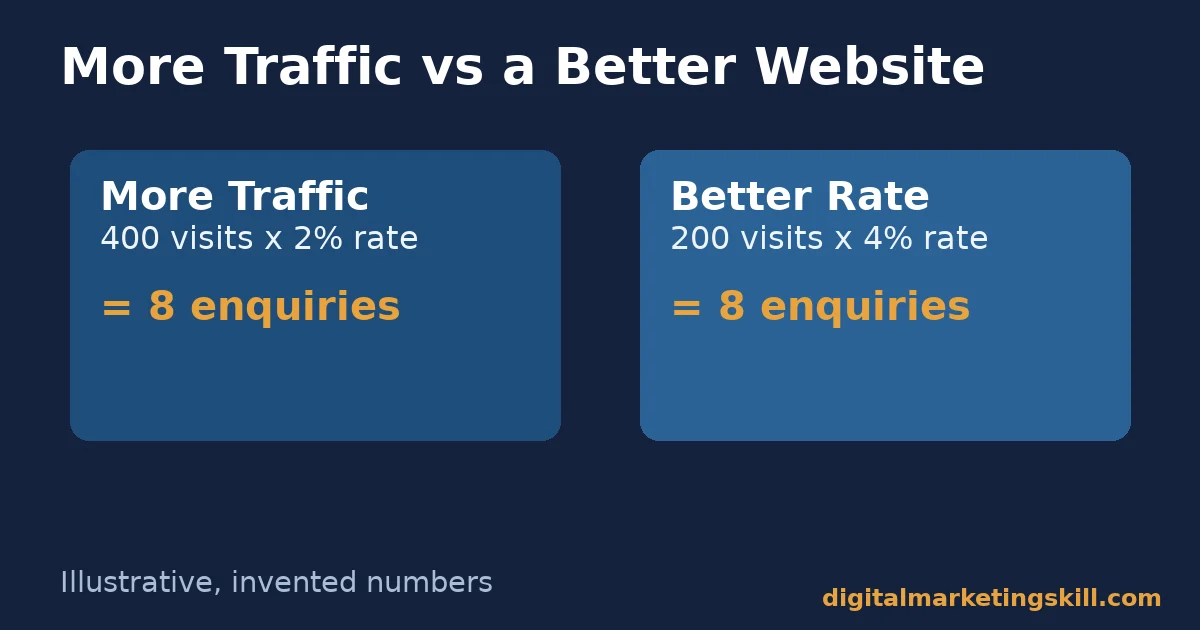
Here is an illustrative, invented example. Say a firm’s site gets 200 monthly visits and converts 2% into enquiries, for 4 enquiries. Doubling traffic to 400 visits at the same 2% rate produces 8 enquiries. Raising the conversion rate to 4%, with no added traffic, also produces 8 enquiries. That second path is usually far cheaper than doubling traffic through ads or content.
Most architecture firm websites have room to improve their enquiry rate before they need more traffic. The fixes above, like one clear enquiry path, cost nothing to test, and they often work faster than any new campaign.
Start with the page that already gets the most visits, since a small conversion gain there affects more visitors than the same gain on a page few people see. Change one thing at a time, such as the headline or the form length, and compare results for at least a month before deciding whether it helped.
A Real Case: Content Changed the Growth Pattern
A residential architecture firm in London moved from inconsistent, “feast or famine” project flow to steadier inbound enquiries. The change came after it published detailed project case studies and process write-ups, rather than only finished-project galleries, according to a case study published by the marketing agency that worked with the firm.
This is one firm’s result, published by the agency it hired. Treat the exact outcome as specific to that firm’s market and prior baseline, not a universal guarantee. The underlying lesson still generalises: process-focused content, not just finished photography, separated the firm from competitors publishing the same kind of portfolio galleries.
That pattern matches the mechanism explained earlier in this guide. Finished-project photography proves a firm can deliver a good result, but it rarely explains how the firm got there. Process content fills that gap. It gives a prospective client a reason to trust the firm’s judgment before a single conversation happens, which shortens the trust-building stage of the long decision window architecture clients go through.
Your Next Step
A firm does not need every channel running perfectly at once. Pick the channel that matches where current clients already come from. Fix the website’s one enquiry path. Track the five numbers above every month.
If you want structured, practical training across every channel in this guide, the Master Diploma in Digital & AI Marketing from Digital Marketing Skill Institute is built from ten execution-first courses across four AI-powered tracks: AI-Powered WordPress and SEO Specialist, AI-Powered Lead Generation and Email Automation, AI-Powered Social Media Management and Advertising, and AI-Powered Google Specialist, with a Full Stack option for completing all four.
Every track includes unlimited 1-on-1 coaching and mentoring, a U.S. Project Internship with a verified U.S. Work Reference Letter, and dual US and UK accreditation recognised in more than 100 countries. The program is 100% online, so a marketer or firm owner can apply these channels from anywhere in your country.
Explore the full Master Diploma program structure, browse more guides on the Digital Marketing Skill Institute blog, or read student reviews before you apply. You can start today at https://digitalmarketingskill.com/, wherever you live.
Frequently Asked Questions About Architecture Firm Marketing
What is the single most important channel in architecture firm marketing?
There is no single most important channel. A clear, fast-loading website with one obvious enquiry path is usually the highest-leverage fix, because it improves the value of every visitor the other channels already send.
How much should a small architecture firm spend on marketing?
There is no fixed figure that fits every firm, since it depends on project size, margins and how long the sales cycle runs. Start by tracking cost per qualified enquiry on current spend, then grow the channels with the best ratio.
Does SEO really work for architecture firms?
Yes, but it takes months, not weeks, because search engines need time to crawl, index and rank new or updated pages. It rewards firms that consistently publish pages built around real client search questions.
Is social media worth the time for a small architecture firm?
Yes, especially for showing process and finished work. It works best as a discovery channel that feeds the website and email list, not as the only place the firm’s marketing lives.
How often should an architecture firm send marketing emails?
Pick a schedule you can actually sustain, such as monthly project updates, rather than an ambitious weekly plan that quietly stops after a few sends. Consistency matters more than frequency.
Can a one-person architecture practice do this without an agency?
Yes, especially by starting with one channel, such as a website fix or one well-targeted content piece, rather than trying to run every channel at once. Many of the fixes in this guide cost time, not a marketing budget.
How is architecture firm marketing different from marketing other professional services?
The core channels are similar, but the content format differs. Architecture work is highly visual, so project photography, process documentation and portfolio pages carry more weight than they do in less visual professional services.
Should an architecture firm hire an agency for this?
It depends on time and in-house skill, not firm size alone. A small practice with one person who understands the basics in this guide can often run a simple, consistent version of architecture firm marketing without outside help, then bring in specialist support for technical SEO or paid campaigns later.
How long before architecture firm marketing shows results?
Expect initial traction within three to four months for most fixes, such as a clearer website or a first batch of search-focused content. Design decisions take a long time. Full pipeline impact often takes six to twelve months to show clearly. Track leading indicators like enquiries and traffic before judging the full result.
What is the biggest difference between marketing a small firm and a large one?
Scale changes execution more than strategy. A small firm usually cannot run every channel at once. It should pick the one or two channels that fit its current client base best, do them consistently, then add more once those are working.
A large firm can run more channels in parallel. The same underlying principles still apply at any size: a clear website, real search intent behind each page, and consistent follow-up with warm leads.
Every figure in this guide was checked against its original source before publication. Figures marked as illustrative are invented examples, not real results.
![9 Amazing Digital Marketing Skills to Make Money Online [With Proof]](https://digitalmarketingskill.com/wp-content/uploads/2019/07/9-Amazing-Digital-Marketing-Skills-to-Make-Money-Online-With-Proof-17.png)






