A transition to freelancing works best as a planned move, not a sudden exit. MBO Partners’ State of Independence report counts 27.7 million full-time independent workers in the US, 16.7% of the workforce. 84% of them say they are happier working on their own. This guide lays out the real numbers behind that move and the order to do things in. It also covers the mistakes that turn a planned transition into a stressful one. If administrative or marketing support work appeals to you, our guide on how to become a virtual assistant covers the pay tiers and first steps.
Key Takeaways
- Full-time independence is common, not rare. MBO Partners counts 27.7 million full-time independent workers in the US, 16.7% of the total workforce.
- High earners are not unusual. MBO Partners found 4.7 million US independents now earn $100,000 or more a year.
- Satisfaction runs high once the leap is made. 84% of full-time independents say they are happier working on their own, and 65% feel more secure than they did as employees.
- Most do not look back. 54% of full-time independents say they will not return to a traditional job.
- Health, not just income, improves. 79% of full-time independents say working on their own is better for their health.
In this guide
- What Most Transition-to-Freelancing Advice Misses
- How a Successful Transition Actually Unfolds
- The Three Real Risks, Not the Imagined Ones
- What to Do About Each Risk
- Mistakes That Undercut an Otherwise Solid Plan
- How to Measure Whether the Transition Is Actually Working
- A Practical Overlap Plan for Your Transition to Freelancing
- The One Rule: Overlap, Do Not Jump
- A Real Case: Replacing a Salary, One Client at a Time
- Frequently Asked Questions About Transitioning to Freelancing
- Start the Overlap This Month
What Most Transition-to-Freelancing Advice Misses
Most advice on this topic skips straight to client-getting tactics. Find clients, raise your rates, build a portfolio. None of that is wrong, but it assumes you have already made the hardest decision: when to actually leave the full-time job.
This guide works backward from that decision instead. It covers the financial runway, the order of operations, and the real risks first. Finding your first paying client comes after that groundwork, not before it. Skipping that groundwork is the single biggest reason a transition to freelancing feels chaotic rather than planned.
A few ground rules first. The MBO Partners figures describe US independent workers. Read them as a large, current snapshot, not a universal guarantee for your specific market or niche. Treat every number here as an informed inference from that evidence, not a promise about your own outcome.
How a Successful Transition Actually Unfolds
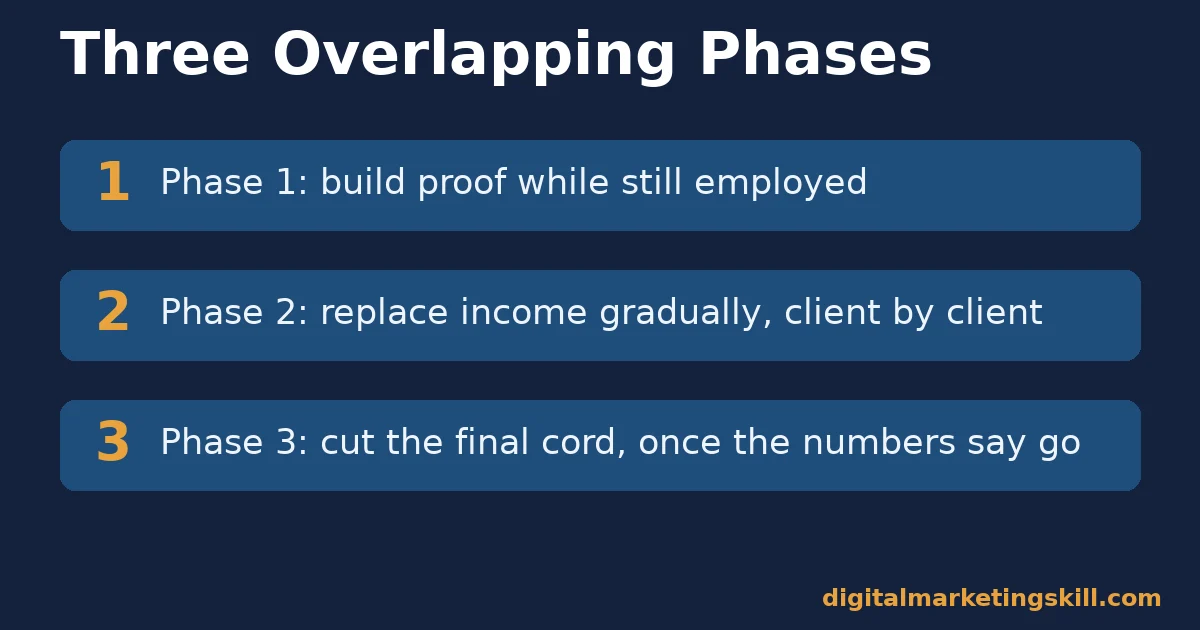
Independent work at this scale is not a fringe trend. The US Census Bureau counted 29.8 million nonemployer businesses, mostly self-employed individuals, making up roughly 6.8% of the US economy. A transition to freelancing rarely happens in one dramatic step, even though it often gets described that way. It unfolds in three overlapping phases instead: building proof while still employed, replacing income gradually, then cutting the final cord.
Proof Comes Before the Leap, Not After
Before you leave, you need evidence that someone outside your employer will pay you for your skills. A single paid side project, even a small one, is worth more at this stage than a polished portfolio with no paying clients behind it. Proof reduces risk; a portfolio alone does not.
Income Replacement Comes Before the Exit Date
MBO Partners found 54% of full-time independents say they will not go back to a traditional job. That figure suggests the transition works best when it is sustainable from early on, not rushed. Replacing a meaningful share of your salary before quitting, even 20 to 30%, changes the transition from a leap of faith into a calculated bet.
The Three Real Risks, Not the Imagined Ones
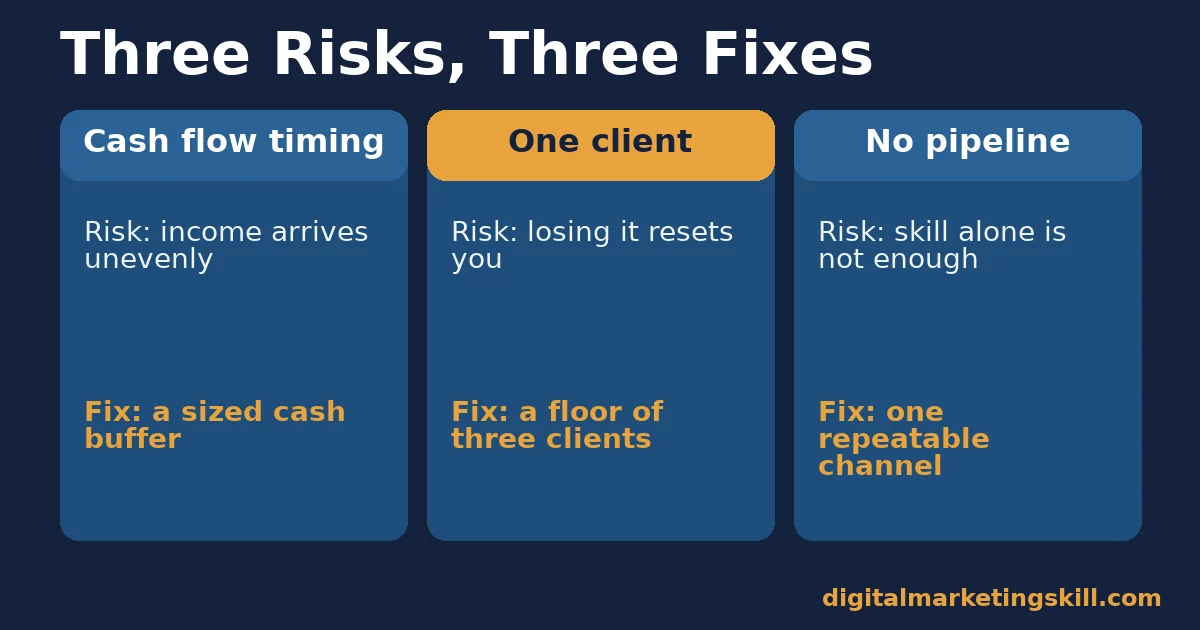
Forget vague fears about “failure.” Three specific, named risks actually derail a transition to freelancing, and each one has a concrete fix.
Risk One: Cash Flow, Not Total Income
A freelance income can average out to more than a salary over a year and still cause real financial stress. It rarely arrives in equal monthly amounts the way a paycheck does. A client paying 60 days late, or a project that slips a month, can create a gap even when the year-end total looks healthy. Treat timing, not just total earnings, as the risk to manage.
As an illustrative, invented example: picture a freelancer who earns the equivalent of their old salary across a full year, but two of their three clients both pay on 45-day terms. In a month where both payments land late, that freelancer can be short on rent despite being, on paper, exactly on target for the year. The fix is not more income. It is a cash buffer sized to cover that kind of timing gap.
Risk Two in a Transition to Freelancing: Depending on One Client
Early on, it is tempting to take one large client and treat that as “made it.” But one client is really just a second employer, with none of the protections a real job carries. Losing that one client resets the transition to zero overnight. Worse, a single dominant client often slows the search for others. There is little visible urgency to look for new work while the one relationship still feels stable.
Risk Three: Treating Marketing as Optional
Many new freelancers plan their service but never plan how clients will actually find them. MBO Partners’ satisfaction figures describe people already established as independents, not the harder early months before a pipeline exists. Building a simple, repeatable way to find clients matters as much as the skill you are selling. A skilled freelancer with no client-finding system will still run short of work, regardless of how strong the underlying service is.
What to Do About Each Risk
Naming the risk only helps if you build a specific habit against it. Here is the fix for each of the three risks above.
Cash Flow: Lead With a Runway, Not a Hope
Build a cash buffer before you leave, sized to your own expenses rather than a generic rule you read somewhere. Fidelity’s general guidance on emergency funds suggests three to six months of essential expenses as a starting point for employees; independent income swings harder, so track your actual essential monthly costs for a few months first and lean toward the higher end of that range.
Single-Client Risk: Lead With a Floor of Three
Aim for at least three active clients before you consider any one of them central to your income. Three is not a magic number, but it is enough that losing one client is a setback, not a collapse.
Marketing Gap: Lead With One Repeatable Channel
Pick one way of finding clients, whether that is referrals, a specific platform, or direct outreach, and run it consistently before adding a second channel. A repeatable client-finding system beats a scattered mix of tactics tried once each.
Mistakes That Undercut an Otherwise Solid Plan
Some mistakes quietly undo months of good planning, even when the underlying decision to transition was sound.
- Quitting before any paid proof exists. This turns the transition into a cold start instead of a continuation of existing momentum.
- Underpricing to win the first few clients. Low early rates are hard to raise later with the same clients, and they distort your sense of what the market actually pays.
- Skipping a separate business bank account. The US Small Business Administration recommends opening one as soon as you start accepting or spending business money. Mixing personal and freelance money makes it far harder to see whether the business itself is actually profitable.
- Ignoring taxes until the deadline. The IRS self-employed tax center requires most independent workers to pay estimated tax quarterly, not annually. A surprise bill can undo months of saved runway.
- Treating the first client like a full-time job again. Over-committing to one client recreates the single-client risk described above, just with a different job title.
Which Mistake to Fix First
If you have already quit, fix the business bank account first. It is the fastest change to make, and it fixes the view of your own numbers that every other decision depends on. If you have not quit yet, fix underpricing first instead, since early rates are far easier to set correctly than to renegotiate later with clients already used to a lower number.
How to Measure Whether the Transition Is Actually Working
Do not judge a transition to freelancing by how the first few weeks feel. Early weeks are noisy. Track three numbers instead, over a full quarter.
Three Numbers Worth Tracking
Income replacement percentage. This is freelance income divided by your old salary, tracked monthly. A rising trend over several months is a far better signal than any single strong month.
Active client count. Count clients who paid you in the last 90 days, not clients you have ever worked with. This number should sit at three or more once you are relying on freelancing full time.
Runway in months. This is your cash buffer divided by your monthly essential expenses. Watch whether this number is shrinking, holding steady, or growing as income replacement increases.
Reading These Numbers Together
Rising income replacement with shrinking runway means you are on track but still need the buffer to hold a little longer. Flat income replacement with a shrinking runway is the clearest signal to pause and revisit the marketing channel, not quit the idea entirely.
Rising active client count with flat income replacement often points to underpricing, since more clients should normally move the income number too. Check your rates before assuming the marketing channel itself has failed. A channel that brings in plenty of clients at too low a price looks identical, on the surface, to a channel that is not working at all.
A Practical Overlap Plan for Your Transition to Freelancing
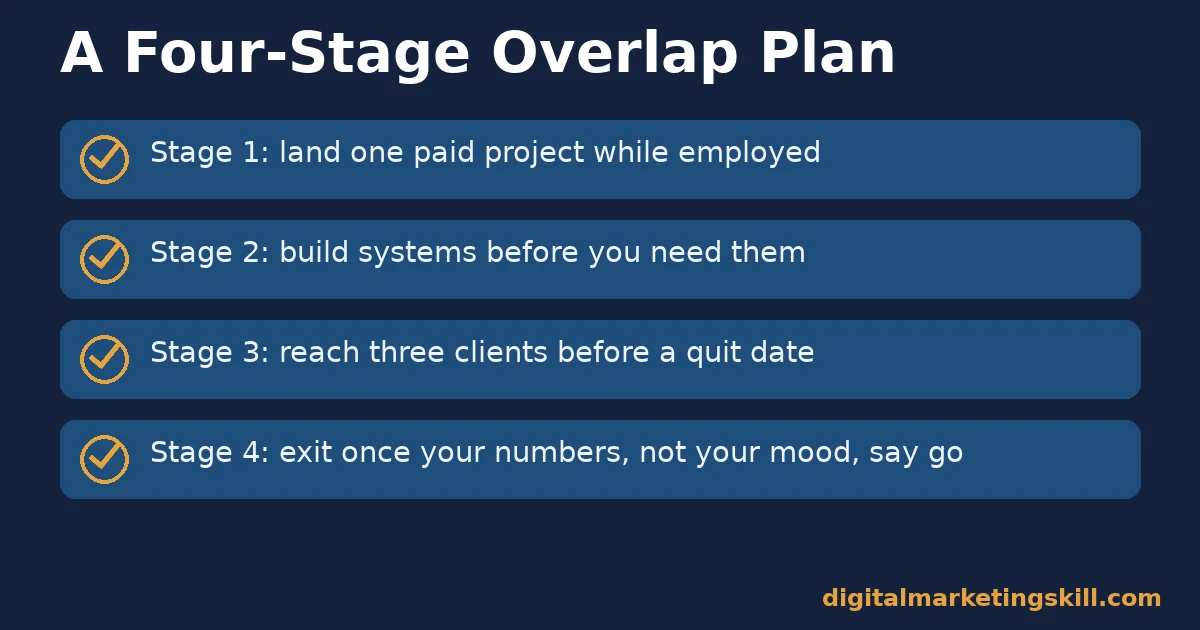
A transition to freelancing goes more smoothly with a rough timeline attached to it, even an imperfect one, than with no timeline at all. The exact pace will vary by person, but the order below holds regardless of how fast or slow you move through it.
Stage One: Land One Paid Project While Still Employed
Before anything else, find one real, paid project outside your current job. It does not need to be large. The goal is proof that your skills convert into outside income, which every later stage of the transition to freelancing depends on.
Stage Two: Build the Systems Before You Need Them
Set up a separate business bank account, a simple way to track hours or deliverables, and a basic contract template, while you still have the stability of a salary to fall back on. Building these systems under pressure, after you have already quit, is harder and more error-prone than building them now.
Stage Three: Scale to Three Clients Before You Set a Quit Date
Work toward the three-client floor described above while still employed, even if progress is slow some months. Reaching that floor is a better signal to quit than any fixed number of months, because it reflects demand for your work rather than a calendar guess.
Stage Four: Set the Exit Date Once the Numbers, Not Your Mood, Say Go
Quit once your income-replacement percentage and runway, both covered in the measurement section below, cross the thresholds you set for yourself. A transition to freelancing driven by frustration with the current job, rather than by the numbers being ready, is far more likely to feel like a crisis than a plan.
Set your own thresholds in advance, before frustration or excitement can influence the decision. A common approach is to pick a specific income-replacement percentage, such as 70 or 80%, paired with a minimum runway in months, and treat both as non-negotiable before handing in notice. Writing the numbers down ahead of time keeps the final decision factual rather than emotional.
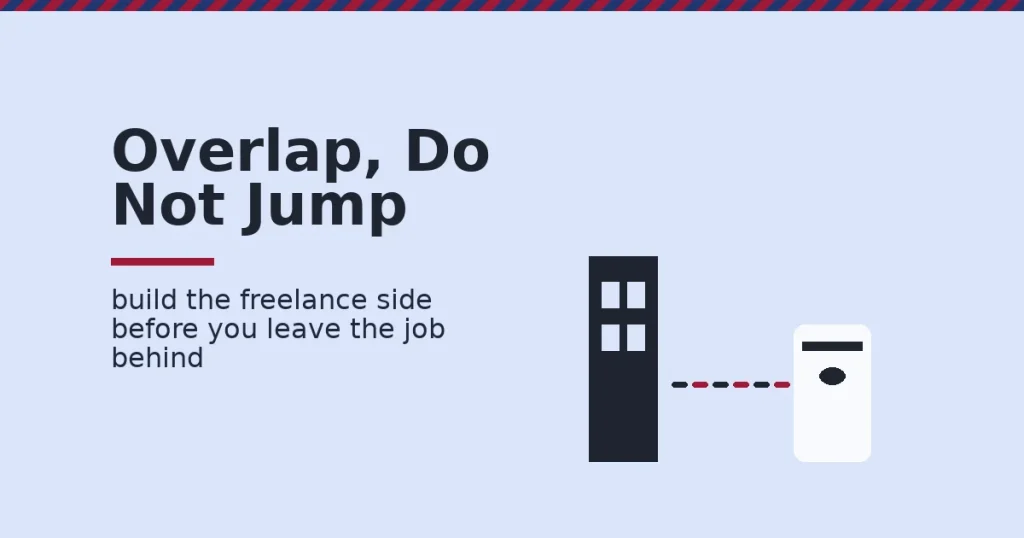
The One Rule: Overlap, Do Not Jump
If you take only one piece of advice from this guide, let it be this: build the freelance side before leaving the job, not after. MBO Partners’ finding that most full-time independents would not go back reflects people who, in most cases, built real footing first. An overlap period is not slower than a clean jump. It simply moves the risk to a point where you can still absorb it.
A Real Case: Replacing a Salary, One Client at a Time
One digital marketing graduate, Damola Akanbi, described this transition in a review on the Institute’s site. He quit his job and now averages $1,500 per client running digital marketing campaigns. His case shows the mechanism in this guide in practice. A specific, sellable skill, applied across multiple clients, replaced a single salary with several smaller, more resilient income streams.
Notice what his case does not describe: a single large client replacing the old salary one-for-one. Instead, several mid-sized client relationships, each valuable but not individually critical, add up to a more resilient total. That structure is a direct answer to the single-client risk named above, not a coincidence of how his particular business happened to grow.
What a Slower, More Cautious Transition to Freelancing Looks Like
Not every transition to freelancing needs to move quickly to count as successful. Some people deliberately stretch stage two and three over a year or more, building systems and clients gradually around a full-time job before ever setting a quit date. A slower pace is not a failure of the plan. It simply spends more time in the lower-risk, still-employed stages described above. For someone who values certainty over speed, that trade is entirely reasonable, and it rarely costs much beyond the extra months spent planning.
Frequently Asked Questions About Transitioning to Freelancing
How much savings do I need before I transition to freelancing?
Size your buffer to your own essential monthly expenses, tracked for a few months beforehand, rather than guessing. A buffer covering several months of essential costs gives the income-replacement process above room to work.
Should I tell my employer I am planning to freelance?
Check your contract for any conflict-of-interest or moonlighting clauses before you take on paid side work. Beyond that, timing the conversation is a personal and situational decision, not a universal rule.
How many clients do I need to feel financially stable?
Three active clients is a reasonable floor, since it means losing any single one is a setback rather than a collapse of your entire income.
Is it better to freelance part-time first or go all in?
The overlap approach in this guide, building proof and income on the side before leaving, consistently reduces risk compared with a sudden full exit with no existing client base.
What is the biggest financial mistake new freelancers make?
Treating cash flow timing the same as total annual income. A year can look profitable on paper while specific months still create real financial stress.
Do freelancers actually earn more than employees long-term?
MBO Partners’ data shows 4.7 million US independents now earn six figures, which proves strong earning is achievable, though it is not guaranteed and depends heavily on skill, niche, and client-finding ability.
How long does a typical transition to freelancing take?
There is no fixed timeline, since it depends on how quickly you can replace income and build a stable client base. Some people move through the four stages above in a few months; others take over a year, and both can succeed. Judging the transition by the three tracked numbers above works better than judging it by a calendar date.
Can I use freelancing as a test before fully committing to self-employment?
Yes, and the overlap plan above is built around exactly that idea. Treating the first paid project as a test, rather than a commitment, lowers the pressure on that first client relationship and makes an honest decision easier later.
Start the Overlap This Month
Pick one paid side project to build proof, start tracking your essential monthly expenses, and set a target income-replacement percentage before you set a quit date. Review your three numbers, income replacement, active clients, and runway, every single month until the full transition to freelancing is genuinely complete.
If you want the specific digital marketing skills that make freelance work sellable from day one, the Digital Marketing Skill Institute’s Master Diploma in Digital & AI Marketing runs across four AI-powered tracks: AI-Powered Social Media Management and Advertising, AI-Powered Lead Generation and Email Automation, AI-Powered Google Specialist, and AI-Powered WordPress and SEO Specialist. Together they total ten execution-first courses, with a Full Stack option for completing all four. The program includes unlimited 1-on-1 coaching and mentoring, a U.S. Project Internship with a verified U.S. Work Reference Letter, and a dual US and UK accredited diploma recognised in more than 100 countries. It runs 100% online, so you can build a freelance career from anywhere in your country, starting at digitalmarketingskill.com.
If you are earlier in the process, see our guide to freelancing for beginners, compare freelance marketplaces, read our guide to making money from freelancing, explore the Master Diploma program, or apply at digitalmarketingskill.com.
Every figure in this guide was checked against its original source before publication. Figures marked as illustrative are invented examples, not real results. Once you are earning as a freelancer, protecting that income and your energy matters just as much as landing it; our guide on how to avoid freelancer burnout covers the two biggest risks and how to fix each.