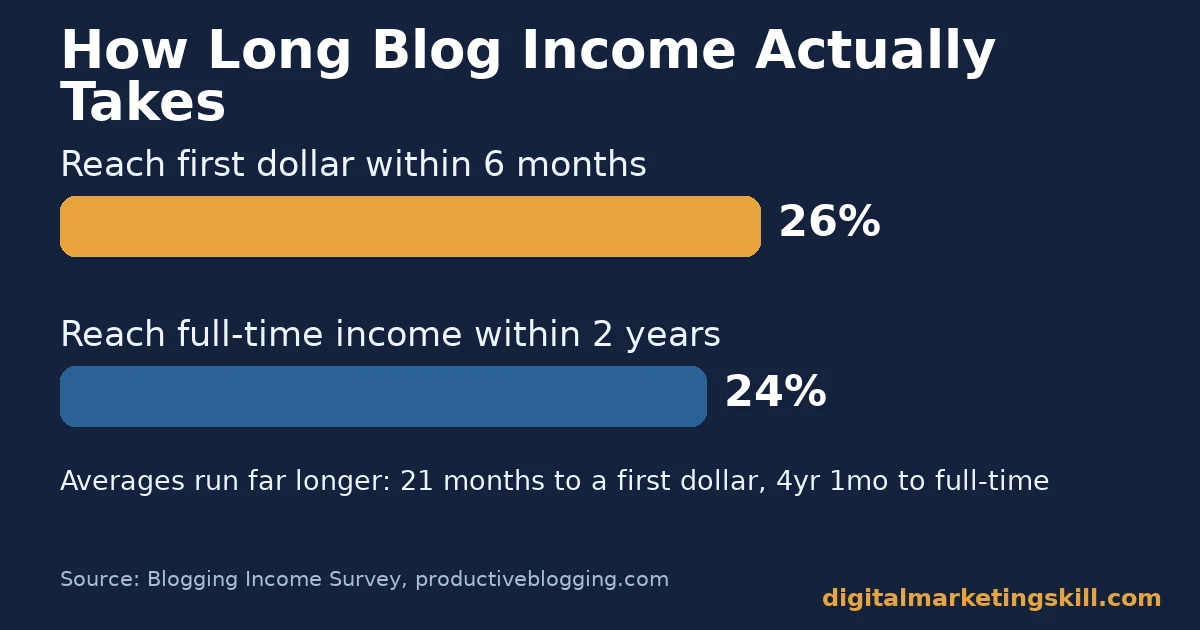
A blog income timeline rarely moves in a straight line. Survey data puts the average time to a first dollar at 21 months. Yet a quarter of bloggers earn something within six months. The real driver is not luck. It is which monetization model you pick, and how fast you build the traffic it needs.
Key Takeaways
- The average hides the spread. The Blogging Income Survey found bloggers take an average of 21 months to earn a first dollar. Yet 26% reach their first dollar within six months.
- Full-time income takes longer than most people plan for. The same survey found an average of four years and one month to reach full-time income. Still, 24% got there within two years.
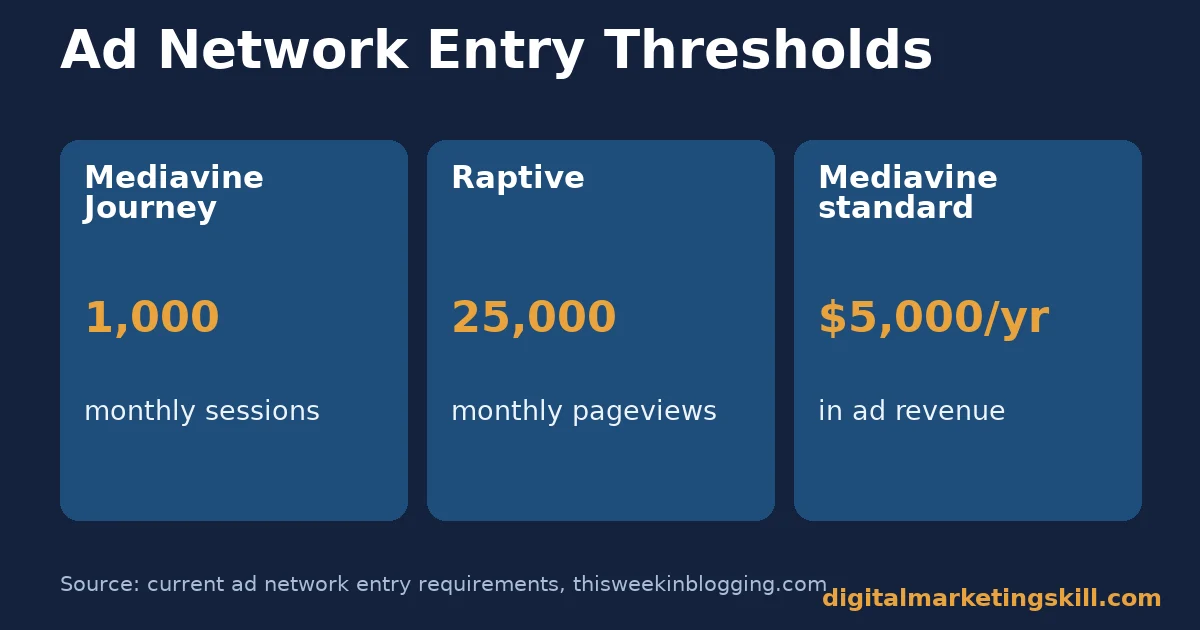
- Ad income needs real traffic first. Premium ad networks require 25,000 monthly pageviews (Raptive) or roughly $5,000 a year in revenue (Mediavine). Ad income arrives only after an audience exists.
- Email lists compound slowly, then quickly. Lists under 1,000 subscribers can grow 25-50% a month. Growth slows to 8-18% once a list passes 10,000, which changes how fast an offer can scale.
- Experience keeps paying off. Bloggers with five to ten years of experience average $2,325.62 a month. Those with ten or more years average $7,060.72, roughly three times as much.
In this guide
- What Most Blog Income Advice Skips
- The Three Timelines Inside a Blog Income Timeline
- What Differs By Monetization Model
- How To Shorten Your Blog Income Timeline
- How To Measure Progress Along the Way
- The One Decision Rule: When To Switch Monetization Models
- Common Mistakes That Add Months to a Blog Income Timeline
- A Real Case: What the Blogging Income Survey Shows Over Time
- Frequently Asked Questions About Blog Income Timeline
- Where To Learn the Skills Behind Every Stage
What Most Blog Income Advice Skips
Most posts about blog income promise a number. They name a dollar figure by a fixed month. That number almost never applies to your blog. It depends on a model and a niche the writer chose, not the one you have.
This guide skips the single number. Instead, it breaks your blog income timeline into the parts that actually move. How long does it take to build an audience? How long do readers take to trust you? And how long does your chosen monetization model take to pay out once both exist?
A few ground rules first. The figures below come from the Blogging Income Survey. It relies on self-reported respondents, so treat the numbers as a snapshot of one community, not a universal law. Ad network thresholds also change over time; the ones named here were current when checked. Nothing in this guide promises an income outcome.
The Three Timelines Inside a Blog Income Timeline
A blog income timeline is really three shorter timelines stacked on top of each other. Each one has to finish, at least partly, before income shows up.
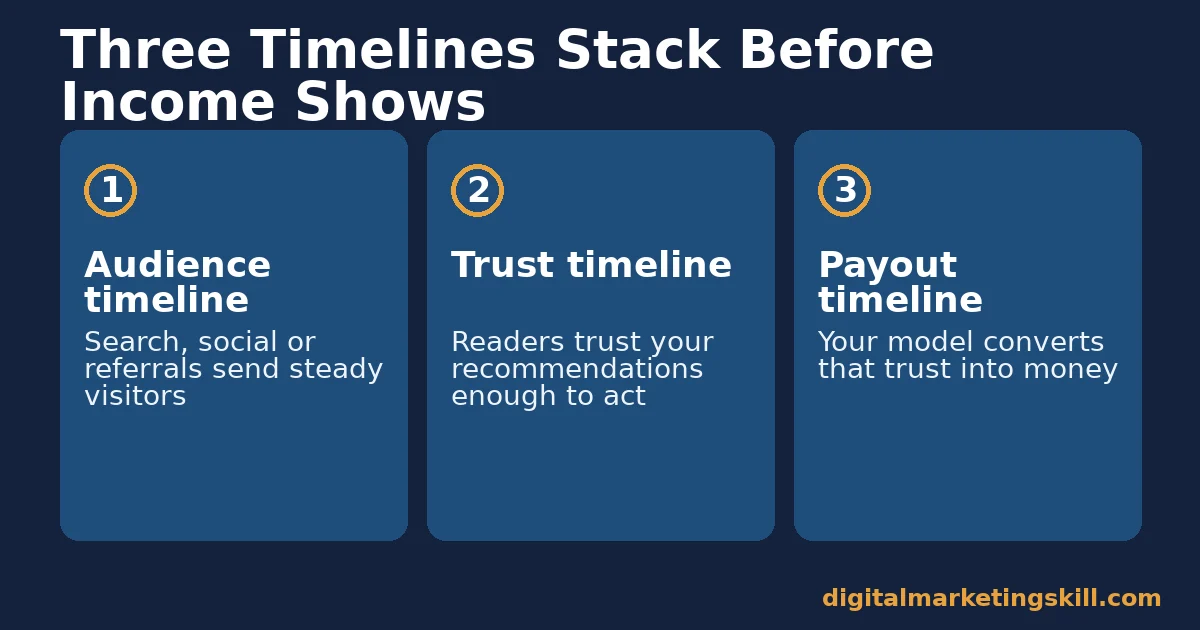
The first is the audience timeline. It covers how long it takes search engines, social platforms or referrals to send you steady visitors. The second is the trust timeline. It covers how long readers take to trust your recommendations enough to click, buy or subscribe. The third is the payout timeline. It covers how long your specific model takes to turn that trust into money, once both exist.
Stack those three and the 21-month average starts to make sense. A new blog might need six to twelve months to earn steady search traffic. It then needs a few more months for readers to start trusting its recommendations. A payout cycle sits on top of both before the first dollar lands. Skip a step, and the model has nothing to work with yet.
The practical use of this model is diagnosis. If income has stalled, work out which timeline is still unfinished. Traffic without trust rarely converts. Trust without enough traffic rarely scales. A payout model that matches neither one wastes both.
A Worked Example of the Stack
Illustrative, invented numbers show how the stack works in practice. A blog might spend months one through eight building toward 5,000 monthly sessions, almost entirely on the audience timeline. From month eight to month fourteen, a smaller, returning slice of those readers starts clicking affiliate links, which is the trust timeline catching up.
The first real payout often lands only in month fifteen or sixteen, once both timelines have enough overlap for the chosen model to pay. None of the three timelines is wasted time; each is doing work the other two depend on.
Niche also shifts where the stack gets stuck. A blog in a well-searched, broad niche usually finishes its audience timeline faster but its trust timeline slower, since broad topics attract more one-time searchers. A blog in a narrow, specific niche often finishes its trust timeline faster, because a smaller audience reads more posts and returns more often, even though its audience timeline takes longer to clear any ad network threshold.
What Differs By Monetization Model
The three timelines above do not move at the same speed for every model. Each one leans harder on a different stage. That is why the same blog income timeline advice does not fit every blogger.
Ad-Supported Blogs: Built For Volume
Display advertising pays per thousand pageviews. It is entirely a volume game. According to a roundup of current ad network entry requirements, Raptive now opens its network at 25,000 monthly pageviews, down from a 100,000-pageview threshold it once required. Mediavine asks for roughly $5,000 a year in ad revenue through its standard programme. Its entry-level Journey tier accepts sites with as few as 1,000 monthly sessions.
Reported RPM, or revenue per thousand sessions, commonly falls between $5 and $50 for mainstream blogs, depending on niche and season. A blog needs tens of thousands of monthly sessions before that income becomes meaningful. That is why ad-supported blogs usually have the longest audience timeline of the three models, and the shortest trust timeline. A reader does not need to trust you to generate an ad impression.
Affiliate Blogs: Built For Trust
Affiliate income needs far fewer visitors than ad income. But it leans hard on the trust timeline. A reader has to believe your recommendation enough to click through and buy. That usually means reading more than one post, not just landing on it from search.
This is also why affiliate blogs often earn their first dollar faster than ad-supported ones, even with a smaller audience. A few thousand engaged monthly readers in a narrow niche can outperform a much bigger, general audience here. The payout timeline only needs one convinced click, not a large volume of impressions. Our guide to turning a blog into income walks through the main payout models in more detail.
Digital Product Blogs: Built For a Launch Moment
A digital product, such as a template, course or ebook, does not pay continuously like ads and affiliate links do. It pays in a concentrated launch moment. So its timeline depends on how long it takes to build an email list willing to buy on the day you ask.
That makes the trust timeline the real bottleneck. Email list growth rate benchmarks put a healthy pace at 2-5% a month once a list is established. Smaller lists under 1,000 subscribers can grow 25-50% a month in percentage terms, even though the absolute numbers stay small.
A product blog’s first real income event often lands later than an affiliate blog’s first commission. It can also be larger once it arrives. For the traffic side of this model, see our guide on how to increase blog traffic.
How To Shorten Your Blog Income Timeline
Knowing which timeline is the bottleneck for your model tells you where to put effort. The fixes below mirror the three models above.
Ad-Supported Blogs: Lead With Volume Early
Since the audience timeline is the bottleneck, prioritise topics with proven search demand over narrow personal interests. Publish consistently rather than in bursts. Search visibility compounds with a steady archive. Setting a specific, written target helps here; see our guide to setting blogging goals the data actually supports. Track monthly sessions against the entry thresholds above as your clearest milestone. Revenue will stay near zero until that threshold is crossed.
Affiliate Blogs: Lead With Trust Content First
Write comparison and “how I use this” content before broad roundup posts. Specific, demonstrated experience builds trust faster than a long list of options. Disclose affiliate relationships clearly and close to the recommendation itself, as the FTC’s endorsement guidance requires. Keep recommendations narrow to your actual niche. A reader who senses you recommend everything trusts you with nothing.
Measure click-through rate on affiliate links before you measure total commission. It shows whether trust is building, even before a sale happens. For a deeper look at this, see the traffic, conversion and payout equation behind blogging income.
Digital Product Blogs: Lead With a Waitlist
Start collecting emails from your very first useful post, long before the product exists. List size on launch day sets a ceiling on revenue that content alone cannot lift afterwards. Give the list several genuinely useful, free pieces before any pitch. The trust timeline for a paid product is longer than for a single affiliate click.
A well-placed signup form matters too: one analysis of over 1.24 billion popup displays found an average opt-in rate of 2.1%, rising to 3-8% for well-optimised forms. Open a short, honest waitlist before the full launch. That way you gauge demand against a real number, not a guess.
How To Measure Progress Along the Way
A blog income timeline is hard to manage by revenue alone. Revenue lags behind the work that produces it. These metrics show progress earlier.
Monthly sessions is the count of visits in a 30-day window. Track it against the ad network thresholds above if display advertising is part of your plan.
Email list growth rate is new subscribers minus unsubscribes, divided by total list size, each month; 2-5% is a healthy pace for an established list.
Affiliate click-through rate is affiliate link clicks divided by the number of readers who saw them. A rising rate, even without sales, shows trust is building.
RPM, or revenue per thousand sessions, is ad or affiliate revenue divided by sessions, multiplied by 1,000. It isolates whether your audience quality is improving, separate from audience size.
Email conversion rate is purchases divided by emails sent. A study of over 300 million sent emails found an overall average of 0.32%, but 3.28% for sends to small lists of 1-500 people.
Read these together, not in isolation. Rising sessions with a flat click-through rate usually means traffic quality is weak, even if the audience timeline looks healthy. Flat sessions with a rising click-through rate often means the trust timeline is working. More traffic would convert well, if you found it.
The One Decision Rule: When To Switch Monetization Models
Pick the model that matches the timeline you have already built, not the one you started with by habit. Say your sessions are climbing past the ad network thresholds, but your affiliate click-through rate stays flat. Your audience timeline has outgrown your trust timeline. Ads will likely out-earn affiliate links for now.
Say your sessions are modest, but a loyal, repeat readership has formed. Your trust timeline has outgrown your audience timeline. Affiliate or product income will likely out-earn ads.
Illustrative, invented numbers: imagine a blog reaches 30,000 monthly sessions with a 0.4% affiliate click-through rate and $38 affiliate RPM, against an estimated $22 ad RPM at that traffic level. The affiliate RPM already leads. Doubling down on affiliate trust content would likely out-earn adding ads, even though the blog has just crossed the ad network traffic threshold.
Common Mistakes That Add Months to a Blog Income Timeline
A few habits stretch a blog income timeline far more than the model itself ever would. Watch for these five.
Switching Niches Before a Timeline Finishes
Changing topic every few months resets the audience timeline each time. Search engines and readers both need a consistent signal of what your blog is about before either one builds. A niche change restarts the clock on authority, even if some old posts still rank.
Chasing All Three Models Before Any Audience Exists
Adding ads, affiliate links and a digital product on day one spreads thin effort across three payout timelines that each need a different foundation first. Pick one model that matches your current traffic and trust level, and add the others only once that first one is working.
Watching the Wrong Metric For Your Model
An affiliate blogger who only tracks pageviews misses whether trust is actually building, since affiliate income depends on click-through rate more than raw traffic. An ad-supported blogger who only tracks commission conversations wastes time a volume problem needs instead. Match the metric in the measurement section above to your actual model.
Starting the Email List Too Late
Because healthy list growth sits at 2-5% a month, a list started a year late is not a year behind. It is a year behind, plus a slower compounding base for every month after that. Starting a list on day one, even with a handful of readers, is one of the few decisions that shortens every later stage of a blog income timeline at once.
Quitting Inside the Average, Not the Median
The 21-month average to a first dollar includes bloggers who took far longer than that, which pulls the average above the 12-month median. A blog that has not earned by month twelve is still inside a normal range, not a failure. Many bloggers stop just before the timeline they were already most of the way through would have paid off.
A Real Case: What the Blogging Income Survey Shows Over Time
The clearest evidence that a blog income timeline keeps paying off comes from the Blogging Income Survey. It groups respondents by years of experience, not by a single snapshot month. Bloggers with five to ten years of experience reported average monthly income of $2,325.62. Bloggers with ten or more years reported $7,060.72 a month, roughly three times as much.
The gap matters more than either number alone. Income seems to compound well past the first-dollar milestone most advice focuses on. An archive, an email list and search authority all keep building long after month one.
The limits are real: this is self-reported data from one community, not an audited dataset. It also says nothing about the bloggers who quit before reaching five years. Read it as evidence that a long blog income timeline still pays off for those who continue, not as a guarantee for every blog.
Frequently Asked Questions About Blog Income Timeline
How long is a realistic blog income timeline for a first dollar?
Survey data puts the average at 21 months, with a median closer to 12 months. About a quarter of bloggers earn something within six months. Your actual pace depends heavily on your monetization model and how consistently you publish.
Which monetization model pays the fastest?
Affiliate income often produces a first dollar faster than display ads. It needs far fewer visitors. Ads need enough volume to clear a network’s entry threshold before anything is paid at all.
How much traffic do I need before ads are worth adding?
Current entry points sit around 25,000 monthly pageviews for Raptive, and roughly $5,000 a year in revenue, or a similar audience size, for Mediavine’s standard programme. Mediavine’s Journey tier accepts sites with as few as 1,000 monthly sessions, so a smaller blog can start there.
Does email list size matter if I only want ad income?
Less than it matters for affiliate or product income. It still helps, since subscribers often return and read more pages per visit than one-time search visitors. That supports the volume ad income depends on.
Why does my blog income timeline feel slower than other people’s?
Niche, monetization model and publishing consistency all change the pace. Most public blog income stories also highlight above-average outcomes. Compare your three timelines against your own model, not against someone else’s model.
Should I switch monetization models if income is slow?
Only after checking which timeline, audience, trust or payout, is actually unfinished. Switching models before the right timeline has matured usually restarts the clock, rather than speeding it up.
Is blogging still a realistic way to build income?
The survey data shows a wide range of outcomes. Some bloggers never earn; others average thousands a month after several years. It rewards patience and consistency more than any single tactic, with no guaranteed outcome.
Does niche change my blog income timeline?
Yes. A broad, well-searched niche often builds an audience faster but trust more slowly, since more visitors arrive as one-time searchers. A narrow niche usually builds trust faster, because a smaller audience reads more posts and returns more often, even if it takes longer to reach the traffic volume some ad networks require.
Where To Learn the Skills Behind Every Stage
Every stage of a blog income timeline is a skill. Building search traffic, writing trust-building content, running email campaigns, and setting up SEO and ad groundwork can all be learned faster with structured practice than by trial and error alone.
The Master Diploma in Digital & AI Marketing from Digital Marketing Skill Institute is built around four AI-powered tracks: AI-Powered Social Media Management and Advertising, AI-Powered Lead Generation and Email Automation, AI-Powered Google Specialist, and AI-Powered WordPress and SEO Specialist. Together they total ten courses, with a Full Stack option for completing all four tracks.
The programme includes unlimited one-on-one coaching and mentoring, plus a U.S. Project Internship with a verified U.S. Work Reference Letter. It carries dual US and UK accreditation, recognised in more than 100 countries, and runs fully online.
Visit Digital Marketing Skill Institute to see the full curriculum. Read more on the Master Diploma programme page, browse more guides on the blog, or go straight to the application page, wherever you live.
You can also read real outcomes on the reviews page, alongside the earnings disclaimer: individual results vary and no income is guaranteed. Whether your blog is six months or six years old, there is a next skill worth learning, no matter where in your country you are starting from. The first step is at digitalmarketingskill.com.
Every figure in this guide was checked against its original source before publication. Figures marked as illustrative are invented examples, not real results.