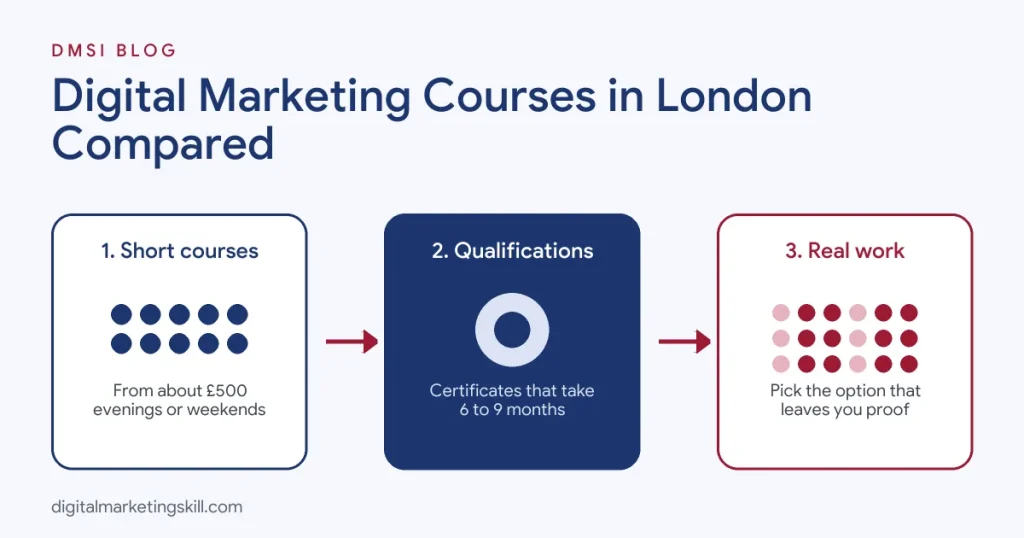
Digital marketing courses in London range from short evening classes at around £500 to accredited certificates costing £2,000 or more, plus funded apprenticeships and online programs you can take from anywhere in the city. The right choice depends on your goal: if you want a job, pick the option that gives you real work to show employers, not just a certificate. Compare format, price, time and, above all, whether the course includes practical experience.
This guide compares the main ways to learn digital marketing in London, including in-person courses, apprenticeships, professional qualifications and online programs with real projects. If you are weighing online options across the UK, see our guide to the best online digital marketing course in the UK.
Key Takeaways
- City Lit’s “Start a career in digital marketing” short course lists a full fee of £549, with lower senior and concession rates.
- The Level 3 Multi-channel Marketer apprenticeship typically takes 18 months and has a maximum government funding band of £11,000, paid through the employer rather than the apprentice.
- From 1 April 2026, the apprentice minimum wage is £8.00 an hour for apprentices under 19 or in their first year.
- Robert Half’s 2026 data puts the median London digital marketing executive salary at £40,750, so the skills pay off once you can prove them.
- Most London courses we compared teach skills but do not include a work placement, so you need to build proof of results yourself.
In this guide
- What Most Guides to London Digital Marketing Courses Miss
- How Digital Marketing Courses in London Actually Work
- Digital Marketing Courses in London Compared
- The Options in More Detail
- Digital Marketing Apprenticeships in London
- Marketing Degrees and Masters in London
- How to Choose: Six Steps
- Common Mistakes When Choosing a Course
- How to Measure Whether a Course Worked
- The One Rule for Choosing a Course
- An Illustrative Case
- Frequently Asked Questions About Digital Marketing Courses in London
- Your Next Step
What Most Guides to London Digital Marketing Courses Miss
Most course roundups compare topics, length and price. Those matter, but they miss the question employers ask first: what have you actually done?
A London marketing employer reading your CV sees dozens of certificates. What makes you stand out is a campaign you ran, a page you ranked, or an ad account you managed, with numbers to show for it. Many courses teach the theory well and set practice exercises, but few give you real work on a real business.
So the useful way to compare courses is in two parts. First, does it teach the skills for the role you want? Second, does it give you real results to show, or will you need to create those yourself? This guide answers both for each option.
How Digital Marketing Courses in London Actually Work
Courses open to Londoners fall into four groups. Each suits a different budget, schedule and goal.
Built for evenings and weekends
Short in-person or hybrid courses, often from adult education colleges, cover the basics in a few weeks. They are affordable and good for testing whether digital marketing suits you. They rarely include real client work.
Built for a recognised qualification
Professional qualifications such as those from the Chartered Institute of Marketing (CIM) or the Digital Marketing Institute (DMI) carry an awarding body’s name. They take longer and cost more, and they suit people who want a formal credential, often alongside a job.
Built for working while you learn
Apprenticeships combine a paid job with structured training. You need an employer to hire you first, so they are a job search as much as a course.
Built for real projects online
Some online programs build practical work into the course itself, so you finish with results to show. You can take them from anywhere in London, around a job, without commuting to a classroom.
Digital Marketing Courses in London Compared
Here is how the main options compare. Prices are as published when we checked in November 2026. Where a provider does not publish a price, we say so.
| Option | Format and length | Price | Real work or placement |
|---|---|---|---|
| DMSI Master Diploma (AI-powered tracks) | 100% online, 3 months, mentored | $150 per track with the scholarship | U.S. Project Internship from day one, plus a U.S. work reference letter |
| City Lit Pro: start a career in digital marketing | Short course, in person or online, Holborn | £549 full fee (concessions available) | No placement |
| City Lit Level 3 Certificate in Social Media Marketing | Accredited, part-time evenings over most of an academic year | £2,349 to £2,699 in recent years | No placement |
| General Assembly Digital Marketing short course | 10 weeks part-time evenings or 1 week full-time | No GBP price on its UK page | Course projects. No placement |
| CIM Level 4 Certificate in Professional & Digital Marketing | Through study centres, 6 to 9 months | Tuition set by each centre. Assessment from £460 | No placement |
| DMI Professional Diploma in Digital Marketing | Self-paced online, about 22 to 28 hours of content | Not published | No placement |
The Options in More Detail
1. DMSI Master Diploma in Digital & AI Marketing
We put our own program first because it is built around the thing employers check: real work you can prove. You choose one of four AI-powered tracks, Social Media Management and Advertising, Lead Generation and Email Automation, Google Specialist, or WordPress and SEO Specialist, or take all four in the Full Stack option. From your first week you work on a U.S. Project Internship, applying what you learn to a real company’s marketing. You get unlimited one-on-one coaching and finish with a verified U.S. work reference letter. It is 100% online over three months, so you can study around a London job. Each track is $430, or $150 with the 65% partial scholarship.
2. City Lit short courses
City Lit is an adult education college in Holborn with a range of digital marketing courses, from one-day introductions to longer programs. Its “Start a career in digital marketing” course covers SEO, paid search, content, social media and email, with a full fee of £549 and lower senior and concession rates. It is a good, affordable introduction if you want to learn in a classroom. You will need to build your own real-world portfolio alongside it.
3. City Lit Level 3 Certificate in Social Media Marketing
This accredited certificate runs part-time over most of an academic year, combining online and in-person sessions. Fees in recent runs have been £2,349 to £2,699, and City Lit says some accredited courses have free places for eligible learners. It suits people who want a formal Level 3 qualification focused on social media.
4. General Assembly
General Assembly offers its UK Digital Marketing short course as a 10-week, part-time evening course or a one-week, full-time accelerated course, taught live by industry practitioners. It covers campaign strategy, channels and analytics, with course projects. Check the current price with its admissions team, as its UK page does not list a fee in pounds.
5. CIM Level 4 Certificate
The Chartered Institute of Marketing’s Level 4 Certificate in Professional & Digital Marketing is a widely recognised professional qualification, taken through approved study centres. Study usually takes six to nine months. Tuition is set by each centre, and CIM’s assessment fees start from £460. It suits people already working in marketing who want a formal step up.
6. DMI Professional Diploma
The Digital Marketing Institute’s Professional Diploma is a self-paced online course with about 22 to 28 hours of content across the main digital channels. It suits people who want a recognised name on their CV and like to study alone.
Digital Marketing Apprenticeships in London
Marketing apprenticeships are one of the most searched routes in London. An apprenticeship is a real job with training built in: you are employed, paid and trained at the same time.
In England, the main marketing standard is the Level 3 Multi-channel Marketer, which replaced the older Level 3 Digital Marketer apprenticeship. It typically takes 18 months, and its maximum government funding band is £11,000, paid through the employer. Job titles include digital marketing assistant, marketing assistant and social media assistant.
From 1 April 2026, apprentices under 19, or in the first year of their apprenticeship, must be paid at least £8.00 an hour. After the first year, apprentices aged 19 or over move to the minimum wage for their age. Many London employers pay above the minimum.
The catch is that you need to win the job first. Apprenticeships are advertised on GOV.UK’s Find an apprenticeship service, and good London roles attract many applicants. A small portfolio of real work helps you stand out here too. For more on the job side, read our guide to digital marketing jobs in London.
Marketing Degrees and Masters in London
London’s universities offer undergraduate marketing degrees and master’s programs in marketing and digital marketing. They give you depth, theory and a university network, and some include a placement year. The trade-offs are time and cost: a degree takes three years and a master’s usually one, with fees far above any short course. If your goal is to get into a digital marketing role quickly, a shorter, practical route often gets you there sooner. If you want an academic qualification or plan a long-term career in strategy or research, a degree may suit you better.
How to Choose: Six Steps
- Name your goal. A first job, a promotion, freelance clients or your own business each point to a different option.
- Pick one role family. Social media, SEO, paid ads, email or content. A course that goes deep in one beats a shallow tour of all.
- Check for real work. Ask: will I finish with results on a real business that an employer can check?
- Match the schedule. Evening, weekend, full-time or online. Choose what you can actually keep up with.
- Compare total cost. Include tuition, exam fees, travel and any tools you must buy.
- Read reviews. Look for reviews that mention jobs or clients won, not just enjoyment of the classes.
Common Mistakes When Choosing a Course
Choosing on price alone
The cheapest course can cost you more if it leaves you with no proof and no job. Compare what you get, not just what you pay.
Collecting certificates
Several certificates without real results do little for a London CV. One strong piece of proof does more.
Ignoring the time commitment
A course you cannot keep up with is wasted money. Be honest about your evenings and weekends.
Forgetting what happens after
Ask what support you get when the course ends, such as coaching, CV reviews or a reference.
Assuming an apprenticeship is a course you can just sign up for
Apprenticeships are jobs. You apply to an employer, not a college, and compete with other applicants.
How to Measure Whether a Course Worked
- Proof pieces. How many real results can you now show? Aim for at least two.
- Applications and replies. Track how many roles you apply for and how many reply, before and after the course.
- Confidence in interviews. Can you talk through a campaign you ran, start to finish, with numbers?
The One Rule for Choosing a Course
Choose the course that leaves you with real work to show. Skills get you through the interview; proof gets you the interview in the first place.
An Illustrative Case
This is an illustrative example, not a real person. It shows how the steps above can fit together. Results like this are not typical or guaranteed.
Priya works in retail in Ealing and wants to move into social media marketing. She considers a 10-week evening course but worries she will finish with a certificate and no experience.
She picks a social media track that includes a real project from the start. Over three months she plans and runs content and a small ad campaign for a real business, and records the results. She adds them to her CV and LinkedIn, applies to junior social media roles in London, and gets two interviews in her first month of applying.
Frequently Asked Questions About Digital Marketing Courses in London
How much does a digital marketing course in London cost?
Short evening courses start at around £500, such as City Lit’s £549 career starter course. Accredited certificates can cost £2,000 or more. Our Master Diploma in Digital & AI Marketing is $430 per AI-powered track, or $150 with the 65% partial scholarship, and includes a U.S. Project Internship from day one. Apprenticeships have no course fees for the apprentice, as training is funded through the employer.
What is the best digital marketing course in London for getting a job?
The best course for a job is one that gives you real results to show employers, not just a certificate. Compare whether each option includes practical work on a real business. The DMSI Master Diploma builds this in: you work on a U.S. Project Internship from your first week and finish with a verified U.S. work reference letter.
Are there free digital marketing courses in London?
Some colleges offer free places on certain accredited courses for eligible learners, and apprenticeships carry no course fees for the apprentice. Check eligibility with each provider.
How long does it take to learn digital marketing?
Short courses take a few weeks. Practical programs and professional certificates take three to nine months. Apprenticeships take around 18 months. How fast you get hired depends more on the proof you build than the time you spend.
Do I need a degree to do a digital marketing course?
No. Most short courses, online programs and apprenticeships do not require a degree. Apprenticeship employers set their own entry requirements.
What is the Level 3 Multi-channel Marketer apprenticeship?
It is the main marketing apprenticeship standard in England. It typically takes 18 months, and prepares you for roles such as digital marketing assistant and social media assistant.
Can I study digital marketing online while living in London?
Yes. Online programs let you study around a job without commuting. Look for one that includes real projects and coaching, so you do not learn alone.
Is a CIM qualification worth it?
CIM qualifications are widely recognised in UK marketing, especially for people already working in the field who want a formal credential. They do not include a placement, so pair one with practical work.
Should I do a master’s in digital marketing in London?
A master’s suits people who want academic depth or a strategy career. If your goal is a first role quickly, a shorter practical course is often a faster route.
What should I learn first in digital marketing?
Start with one role family, such as social media, SEO or email, and learn it well enough to get a real result. Our guide to job-ready digital marketing skills helps you choose.
Your Next Step
Courses teach skills; employers hire proof. The Master Diploma in Digital & AI Marketing at Digital Marketing Skill Institute is built around four AI-powered tracks: Social Media Management and Advertising, Lead Generation and Email Automation, Google Specialist, and WordPress and SEO Specialist. A Full Stack option covers all four.
Every track includes a U.S. Project Internship from day one and unlimited one-on-one coaching, so you finish with real results and a verified U.S. work reference letter. The program carries dual US and UK accreditation, is recognised in more than 100 countries, and runs 100% online over three months.
You can study it from anywhere in your country. Read student reviews, then apply for the 65% partial scholarship to see if you qualify.
Every figure in this guide was checked against its original source before publication. Course prices and formats were checked on each provider’s website in November 2026 and may change. Apprenticeship facts come from GOV.UK and the Low Pay Commission. The case above is an illustrative example, not a real result.