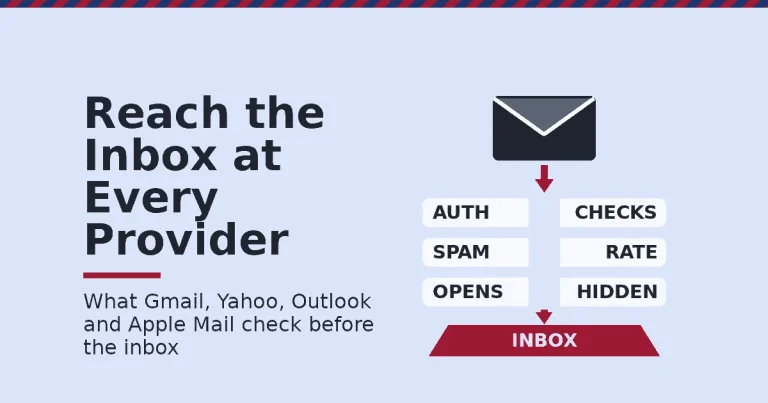
A digital marketing skill only helps your CV when you can prove it fast: a link, a number, or a finished piece of work, in under two minutes. Listing “SEO” or “social media” with no proof reads the same as listing nothing. Recruiters cannot screen a bare word on its own.
Key Takeaways
- Skills claims, not just degrees, are being checked more closely. SHRM research found 56% of employers use pre-employment skills assessments. It also found that 79% say assessment scores matter as much as or more than traditional hiring criteria.
- Dropping a requirement rarely changes who gets hired. Research from Harvard Business School and the Burning Glass Institute covered 11,300 roles at large US firms. It found fewer than 1 in 700 new hires actually benefited when a company dropped its degree requirement.
- Demand for marketing talent keeps growing. The US Bureau of Labor Statistics projects 7% growth for marketing managers over the next decade. It also projects about 36,300 average annual openings across the role.
- Skill shortages already delay real work. Robert Half research found skills shortages delayed marketing automation projects at 37% of organizations. AI integration work was delayed at another 37%.
- Finding the right skill set is the top hiring barrier. In a large marketer survey, “finding candidates with the right skill set” ranked as hiring managers’ top challenge. It ranked ahead of budget or headcount limits.
In this guide
- What Most “Digital Marketing Skills” Lists Miss
- How a Digital Marketing Skill Actually Gets Screened
- Three Categories of Digital Marketing Skill, and What Each Proves
- How to Prove Each Digital Marketing Skill on Your CV
- How to Check Whether a Digital Marketing Skill Is CV-Ready
- The One Rule: If You Cannot Prove It in Two Minutes, Do Not List It as a Skill
- A Real Case: Turning Project Experience Into a Hireable Skill
- Frequently Asked Questions About Digital Marketing Skill
- Your Next Step: Audit Your CV’s Skill List This Week
What Most “Digital Marketing Skills” Lists Miss
Most lists of digital marketing skills are just that: lists. SEO, content, social, email, analytics, paid ads. None of that is wrong. However, it is also not useful, because it does not say which skill actually moves a CV to the interview pile.
What gets missed is proof. A recruiter scanning fifty CVs cannot verify a skill from a single word. So a named project, a number, or a link does the verifying for them, in seconds instead of a guess.
Treat the research here as named and dated by source, not as a universal rule. Several figures are US-only, and company-level hiring behavior varies widely. Still, the skill-category comparison below is our own way of organizing the evidence, not an official ranking.
One more ground rule worth stating up front: a digital marketing skill is only as useful as the proof behind it. That idea repeats through every section below, because it is the one thing most skills advice skips.
It also explains why two candidates with the same bullet points on a CV can get very different outcomes. One has a sentence of proof ready behind each skill; the other has only the word itself, and hopes nobody asks a follow-up question.
How a Digital Marketing Skill Actually Gets Screened
A skill on a CV goes through roughly four filters before it ever reaches a human conversation. First, an automated or manual keyword scan. Then a recruiter’s quick read. Next, increasingly, a skills assessment. Finally, an interview where the claim gets tested directly.
SHRM’s research on hiring practice found that 56% of employers now use pre-employment skills assessments. It also found that 79% say the scores matter as much as a traditional résumé or interview. So a skill you cannot demonstrate under that kind of test will not survive it.
These assessments are not always elaborate. Sometimes it is a short writing sample, a mock campaign brief, or a timed task inside a tool you claim to know well. Each one tests the same thing: whether the skill on the CV survives contact with a real task.
Why “No Degree Required” Rarely Changes Who Gets Hired
Many employers have publicly dropped degree requirements in favor of skills-based hiring. Research from Harvard Business School and the Burning Glass Institute tracked 11,300 roles at large US firms. Even so, it found fewer than 1 in 700 new hires actually benefited from the dropped requirement.
The lesson is not that skills-based hiring is fake. Instead, a policy change on paper rarely overrides what a hiring manager actually screens for. In practice, that means specific, provable ability, not a broader applicant pool on its own.
In other words, the headline policy matters less than what happens inside the actual screening process. NACE research on employer hiring practice backs this up.
About half of employers have roles officially flexible on degree requirements. But few actually hire a candidate without a degree more than a quarter of the time, even where the policy exists. That gap between policy and practice is exactly what the rest of this guide focuses on closing.
Three Categories of Digital Marketing Skill, and What Each Proves
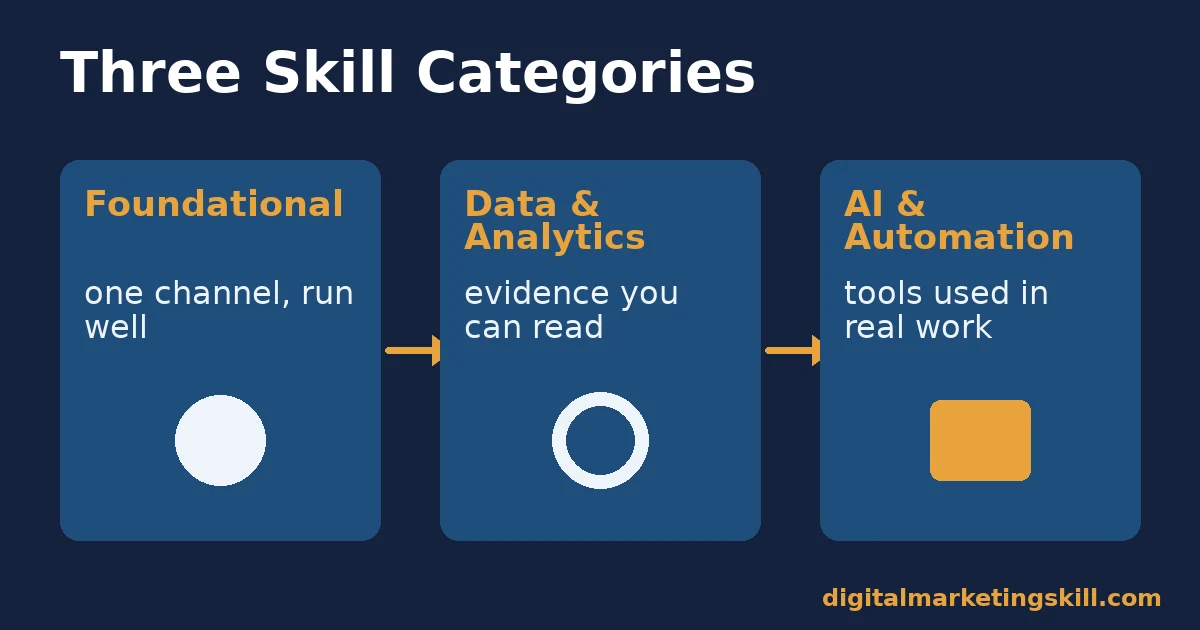
Not every digital marketing skill proves the same thing to an employer. In a large marketer survey, the most valuable skills ranked were AI and automation fluency, cross-organizational communication, and data and analytics. So those fall into three broad categories worth separating on a CV.
For a hiring-data view of which channel skills tend to matter most, see our guide to in-demand digital marketing skills. The three categories below sit underneath that picture.
Foundational Skills: Built on One Visible Channel
Foundational skills are channel-specific: SEO, paid search, social media management, email marketing, content writing. The US government’s own O*NET occupational database lists sales and marketing knowledge as a core competency underneath all of them. They prove you can run one piece of the marketing mix competently on your own.
The trade-off is that foundational skills are the most common claim on every competing CV. Listing “SEO” alone proves almost nothing; a specific, measurable SEO result proves a great deal.
That is because almost every applicant for a marketing role can type “SEO” into a skills section. Very few can state the exact keyword they targeted, the ranking position it reached, or the traffic change that followed. That gap is where a CV actually gets noticed.
Data and Analytics Skills: Built on Evidence You Can Read
Data and analytics skills cover reading a dashboard, running an A/B test, or building a simple report. They prove you can tell whether marketing work is actually working.
The trade-off is depth. A screenshot of a dashboard proves little on its own. What moves a CV is the decision you made because of the numbers, and what changed afterward.
A short before-and-after sentence works well here: what the metric looked like, what you changed, and what it looked like afterward. That sequence is far easier for a recruiter to evaluate quickly than a loose claim of being “data-driven.”
AI and Automation Fluency: Built on Using New Tools Well
AI and automation fluency means using AI tools inside real marketing workflows: drafting, research, campaign automation, reporting. It is the newest category. Current survey data ranks it as the single most valuable skill employers look for right now.
The trade-off is that fluency claims are easy to overstate, and just as easy to test. A short, specific example of a workflow you built or sped up proves far more than naming the tools you opened.
How to Prove Each Digital Marketing Skill on Your CV
Each category above needs a different kind of proof to survive a recruiter’s quick read and a skills assessment. Match the fix below to whichever category you are listing.
Write the proof before you need it, not during an application deadline. Keep a running document of specific examples for every skill you claim, so you are never scrambling to remember a number under time pressure.
Foundational Skills: Lead With a Named Result
Replace “SEO” with one sentence naming the channel, the action, and the measurable result. That result could be traffic, ranking position, or a conversion change. A single concrete sentence outweighs an entire unranked list of channel names.
Keep a short portfolio link or a one-page case study ready for your strongest one or two foundational skills. Do not try to document every channel you have ever touched. Our guide to writing a digital marketing cover letter covers how to weave that same proof into the rest of your application.
Data and Analytics: Lead With the Decision You Made
Describe the decision a piece of data led to, not just the tool you used to find it. “Used Google Analytics” proves far less than “cut a underperforming campaign after the data showed a high cost per lead.”
Practice explaining one analytics example out loud before an interview. A skill that sounds confident and specific in conversation reads as far more real than the same skill listed as a single word.
AI and Automation: Lead With a Workflow, Not a Tool List
Describe one real workflow you automated or sped up with AI tools. Include roughly how much time or effort it saved. A workflow example beats a list of tool names every time, because tool names change constantly on their own.
Keep the example current and specific to marketing tasks: content drafts, campaign structuring, reporting, research. A vague “I use AI” claim is common enough now that it reads as filler unless backed by a real example.
Be honest about the edits you made afterward, too. A workflow that still needed your judgment to fix or finish is a stronger, more believable example than one framed as fully automatic from start to finish.
How to Check Whether a Digital Marketing Skill Is CV-Ready
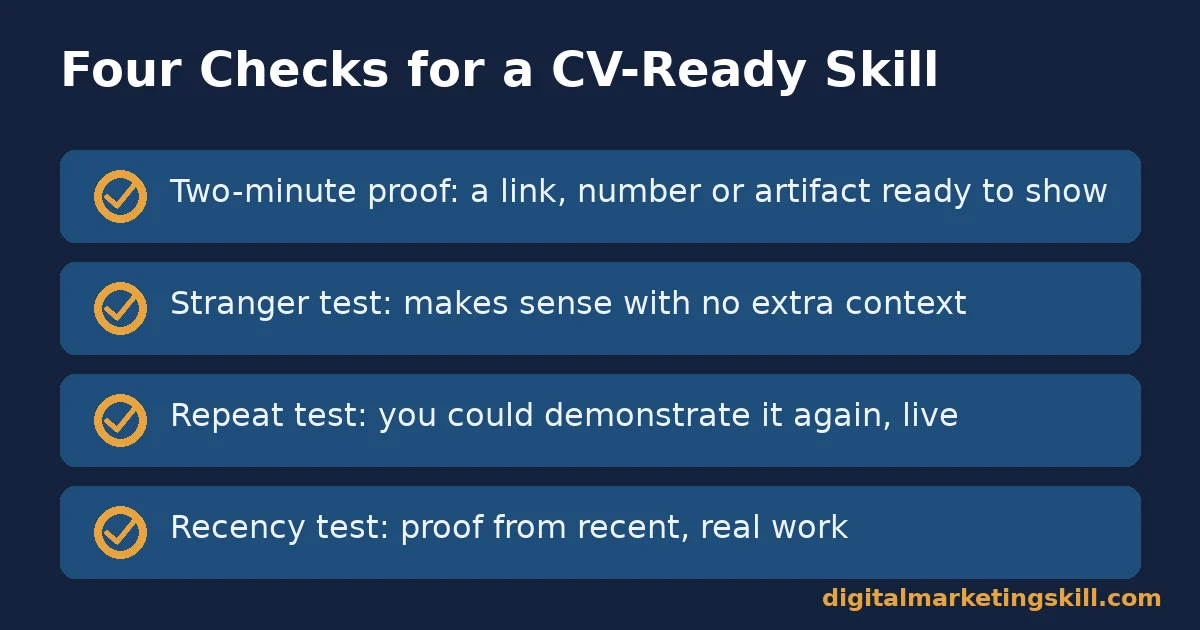
Before you list any digital marketing skill, run it through these four checks. A skill that fails more than one is not ready to go on a CV yet.
Four Checks for a CV-Ready Skill
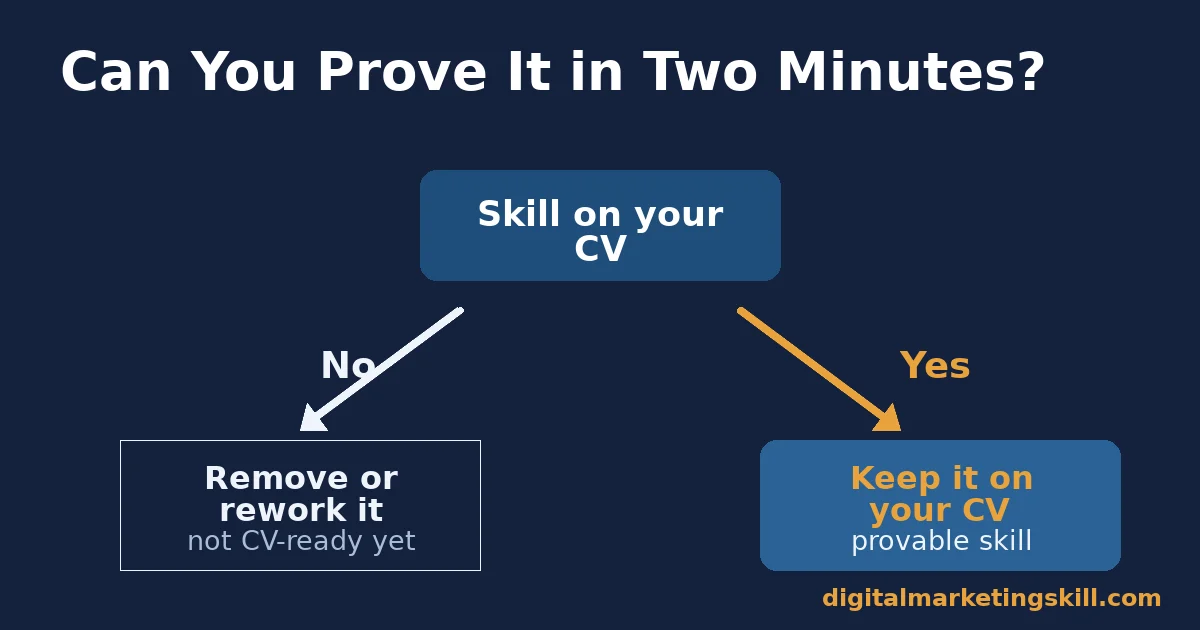
The two-minute proof test. Can you show a link, number or artifact that proves this skill in under two minutes? If not, it is a claim, not yet a provable skill.
The stranger test. Would someone outside your team understand the proof without extra context? A metric only your old manager could interpret will not survive a screening call.
The repeat test. Could you demonstrate this skill again, live, under mild pressure? If a skill only worked once with heavy help from a mentor or template, it is not solid yet.
The recency test. Is your proof from recent, real work, not an old course exercise? Tools and platforms change fast enough that dated proof carries much less weight.
Run through all four checks together for your top three skills before you update a CV. Most people find at least one skill they believed was CV-ready is actually missing a proof point once they test it honestly.
The One Rule: If You Cannot Prove It in Two Minutes, Do Not List It as a Skill
Here is the rule worth applying to every line of a CV. If you cannot produce a link, a number, or a specific example proving a digital marketing skill within two minutes, remove it. Replace it with one you can prove instead.
This rule applies even to skills you are confident in. Confidence is not the same as proof, and a recruiter has no way to measure confidence directly. They can only measure what you show them.
Illustrative, invented example: two candidates both list “content marketing.” The first can only describe the term in general. The second opens one blog post, names the keyword it targets, and states the traffic change after publishing.
A recruiter spending thirty seconds per CV line will remember the second candidate’s one sentence far longer. That is true even though both candidates wrote the exact same two words on their CV.
A Real Case: Turning Project Experience Into a Hireable Skill
As published on the Digital Marketing Skill Institute’s reviews page, former student Grace A. had moved to the United States. She described being stuck in “survival jobs” for lack of local experience.
A structured project experience gave her a concrete portfolio to point to, and she became a Digital Marketing Manager. The project work, not a general list of channel names, is what turned her skills into something a hiring manager could verify.
Notice what the case does not show: a magic keyword, a single certificate, or a clever CV template. What it shows is the same pattern as the two-minute proof test above, applied to a real career change.
Gaps in a CV, like Grace A.’s lack of local experience, often matter less than what you can show you built since then. A strong portfolio piece can outweigh a résumé gap that would otherwise raise a recruiter’s first question.
This is one published, self-reported outcome, not a typical or guaranteed result. Our earnings disclaimer applies to every outcome referenced in this guide.
Frequently Asked Questions About Digital Marketing Skill
What is the most important digital marketing skill right now?
Current survey data ranks AI and automation fluency, cross-organizational communication, and data and analytics as the most valued skills. All three rank ahead of any single channel skill, such as SEO or social media alone.
How do I prove a digital marketing skill without work experience?
Build one small, real project: a mock campaign, a personal blog optimized for one keyword, or a free tool used on a real small business with permission. A finished project proves a digital marketing skill, even with no job title attached.
Ask permission before using a real business’s data or name in a portfolio piece, and be transparent that it was unpaid or practice work. Honesty about the project’s scope matters more than making it sound bigger than it was.
Do certifications count as a digital marketing skill?
Certifications help most when paired with a project, not presented alone. A certificate shows you studied a topic; a linked project shows you can apply it, which is what most screening actually checks for.
How many digital marketing skills should I list on a CV?
Three to five, each backed by a sentence of proof, beats a long unranked list every time. A shorter, provable list reads as more credible than a long list of unverified channel names. Order the list by strength, with your most provable, most relevant skill first.
Is a digital marketing skill assessment hard to pass?
It tests whether you can apply a skill, not just define it, so a skill you have only read about is unlikely to pass. A skill you have actually used on a real task, even a small one, usually passes comfortably.
Which digital marketing skill is easiest to learn first?
Start with the channel closest to work you already do, since existing context speeds up both learning and proving the skill. A complete beginner often finds content and basic SEO the most approachable starting point, because both can be practiced and shown on a small personal project without needing a client or an employer first.
Can soft skills count as a digital marketing skill?
Yes. Cross-organizational communication ranks among the most valued skills in current survey data, right alongside technical channel skills. So a provable example of aligning marketing with sales or product teams is worth including.
Should I remove a digital marketing skill I cannot prove?
Yes, or replace it with a smaller, honest claim you can back up. A short, real example of a skill still in progress reads better than an unprovable claim that invites an awkward follow-up question.
Do employers really check digital marketing skills before hiring?
Increasingly, yes. Skills assessments, portfolio reviews and short practical tasks are now common steps in marketing hiring, which is exactly why proof behind each listed skill matters more than the list itself.
How is a digital marketing skill different from a digital marketing tool?
A tool is what you use; a skill is what you can do with it. Naming a tool, such as a specific analytics or ad platform, is not itself a skill until you can describe a task you completed using it well. Treat tool names as supporting detail inside a proof sentence, never as the proof itself.
Your Next Step: Audit Your CV’s Skill List This Week
Run every digital marketing skill on your CV through the two-minute proof test, wherever you live in your country. Remove or rework anything you cannot back with a link, a number, or a specific example. Start with the skill you rely on most, since that is the one most likely to come up first in any screening conversation.
Build Provable Skills With Structured Projects and Mentoring
If you want a structured way to build real, provable digital marketing skills, rather than a list of channel names, the Digital Marketing Skill Institute’s Master Diploma can help.
It is organized into four AI-powered tracks: AI-Powered Social Media Management and Advertising, AI-Powered Lead Generation and Email Automation, AI-Powered Google Specialist, and AI-Powered WordPress and SEO Specialist. The four tracks are built from ten courses, with a Full Stack option to complete all four.
The program includes unlimited 1-on-1 coaching and mentoring, a U.S. Project Internship with a verified U.S. Work Reference Letter, and dual US and UK accreditation recognised in more than 100 countries, delivered 100% online.
See the full program details on the Master Diploma program page, browse more guides on the digital marketing blog, or go straight to the application page to start building a provable skill set, anywhere in your country. Learn more about the Institute at digitalmarketingskill.com, and start wherever you are today at digitalmarketingskill.com.
Every figure in this guide was checked against its original source before publication. Figures marked as illustrative are invented examples, not real results.