
Email click-through rate is the share of delivered emails that earned at least one click. Most senders read it wrong. They chase opens, but clicks are what drive traffic, leads and sales. A realistic email click-through rate sits near 2.62%, the all-industry average. The type of email you send changes that number more than any subject line trick.
Key Takeaways
- The average email click-through rate across all industries is 2.62%. Education and training reaches 3.02%. Ecommerce trails at 1.74% (Mailchimp’s aggregate benchmark).
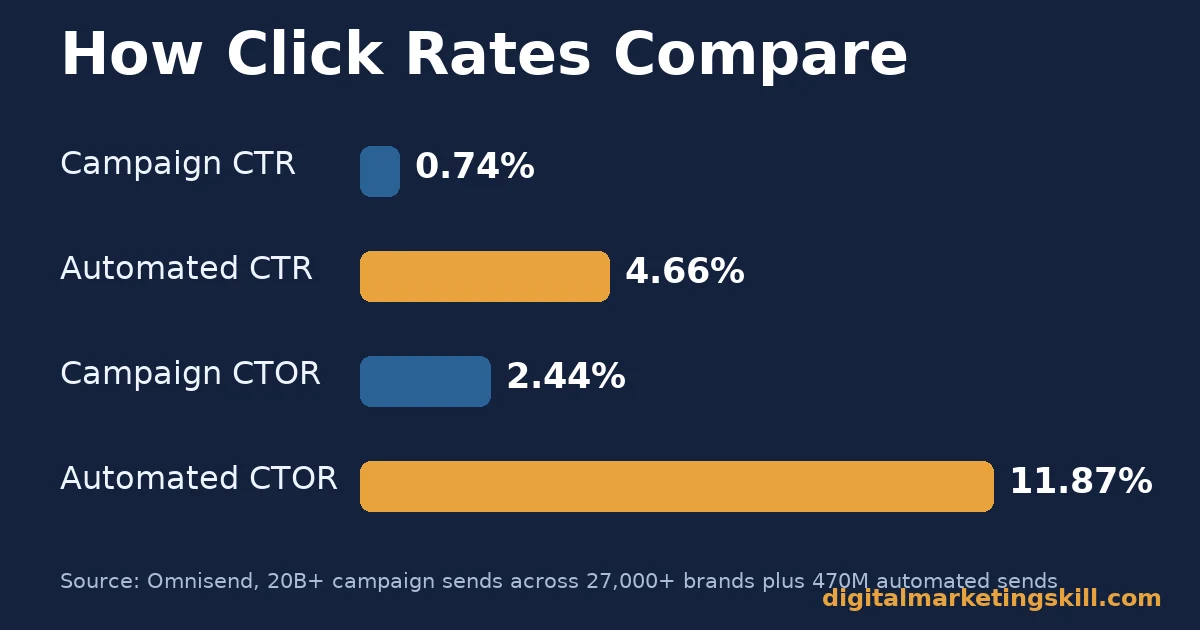
- Automated emails earn a 4.66% click rate against 0.74% for one-off campaigns. That gap means you should fix automation before any subject-line tweak (Omnisend’s send data).
- Click-to-open rate (CTOR) isolates what happens after the open. It runs at 2.44% for campaigns and 11.87% for automated flows in the same dataset.
- Swapping a plain text link for one button lifted Campaign Monitor’s own click-throughs by 28% in its internal test, a small change with an outsized return.
- Automated flows earn roughly 22 times the revenue per email of one-off campaigns ($3.41 versus $0.155, per Omnisend). Segmentation and automation usually beat copywriting fixes for email click-through rate.
In this guide
- Why Email Click-Through Rate Still Confuses Marketers
- How Email Click-Through Rate Actually Works
- What Differs by Email Type
- How to Lift Each Type
- Mistakes That Quietly Lower Email Click-Through Rate
- Measure the Right Numbers for Email Click-Through Rate
- The One Rule That Decides What to Fix First
- A Real Case Worth Studying
- Frequently Asked Questions About Email Click-Through Rate
- Start Improving Your Email Click-Through Rate Today
Why Email Click-Through Rate Still Confuses Marketers
Search “good email click-through rate” and you will find numbers from 1% to 10%. Most have no source or scope attached. Some of that spread is real. It comes from mixing one-off campaigns with automated flows, mixing list sizes, and mixing industries that have little in common. A benchmark without its scope attached is not a benchmark. It is a guess dressed up as data.
This guide treats published benchmarks as a snapshot, not a permanent scoreboard. Know which email type you are measuring. Know who else sits in the comparison set. Only then decide whether your email click-through rate is actually a problem.
There is a second, quieter gap in most advice on this topic. It treats every click as equally valuable. A click from a cold segment and a click from a repeat buyer are not the same signal, even though most dashboards report them as one number. Treat email click-through rate as a diagnostic, something that tells you where to look next, not a score to maximize on its own.
How Email Click-Through Rate Actually Works
Click-through rate is the percentage of delivered emails that earned a click on a link, button or image. The formula is unique clicks divided by emails delivered, times 100. Two things have to happen in order. First the subscriber opens the email. Then they find a reason to click something inside it. Email click-through rate measures that whole chain, start to finish.
The second step has its own metric: click-to-open rate (CTOR). CTOR is the percentage of openers who clicked, so it is unique clicks divided by unique opens. CTOR removes the subject line and send-time variables that drive opens. What is left is the copy, the offer and the call to action (CTA) alone. A healthy CTOR paired with a weak email click-through rate points at a subject-line or deliverability problem upstream. A weak CTOR points at the content itself.
Omnisend’s own data shows this split clearly. Campaign emails average a 2.44% CTOR. Automated flows reach 11.87%, even though both groups open at similar rates. The gap lives almost entirely inside the email, not the inbox.
Clicks also need a working link and a working inbox placement before any of this matters. A broken link, a redirect that times out, or a spam folder that swallows the message before a human ever sees it will all read as a zero in your email click-through rate, even though the real failure happened one step earlier in the chain. Check link health and deliverability first, before you blame the offer or the design.
What Differs by Email Type
Benchmarks only mean something once you separate emails by the job they do. Four types behave differently enough that one fix rarely helps all of them.
Campaign Emails: Built to Compete for Attention Once
A one-off newsletter or promotion arrives cold. It competes with everything else already sitting in the inbox. Omnisend’s aggregate of more than 20 billion campaign sends, across 27,000-plus brands, puts campaign CTR at 0.74%. Jobs & Education sits at the low end, 0.58%. Business & Industrial sits at the high end, 1.47%. The spread between industries is smaller than most marketers assume. The spread between campaigns and automation is not.
Automated Emails: Built to Arrive at the Right Moment
Welcome sequences, abandoned-cart flows and post-purchase follow-ups fire because of something the subscriber just did. Relevance is built in before you write a word. That context produced a 4.66% CTR and an 11.87% CTOR in the same Omnisend report, plus $3.41 in revenue per email against $0.155 for campaigns. The mechanism is timing, not creativity. A message that matches the subscriber’s last action needs less persuasion to earn a click.
Transactional Emails: Opened Fast, Clicked Rarely
Receipts, shipping updates and password resets open at very high rates, because people expect and need them. Most contain only one informational link. A raw CTR comparison against marketing emails misleads you here. Treat their click rate as a usability signal, not an engagement score. Can the subscriber find tracking or support fast? That is the real question.
Re-Engagement Emails: The Steepest Uphill Battle
Win-back campaigns target subscribers who stopped opening or clicking months ago. They start from the weakest possible signal: inactivity itself. Expect a lower email click-through rate than any other type here. Treat even a modest response, 1-2%, as a win, because it reactivates subscribers who would otherwise leave the list for good. The real goal of a win-back send is list hygiene, not a high click-through rate.
How to Lift Each Type
Each email type responds to a different lever first. Apply these in order. Do not test everything at once.
Campaign Emails: Lead With One Link and One Reason
Cut every campaign email to one primary call to action. Marketing Sherpa documents a case for Whirlpool: cutting CTAs from four to one produced a 42% increase in click-through rate. Fewer choices meant less hesitation. Pair that with a button instead of a plain text link. Campaign Monitor’s own redesign test found a button-based CTA raised click-throughs by 28% over a text link. That is one company’s internal result, not an industry-wide study, but it matches how most people scan rather than read an email. If your list runs on a weak effective email marketing strategy, fix list quality and segmentation first. A disengaged list will not click, no matter how the button looks.
Automated Emails: Lead With Trigger, Timing and Segmentation
Automated flows already carry context, so the highest-leverage fix is narrowing who enters each flow and when. Segment by the triggering action: cart abandoned, product viewed, first purchase made. Avoid broad demographic buckets instead. Keep the first message in any sequence close to the trigger event, so the context stays fresh. The data above shows roughly a six-fold email click-through rate gap between campaigns and automation. Most of that gap is relevance, not design polish. A documented email marketing automation strategy also protects revenue per email, which is why the gap shows up in revenue data too, not only in clicks.
Transactional Emails: Lead With Clarity, Not Persuasion
Do not try to sell inside a receipt. Find the one link people actually need: track my order, reset my password, view my invoice. Make that link the most visually obvious element on the page. Keep any secondary marketing content below it, clearly separated, so it never competes with the task the subscriber opened the email to finish.
Re-Engagement Emails: Lead With an Easy Exit or a Real Reason Back
Give inactive subscribers two clear options in one message. Offer one real reason to come back: what changed, what is new. Then give them one easy way to leave the list, no hard feelings attached. A subscriber who neither clicks nor unsubscribes after a focused win-back attempt is a strong candidate for suppression. Mailing unengaged addresses drags down your sender reputation, which quietly lowers email click-through rate on every other send too.
Mistakes That Quietly Lower Email Click-Through Rate
Most click-through rate problems trace back to a handful of repeat offenders. None need a redesign. They need a different habit.
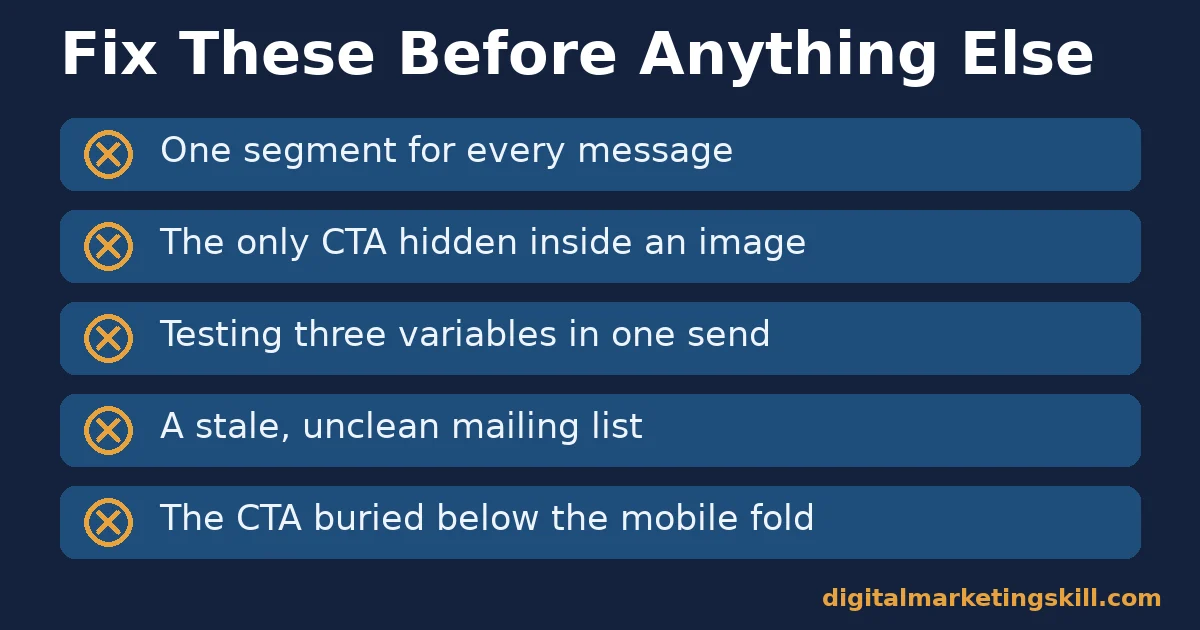
- One segment, every message. The offer that earns a click from a new subscriber can feel irrelevant to a three-year customer. Irrelevance is the single biggest driver of a low email click-through rate.
- Images carrying the only CTA. Many email clients block images by default, so a call to action that lives only inside a graphic stays invisible to part of your list. Repeat it as live text too.
- Testing more than one variable at once. Change the subject line, the CTA and the send time together, and you cannot tell which change moved the number.
A Few More Worth Fixing
- Treating every click as equal. A click on an unsubscribe link and a click on your main offer both count toward a raw click metric on some platforms. Separate link-level data before you draw conclusions.
- Ignoring list hygiene. Stale or invalid addresses lower delivery rates and can get a sender flagged, and a message that never reaches the inbox cannot be clicked.
- Burying the CTA below the fold on mobile. A call to action placed far down a long email needs several scrolls before a phone reader even sees it. A shorter, front-loaded layout wins more clicks.
- Writing one subject line and moving on. The subject line decides whether anyone sees the content at all, so treating it as an afterthought caps your email click-through rate before the email even opens.
- Sending at the same time for every segment. A single global send time ignores time zones and daily routines, and attention is a precondition for a click.
Measure the Right Numbers for Email Click-Through Rate
Three metrics answer three different questions. Conflating them is the most common measurement mistake.
- Click-through rate (CTR): unique clicks divided by emails delivered. Read it as “how many people acted,” relative to everyone who received the email. Use it to compare campaigns of similar size and type.
- Click-to-open rate (CTOR): unique clicks divided by unique opens. Read it as “how convincing was the content,” once someone actually looked. It removes subject-line and deliverability noise from the comparison.
- Revenue or conversions per email sent: total revenue or goal completions divided by emails delivered. Read it as the bottom line that CTR and CTOR are supposed to predict. The Omnisend dataset shows the campaign-versus-automation gap hardest to ignore here: $0.155 versus $3.41 per email.
Track all three side by side for one full send cycle before you change anything. A CTR drop with a flat CTOR usually means fewer people are opening, not that the content got worse. Watch how email marketing ROI moves once segmentation is applied properly, since that is often where the real payoff shows up before email click-through rate itself moves much.
The One Rule That Decides What to Fix First
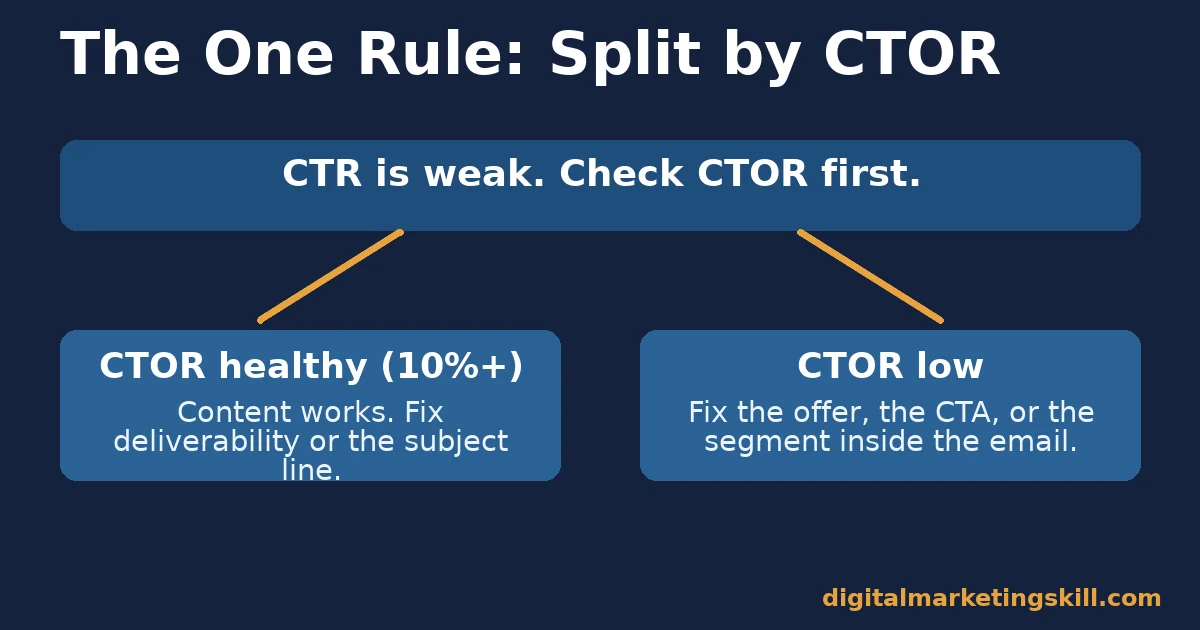
Before you test subject lines, buttons or send times, split the problem with CTOR. If CTOR is healthy, above roughly 10% for most lists, but CTR is weak, the content works. The fix sits upstream, in sender authentication and deliverability or the subject line, not inside the email. If CTOR itself is low, the fix sits inside the email: the offer, the CTA, or the relevance of the segment you send to.
Illustrative, invented numbers: a campaign goes to 10,000 subscribers with a 32% open rate and a 3% CTR. That is 3,200 opens and 300 clicks, a CTOR near 9.4%. That sits close to the campaign benchmark above, so the next test should target the subject line and send time, not a content rewrite.
Now compare a second illustrative, invented case. Same list, same 10,000 sends, same 32% open rate, but only a 0.8% CTR. That is 3,200 opens and 80 clicks, a CTOR of 2.5%, well below the campaign benchmark. The diagnosis flips here, because the subject line already did its job. Put the next test inside the email instead: the offer, the CTA copy, or cutting competing links down to one.
Run this split before any other change. It tells you which half of the funnel to work on. Working on the wrong half wastes a full send cycle without moving the number that matters.
A Real Case Worth Studying
Olajire Jacob, a Digital Marketing Skill Institute graduate, describes being paid $500 to set up email marketing flows for clients in the United States, the United Kingdom and Canada. That work scaled to $5,000 a month, as published on the Institute’s reviews page. The mechanism matches the automation data above. Built-once, triggered-automatically flows kept earning without a new campaign every time. That is why the service scaled past what one-off campaign work usually supports. This is one published client result, not a guarantee. Results depend on niche, pricing and effort, and this example is presented consistent with the Institute’s earnings disclaimer.
The lesson generalizes past freelance service work. Any team that moves a recurring, predictable message, a welcome sequence, an onboarding series, a renewal reminder, out of the campaign calendar and into an automated, triggered flow should expect the same shift the benchmark data shows: fewer manual sends, a higher email click-through rate per email, and revenue that keeps compounding after the setup work is done.
Frequently Asked Questions About Email Click-Through Rate
What is a good email click-through rate?
For one-off campaigns, anything near or above the 2.62% all-industry average is competitive. For automated flows, compare against roughly 4.66% instead. Mixing the two types produces a misleading target.
What is the difference between click-through rate and click-to-open rate?
Click-through rate divides clicks by everyone the email reached, so it reflects both the subject line’s pull and the content’s persuasiveness. Click-to-open rate divides clicks by openers only. It isolates the content and offer from the subject line and deliverability.
Why is my open rate high but my click-through rate low?
A high open rate with a low CTOR usually means the subject line earned curiosity the content did not deliver on. Check whether the first two sentences and the primary CTA match what the subject line promised.
Do buttons really get more clicks than text links in email?
In Campaign Monitor’s own documented test, switching a primary CTA from a text link to a button produced a 28% increase in click-throughs. That is one company’s internal result, not a universal multiplier, but it matches how most subscribers scan an email rather than read it in full.
How many links or CTAs should one marketing email include?
Fewer than you think. The Whirlpool case Marketing Sherpa documents found that cutting CTAs from four to one produced a 42% increase in click-through rate. A single clear action removes the hesitation multiple competing links create.
Does email automation really get a higher click-through rate than campaigns?
Yes, consistently and by a wide margin: roughly 4.66% versus 0.74% in Omnisend’s send data. Automated emails trigger off something the subscriber just did, which supplies relevance a cold campaign has to work much harder to earn.
How often should I test subject lines, CTAs or send times?
Test one variable per send. Let it run long enough to reach a stable sample before you judge it. Testing subject line, CTA and timing at once makes it impossible to know which change moved the number.
Why is my re-engagement email’s click-through rate so much lower than my other campaigns?
That is expected, not a sign of a broken campaign. Re-engagement emails target subscribers who already stopped opening or clicking. A small positive response still does its real job here: it separates subscribers worth keeping from addresses you should remove to protect deliverability for every other send.
Start Improving Your Email Click-Through Rate Today
Email click-through rate rewards relevance and clarity more than clever copy. Segment before you personalize. Automate before you optimize subject lines. Cut every email down to one primary call to action. Pick one lever from this guide. Apply it to your next send. Measure CTR and CTOR side by side, then move to the next lever. Treat every change as a small, measured step, not one big relaunch, because the biggest gains above came from structural changes (automation, segmentation, one CTA), not from a single clever line of copy.
The Digital Marketing Skill Institute’s Master Diploma in Digital & AI Marketing includes an AI-Powered Lead Generation and Email Automation track, one of four AI-powered tracks, ten courses total, with a Full Stack option covering all four. The program is built around unlimited 1-on-1 coaching and mentoring and a U.S. Project Internship with a verified U.S. Work Reference Letter. It is dual US and UK accredited, recognised in more than 100 countries, and 100% online, so you can build and run email systems like this one from anywhere in your country. Explore the Master Diploma program, read more graduate outcomes on the reviews page, browse the digital marketing blog for related guides, or go straight to the application page to get started at digitalmarketingskill.com.
Every figure in this guide was checked against its original source before publication. Figures marked as illustrative are invented examples, not real results.
![9 Amazing Digital Marketing Skills to Make Money Online [With Proof]](https://digitalmarketingskill.com/wp-content/uploads/2019/07/9-Amazing-Digital-Marketing-Skills-to-Make-Money-Online-With-Proof-17.png)






